Introduction
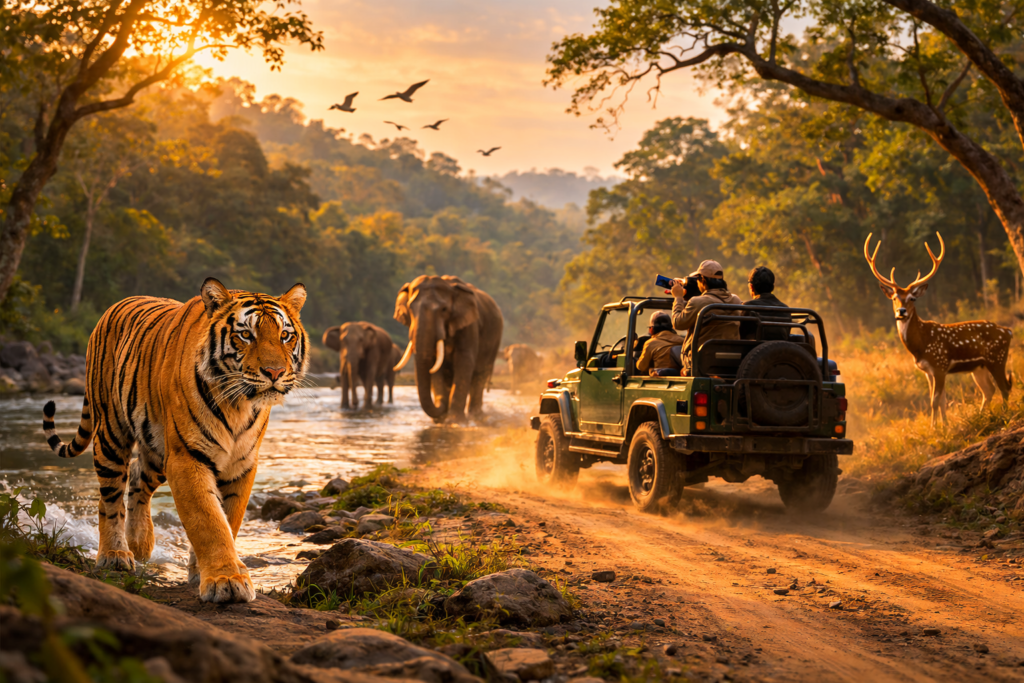
Are you an adventure lover? This is the time to go on an India Wildlife tour! India has the best natural ecosystem for wildlife animals & birds. With over 52 tiger reserves, we have selected the top 7 reserves based on frequent spotting of tigers. So let’s get started.
Top Tiger Reserves in India
Without any order, below is the unanimous list of the seven best tiger reserves in India:
Kanha National Park
You know what inspired Rudyard Kipling to write The Jungle Book? It’s Kanha National Park.
Kanha National Park sits in the Mandla and Balaghat districts of Madhya Pradesh, and the moment you enter, you understand why it left such a deep impression. Wide open meadows, sal forest and bamboo groves…feel nature’s best here.
There are a total of 4 zones: Kanha, Kisli, Mukki and Sarhi. Kanha and Kisli zones are the most popular for tiger sightings. You can spot 100 breeding Bengal tigers, 600 Barasingha (that were on the verge of extinction), leopards, Indian Gaur, bears, grey langur, porcupine, elephants and sambar deer.
By the way, this land is also the home to Gond and Baiga tribal groups. So, if you take a Central India wildlife tour, don’t forget to spend a day or two at Kanha Tiger Reserve.
How to reach: Jabalpur and Gondia railway stations are the closest to the national park. You can fly to Jabalpur Airport, which is well-connected to major cities like Delhi and Mumbai.
Best Time to visit: The park is open from mid-October to June. For the best tiger sightings, plan your visit during the summer months of April to June.
Ranthambore Tiger Reserve
If you are visiting India for the first time and you only have time for one tiger reserve, Ranthambore is probably your answer. It’s in eastern Rajasthan, around 160 km from the capital city Jaipur.
Now, when you hear Rajasthan, the synonyms that often come to our mind are royalty, culture & warrior land. But there are some of the best wildlife adventure experiences in Rajasthan. Where else can you get fort ruins & tigers roaming free in nature?
The park is very diverse, with around 10 safari zones. The best ones are Zone 2, Zone 3 (Padam Talao), and Zone 4 (Malik Talab area). You can see animals like tigers, crocodiles, honey badgers, monkeys, hyenas, jackals, Desert Fox, jungle cats, and turtles. For birdwatchers, Ranthabore has kingfishers, crested serpent eagles, and the Indian paradise flycatcher.
If you take up the golden triangle tour package, make sure you add Ranthambore to your itinerary.
How to reach: The nearest railway station is Sawai Madhopur, which is well connected to Delhi, Jaipur, and Agra by direct trains. If coming by air, Jaipur airport is best choice with 3-hour road travel.
Best Time to visit: April to June are the best months to spot tigers. You can also visit from October to November and take a full-day safari if you want comfort and coolness.
Bandhavgarh Tiger Reserve
If your goal on an India wildlife tour is to spot a white tiger in the wild, then Bandhavgarh tiger reserve should be on the list. Located in the Vindhya Hills this is another famous tiger reserve of Madhya Pradesh.
It is one of the best places in India to experience a true jungle safari. You will find the great royal bengal tigers in their natural habitat. But it’s not just about the tigers. The park is home to over 22 species of mammals and 250 species of birds. You can spot leopards, sloth bears, Indian gaurs, Nilgai, grey mongoose, striped hyena, elephants and more.
Interestingly, Bandhavgarh also has a fascinating historical side. It is believed that the 2000 year old fort Inside The Park Was Built By Lord Rama for Lakshman and hence the name Bandhavgarh (Bandhav = Brother, Garh = fort)
How to reach: The closest railway station is Umaria (approx 30 mins away). You can also fly into Jabalpur or Khajuraho airports and drive down.
Best Time to visit: October to June, with March to May offering the highest chances of tiger sightings.
Jim Corbett National Park
Your India wildlife tour is incomplete without Jim Corbett. It was first named as Hailey National Park. This was the first place where Project Tiger was launched, and it still holds a special place in every wildlife lover’s heart.
Corbett offers a completely different jungle experience compared to central Indian reserves. Here you will see dense forests, river valleys, grasslands, and hills all in one place.
The park is famous for its Bengal tigers, but wildlife sightings also include Asian elephants, leopards, crocodiles, deer, and over 600 species of birds. There are 8 Safari zones but Dhikala, Bijrani, and Jhirna are the most popular as you can spot tigers here.
How to reach: The easiest way is to take a train to Ramnagar, which connects well with Delhi. If you prefer driving, it’s about a 5 to 6 hour scenic drive from the capital.
Best Time to visit: If you love the cold and birds, November to February is beautiful. For tiger sightings, stick to April to mid-June when the vegetation dries out.
Sunderbans Tiger Reserve
Ready for something totally different? In the Sundarbans, you put the jeep away and hop on a boat. Located in West Bengal, this is the largest mangrove forest in the world and a UNESCO World Heritage Site.
The tigers here are famous for swimming. They move between islands through the tidal creeks. They are wilder and far less accustomed to humans than tigers in central India’s reserves. If you love adventure and mystery, this is the place for you.
While it might be harder to spot a tiger here than in central India, but that adds to the thrill. And the sheer atmosphere of the mangroves makes the experience even more beautiful.
In the Sunderbans, you will see saltwater crocodiles, Irrawaddy dolphins, spotted deer, and a lot of birds, including kingfishers, herons, and the rare masked finfoot.
How to reach: First, get to Kolkata by train or flight. From there, drive about 2-3 hours to Godkhali or Sonakhali. That is where you board the boat to enter the mangroves.
Best time to visit: November and February, when the weather is manageable.
Pench Tiger Reserve
Pench Tiger Reserve lies on the border of Madhya Pradesh and Maharashtra. This one is open and less crowded than other parks.
Bengal Tigers are the main draw here. But apart from that, you may also see leopards, wild dogs (dhole), sloth bears, Indian bison, jackals, and many species of deer. Pench is also a great place to spot birds such as Indian rollers, peafowl, and eagles.
How to reach: The park is accessible from two sides. For the Madhya Pradesh side, take a train to Nagpur (about 90 minutes away). For the Maharashtra side, you can head to Seoni.
Best time to visit: April to June is the best time to spot tigers here.
Tadoba Tiger Reserve
If you want a slightly less crowded safari destination with a good chance of tiger sightings, Tadoba Andhari Tiger Reserve is a great addition to your India wildlife tour.
The landscape is a mix of dry deciduous forest, bamboo patches, and several lakes and waterholes that become natural gathering points for animals in summer. Tadoba is unique because its buffer zones (like Agarzari and Devada) are just as beautiful as the core area, and the tigers frequently roam here too.
Booking a safari in these zones is actually easy and cheap. And as the crowd is less, you get to spend more time observing the jungle rather than rushing from one tiger sighting to another.
How to reach: Reach Nagpur airport and then take a cab to the reserve. You can also take a train to Nagpur and then drive to the reserve.
Best time to visit: March to June is peak season to see tigers come out.
Best Time for Wildlife Safaris
The park is open from October to June, but the story changes with the seasons.
- Summer (April to June): This is when the jungle gets dry and water sources shrink. Tigers have no place to hide, so sightings are at their peak. It gets hot, but the reward is usually worth the sweat.
- Winter (November to February): Great time for wildlife photography. The weather stays cool, and the misty mornings make jungle safaris feel magical.
- Monsoon (July – September): Some parks like Tadoba allow safaris in its buffer zones during the monsoon season. Otherwise, most core zones are closed.
Jeep vs. Canter Safaris: What to Choose?
Most national parks offer two types of safaris.
Jeep Safari
- Smaller vehicle with 6 to 7 people
- You can spot, take quieter routes and do better photography
- Higher chances of exploring deeper forest routes
Canter Safari
- Larger open bus with 15–20 people
- More affordable option
- Available mainly in larger zones like Dhikala in Corbett
If you want a more personal wildlife experience, jeep safari is usually the better option.
Responsible Wildlife Tourism Practices
Here are a few tips you must try to follow for your next India wildlife tour:
- Keep noise low, especially near a sighting. Animals that feel threatened or stressed by human presence.
- Never ask your driver to go off-road or break rules. Pressure from tourists to chase sightings is one of the biggest problems in Indian wildlife tourism. Rules are for your safety.
- It might seem kind to offer a biscuit to a monkey or deer, but it makes them dependent on humans and can make them sick.
- Take your plastic bottles and wrappers back with you. The forest is their home, not a dustbin. Let’s keep it wild and clean for the next visitors.
Conclusion
There is nothing quite like the thrill of spotting a tiger in the wild. It is a memory that stays with you long after you return home. From the open meadows of Kanha and the historic ruins of Ranthambore to the Sunderban lakes…every park offers a unique window into nature that you simply can’t get from a documentary.
If you are ready to answer the call of the wild but need a hand planning the details, the team at Discovery Prime Tours is here to help. Routes, permits, stays – we handle it all so you only have to do one thing – relax & enjoy, whether it is a wildlife journey or exploring the best tour packages in Kerala. Get ready for your next India wildlife tour! Contact us for more details on the next steps.
FAQs
Which national parks are included in an India wildlife tour package?
Jim Corbett, Ranthambore National Park, Kanha National Park, and Bandhavgarh National Park & Tiger Reserve are some of the national parks fixed in the itinerary of our India wildlife tour. We can, however, customize the package and add more tiger reserves and sanctuaries if you want.
When is the best time to see tigers in India?
Most zones of tiger reserves in India are open from October to June. However, the ideal time to visit will be in the dry months of March to May.
Are wildlife safaris safe for families?
Yes, our wildlife safaris come with private vehicles, local guides & safe routes, making it safe for kids & family groups.
How many safaris should I book for better sightings?
You can book an early morning and an evening safari to see more wildlife.
What should I pack for a wildlife tour in India?
Wear comfortable walking shoes and light & breathable clothes to beat daytime heat. Carry a backpack with a hat, sunscreen, sanitizer, insect repellent, and a pair of sunglasses & binoculars for an India wildlife tour.