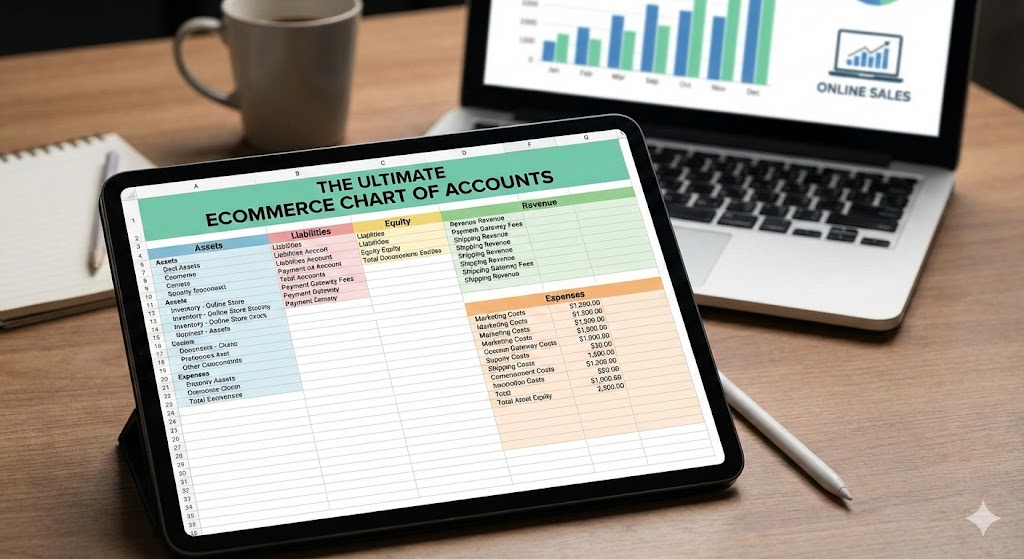
Running an ecommerce business involves much more than listing products and fulfilling customer orders. Behind the scenes, your financial structure determines how confidently you can scale, forecast cash flow, secure investment, and prepare for taxes. One of the most overlooked—but most powerful—tools in this process is your Chart of Accounts (COA).
A well-organised COA is the backbone of your financial system. It shapes how you track income, expenses, assets, liabilities, inventory, fees, and taxes across multiple sales channels. Without it, your numbers become chaotic, and your reports lose accuracy. With it, you can run your ecommerce operations like a data-driven, profit-optimised machine.
This guide breaks down everything you need to build the ultimate chart of accounts for ecommerce, including recommended account categories, examples, and best practices used by top UK sellers.
Why Your Ecommerce COA Matters More Than You Think
Most ecommerce brands deal with messy financial data by default—multiple sales channels, returns, refunds, chargebacks, payment-gateway fees, advertising, shipping, and inventory purchases.
A clear COA helps you:
- Track profitability per sales channel
- Understand true cost of goods (COGS)
- Separate operational expenses from fulfilment costs
- Prepare clean financial statements
- Improve cash-flow forecasting
- Make tax season far less stressful
- Attract investors or lenders with clean books
Many sellers eventually work with a UK accountancy firm because ecommerce accounting comes with unique challenges. But even if you’re doing it yourself, your chart of accounts is the foundation you absolutely must get right from the start.
What Exactly Is a Chart of Accounts for Ecommerce?
A Chart of Accounts is simply the system you use to organise all financial transactions into logical groups. Every accounting platform—Xero, QuickBooks, Sage, or FreeAgent—uses a COA.
For ecommerce businesses, the COA must be adapted to:
- Multi-channel sales (Amazon, eBay, Shopify, Etsy)
- Transaction-based income and fees
- High-volume inventory purchases
- Returns and refund adjustments
- Payment gateway deductions
- Sales tax (VAT) requirements
- Shipping, fulfilment, and logistics expenses
A standard “service business COA” won’t work. Ecommerce needs far more detailed categorisation so you can see where money is truly earned and lost.
The Core Sections of an Ideal Ecommerce Chart of Accounts
A strong COA typically includes five main categories:
1. Assets
Things your business owns or controls.
2. Liabilities
Money your business owes others.
3. Equity
Your ownership value in the business.
4. Income
All revenue and inflows from sales.
5. Expenses
Costs required to run the business.
But when customised for ecommerce, these sections become much more detailed.
1. Assets for Ecommerce Businesses
Your asset section should include accounts such as:
Inventory (Stock on Hand)
This is your largest asset as an ecommerce seller. You’ll track:
- Opening inventory value
- Stock purchases
- Adjustments for damaged, lost, expired, or shrinkage
Prepaid Inventory or Deposits
If you manufacture products or prepay suppliers, these amounts need clear tracking.
Accounts Receivable
Applicable if you invoice customers outside marketplaces.
Cash & Bank Accounts
Include:
- Main business bank account
- Paypal
- Stripe
- Amazon settlements (can be mapped separately)
Fixed Assets
Cameras, laptops, machinery, warehouse equipment.
VAT Recoverable
VAT you can reclaim.
2. Liabilities for Ecommerce Sellers
Your liabilities typically include:
- VAT Payable
- PAYE/NIC (if you have employees)
- Merchant fees payable (e.g., Stripe pending balances)
- Short-term loans or funding
- Credit cards or overdrafts
Ecommerce sellers often use financing tools—Amazon lending, Clearco, PayPal Working Capital—so liability tracking is essential.
3. Equity Accounts
This includes:
- Owner’s capital
- Retained earnings
- Director’s loan account
You should avoid mixing personal and business funds. Working with accountancy services UK ensures your equity is always tracked correctly.
4. Income Accounts (Where Ecommerce Gets Complicated)
Income classification is extremely important for online sellers.
Separate income by channel:
- Amazon UK Sales
- Shopify Sales
- eBay Sales
- Etsy Sales
- Wholesale or B2B Sales
Additional income accounts:
- Shipping Income
- Gift-wrapping Income
- Promotional Income (if reimbursed by marketplaces)
- VAT on Sales (separate tracking recommended)
If your business runs multiple platforms, structured income accounts help you understand which channel is most profitable. That’s where a UK accountancy firm becomes valuable—they’ll set this up cleanly.
5. Expense Accounts (The Most Detailed Section in Ecommerce Accounting)
Ecommerce expense accounts must be very granular. Here’s the recommended structure:
Product & Fulfilment Expenses
- Cost of Goods Sold (COGS)
- Shipping/Freight Inwards
- Amazon FBA Fees
- Shopify Transaction Fees
- eBay Final Value Fees
- Merchant Fees (Stripe, PayPal, Klarna)
- Picking & Packing Fees
- Customs Duties & Import VAT
- Warehousing Costs
- Packaging Materials
Marketing & Advertising
- Meta Ads
- Google Ads
- Amazon PPC
- Influencer Payments
- Creative/Video Production
Operational Expenses
- Software subscriptions
(Shopify, Klaviyo, Helium10, Canva, etc.) - Virtual office costs
(useful to link virtual office UK) - Accounting software
- Internet & phone
Administrative Expenses
- Bank charges
- Insurance
- Professional fees
(including accountancy services UK) - Travel
- Office supplies
A proper COA ensures you can instantly see your biggest cost drivers.
How to Structure COGS (Cost of Goods Sold) Correctly
COGS is one of the trickiest parts of ecommerce accounting. It should include:
- Product purchases
- Landing costs
- Import shipping
- Duties
- Freight forwarding fees
- Amazon prep centre fees
- Packaging
This ensures your true gross profit is accurate. Many sellers struggle here, which is why they lean on experienced UK accountancy firms for correct COGS mapping.
Handling Sales Returns & Refunds in Your COA
Ecommerce returns are common. Your COA should include:
- Sales Returns
- Refund Adjustments
- Inventory Write-offs
- Return Shipping Costs
Tracking these separately helps you measure product quality and customer satisfaction.
Accounting for Payment Gateway Fees
Use separate expense accounts for:
- PayPal Fees
- Stripe Fees
- Klarna Fees
- Amazon Referral Fees
This allows you to calculate:
- Profit per channel
- True cost per transaction
- ROI for advertising and promotions
Bank Accounts + Settlement Accounts Setup
Make sure you track:
- Bank account
- PayPal balance
- Stripe balance
- Amazon settlement account
- Shopify payments clearing account
This avoids duplicated income and keeps reconciliations clean.
VAT Handling in Your COA (UK Sellers Must Read)
Your COA should clearly separate:
- VAT on Sales
- VAT on Purchases
- VAT Payable
- VAT Recoverable
- Import VAT
Incorrect VAT categorisation is one of the top issues ecommerce sellers face.
Tools That Make Your COA Even More Powerful
Your chart of accounts becomes even stronger when combined with:
- Xero
- QuickBooks
- A2X
- Link My Books
- Dext
- Shopify accounting plugins
These tools automate categorisation and sync marketplace data cleanly into your COA.
Why Every Ecommerce Business Should Customise Their COA
No two online shops operate the same way. You must tailor your chart of accounts to:
- Your platforms
- Your fulfilment model
- Your payment providers
- Your shipping methods
- Your VAT structure
- Your business size
A generic “template” won’t cut it.
Working with professionals (like those offering accountancy services UK) ensures your COA is built correctly from day one—so you can scale without financial chaos.
Conclusion: Your Ecommerce Success Depends on a Strong COA
The right Chart of Accounts gives you:
- Complete clarity over your numbers
- Accurate P&L statements
- Cleaner VAT submissions
- Better cash-flow forecasting
- Stronger decision-making
- Higher profit margins
- Less stress at year-end
Whether you’re just starting out or scaling across multiple marketplaces, a structured COA is the foundation that keeps your ecommerce business financially healthy.
If you want professional support, pairing your setup with trusted UK accountancy firms can help automate, streamline, and future-proof your entire financial system.