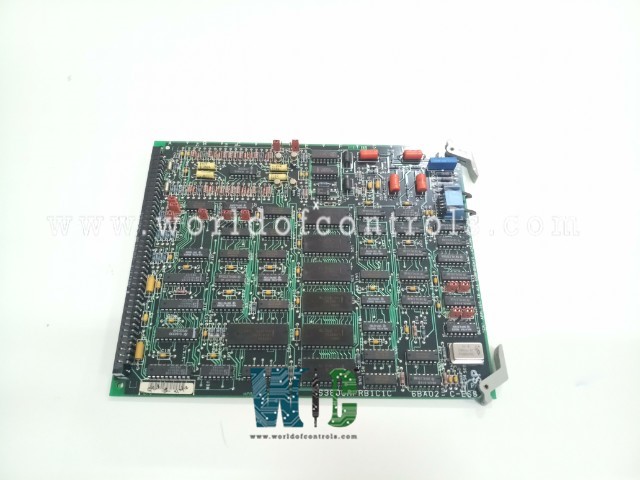
DS3800HPRB1C1C
Introduction to GE Speedtronic Turbine Control Systems
GE Speedtronic systems are widely deployed in gas and steam turbine applications to manage control, monitoring, and protection functions. These systems are designed to operate in demanding industrial environments where accuracy, reliability, and rapid response are essential. Among the many signals processed by Speedtronic controllers, turbine speed is one of the most critical parameters, and pulse rate input cards play a central role in acquiring this information.
Importance of Turbine Speed Measurement
Accurate turbine speed measurement is fundamental to safe and efficient turbine operation. Speed data is required to:
- Control fuel or steam admission
- Manage acceleration during startup
- Synchronize generators with the electrical grid
- Detect abnormal operating conditions such as overspeed
Because turbine speed can change rapidly, especially during startup or load variations, pulse-based measurement techniques are preferred for their precision and fast response time.
What Is a Pulse Rate Input Card?
A pulse rate input card is a hardware interface within the Speedtronic control system that receives pulse signals from turbine speed sensors. These sensors, commonly magnetic pickups or proximity probes, generate electrical pulses as the turbine shaft rotates. The frequency of these pulses is directly proportional to the rotational speed of the turbine.
The input card conditions these raw signals and converts them into digital data that can be processed by the Speedtronic controller. Without this interface, the control system would be unable to accurately interpret turbine speed.
Signal Conditioning and Processing
Pulse signals generated in turbine environments are often low-level and exposed to electrical noise, vibration, and temperature fluctuations. The pulse rate input card performs several key signal-conditioning functions, including:
- Amplifying weak sensor signals
- Filtering noise and signal distortion
- Shaping pulses into a consistent digital format
Once conditioned, the card counts the number of pulses over a defined time interval. The Speedtronic controller then calculates turbine speed based on pulse frequency, enabling real-time monitoring and control.
Role in Speed Control Functions
Pulse rate input cards provide continuous speed feedback to the Speedtronic control loops. This feedback is used to regulate fuel or steam flow, ensuring the turbine operates at the desired speed under varying load conditions.
During startup, accurate pulse rate measurement allows the system to control acceleration smoothly, preventing mechanical stress on turbine components. During normal operation, speed feedback supports stable load sharing and efficient performance.
Contribution to Turbine Protection
In addition to control, pulse rate input cards are critical to turbine protection. Overspeed conditions can cause severe mechanical damage and pose safety risks. The Speedtronic system relies on fast and accurate speed data to detect these conditions and initiate immediate protective actions, such as fuel shutdown or emergency trip sequences.
In many installations, multiple pulse inputs are used to provide redundancy. This design improves reliability and ensures that a single sensor or input failure does not compromise turbine protection.
Reliability and Maintenance Considerations
Pulse rate input cards used in turbine control systems are designed for continuous operation in harsh industrial conditions. High-quality components and robust circuit design contribute to long service life and dependable performance.
Routine maintenance typically includes:
- Verifying sensor signal quality
- Inspecting wiring and connectors
- Replacing aging components during planned outages
Proper maintenance helps prevent signal loss, inaccurate speed readings, and unplanned turbine trips.
Conclusion
Pulse rate input cards are essential components of GE Speedtronic turbine control systems, enabling precise speed measurement for both control and protection functions. By converting raw sensor pulses into reliable digital speed data, these cards support safe operation, efficient performance, and rapid response to abnormal conditions. Understanding their role helps engineers and operators maintain dependable turbine systems in demanding industrial applications.