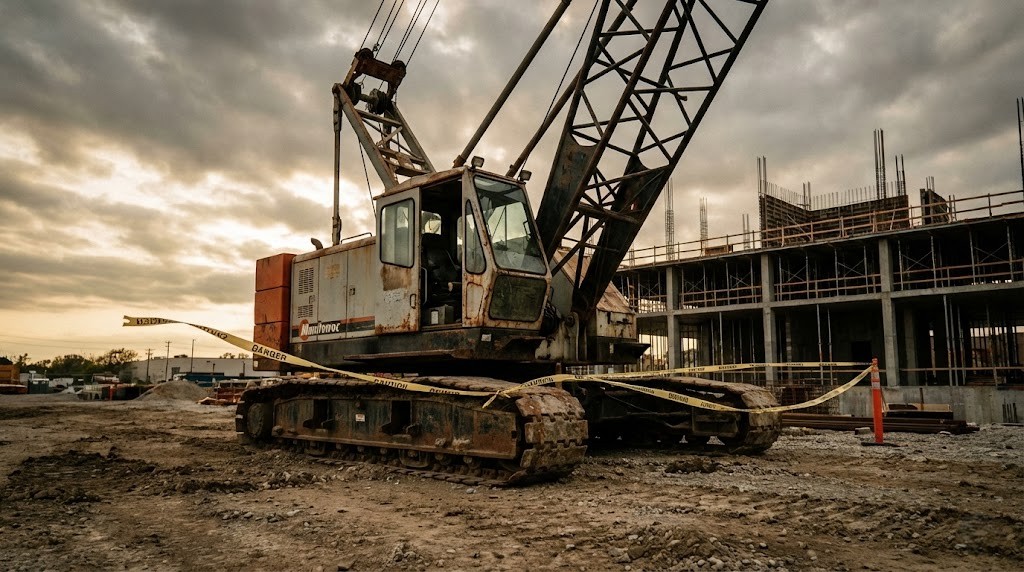
A crane that isn’t moving steel isn’t just stationary—it’s actively consuming profit in ways that surprise operators who haven’t traced the full financial impact.
Let’s examine the complete cost of operational interruptions, why discount components frequently become expensive liabilities, and how quality Manitowoc parts sourced through a capable crane parts supplier transforms your economic equation.
The Comprehensive Toll of Every Idle Hour
Standard downtime accounting often stops at lost revenue. This truncated view obscures the true financial damage.
Envision a significant commercial project utilizing a 150-ton lattice boom crawler. When all cost factors converge, downtime expenses range from $1,500 to $5,000 hourly, incorporating:
- Stranded asset value from owned equipment or rental agreements sitting dormant
- Unproductive payroll for complete crews including operators, riggers, and signal personnel
- Contractual damage provisions triggered when crane availability controls critical milestones
- Secondary operation paralysis as dependent trades and equipment await crane-fed materials
- Crisis-mode logistics — express shipping charges, overtime technical rates, rush fees
What presents as a manageable 16-hour repair window actually devours 48 hours of project momentum, extends through non-working periods, and generates cascading scheduling disruptions. Controlled execution deteriorates into emergency management.
The critical consideration: what percentage of this financial trauma was preventable through proper sourcing decisions?
The Aftermarket Illusion
Non-genuine crane components entice with superficial affordability. A slew bearing quoted at $4,200 from a qualified crane parts supplier might appear from independent sources at $2,800. That $1,400 spread feels like prudent cost management.
Until the component surrenders prematurely at 400 hours rather than delivering the engineered 1,200-hour service life.
The aftermarket Manitowoc parts dilemma isn’t universal inadequacy. Certain pieces function satisfactorily under minimal stress and optimal conditions. The hazard is unpredictability—you cannot distinguish reliable from unreliable until failure manifests, inevitably during crucial lifts, peak project intensity, or contract-sensitive periods.
Manitowoc’s engineering philosophy operates within stringent tolerance specifications. Wire rope drums, boom hoist cylinders, slewing rings, and load moment indicators form precision-integrated systems. Substituting dimensionally similar but specification-deviant components introduces uncertainty factors absent from original design parameters. Occasionally systems accommodate these variations. Frequently neighboring components experience accelerated degradation. Sometimes catastrophic failures occur, erasing all “savings” and generating additional liabilities.
Warranty exposure compounds these risks. Many manufacturer crane warranties explicitly terminate coverage following aftermarket component installation. Equipment protected by service agreements demands careful contractual scrutiny before any external sourcing.
Where Quality Manitowoc Parts Generate Returns
Analyze a representative scenario.
Your Grove GMK5250L—a standard Manitowoc-family all-terrain crane—requires main boom mid-section wear pad service. Two procurement options emerge:
- Option One: Third-party pads at $180 each, eight required. Total investment: $1,440.
- Option Two: Authentic quality Manitowoc parts at $290 each. Total investment: $2,320. Differential: $880.
Historical performance indicates third-party pads surviving 18 months under typical duty cycles. OEM pads consistently reach 30 months or beyond, per Manitowoc’s official maintenance guidelines. Monthly amortization costs reveal $80 for aftermarket versus $77 for genuine—before factoring additional installation labor and potential boom chord damage from suboptimal dimensional control.
This pattern persists across consumables and wear items. Front-loaded “savings” evaporate under lifecycle cost examination.
Your Crane Parts Supplier: A Critical Operational Partner
Securing appropriate components solves half the equation. Rapid acquisition solves the other half.
When crane failures strike, every procurement delay multiplies financial losses. A proficient crane parts supplier brings Manitowoc-specific expertise—they command the parts classification architecture, navigate superseded number sequences, and deliver honest availability assessments.
The gap between suppliers with substantive OEM inventory versus order-brokering operations typically equals 48-72 hours of additional downtime. At $2,000 standard daily downtime cost, supply chain failures—not equipment problems—inflict $4,000-$6,000 in avoidable damage.
Evaluate crane parts supplier capabilities through these lenses:
- OEM authenticity or aftermarket substitutions in stock?
- Realistic lead times for mission-critical components?
- Manitowoc-certified parts specialists or generic warehouse personnel?
- Coverage spanning vintage models through current production lines?
Suppliers responding with specificity and data-supported confidence warrant premium positioning. You’re acquiring supply chain insurance, not merely a part number.
Predictive Maintenance and Asset Documentation
Strategic operators leverage this advantage: systematic use of genuine quality Manitowoc parts creates unbroken service documentation. Manitowoc’s telematics infrastructure and dealer networks track component provenance when OEM parts are installed. This powers accurate predictive maintenance forecasting, strengthens resale positions, and builds compelling warranty claim support.
Generic components fragment documentation continuity. Mixed-provenance equipment resists predictive optimization and suffers market value erosion.
Strategic Conclusion
Operational interruptions destroy profitability. The mathematics remain stubborn: authentic Manitowoc parts, sourced through established crane parts supplier networks, cost less over equipment life than aftermarket alternatives appearing cheaper initially.
The objective isn’t parts budget maximization. It’s downtime elimination, schedule preservation, and rework prevention. These goals differ fundamentally, and professionals internalizing this distinction consistently outperform competitors.
When your crane anchors the critical path, every internal component represents a strategic business determination. Choose with complete operational awareness.