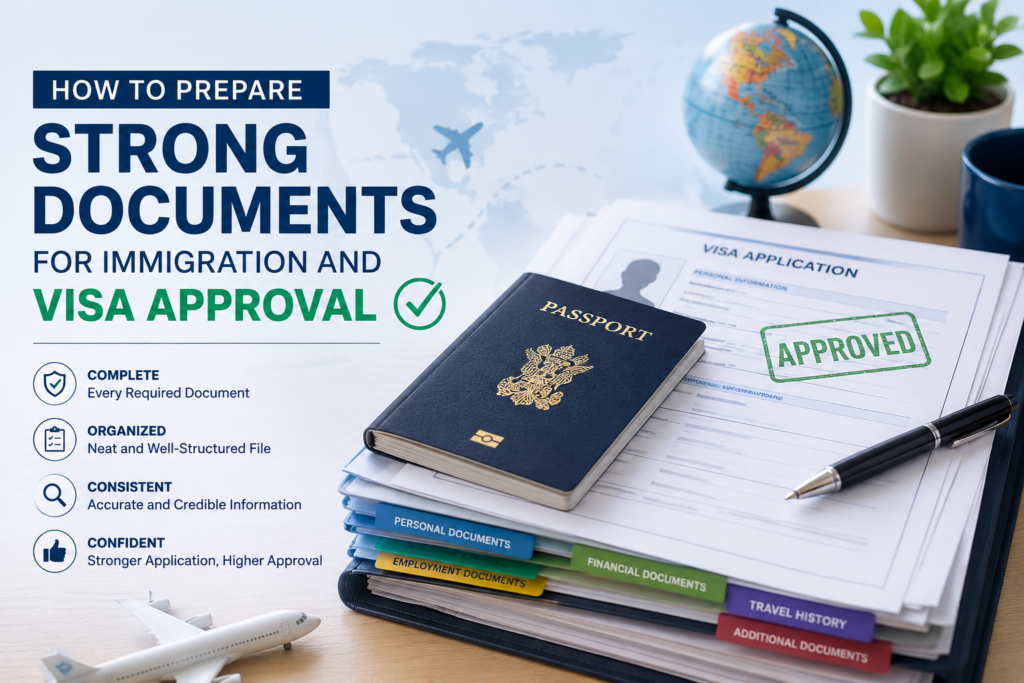
Getting your visa approved is not just about filling out a form, it is about presenting a complete, credible, and well-organized file that gives the immigration officer every reason to say yes. Whether you are applying for a study visa, a visitor visa, permanent residency, or a work permit, your supporting documents are the backbone of your application. A missing signature, an inconsistent date, or a blurry scan can be the difference between approval and rejection.
At Bajwa Migration Services, we have helped hundreds of applicants navigate this process. Based on that hands-on experience, here is a comprehensive guide to preparing strong immigration documents and avoiding the costly mistakes that lead to refusals.
Why Strong Immigration Documents Matter
First Impressions Can Decide Your Visa Outcome
Immigration officers review hundreds of applications every day. Your file has seconds to establish credibility before it gets deeper scrutiny. A neatly organized, logically presented application signals that you are a serious, well-prepared applicant — and that matters.
How Visa Officers Review Applications
Officers are trained to look for consistency. They cross-check your application form against your financial documents, your travel history, your employment records, and your stated purpose of travel. Any discrepancy even a minor one raises a red flag.
What Weak or Incomplete Documents Signal
Incomplete paperwork does not just cause delays. It signals either negligence or an attempt to conceal information. Both interpretations work against you. Strong documentation, on the other hand, builds the officer’s confidence that you will comply with visa conditions and return home after your visit.
Essential Documents Required for Immigration and Visa Approval
Every visa category has its own checklist, but the following documents form the universal foundation of any strong immigration file:
Valid Passport: Must be valid for at least six months beyond your intended date of travel. Ensure all pages are clear and undamaged.
Visa Application Forms: Complete every field accurately. Leave nothing blank; write “N/A” where a section does not apply to you.
Passport-Size Photographs: Follow the exact specifications of the destination country (background colour, dimensions, recency). Non-compliant photos are a common and easily avoidable rejection reason.
Proof of Identity: National ID card, birth certificate, or equivalent government-issued document.
Educational Certificates and Transcripts: Required for study visas and many skilled migration pathways. Get originals and certified copies ready.
Work Experience Documents: Experience letters, appointment letters, pay slips, and promotion letters, all on official company letterheads.
Financial Proof and Bank Statements: Usually the last three to six months of statements showing consistent transactions, not sudden large deposits.
Medical Examination Reports: Required for long-stay, PR, and certain work visas. Must be conducted by an approved panel physician.
Police Clearance Certificate (PCC): Most countries require a PCC from every country you have lived in for 12 months or more in the past ten years.
Travel History Documents: Previous visa stamps, hotel bookings, and flight records that demonstrate a clean travel record and history of compliance.
How to Organize Your Visa Application Documents Properly
Document preparation is not just about what you submit it is about how you submit it.
Create a checklist before you begin. Map every required document against the official checklist published by the embassy or immigration authority. Tick items off only when you have the complete, correct version in hand.
Arrange papers in chronological order. Financial statements and employment records are easiest to verify when arranged from oldest to most recent. This saves the officer time and reduces the risk of something being overlooked.
Use labels and dividers. Organize your file into clearly labelled sections: Personal Documents, Financial Documents, Employment Documents, Travel History. This is especially important for complex PR or work permit applications with large volumes of paperwork.
Keep both digital and physical copies. Store scanned copies in a secure cloud folder. Many applications now require online submission, and having organized digital files prevents last-minute scrambling.
Neat presentation matters. Avoid stapling loose documents together without order. Use plastic sleeves or document wallets where appropriate. A poorly presented file looks like a low-effort application.
Common Document Mistakes That Lead to Visa Rejection
These are the errors we see most frequently at Bajwa Migration Services and the ones most applicants only discover after a rejection letter arrives.
Submitting Fake or Altered Documents: This is the most serious mistake, resulting in permanent bans from many countries. Even minor alterations to dates or figures can be detected.
Inconsistent Information Across Forms: If your application form says you earn ₹60,000 per month but your bank statement shows ₹35,000 in monthly credits, expect questions or a flat refusal.
Missing Signatures and Dates: An unsigned form is an invalid form. Check every page.
Expired Documents: A PCC issued 18 months ago or a passport expiring in four months will invalidate your application regardless of everything else.
Poor-Quality Scanned Copies: Blurry, dark, or cropped scans are not acceptable. Scan at a minimum of 300 DPI and ensure every corner of the document is visible.
Incorrect Financial Proof: Presenting a savings account with a single large transfer made just before the application date is a common mistake. Officers look for organic, consistent transaction history.
Translation Errors: All documents in a language other than English (or the country’s official language) must be translated by a certified translator. Machine translations are not accepted.
Financial Documents That Strengthen Visa Approval Chances
Financial credibility is one of the most scrutinized aspects of any visa application. Here is what to prepare:
Bank Statements: Provide the last three to six months. The balance should comfortably cover your travel, accommodation, tuition (for study visas), or settlement costs (for PR). The exact amount varies by destination country and visa type.
Salary Slips and ITR: Pay slips from your current employer for the last three to six months, along with your Income Tax Returns for the past one to two financial years, demonstrate stable, legitimate income.
Sponsorship Documents: If someone else is funding your trip, include a signed sponsorship letter, the sponsor’s bank statements, their proof of income, and their relationship to you.
Property Papers and Asset Proof: Fixed deposits, property ownership documents, and investment portfolios all add to your financial credibility and demonstrate ties to your home country.
Avoid Large Suspicious Deposits: A sudden transfer of ₹5 lakhs into an account that usually holds ₹40,000 raises immediate suspicion. If you need to show higher funds, plan months in advance.
How to Prepare Employment and Education Documents
Employment documents should include your appointment letter, latest experience letter (dated within 30–60 days of your application), three to six months of pay slips, and a No Objection Certificate (NOC) from your employer where applicable.
Educational documents should include all degree certificates, mark sheets, and transcripts from your highest qualification. For immigration pathways to Australia, Canada, or the UK, you may also need a credential assessment from the relevant authority (WES, NAATI, UK NARIC, etc.).
Statement of Purpose (SOP) A well-written SOP is one of the most underrated documents in a study or skilled visa application. It should clearly explain your reasons for choosing the destination, the institution, and your career plan. Generic, template-based SOPs are easy for officers to spot.
Recommendation Letters Academic or professional references should be specific, recent, and signed on official letterheads.
Country-Specific Visa Documentation Requirements
Requirements vary significantly by country. Always verify against the official government source before submitting.
Canada: Applications through IRCC typically require IELTS or CELPIP scores, ECA credential assessments, a valid medical exam, PCC from all relevant countries, and proof of settlement funds as defined by IRCC’s low-income cut-off tables.
Australia: Skills assessments through bodies like Engineers Australia or VETASSESS, English proficiency scores, state nomination documents (for state-sponsored streams), and a character assessment (Form 80) are standard requirements.
United Kingdom: The UK requires a Confirmation of Acceptance for Studies (CAS) for student visas, financial evidence meeting specific thresholds, an ATAS certificate for certain research courses, and a tuberculosis test result for applicants from countries on the TB testing list.
USA: DS-160 form, SEVIS fee receipt, interview appointment letter, financial affidavits (Form I-20 or DS-2019), and strong evidence of ties to your home country are standard for non-immigrant visas.
Schengen Area: Travel insurance with minimum €30,000 coverage, hotel bookings, a detailed travel itinerary, and sponsorship letters (if applicable) are required. Bank statements must reflect the minimum daily subsistence amount for the specific Schengen country.
Tips to Make Your Immigration File Stronger
Beyond the checklist, these practical steps help build a more compelling application overall:
- Write a convincing SOP that is tailored to your specific circumstances not copied from a template.
- Include a detailed travel history with past visa copies, stamps, and itineraries to show a clean record.
- Show strong ties to your home country property, family dependants, a stable job, or a business to demonstrate intent to return.
- Add explanation letters for any gaps in employment, changes in financial balance, or periods of travel that look inconsistent.
- Maintain consistency across all documents the same spelling of your name, the same address, the same dates everywhere.
- Seek professional guidance early not after a rejection.
How Bajwa Migration Services Helps Clients Prepare Strong Visa Documents
At Bajwa Migration Services, our approach is built on thoroughness. Before we submit any application on your behalf, we conduct a complete document assessment reviewing every piece of paperwork for accuracy, consistency, completeness, and compliance with the specific requirements of your target country and visa category.
Our consultants bring hands-on experience across study visas, visitor visas, work permits, and permanent residency pathways. We check for errors that most applicants miss, ensure your financial narrative is coherent and credible, verify translations and notarizations, and help you write an SOP that tells your story effectively.
Whether you are a first-time applicant or have faced a refusal before, we provide the structured support and expert review that turns a weak file into a strong one.
📞 Ready to start your immigration journey with confidence? Contact Bajwa Migration Services today for a personalized document assessment.
Frequently Asked Questions
What documents are most important for visa approval?
Your passport, financial proof, and application form are the three most scrutinized. Beyond that, the most important documents depend on the visa type SOPs for study visas, employment letters for work permits, and ties-to-home-country evidence for visitor visas.
How can I avoid visa rejection due to documentation?
Use the official embassy checklist, double-check every date and signature, scan at high resolution, and have your documents reviewed by an immigration professional before submitting.
Do all documents need notarization?
Not always. Notarization requirements vary by country and document type. Translations almost always need to be certified. Check the specific requirements for your visa category.
How recent should bank statements be?
Typically within the last three to six months. Most countries specify this in their application guidelines. Do not submit statements that are more than 30–60 days old at the time of submission.
Can incorrect information cause permanent rejection?
Yes. Providing false or misleading information is grounds for permanent bans in countries like Canada, Australia, and the UK. Always disclose accurately.
What should I do if a document is missing?
Contact the issuing authority immediately and request a replacement or certified letter in lieu. Never substitute a fabricated document. Explain the situation in a covering letter.
Are scanned copies acceptable for immigration applications?
For most online applications, yes but they must be clear, complete, and in the required format (usually PDF or JPEG, within specified file sizes). Always check the portal’s technical requirements.
How long should I keep copies of immigration documents?
Keep all immigration-related documents for a minimum of 10 years. These may be required for future visa applications, PR renewals, or citizenship applications.
Should I hire an immigration consultant?
For complex applications or if you have previously been refused, professional assistance significantly reduces the risk of errors and strengthens your overall case.
How does Bajwa Migration Services help with visa documentation?
We offer end-to-end document review, preparation guidance, translation verification, SOP drafting support, and comprehensive checking across all document categories before submission.
Conclusion
A visa approval is rarely a matter of luck it is a matter of preparation. Every document you submit is a piece of evidence that builds (or erodes) the immigration officer’s confidence in your application. Inconsistent information, missing paperwork, and poor presentation are all avoidable, and they are all fixable provided you address them before submission, not after rejection.
Take the time to build a complete, accurate, and well-organized file. Understand what each document is communicating, not just what form it takes. And if you are unsure about any aspect of your application, do not guess.
The team at Bajwa Migration Services is here to help you get it right the first time. Reach out today for expert immigration guidance tailored to your individual situation.