The Indian solar energy sector is undergoing a massive structural transformation, shifting from centralized utility-scale reliance toward a more distributed, hybrid, and digitally integrated grid. As India marches toward its ambitious renewable energy targets, the solar inverter—the “brain” of any photovoltaic (PV) system—has become the critical focal point for efficiency and grid stability.
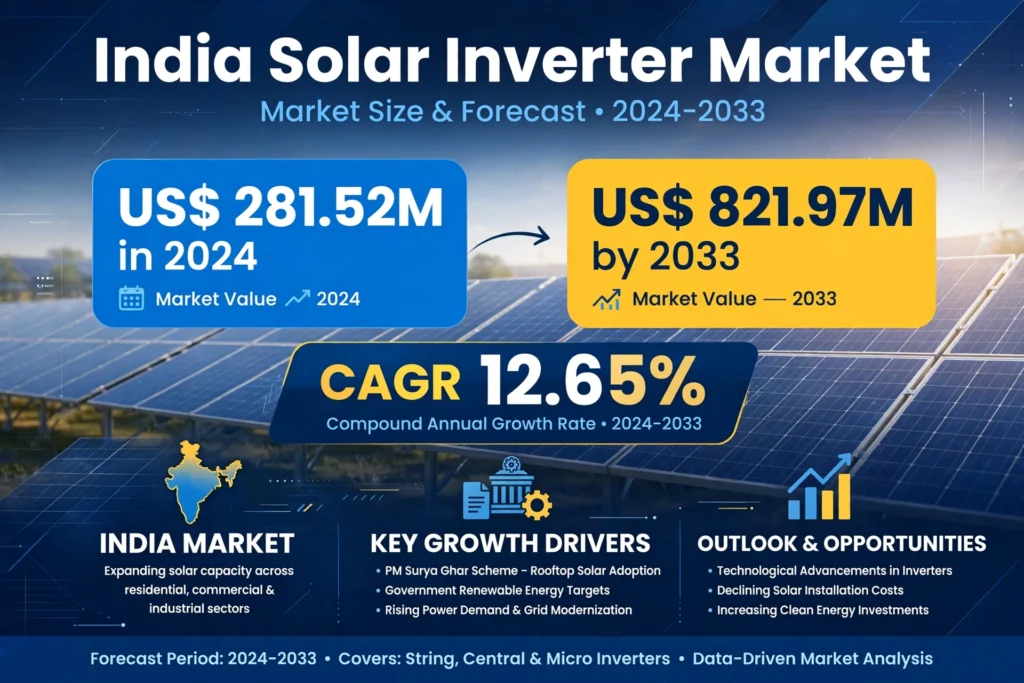
According to recent market analysis, the India Solar Inverter Market is expected to reach US$ 1,023.75 million by 2034, expanding from US$ 502.42 million in 2025. This growth represents a robust CAGR of 8.23% over the 2026–2034 forecast period, fueled by falling technology costs, government mandates, and the urgent need for commercial energy independence.
Industry Overview: The Engine of Renewable Integration
A solar inverter serves as the essential interface between DC-producing solar panels and the AC-powered electrical grid. As India targets 500 GW of non-fossil fuel capacity by 2030, the demand for sophisticated inverter technology has diversified across three primary segments:
-
Utility-Scale: Central and high-capacity string inverters for massive solar parks.
-
Commercial & Industrial (C&I): Smart string inverters optimized for rooftops and corporate sustainability mandates.
-
Residential: Compact, hybrid inverters integrated with battery storage to mitigate grid volatility.
The market is currently pivoting toward “Smart Inverters” that comply with IEEE 1547-2018 standards, capable of exporting reactive power to stabilize local feeders—a necessity as intermittent solar energy penetration increases.
Key Growth Drivers
The sector’s trajectory is underpinned by favorable economics and strategic government intervention.
1. The Proliferation of Net-Metering Policies
State-level regulations are the primary unlocks for distributed generation. With 28 states and union territories now offering net-metering, and pioneers like Delhi and Telangana permitting “virtual crediting” across multiple locations, housing complexes and industrial chains can now optimize their energy bills at scale. In 2024, Telangana raised its per-consumer cap to 10 MW, effectively creating a new high-voltage market for three-phase commercial inverters.
2. Deflationary Pressure on PV Costs
Early 2025 saw PV module prices drop to approximately USD 0.11 per watt. As modules become cheaper, the relative cost contribution of the inverter in a total system installation has risen from 6% to 9%. This has incentivized developers to invest in higher-efficiency models (98.5%+ efficiency) to maximize project returns. To combat high ambient temperatures in Western India, vendors are increasingly adopting silicon-carbide (SiC) power blocks, which reduce thermal losses and improve longevity.
3. SME Adoption via “PM Surya Ghar”
Small and medium-sized enterprises (SMEs) are becoming the fastest-growing customer segment. Faced with industrial tariffs exceeding INR 9.00 per kWh in states like Maharashtra and Karnataka, SMEs are utilizing 20% capital subsidies under the PM Surya Ghar scheme to transition from diesel generators to solar-battery hybrid systems. This modular trend favors string inverters, which allow businesses to scale capacity in 10 kW increments.
Critical Challenges
Despite rapid expansion, the market faces structural headwinds:
-
Import Dependency: India relies heavily on imported semiconductors and power electronics. Geopolitical supply chain disruptions directly impact manufacturing timelines and domestic pricing stability.
-
Grid Infrastructure Bottlenecks: Outdated distribution networks struggle with the bi-directional power flow of rooftop solar. Inconsistent power quality and voltage fluctuations can lead to premature inverter failure, necessitating more rugged, localized hardware.
-
Upfront Cost Barriers: Despite technological maturity, the initial installation cost—ranging between INR 45,000 and INR 75,000 per kW—remains a barrier for price-sensitive rural consumers, requiring better financing penetration.
Regional Market Landscapes
-
Maharashtra: A hub for industrial innovation, the state leads in C&I adoption, driven by large manufacturing clusters seeking to lower operational expenses through captive solar power.
-
Tamil Nadu: With a goal of 9,000 MW of solar capacity by 2030, the state is a leader in utility-scale infrastructure. Its high solar irradiance makes it a prime market for 1,500V central inverter platforms.
-
Karnataka: Benefiting from a robust tech ecosystem, Karnataka is the leader in “smart” and “hybrid” inverter adoption, particularly for IT parks and urban residential complexes requiring 24/7 power backup.
-
Uttar Pradesh: The state is witnessing a rural-led surge, with government-backed decentralized projects for irrigation and village electrification driving volume for rugged, low-maintenance string inverters.
Strategic Market Segmentation
Future Outlook: The Path to 2034
The push to 2034 will be defined by Hybridization. As battery storage costs continue to decline, the market will move away from standard grid-tie inverters toward integrated storage-ready hybrids. Digital diagnostics—where vendors offer firmware updates to optimize performance remotely—are already becoming a standard “service-as-a-product” offering. Companies that succeed will be those with local assembly facilities that can meet the “Make in India” requirement while maintaining global quality benchmarks.
Frequently Asked Questions (FAQs)
1. What is the projected market size of the Indian solar inverter industry by 2034? The market is forecast to reach US$ 1,023.75 million by 2034, growing from US$ 502.42 million in 2025 at a CAGR of 8.23%.
2. Which type of inverter is most popular in India? String inverters dominate the market due to their modularity, which makes them ideal for the rapidly growing C&I (Commercial & Industrial) rooftop sector.
3. How does the PM-KUSUM scheme impact the market? The PM-KUSUM scheme provides massive government support for solarizing agricultural pumps, creating steady demand for ruggedized inverters in rural and agricultural regions.
4. What are “Hybrid Inverters” and why are they trending? Hybrid inverters can manage both solar input and battery storage. They are trending because they allow users to store excess energy for use during nighttime or grid outages, reducing reliance on expensive diesel backups.
5. Why are imports a challenge for the Indian inverter market? Most high-end power electronics and semiconductor chips are imported. Reliance on these components makes local manufacturers vulnerable to global supply chain shocks and currency fluctuations.
6. What is the role of “Smart Inverters” in the Indian grid? Smart inverters can monitor grid conditions and export reactive power, helping stabilize the local voltage levels—a critical requirement for integrating India’s massive planned solar capacity.
7. Which states are the top consumers of solar inverters? Maharashtra, Tamil Nadu, Karnataka, and Gujarat lead in consumption due to a combination of high industrial demand, strong solar policies, and aggressive renewable energy capacity targets.