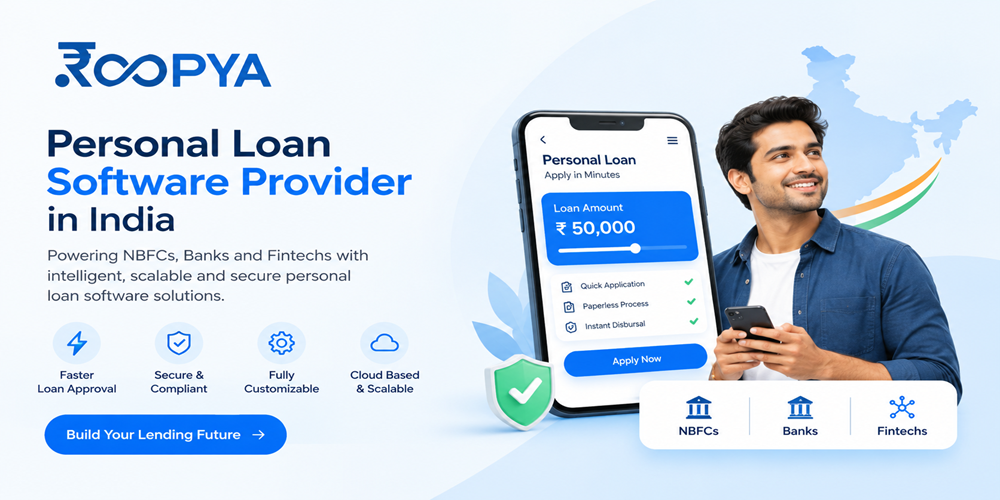
Roopya offers no-code personal loan software for banks, NBFCs and MFIs in India. Go live in about one day with origination, servicing, collections and analytics.
Personal loans have become one of the most important products in India’s lending market. They serve salaried employees, self-employed professionals and small households who need funds for medical bills, education, travel, home repairs or debt consolidation. For the institutions that offer them, the challenge is no longer just approving a loan. It is managing thousands of applications, verifying identities, assessing risk, disbursing funds, collecting repayments and staying compliant with regulations, often at the same time.
This is where a personal loan software provider becomes essential. The right platform replaces fragmented spreadsheets, disconnected tools and manual processes with a single system that supports the entire loan lifecycle. This guide explains what personal loan software does, why Indian lenders need it, what features to evaluate, and how to choose a provider that fits your business.
What Is Personal Loan Software?
Personal loan software is a digital platform built to manage unsecured personal loans from the first customer touchpoint to final repayment. Rather than being a single tool, it is usually a set of connected modules. Some cover the front end, where customers apply and submit documents. Others handle the back end, where loans are underwritten, sanctioned, serviced and reported.
A well-designed platform gives lenders control over how each product behaves. Interest rules, eligibility criteria, documentation requirements, approval limits and communication workflows can all be configured without rebuilding the system each time the business changes. This flexibility matters because lending policies evolve with market conditions, regulatory updates and the lender’s own risk appetite.
Why Indian Lenders Need Dedicated Personal Loan Software
India’s lending ecosystem is large, competitive and fast-moving. Banks compete with NBFCs, fintech lenders and microfinance institutions for the same borrowers, and customers expect an application experience that is quick, transparent and mobile-friendly. Lenders who still rely on manual processes often struggle to meet those expectations.
Manual workflows create predictable problems. Data entry errors slow down approvals. Documents get lost between teams. Collection efforts are not coordinated, so overdue accounts fall through the cracks. Reporting takes days rather than minutes, which makes it harder to spot portfolio stress early. A dedicated platform addresses each of these issues by standardising the process, keeping a single source of truth for every loan and giving managers real-time visibility.
There is also a compliance dimension. Indian lenders operate under a detailed regulatory framework, and they must be able to demonstrate how each decision was made, what documents were collected and how customers were treated throughout the loan journey. Software that records these steps automatically reduces the risk of audit findings and makes grievance handling more manageable.
Finally, scale matters. A system that works for a few hundred loans a month may become a bottleneck at thousands. Dedicated personal loan software is built to handle growing volumes, integrate with external data sources and support new products without a major rebuild.
The Core Modules of a Personal Loan Platform
Most complete personal loan platforms are organised around five functional areas. Understanding each one helps you evaluate whether a provider covers your needs or whether you would need to stitch together several vendors.
Loan Origination System (LOS)
The origination module manages everything from the application form to the final sanction. It captures customer details, runs identity and eligibility checks, pulls credit bureau data, applies decisioning rules and routes exceptions to the right approver. A strong origination system also handles digital document collection and verification, so applicants do not have to visit a branch to complete their file.
Loan Management System (LMS)
Once a loan is disbursed, the servicing module takes over. It generates amortisation schedules, tracks repayments, manages interest accruals, handles part payments and foreclosures, and gives customers access to a self-service portal. The LMS is the system of record for the portfolio, so accuracy here is critical.
Collections System
Collections software helps lenders recover overdue amounts efficiently and respectfully. It automates payment reminders, assigns accounts to agents based on delinquency stage, tracks promise-to-pay commitments and offers structured repayment plans where appropriate. Good collections tooling improves recovery rates while keeping the borrower relationship intact.
Early Warning System (EWS)
An early warning module looks for signs of stress before a payment is missed. It monitors behavioural patterns, changes in repayment habits and other indicators to flag accounts that may default. Lenders can then intervene early with a call, a restructuring offer or a revised payment date, which is usually less costly than recovering a defaulted loan.
Analytics and Reporting
The final module turns operational data into decisions. Dashboards show disbursement volumes, approval rates, delinquency trends and portfolio performance. Regulatory and internal reports can be generated on a schedule and exported in the formats teams need. Without this layer, managers are often working from stale figures.
What to Look for in a Personal Loan Software Provider
Choosing a provider is a significant decision, because the platform will sit at the centre of your lending operations for years. The features below are worth comparing across vendors.
Regulatory Alignment
The provider should demonstrate an understanding of Indian lending regulations and keep the platform updated as rules change. Ask how compliance updates are delivered, whether they are included in the subscription, and how the system supports audit trails and documentation standards.
Integration Depth
A personal loan platform rarely works alone. It needs to connect with credit bureaus, KYC and verification services, payment gateways, core banking systems, CRMs and ERPs. Check whether integrations are pre-built, how many are available and whether an open API architecture allows your team to connect additional systems.
Configurability Without Code
If every product change requires developer time, your business will move slowly. Look for a platform that lets business users configure loan products, credit policies and approval workflows through a visual interface. This shortens the time between a policy decision and its execution in the live system.
Fraud Controls
Personal loans are attractive to fraudsters, particularly when applications are submitted digitally. The platform should include identity checks, document verification and anomaly detection that flag suspicious applications before they reach disbursement.
Security and Data Handling
Loan data is sensitive. Providers should describe how they protect customer information, control user access, log activity and handle backups. Ask about certifications, hosting arrangements and how data is separated between clients.
Scalability and Support
Consider how the system performs as volumes grow and how responsive the support team is when something goes wrong. Ask for references from lenders of a similar size and clarify service levels before signing.
How Roopya Supports Personal Loan Lenders
Roopya is a lending technology company that provides loan origination and loan management software for banks, NBFCs, microfinance institutions and other lenders in India. Its platform is built on a no-code, unified infrastructure that covers the lending lifecycle from application to collections, and its personal loan offering is designed for lenders who want to launch or upgrade their products without a lengthy technology project.
According to Roopya’s website, the platform includes a loan origination system, a loan management system, a collections module, an early warning system, lending analytics and advanced reporting. The company also highlights a no-code business rule engine, which lets teams set credit policies and approval workflows visually, and an open API architecture for connecting to existing systems.
Roopya also lists more than 300 pre-integrated APIs, including credit bureaus, verification services and payment gateways, along with more than 20 pre-configured loan products. For lenders, the practical benefit is a shorter path from decision to launch, because many of the building blocks are already in place. Roopya further describes AI-supported features for document analysis, fraud detection and credit decisioning. As with any vendor claim, these should be validated against your own data and use cases during a proof of concept.
Roopya’s pricing model is described as pay-as-per-use, which means lenders are not required to make a large upfront licence commitment. This can be helpful for institutions that are testing a new product line, entering a new market or preferring operating costs to capital expenditure.
Implementation, Pricing and Go-Live
Implementation is often the biggest concern for lenders considering new software. The most useful questions to ask a provider are practical ones: what needs to be configured, which integrations are required, who owns the data migration, and what the realistic timeline looks like for your specific products. Roopya states that lenders can go live in about one day using its plug-and-play infrastructure. In practice, the duration depends on the number of integrations, the complexity of your policies and how quickly your teams make decisions, so a scoping session is the best way to set a realistic plan.
When comparing pricing, look beyond the headline rate. Include implementation fees, integration charges, support tiers and any costs tied to volume. A pay-as-per-use model can be attractive, but it is worth modelling your expected monthly volumes to understand the total cost over a full year.
Choosing the Right Provider: A Practical Checklist
Before you shortlist vendors, define your priorities. Are you launching a new personal loan product, replacing a legacy system, or scaling an existing portfolio? The answer will shape which modules and features matter most. Then request demonstrations using your own scenarios, such as a borrower with an incomplete document or a loan that moves into early delinquency. Ask each vendor to walk through how their system handles those cases, rather than relying on a general product tour.
Finally, speak with existing customers. Their experience with onboarding, support and ongoing product changes will tell you far more than a marketing page can.
Conclusion
A personal loan software provider does more than digitise applications. It gives lenders a reliable way to origination, servicing, collecting and monitoring personal loans at scale while staying organised and compliant. For banks, NBFCs and MFIs in India, the right platform can shorten time to market, reduce operational errors and improve portfolio quality.
If you are evaluating personal loan software, start by mapping your current process, identifying the biggest bottlenecks and shortlisting providers that address them. To see how Roopya’s personal loan platform works for your business, visit https://roopya.money/personal-loan-software-for-bank-nbfc-mfi/ or request a demo through the website.
3. Frequently Asked Questions
What is personal loan software?
Personal loan software is a digital platform that helps banks, NBFCs and microfinance institutions manage the full lifecycle of unsecured personal loans. It covers application capture, credit assessment, sanction, disbursement, repayment tracking, collections and reporting, all in one system instead of scattered spreadsheets and manual files.
Who needs a personal loan software provider in India?
Any regulated lender offering unsecured personal loans can benefit, including scheduled commercial banks, non-banking financial companies (NBFCs), housing finance companies, microfinance institutions and fintech lenders. Organisations that want faster turnaround, fewer manual errors and better portfolio visibility are the strongest candidates.
How long does it take to go live with Roopya?
Roopya’s platform is designed for a fast onboarding process. The company states that lenders can go live in about one day using its plug-and-play infrastructure and pre-configured loan products. Actual timelines depend on integrations, approval workflows and the complexity of your lending policies, so it is best to confirm the plan during a demo.
Is Roopya’s platform a no-code solution?
Yes. Roopya describes its platform as no-code, which means business users can configure loan products, credit policies, approval workflows and business rules through a visual interface without writing software code. Your technology team can still use open REST APIs for deeper integrations with CRMs, ERPs and other systems.
Does the software integrate with credit bureaus and verification services?
Roopya lists more than 300 pre-integrated APIs, covering areas such as credit bureaus, verification services and payment gateways. Lenders should confirm which specific providers are available for their use case and whether any additional contracts or fees apply.
How is Roopya priced?
Roopya positions its pricing as pay-as-per-use, with no large upfront licence cost. Because commercial terms can vary with volume, product scope and services, the most accurate approach is to request a proposal through the website’s contact form.
How can I request a demo?
You can request a tailored walkthrough by visiting the Roopya website and submitting the demo request form with your details and lender type. A member of the team will then reach out to schedule the session.