fire sprinkler services
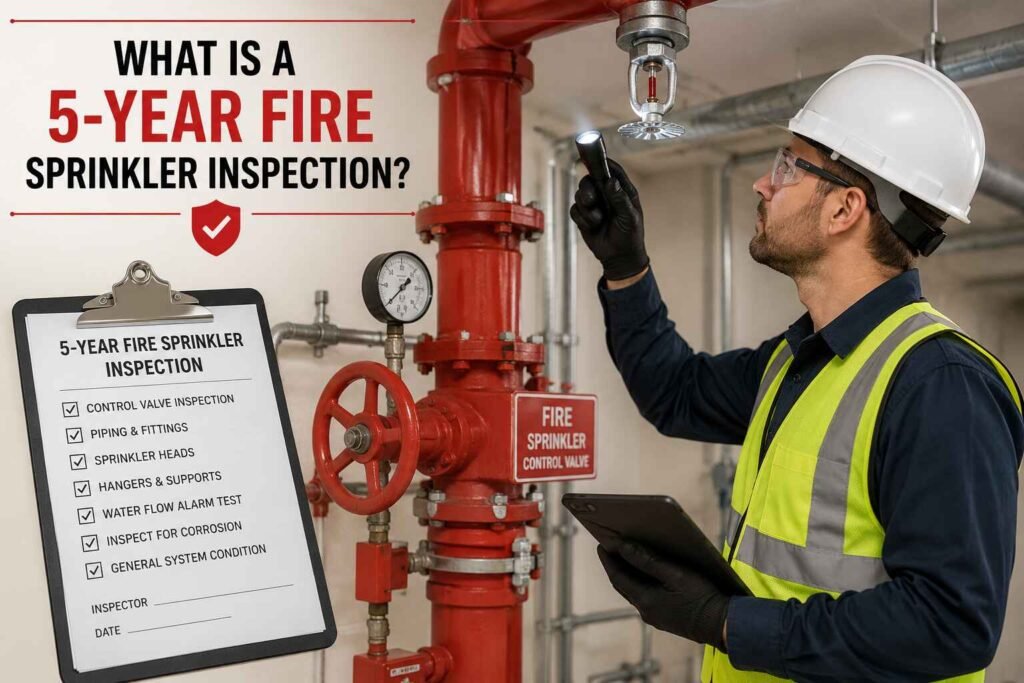
Most commercial property owners know they need annual fire sprinkler inspections. What catches a lot of people off guard is the 5-year inspection, a more intensive evaluation that goes well beyond what a standard annual visit covers. If your building has a fire sprinkler system and you have never heard of the 5-year inspection requirement, this matters more than you might realize.
The 5-year inspection is not just a longer version of the annual checkup. It digs into parts of your sprinkler system that routine inspections never touch, specifically the inside of your pipes, the condition of individual sprinkler heads, the mechanical performance of critical valves, and the integrity of your water supply components. Skipping it or letting it slide past the required timeframe is a code violation that can expose your business to serious liability and leave your building unprotected in ways that nobody sees coming until something goes wrong.
Why the 5-Year

Exists in the First Place
The Hidden Deterioration Problem Inside Sprinkler Systems
A fire sprinkler system looks solid from the outside. The pipes run through the ceiling, the heads hang in place, the gauges show pressure, and everything appears to be functioning. But inside those pipes, things change over years of service in ways that no visual inspection from the floor can reveal.
Steel pipes corrode from the inside out. Mineral deposits from water accumulate over time and narrow the pipe diameter, reducing flow capacity. In systems that experience air pockets, a process called microbiologically influenced corrosion creates pitting and pinhole leaks that develop slowly and silently. Sediment from the municipal water supply settles in low-lying sections of pipe. None of this is visible without actually opening the system up and looking inside.
The 5-year inspection requirement exists because these problems are real, they are common, and they can compromise a sprinkler system’s ability to perform at the moment it is most needed. A pipe that is 40 percent blocked with sediment and corrosion cannot deliver water at the pressure and flow rate the system was designed to produce. That means sprinkler heads that activate in a fire may not get the water they need to do their job.
What NFPA 25 Actually Requires
The National Fire Protection Association’s NFPA 25, titled the Standard for the Inspection, Testing, and Maintenance of Water-Based Fire Protection Systems, is the document that establishes exactly what has to happen and when. It is adopted in California and enforced by local fire authorities. NFPA 25 requires a comprehensive internal inspection of sprinkler system piping at five-year intervals, along with specific testing of sprinkler heads, control valves, backflow preventers, and fire pumps that fall within this inspection cycle.
This standard is not optional guidance. It is a legally enforceable code requirement in California, and local fire marshals check inspection records. When your records show a 5-year inspection is overdue, you have a compliance problem that needs to be corrected.
What Happens During a 5-Year Fire Sprinkler Inspection
Internal Pipe Inspection and Obstruction Investigation
The internal pipe inspection is the centerpiece of the 5-year evaluation and the component that separates it most clearly from an annual inspection. A licensed inspector opens the system at specific points, typically at the end sections of pipe runs and at low points where sediment collects, and uses that access to examine the internal condition of the pipes and to check for obstructions.
NFPA 25 requires an obstruction investigation at the 5-year mark, which involves flushing water through the system and collecting what comes out for examination. What gets flushed out tells the inspector a great deal about the internal condition of the entire system.
What Inspectors Are Looking for Inside the Pipes
Inside a pipe that has been in service for years, inspectors look for iron oxide scale from corrosion, calcium carbonate deposits from hard water, biological matter from microbiologically influenced corrosion, sediment from the water supply, and any foreign objects that may have gotten into the system during previous maintenance. The quantity and type of material found determines whether the system requires a full internal flush, a chemical treatment, or pipe replacement in affected sections.
The Flush Procedure and Why It Matters
When obstruction material is found at levels that exceed NFPA 25 thresholds, the inspector will require a full system flush. This involves running water through the entire pipe network at high velocity to clear accumulated debris. In systems where biological corrosion is present, chemical treatment may be applied to address the bacterial colonies responsible for the accelerated deterioration. Skipping this process leaves material inside the pipes that will continue accumulating and will eventually block sprinkler heads from delivering water properly.
Sprinkler Head Assessment and Replacement Criteria
Individual sprinkler heads receive detailed evaluation during the 5-year inspection. Inspectors check every accessible head for physical damage, corrosion, paint overspray, loading from dust or grease, and signs of leakage around the seal. Any head showing these conditions gets flagged for replacement.
Fast-Response Heads and Standard-Response Heads
NFPA 25 requires that a sample of sprinkler heads be sent to a recognized testing laboratory for internal testing at the 50-year mark for standard-response heads. Fast-response heads, which are common in newer commercial installations, require laboratory sample testing at 20 years. The laboratory test subjects the sample heads to the actual conditions that would trigger activation and verifies that the heat-sensing element still functions within the required temperature and response time tolerances.
The 50-Year Rule for Older Sprinkler Heads
If your building has a sprinkler system that is approaching or has passed 50 years of service, the 5-year inspection triggers a mandatory laboratory evaluation of a sample of your heads. If the laboratory results show that the sample heads do not meet performance standards, the entire stock of that head type in your system must be replaced. This is a significant undertaking, but it exists because older heads experience metal fatigue, corrosion of internal components, and degradation of the heat-sensitive element that can prevent activation in a real fire.
Control Valve and Waterflow Device Testing
Every control valve in the sprinkler system requires full operational testing during the 5-year inspection cycle. This means exercising each valve through its full range of travel, from fully open to fully closed and back, to confirm that the valve operates freely and positions correctly. Valves that have been sitting in one position for years without exercise can seize, corrode in place, or lose their sealing capability. A valve that cannot be fully closed becomes a maintenance problem. A valve that is partially closed without anyone knowing is a fire protection emergency waiting to happen.
Main Drain Test and What the Results Tell You
The main drain test is performed annually, but the results at the 5-year inspection get evaluated in the context of the full system assessment. The inspector records static pressure before opening the main drain, then records residual pressure once the drain is fully open and flowing. The difference between these two readings reveals the condition of the water supply to the system. A significant drop in residual pressure compared to previous test records can indicate a developing obstruction in the supply main, a partially closed underground valve, or a degrading municipal water supply condition. Catching this trend at the 5-year inspection creates an opportunity to investigate and correct it before it compromises system performance.
Fire Pump Testing During the 5-Year Cycle
If your sprinkler system relies on a fire pump to boost water pressure, the 5-year inspection includes a comprehensive fire pump test that goes beyond the routine weekly churn test and annual flow test. The 5-year evaluation assesses internal pump components for wear, checks packing and seal conditions, inspects the driver and coupling, and verifies that controller settings and transfer switch functions are correct. Fire pumps work hard in testing and harder in real emergencies. Internal wear that is not caught and addressed can result in a pump that runs but cannot produce the pressure output the system depends on.
Backflow Preventer Testing Requirements
Backflow preventers protect the municipal water supply from contamination by the water sitting in your sprinkler system’s pipes. California law and local water authority regulations require annual testing of backflow prevention assemblies, and the 5-year inspection confirms that testing records are current and that the assembly is functioning correctly. A failed backflow preventer creates both a public health issue and a water authority compliance violation that can result in the water service to your building being shut off.
What Inspectors Commonly Find During 5-Year Inspections
Corrosion and Tuberculation Inside Pipes
Iron tubercles, which are mound-like rust formations that build up on the inside of steel pipe walls, are one of the most common findings during 5-year internal inspections. These formations develop gradually over years and can reduce effective pipe diameter significantly. In advanced cases, tuberculation can block sprinkler heads entirely. Dry pipe systems are particularly vulnerable to internal corrosion because the air trapped in the pipes contains oxygen that reacts with the pipe wall continuously, accelerating the process compared to wet pipe systems that limit oxygen exposure once the air is purged.
Biological Growth and Sediment Buildup
Microbiologically influenced corrosion, often called MIC, results from bacterial colonies that establish themselves inside the pipe network. These bacteria produce acids as a metabolic byproduct, and those acids accelerate pipe wall corrosion dramatically. The evidence shows up as black gelatinous slime in the pipe, a sulfur odor when the system is opened, and pinhole leaks that develop in locations far from any mechanical stress point. Sediment from municipal water supplies, particularly systems that draw from surface water sources, accumulates over years at low points in the pipe network and can trap moisture against pipe walls in ways that accelerate local corrosion.
Frozen or Painted-Over Sprinkler Heads
In commercial buildings that have been repainted, renovated, or where maintenance staff have been less than careful, inspectors regularly find sprinkler heads coated with paint. This seems minor. It is not. Paint coating over the heat-sensitive glass bulb insulates it from the ambient temperature, meaning the head takes longer to activate in a fire or may not activate at all if the coating is thick enough. A painted head is a compromised head, and it needs replacement regardless of its age. Heads that have been physically damaged during maintenance work, struck by equipment, or corroded at the frame also require replacement during the 5-year inspection.
What Happens After the Inspection
Understanding Your Deficiency Report
After the 5-year inspection is complete, your contractor provides a written deficiency report documenting everything found that does not meet NFPA 25 requirements or current code standards. This report categorizes deficiencies by severity. Some items are immediately dangerous and require correction before the building can continue normal occupancy. Others are significant but allow a correction window. Minor items may carry a longer timeline. Every deficiency on the report has a code reference explaining exactly which requirement is not being met, which gives you the documentation needed for insurance purposes, permit applications, and fire authority records.
Timelines for Correcting Deficiencies in California
California fire authorities take fire protection deficiencies seriously and enforce correction timelines. Critical deficiencies, particularly those involving the main water supply, primary control valves, or fire pump failures, typically require immediate correction or the implementation of a fire watch program while repairs are completed. Less critical deficiencies usually carry a 30 to 60 day correction window, after which a re-inspection confirms the work was completed correctly. Ignoring deficiency reports or missing correction deadlines escalates the compliance issue and can result in operational restrictions on the building.
How the 5-Year Inspection Connects to Your Annual and Quarterly Obligations
Building a Complete Inspection Schedule for Your Property
The 5-year inspection does not replace your other obligations. It sits at the top of a layered inspection schedule that includes quarterly checks of waterflow alarms and control valve supervisory devices, annual inspections covering sprinkler heads, gauges, hangers, pipe condition, and system testing, and then the comprehensive 5-year evaluation that goes inside the pipes and addresses the components that annual inspections cannot reach. A complete inspection program covering all three levels is what actually keeps a sprinkler system in code-compliant, operationally reliable condition across its entire service life.
Keeping organized records of every inspection, test, and maintenance action performed on your system is not just good practice. NFPA 25 requires that records be maintained and made available to the authority having jurisdiction upon request. Your fire protection contractor should provide documentation after every service visit that you retain in a building maintenance file.
Choosing the Right Contractor for Your 5-Year Fire Sprinkler Inspection
The 5-year fire sprinkler inspection requires a contractor with the technical knowledge to perform internal pipe evaluations, interpret obstruction investigation findings, assess sprinkler head condition accurately, and test fire pumps and backflow preventers correctly. This is not a job for a general handyman or a contractor without specific fire protection credentials.
Raptor Fire Protection Inc provides professional fire sprinkler services and sprinkler repair services across the Greater San Francisco Bay Area, backed by a C-16 Contractor License (#1091388), NICET certification, and active membership in the American Fire Sprinkler Association. As a veteran-owned company, Raptor brings disciplined attention to detail and honest communication to every inspection and service visit. Every client receives a complete written report, a clear explanation of any deficiencies found, and straightforward recommendations for corrective work without unnecessary upselling or inflated repair scopes.
If your 5-year inspection is coming up or already overdue, getting it scheduled with a qualified contractor protects your building, your tenants, and your compliance standing with local fire authorities.
Conclusion
The 5-year fire sprinkler inspection is one of the most important maintenance events in the life of any commercial sprinkler system. It goes where annual inspections cannot, inside the pipes, into the mechanical condition of critical valves, through the performance characteristics of individual sprinkler heads, and into the reliability of the water supply infrastructure that the entire system depends on. Understanding what this inspection involves, what inspectors commonly find, and what happens after the report is issued gives commercial property owners and facility managers the knowledge to manage this obligation correctly rather than reactively. If you are in the Bay Area and want a licensed, experienced team to handle your 5-year inspection with the thoroughness it requires, Raptor Fire Protection is ready to help.
Frequently Asked Questions
- How do I know if my commercial building’s 5-year fire sprinkler inspection is overdue?
Check your inspection records file for the most recent 5-year inspection report. If you do not have one, or if the date is more than five years ago, the inspection is overdue. Your annual inspection contractor should also note in their report when the 5-year inspection is due based on your system’s history. If records are missing or incomplete, a licensed fire protection contractor can review your system and help establish a baseline inspection schedule going forward. - Does the 5-year inspection apply to all types of sprinkler systems?
Yes. NFPA 25 applies the 5-year internal inspection and obstruction investigation requirement to wet pipe, dry pipe, pre-action, and deluge sprinkler systems. The specific procedures vary somewhat by system type. Dry pipe systems, for example, require internal inspection at more frequent intervals than wet pipe systems in some cases due to their higher susceptibility to internal corrosion from trapped oxygen in the pipe network. - Can my building continue operating while 5-year inspection deficiencies are being corrected?
It depends on the nature of the deficiency. Minor and moderate deficiencies typically allow continued occupancy while corrective work is scheduled and completed within the timeframe established by the authority having jurisdiction. Critical deficiencies involving the primary water supply, main control valves, or major system impairment may require a fire watch program or in serious cases may trigger occupancy restrictions until repairs are completed. Your contractor and local fire authority will specify the requirements based on the specific findings. - What is the difference between an obstruction investigation and a regular flush?
An obstruction investigation is a structured evaluation process required by NFPA 25 that involves opening the system at specific points, examining what is inside the pipes, collecting and evaluating flushed material, and determining whether the system requires corrective action. A regular flush is a corrective maintenance procedure that moves water at high velocity through the pipe network to clear accumulated debris. The investigation tells you whether a problem exists and how severe it is. The flush is what you do to address the problem once the investigation confirms it. - How much does a 5-year fire sprinkler inspection typically cost compared to an annual inspection?
The cost varies based on building size, system complexity, the number of sprinkler heads, whether fire pumps and backflow preventers are included, and the specific findings that require follow-up work. In general, a 5-year inspection costs meaningfully more than an annual inspection because of the additional procedures involved, particularly the internal pipe evaluation and obstruction investigation. Getting a detailed written proposal from a licensed C-16 contractor before the work begins gives you a clear picture of the scope and cost and protects you from unexpected charges after the inspection is complete.