The United States HVAC (Heating, Ventilation, and Air Conditioning) equipment market is undergoing a seismic shift. Once viewed as a utility-focused sector defined by hardware installation, it has evolved into a high-tech ecosystem centered on decarbonization, intelligent automation, and regulatory compliance. As the nation grapples with aging infrastructure and shifting climate patterns, the demand for sophisticated climate control has transformed from a luxury into a fundamental requirement for residential, commercial, and industrial resilience.
Market Valuation and Growth Projections
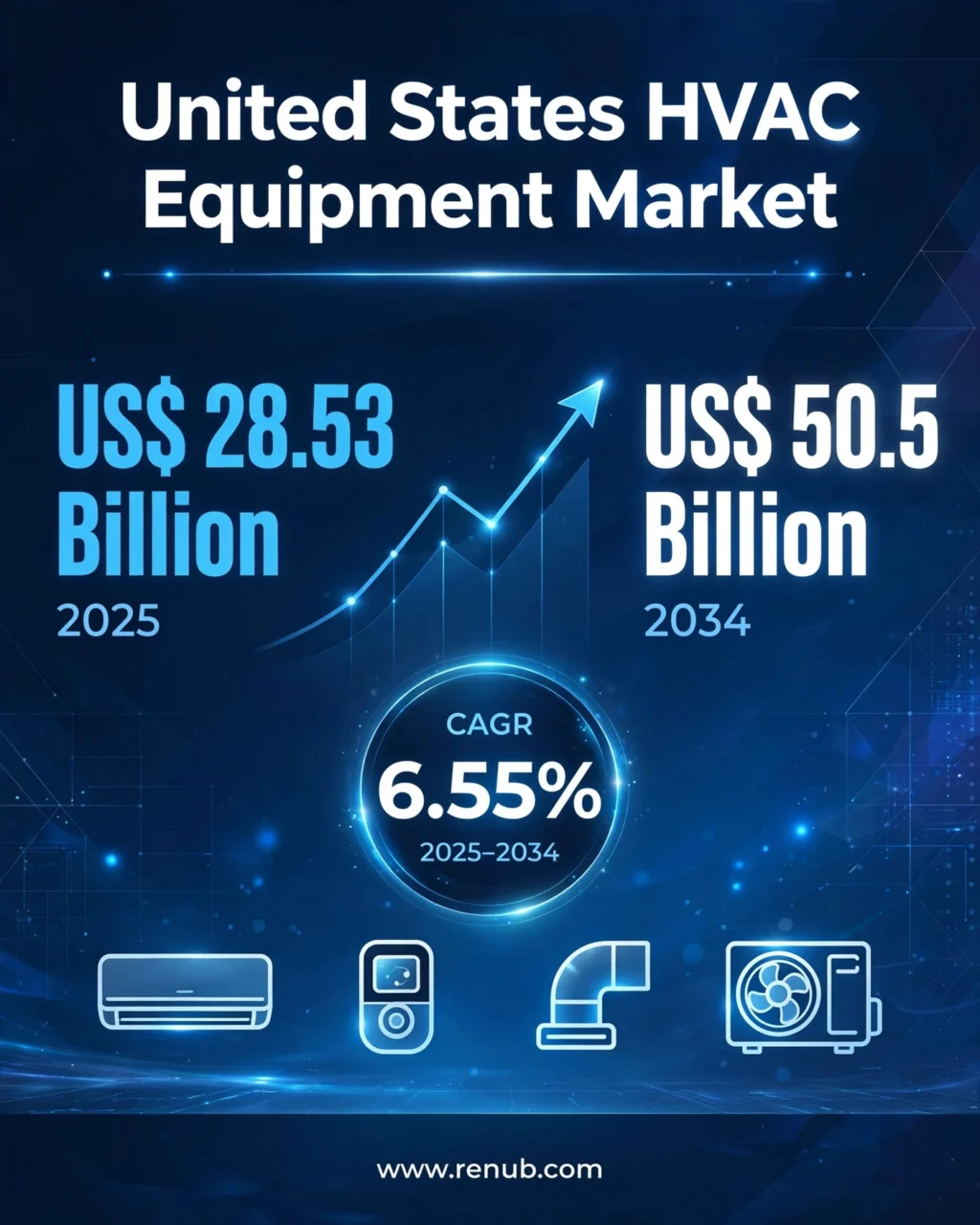
According to recent strategic analysis and market projections, the United States HVAC equipment market is on a trajectory of sustained expansion. The market, valued at US$ 28.53 billion in 2025, is anticipated to reach US$ 50.5 billion by 2034. This growth represents a robust Compound Annual Growth Rate (CAGR) of 6.55% during the forecast period of 2026–2034.
This upward momentum is not merely a product of new construction; it is driven by the urgent replacement of legacy systems, aggressive federal and state energy-efficiency mandates, and the rapid integration of smart-grid technologies. As building owners prioritize environmental, social, and governance (ESG) goals, the transition toward high-efficiency heat pumps and variable refrigerant flow (VRF) systems has become the industry standard.
Primary Growth Drivers
Several converging factors are accelerating the adoption of next-generation HVAC technologies across the United States.
The Shift Toward High-Efficiency and Energy-Saving Systems
Regulatory pressure, specifically through Title 24 upgrades and national minimum SEER (Seasonal Energy Efficiency Ratio) uplifts, has forced a pivot toward premium equipment. While high-efficiency units command a 15–25% price premium over traditional models, the total cost of ownership (TCO) is increasingly favorable due to rising electricity rates and time-of-use pricing models. Utilities are now fueling this transition by pairing equipment rebates with demand-response incentives, effectively subsidizing the shift toward variable-speed compressors and cold-climate heat pumps.
Stringent State and Federal Decarbonization Mandates
The HFC (hydrofluorocarbon) phase-down, which mandates an 85% reduction in R-410A output by 2036, acts as a forced catalyst for equipment replacement. Manufacturers are rapidly redesigning high-volume chillers, rooftop units, and split systems to operate on low-GWP (Global Warming Potential) refrigerants like R-32 or R-454B. Furthermore, state-level legislation—such as New York’s Climate Leadership and Community Protection Act—now requires mandatory electrification for buildings exceeding 25,000 square feet, creating a non-discretionary replacement cycle for aging infrastructure.
The Rise of IoT and Smart Building Automation
Modern HVAC systems are no longer isolated mechanical assets; they are integrated nodes in a building’s digital network. Native connectivity via open APIs allows these systems to interface with facility management software for real-time schedule optimization and predictive maintenance. For commercial developers, IoT-enabled HVAC solutions offer a measurable path to energy savings of 15% to 20%. Consequently, smart thermostats and advanced zoning kits are becoming base-spec requirements in new construction, shifting the industry toward a recurring revenue model centered on software-as-a-service (SaaS) subscriptions for energy management.
Strategic Challenges: Balancing Cost and Compliance
Despite favorable growth trends, the industry faces significant friction points that complicate deployment and market penetration.
-
Elevated Upfront Expenditures: The incorporation of advanced sensors, high-efficiency motors, and new-age refrigerant hardware has driven installation costs upward. In an inflationary environment, labor shortages further exacerbate project costs, causing some price-sensitive residential consumers to delay necessary equipment upgrades.
-
Regulatory Complexity: Manufacturers must navigate a fragmented landscape of federal standards and state-specific building codes. Achieving certification for new, low-GWP refrigerant systems requires substantial R&D investment, creating a high barrier to entry that may stifle smaller regional players who cannot sustain the costs of rapid product redesign.
-
Legacy Infrastructure Integration: Retrofitting historic or older commercial buildings with modern, automated HVAC systems often presents significant engineering challenges. Compatibility issues between new digital controls and decades-old wiring can lead to increased system downtime and complex, costly installation processes.
Regional Market Dynamics
The United States HVAC market is geographically diverse, with demand shaped by specific climate requirements and state-level policy environments.
California: The Sustainability Leader
California serves as the testing ground for the nation’s most aggressive energy-efficiency standards. Driven by “Green Building” initiatives and a focus on wildfire-resilient ventilation, the state exhibits high demand for smart climate control and air purification technologies. The integration of HVAC systems with rooftop solar and home battery storage is increasingly common here, positioning California as the primary hub for residential energy management innovation.
Texas: Growth Through Urbanization
Texas remains a volume-driven market. With rapid population growth and the state’s extreme summer heat, the demand for high-capacity cooling systems is unrelenting. The market is currently seeing a surge in demand for commercial-grade chillers and high-efficiency air handlers to support the state’s booming data center and industrial sectors, which require precision climate control to maintain operational uptime.
New York and Florida: Polarized Needs
-
New York: Focuses on building modernization and electrification. Demand is concentrated on retrofitting institutional and high-rise infrastructure to comply with carbon-neutrality mandates.
-
Florida: Driven by humidity management and year-round cooling requirements. The market here prioritizes corrosion-resistant, high-durability equipment capable of sustained operation in coastal, salt-rich environments.
Technological Transformation and Market Consolidation
The industry is currently defined by two major trends: Vertical Integration and Data-Centric Cooling.
Major players are moving beyond simple manufacturing to provide full-service platforms. The 2026 establishment of a national HVAC distribution platform by the Averon Group and Fenco Supply illustrates the industry’s push toward integrated supply chains. By combining digital inventory management with local technical expertise, firms are shortening lead times and improving service reliability—critical factors in large-scale project execution.
Simultaneously, the surge in Artificial Intelligence (AI) and high-density computing is reshaping the commercial segment. Strategic investments, such as Carrier’s partnership with ZutaCore to advance liquid cooling for data centers, highlight how HVAC providers are diversifying into specialized cooling markets. As AI workloads increase energy density, the ability to provide liquid-to-chip cooling solutions has become a competitive differentiator for top-tier HVAC manufacturers.
Future Outlook (2026–2034)
As we look toward 2034, the U.S. HVAC market will likely transition toward a “Service-First” economy. Hardware will become increasingly commoditized, while the value will shift toward the intelligence layer—software that monitors, modulates, and optimizes energy consumption in real-time. The push for net-zero buildings will cement heat pumps as the primary heating solution, eventually rendering gas-fired furnaces obsolete in new construction across most of the United States.
Frequently Asked Questions (FAQs)
1. What is the projected market size of the U.S. HVAC industry by 2034? The U.S. HVAC equipment market is projected to reach US$ 50.5 billion by 2034, growing at a CAGR of 6.55% from its 2025 valuation of US$ 28.53 billion.
2. Why are HVAC installation costs rising in the U.S.? Costs are increasing due to the adoption of advanced, energy-efficient technologies, mandatory transitions to new low-GWP refrigerants, and ongoing labor shortages in the skilled trades sector.
3. What is the impact of the HFC phase-down on the HVAC market? The HFC phase-down mandates an 85% reduction in R-410A use by 2036, forcing manufacturers to redesign equipment for environmentally friendly alternatives like R-32, which drives replacement cycles and increases product R&D costs.
4. How does IoT integration benefit building owners? IoT-enabled HVAC systems allow for predictive maintenance, remote monitoring, and automated schedule optimization, which can reduce energy consumption by 15% to 20% while extending equipment lifespan.
5. Which segment of the HVAC market is growing the fastest? The smart/connected HVAC segment is seeing the fastest growth, driven by residential demand for home automation and commercial demand for ESG-compliant energy management systems.
6. What role does AI play in modern HVAC systems? AI is being used to manage high-density cooling requirements in data centers and to optimize building-wide energy usage by learning occupancy patterns and adjusting climate controls autonomously.
7. Is the U.S. HVAC market becoming more consolidated? Yes. Major manufacturers and private equity-backed groups are increasingly acquiring regional distributors to create national platforms that offer end-to-end service, digital inventory tracking, and professional technical support.