Property Listing Optimization Get More Buyer Attention
A property can have a great location, attractive features, and competitive pricing, but that does not automatically mean buyers will notice it online.
Before a potential buyer schedules a showing, they usually encounter the property through a digital listing. The photographs, headline, description, layout, videos, and overall presentation all influence whether that buyer continues exploring or moves on to another home.
That makes Property Listing optimization an important part of modern real estate marketing.
Optimizing a listing is not about making a property appear better than it really is. It is about presenting the property’s genuine strengths clearly, professionally, and in a way that helps buyers understand its value.
For Real Estate Agents, a well-optimized listing can also create more opportunities to use the same property content across social media, websites, email campaigns, and other marketing channels.
What Is Property Listing Optimization?
Property Listing optimization is the process of improving the content and presentation of a property so buyers can understand and engage with it more easily.
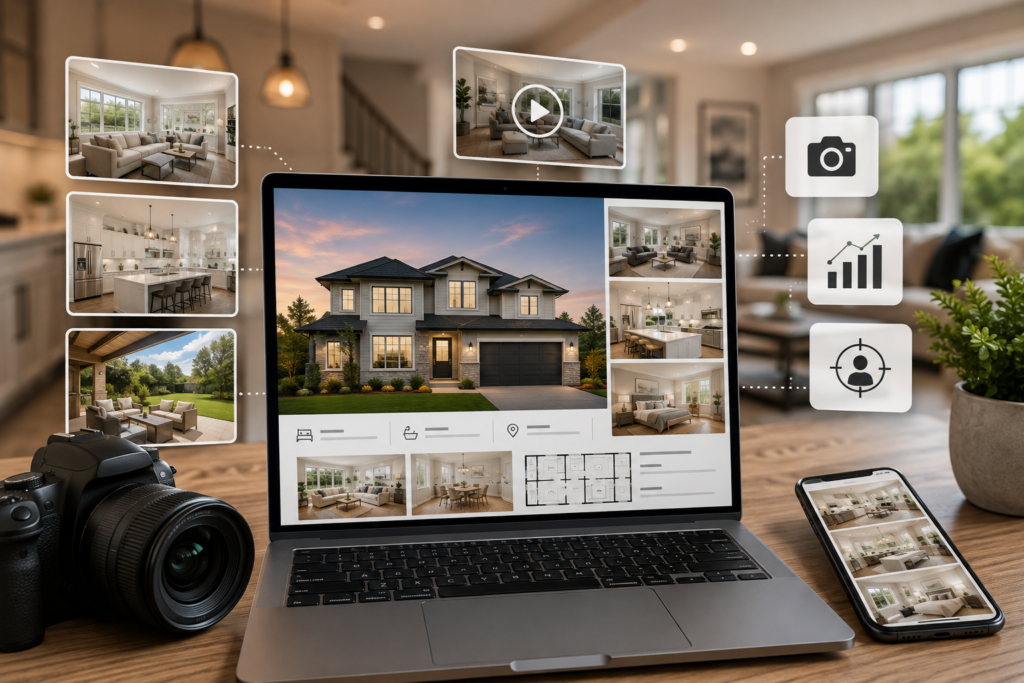
This can include improving property photographs, creating a stronger headline, writing a useful description, organizing images logically, adding floor plans, using video, optimizing the listing for mobile devices, and making important property information easy to find.
The goal is to remove unnecessary friction.
A buyer should be able to quickly understand what the property is, what makes it interesting, where it is located, how the space is arranged, and what they should do next.
When these elements work together, the listing becomes more than a collection of information. It becomes a complete digital presentation of the property.
Start With the Property’s Strongest Features
Every property has something that can make it more appealing to the right buyer.
It might be a recently renovated kitchen, a large backyard, an open floor plan, a home office, a private primary suite, a pool, a great view, or a desirable location.
The listing should make these features easy to discover.
Instead of giving every feature equal importance, agents should identify the characteristics that genuinely differentiate the property.
This helps shape the first photograph, headline, description, social media content, and video strategy.
The strongest marketing usually starts with knowing what makes the property worth noticing.
Improve the First Visual Impression
The first photograph can determine whether a buyer clicks into the full Property Listing.
A dark, cluttered, or poorly composed image may cause potential buyers to continue scrolling even if the home itself is excellent.
The first image should therefore communicate something compelling about the property.
For some homes, that may be an attractive exterior. For others, a bright living room, modern kitchen, or impressive view may be more effective.
The image should also accurately represent the property.
AI-powered photo enhancement can help improve lighting, exposure, and overall presentation, but the final result should remain realistic.
Create a Logical Photo Sequence
A buyer should not have to work to understand a property.
The order of the photographs can help create a natural visual journey.
Start with a strong hero image and then move through the property logically. Show the major living spaces, bedrooms, bathrooms, special features, and exterior areas in an order that helps buyers understand how the home connects.
This is particularly useful for properties with multiple levels or unusual layouts.
When the photograph sequence tells a story, buyers can develop a better mental picture of the home.
Write a Description That Adds Context
Photography attracts attention, but the written description provides information that images cannot communicate.
A weak description simply repeats basic specifications.
A stronger Property Listing description explains what makes the home useful or appealing to its intended buyer.
Instead of only saying that a property has a large kitchen, the description can explain how the kitchen connects to the living area or why its layout works well for entertaining.
Instead of simply mentioning a backyard, explain how the space could support outdoor dining, recreation, or relaxation when those characteristics are genuinely present.
The description should remain factual while giving buyers useful context.
Use Video to Show Flow and Movement
Photographs show individual moments.
Video can show how the property feels when moving from one room to another.
A short walkthrough can demonstrate the relationship between the entry, living room, kitchen, bedrooms, and outdoor spaces.
This can be particularly helpful for buyers who are searching remotely or comparing several homes online.
Video also gives agents additional content for social media.
A single Property Listing can produce a main walkthrough video along with shorter clips focused on specific features.
This creates more opportunities to promote the same property without creating entirely new content each time.
Add a Floor Plan
A photograph can show what a room looks like, but it cannot always explain where that room is located.
A floor plan provides that missing context.
Buyers can use it to understand room relationships, movement through the home, bedroom placement, and overall layout.
This becomes especially valuable for larger homes, multi-level properties, and unusual floor plans.
Combining photographs with a floor plan gives buyers both visual and spatial information.
They can see what the room looks like and understand where it fits within the property.
Consider Virtual Staging
Vacant properties can sometimes be difficult to visualize.
An empty living room may look spacious, but buyers may still wonder how furniture would fit or how the room could function.
Virtual Staging can provide a visual example.
Furniture and décor can be digitally added to the Property Listing photograph, allowing buyers to see a possible arrangement.
This can be especially useful for rooms where scale or functionality is difficult to understand.
Virtual staging should always be disclosed and should complement the actual property rather than create unrealistic expectations.
Optimize for Mobile Buyers
A Property Listing that looks great on a desktop can still perform poorly if the mobile experience is difficult.
Many buyers browse properties from smartphones while commuting, relaxing at home, or comparing homes during the day.
Images should load quickly and remain clear on smaller screens.
Text should be easy to read without excessive scrolling or zooming.
Contact buttons and inquiry options should also be easy to access.
The objective is simple: make it easy for an interested buyer to explore the property and take the next step from any device.
Make the Listing Search-Friendly
Real estate SEO can help a Property Listing become easier to discover through search engines.
Page titles, headings, image alt text, property descriptions, location information, and other on-page elements can provide useful context to search engines.
Agents should use natural, relevant terms rather than stuffing keywords into every sentence.
Location is particularly important.
A listing may be more useful when it clearly communicates the city, neighborhood, property type, and relevant characteristics.
The same principle applies to image file names and alt text.
Descriptive information is more useful than generic file names such as “IMG_4821.jpg.”
Promote the Property Beyond the MLS
Publishing a Property Listing on an MLS or property portal is only one part of the marketing process.
Social media can extend the property’s reach.
Instagram can showcase photography and short-form video. Facebook can support local promotion and community engagement. YouTube can provide space for longer property walkthroughs.
The content should be adapted to each platform rather than copied without modification.
A strong kitchen photograph may become an Instagram post. A short walkthrough can become a Reel. A longer tour can become a YouTube video.
The property becomes a source of multiple marketing opportunities.
Turn One Listing Into More Content
Agents do not need to create every marketing asset from scratch.
A single Property Listing can generate a large collection of content.
The photographs can support social posts.
The property description can provide information for captions and email marketing.
The floor plan can become an educational visual.
The video can be divided into short clips.
Virtually staged rooms can demonstrate potential.
This content repurposing approach can reduce the amount of manual work involved in maintaining consistent marketing.
How Walktru Helps Optimize Property Content
Walktru is designed to help Real Estate Agents create professional property marketing content through an AI-powered workflow.
Instead of treating photography, virtual staging, listing reels, and other visual assets as completely separate projects, Walktru helps agents turn property photos into multiple marketing formats.
An agent can start with photographs captured during a property visit and use them as the foundation for enhanced listing images, virtually staged rooms, listing reels, and other visual content.
This can make the Property Listing preparation process faster while helping agents maintain a consistent visual standard.
The goal is not simply to produce more content.
It is to make the existing property content more useful.
Create a Clear Buyer Journey
A strong listing should guide buyers from initial interest toward action.
The first photograph earns attention.
The rest of the image gallery builds interest.
The description adds context.
The floor plan explains the layout.
Video provides a stronger sense of movement.
Additional property information answers questions.
The call to action then gives the buyer a clear next step.
That might be scheduling a showing, contacting the agent, requesting more information, or visiting the property’s website.
Every part of the listing should support this journey.
Keep Property Information Accurate
Optimization should never come at the expense of accuracy.
AI tools can help improve photographs and create content, but Real Estate Agents should always review the final results.
Property descriptions should be checked for factual accuracy.
Images should not create unrealistic expectations.
Virtual staging should be disclosed.
Property measurements, pricing, room counts, and other important details should be consistent across platforms.
A professional Property Listing should build buyer confidence rather than create confusion.
Use Data to Improve Future Listings
Listing optimization should be an ongoing process.
Agents can review which photographs receive the most attention, which social posts generate engagement, which videos receive inquiries, and which listings produce the most showing requests.
This information can influence future marketing decisions.
If buyers consistently engage with kitchen-focused content, agents can give kitchens more attention in future campaigns.
If video generates stronger inquiries than static posts, agents can increase their use of listing video.
The objective is to learn what works for the specific market and audience.
AI Can Make Optimization Faster
AI is becoming increasingly useful for real estate marketing because it can reduce repetitive production work.
Agents can use AI-powered tools to enhance Property Photos, create virtual staging, produce listing reels, and adapt existing property information into different marketing formats.
This allows agents to spend less time on repetitive tasks.
However, AI should support the agent’s strategy rather than replace it.
The agent still decides which features matter, who the property is being marketed to, and how the home should be positioned.
Technology simply helps execute that strategy more efficiently.
Don’t Overcomplicate the Listing
A Property Listing does not need every possible marketing feature.
The goal is not to overwhelm buyers with content.
The goal is to provide the right information in a clear and useful format.
Strong photography, accurate information, a compelling description, a logical layout, and an appropriate mix of video, floor plans, and virtual staging can be enough to create a professional presentation.
Agents should choose marketing assets based on the property.
A large luxury home may benefit from 3D tours and extensive video.
A smaller property may need strong photography and a simple floor plan.
The strategy should match the listing.
Final Thoughts
A strong Property Listing does more than display a home for sale. It creates the first digital experience between the buyer and the property.
Professional photography, useful descriptions, logical image sequencing, video, floor plans, virtual staging, mobile optimization, and social promotion can work together to make that experience more effective.
For Real Estate Agents, the biggest opportunity is to build a repeatable process that turns every property into a complete marketing package.
Walktru helps simplify that process by providing AI-powered tools for property photo enhancement, virtual staging, listing reels, and other visual marketing content.
The goal is not to make every listing look identical.
It is to identify what makes each property valuable and present those qualities clearly, accurately, and professionally.
When a Property Listing respects the buyer’s time, answers important questions, and makes the home’s strengths easy to understand, it has a much better opportunity to turn online attention into genuine buyer interest.