When Should UAE Businesses Outsource Accounts Payable and Receivable Management?
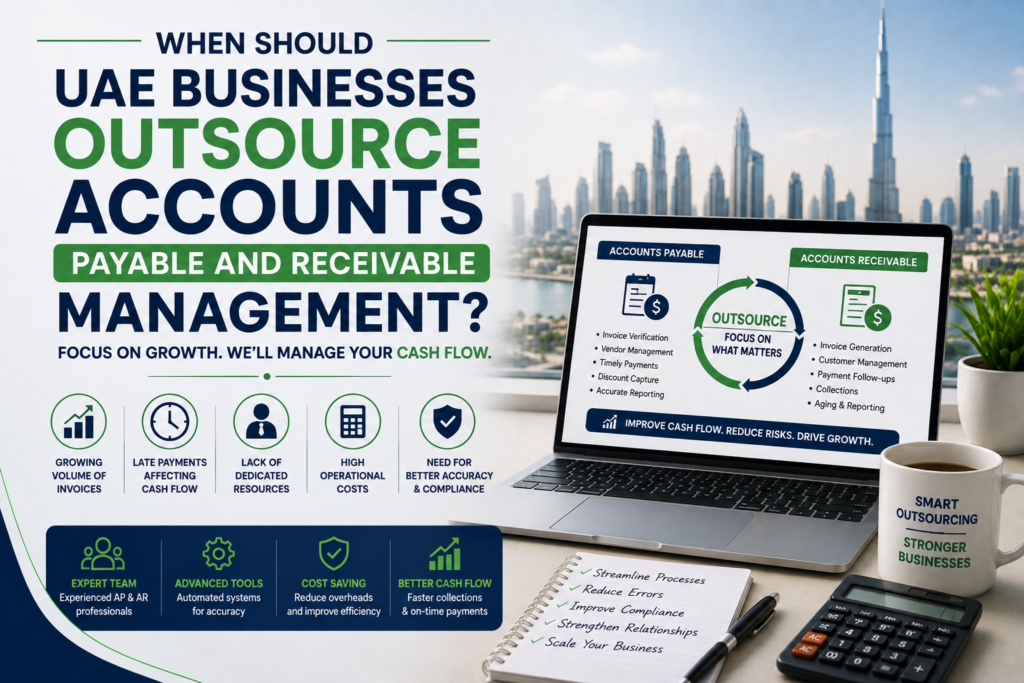
Managing accounts payable and receivable is a fundamental part of running a financially healthy business. Every company needs to process supplier invoices, manage outgoing payments, issue customer invoices, monitor collections, and maintain accurate financial records.
For smaller businesses with relatively few transactions, these responsibilities may be manageable internally. However, as a company grows, the volume and complexity of financial transactions can increase significantly.
Finance teams may find themselves spending more time processing invoices, following up on overdue payments, reconciling accounts, and managing administrative tasks instead of focusing on financial analysis and strategic planning.
This is where outsourced accounts payable and receivable services can become valuable. By engaging external financial specialists, UAE businesses can access professional support for routine and complex AP and AR activities without necessarily building a larger in-house team.
What Are Outsourced Accounts Payable and Receivable Services?
Outsourcing accounts payable and receivable means engaging an external accounting or financial services provider to manage some or all of the company’s AP and AR functions.
Depending on the business’s requirements, outsourced support may include:
Accounts Payable
- Supplier invoice processing
- Invoice verification
- Payment management
- Supplier reconciliation
- Payment scheduling
- AP reporting
- Invoice tracking
Accounts Receivable
- Customer invoicing
- Payment tracking
- Collection follow-ups
- Receivables reconciliation
- Aging reports
- Automated payment reminders
- AR reporting
The scope can be customised according to the company’s transaction volume, internal resources, and financial objectives.
Why Are AP and AR Important for UAE Businesses?
Accounts payable and receivable directly affect a company’s cash flow.
Accounts payable represents money the business owes to suppliers and other creditors, while accounts receivable represents money customers owe the business.
Poor management of either side can create financial challenges.
For example, delayed customer payments can reduce available cash, while poorly managed supplier payments can result in missed deadlines or strained supplier relationships.
An organised AP and AR function helps businesses maintain better visibility over both incoming and outgoing cash.
1. When Your Transaction Volume Is Increasing
Rapid business growth often leads to more financial transactions.
A growing company may have:
- More customers
- More suppliers
- More invoices
- More payments
- More employees
- More reconciliation requirements
Processes that were manageable when the company was small may become inefficient as transaction volumes increase.
If the internal finance team is struggling to keep up, outsourced accounts payable and receivable services can provide additional capacity.
2. When Your Finance Team Is Overloaded
Finance professionals often have responsibilities beyond AP and AR.
They may also handle:
- Bookkeeping
- Payroll
- Financial reporting
- Tax-related work
- Budgeting
- Forecasting
- Compliance
- Management reporting
When AP and AR administration consumes too much time, important financial activities may receive less attention.
Outsourcing routine AP and AR tasks can allow internal employees to focus on higher-value financial responsibilities.
3. When Customer Payments Are Frequently Delayed
Late customer payments can put pressure on working capital.
If a business regularly has to chase customers for outstanding invoices, it may indicate that its receivables process needs improvement.
Professional AR support can help establish structured procedures for:
- Invoice issuance
- Payment tracking
- Aging analysis
- Customer follow-ups
- Collection reminders
- Reconciliation
A consistent collection process can improve visibility over outstanding receivables.
4. When Supplier Payments Are Difficult to Manage
Accounts payable can become complicated when businesses deal with numerous suppliers and different payment terms.
Finance teams may need to track:
- Invoice due dates
- Payment approvals
- Supplier balances
- Purchase orders
- Supporting documents
- Scheduled payments
If invoices are frequently delayed or payments are difficult to track, outsourcing may help create a more organised AP process.
5. When Cash Flow Visibility Is Poor
Businesses need to understand both how much money they expect to receive and how much they need to pay.
Poor AP and AR management can make it difficult to answer questions such as:
- Which customers owe us money?
- Which invoices are overdue?
- How much do we owe suppliers?
- Which payments are due next?
- How much cash will be available?
Professional AP and AR management can help consolidate this information and provide management with clearer financial visibility.
6. When Your Business Has Frequent Reconciliation Issues
Reconciliation is an important part of maintaining accurate financial records.
Businesses may encounter discrepancies involving:
- Customer payments
- Supplier invoices
- Bank transactions
- Duplicate entries
- Unallocated payments
- Outstanding balances
If reconciliation is regularly delayed or errors are difficult to identify, professional support may improve the process.
Regular reconciliation can also help ensure that management decisions are based on reliable financial information.
7. When You Are Experiencing Too Many Manual Processes
Manual spreadsheets, emails, and paper-based records can become increasingly difficult to manage as a business grows.
Employees may spend significant amounts of time:
- Entering invoice information
- Sending reminders
- Updating spreadsheets
- Checking payment status
- Matching transactions
- Preparing reports
Outsourcing combined with appropriate accounting technology can help reduce repetitive administrative work.
8. When You Need Better Financial Reporting
Management needs accurate information to make informed financial decisions.
AP and AR reporting can provide insight into:
- Outstanding customer balances
- Supplier liabilities
- Aging receivables
- Payment trends
- Collection performance
- Upcoming financial obligations
If internal reporting is inconsistent or difficult to produce, outsourced support may help businesses establish more structured reporting processes.
DBTA’s AP and AR services include reporting and analysis designed to provide management with greater visibility into cash flow, receivables, and financial performance.
9. When You Need Access to Specialised Expertise
Not every business needs a large internal finance department.
However, companies may still need expertise in:
- AP process design
- Receivables management
- Reconciliation
- Cash flow monitoring
- Collection procedures
- Financial reporting
- Accounting technology
Outsourcing can provide access to professionals with relevant experience without requiring a business to hire specialists for every financial function.
10. When Your Business Is Expanding
Expansion can increase the complexity of financial operations.
A company entering new markets or increasing its customer and supplier base may need to manage:
- Higher transaction volumes
- New suppliers
- New customers
- Different payment arrangements
- Additional reporting requirements
- Increased working capital requirements
Outsourced AP and AR support can provide additional capacity during periods of expansion.
Benefits of Outsourcing Accounts Payable and Receivable
Businesses may gain several advantages from outsourcing.
Reduced Administrative Work
External professionals can manage repetitive AP and AR activities, reducing the workload for internal teams.
Better Cash Flow Visibility
Organised receivables and payables records can give management a clearer view of expected inflows and outflows.
Improved Accuracy
Structured processes and regular reconciliation can help reduce errors.
Access to Expertise
Businesses can access specialised financial knowledge without necessarily hiring a large in-house team.
Scalability
Outsourced services can often be adjusted as transaction volumes and business requirements change.
Greater Focus on Core Activities
By delegating routine financial administration, management and internal teams can spend more time on strategic priorities.
Outsourcing vs In-House AP and AR Management
| Outsourcing | In-House |
|---|---|
| Access to external expertise | Dedicated internal employees |
| Flexible according to business needs | Direct day-to-day control |
| Can reduce administrative workload | Employees have detailed internal knowledge |
| Useful for businesses without specialised AP/AR staff | Suitable for companies with established finance teams |
| Can scale with transaction volume | Requires recruitment and ongoing employment costs |
There is no universal solution.
The right approach depends on the business’s size, transaction volume, financial complexity, internal resources, and long-term objectives.
What Should Businesses Consider Before Outsourcing?
Before choosing an external provider, UAE businesses should assess several factors.
Scope of Services
Determine whether the provider will manage AP, AR, or both.
Accounting Software
Check whether the provider can work with the accounting or ERP systems already used by the business.
Reporting
Understand what financial reports will be provided and how frequently.
Communication
Establish clear communication channels and responsibilities.
Data Security
Financial information should be handled using appropriate security and access controls.
Scalability
The service should be capable of supporting the business as transaction volumes increase.
How Technology Supports Outsourced AP and AR
Technology can make outsourced financial processes more efficient.
Accounting and ERP systems can help with:
- Invoice processing
- Payment tracking
- Customer collections
- Automated reminders
- Reconciliation
- Aging reports
- Financial reporting
DBTA states that its AP/AR services integrate tools such as Xero, QuickBooks, and ZohoBooks to support automation, reminders, collection tracking, and financial reporting. DBTA AP/AR Service Details
The combination of professional oversight and appropriate technology can reduce manual work while improving access to financial information.
Common Mistakes Businesses Should Avoid When Outsourcing
Outsourcing can be effective, but businesses should avoid choosing a provider based solely on price.
Common mistakes include:
- Failing to define responsibilities
- Not establishing reporting requirements
- Providing incomplete financial information
- Ignoring data security
- Choosing a provider without relevant experience
- Failing to communicate process changes
- Not reviewing performance regularly
A clear service scope and communication process can help businesses get greater value from outsourcing.
How to Know If Your Business Is Ready to Outsource
Your business may be ready to consider outsourcing if several of these situations apply:
- AP and AR tasks are consuming too much employee time.
- Customer payments are frequently overdue.
- Supplier invoices are difficult to track.
- Reconciliation is regularly delayed.
- Financial reports are not produced consistently.
- Transaction volumes are increasing.
- The business lacks specialised AP/AR expertise.
- Cash flow visibility needs improvement.
- Manual processes are creating errors.
- The company is preparing for significant growth.
If these challenges are becoming persistent, an outsourced solution may be worth evaluating.
Best Practices for Outsourced AP and AR Management
UAE businesses should:
- Define the exact scope of outsourced services.
- Maintain accurate financial records.
- Establish clear approval procedures.
- Set reporting and communication requirements.
- Reconcile customer and supplier accounts regularly.
- Monitor overdue receivables.
- Track upcoming supplier payments.
- Use suitable accounting technology.
- Review AP and AR performance regularly.
- Adjust the process as the business grows.
Conclusion
Knowing when to use outsourced accounts payable and receivable services can help UAE businesses manage increasing financial complexity without placing excessive pressure on internal teams. Growing transaction volumes, delayed customer payments, reconciliation problems, manual processes, and limited financial expertise are all signs that external support may be worth considering.
Outsourcing does not necessarily mean giving up control of financial operations. With clear responsibilities, reliable reporting, appropriate technology, and regular communication, businesses can maintain visibility while benefiting from professional support.
For UAE businesses looking to streamline their AP and AR operations, Dubai Business and Tax Advisors (DBTA) offers professional accounts payable and receivable support covering invoice management, payment processing, reconciliation, collection tracking, reminders, and reporting. This can help businesses improve financial organisation, strengthen cash flow visibility, and focus more effectively on their long-term growth.