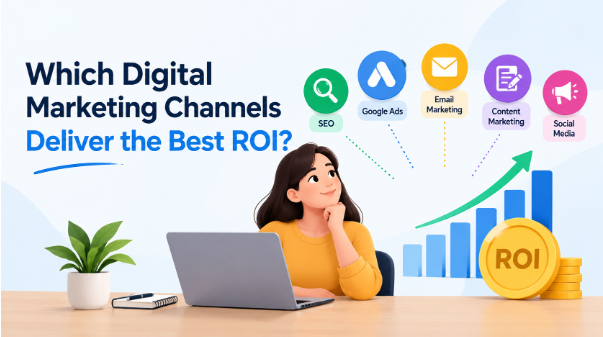
Wondering which digital marketing channel gives businesses the best return on investment? There is no single answer. SEO, Google Ads, email marketing, content marketing and social media can all deliver strong results, depending on the business, target audience, budget and customer journey.
The article, “Which Digital Marketing Channel Gives Businesses the Best ROI?“, explains how businesses can choose the right channels based on their goals and measure whether their marketing investment is actually generating profitable growth.
Key takeaways:
- SEO: Best for long-term organic growth and consistent search visibility.
- Google Ads: Ideal for generating quick leads from high-intent customers.
- Email Marketing: Strong for customer retention, repeat purchases and lead nurturing.
- Content Marketing: Helps build authority, trust and supports SEO over time.
- Social Media: Useful for brand awareness, demand generation and customer engagement.
Rather than focusing only on clicks or cost per lead, businesses should track revenue, conversion rates, customer acquisition cost, ROAS and customer lifetime value to understand true marketing ROI.
Choose channels based on your business goals
Different marketing channels are suited to different objectives:
- Immediate leads: Google Ads
- Organic traffic: SEO
- Repeat purchases: Email Marketing
- Brand awareness: Social Media
- Building authority: SEO + Content Marketing
- High-intent customers: SEO + Google Ads
- Local enquiries: Local SEO + Google Ads
Businesses should also consider customer behaviour and the length of the sales cycle. Customers who search before buying may respond well to SEO and Google Ads, while visually driven products may benefit more from social media. For complex or high-value purchases, SEO, content and remarketing can help customers move through a longer buying journey.
Measure profitability, not just traffic
A channel with a low cost per lead is not necessarily the most profitable. Businesses should look beyond clicks, impressions and engagement and track customer acquisition cost, conversion rate, ROAS, revenue and customer lifetime value.
Poor ROI does not always mean the marketing channel is wrong. Weak targeting, unclear messaging, poor landing pages, inaccurate conversion tracking or ineffective follow-ups can also affect performance.
The best approach is often to combine channels. Google Ads can capture immediate demand, while SEO and content build long-term visibility. Email marketing can then help retain and re-engage customers.
Ultimately, the best digital marketing channel is the one that consistently attracts the right customers at a profitable cost. Read the full article at: Digitrix Media Limited