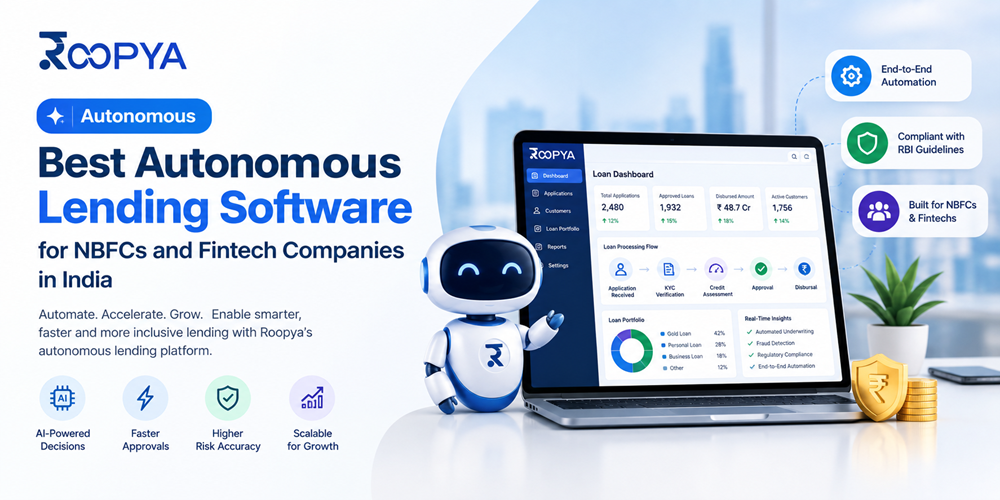
Compare top autonomous lending software for NBFCs & fintechs in India: LOS, LMS, BRE, AI underwriting, RBI-compliant, no-code. See how Roopya fits your stack.
India’s lending industry is going through its biggest technology shift since the arrival of the credit bureau. Digital disbursements through fintech platforms crossed roughly ₹1.7 lakh crore in FY 2024-25, and the number keeps climbing as UPI, Aadhaar e-KYC, and the Account Aggregator framework make it possible to originate, underwrite, and disburse a loan in minutes instead of weeks. But speed alone no longer wins the market. NBFCs and fintech lenders are now competing on how much of the loan lifecycle they can run without a human touching every file – from the first application to the last EMI collection.
That is what “autonomous lending software” really means. It is not a single feature or a chatbot bolted onto an old core. It is a connected stack – loan origination, underwriting, disbursal, servicing, collections, and risk analytics – built so that routine decisions happen automatically, using rules and machine learning, while your credit and operations teams focus on the exceptions that actually need a person.
This guide walks through what autonomous lending software actually does, why it matters for NBFCs and fintechs operating under RBI’s tightening digital lending framework, the features worth evaluating before you sign a contract, and how a modern, no-code platform like Roopya fits into that picture.
What Is Autonomous Lending Software?
Autonomous lending software is a lending technology stack that uses configurable business rules, APIs, and machine learning models to carry out the bulk of loan origination, underwriting, servicing, and collections decisions without manual intervention at every step. The word “autonomous” does not mean there are no humans in the loop – it means the software is designed so that a well-defined, low-risk decision (approve this applicant, flag this document as suspicious, send this borrower a reminder, restructure this EMI schedule) does not have to wait in someone’s inbox.
In practice, this usually means four layers working together:
- A Loan Origination System (LOS) that captures the application, runs eligibility checks, pulls bureau and alternate data, and moves the file through a configurable workflow.
- A decisioning layer – typically a no-code Business Rule Engine (BRE) plus a credit scorecard or machine learning model – that approves, rejects, or refers applications based on policy.
- A Loan Management System (LMS) that handles disbursal, repayment schedules, accounting, and the customer-facing servicing experience.
- A collections and early-warning layer that predicts which accounts are likely to slip and automates reminders, restructuring offers, and agent allocation before an account turns delinquent.
For an NBFC or a fintech lending partner, the value of tying these four layers together isn’t just speed. It’s consistency (every application is judged against the same policy), auditability (every automated decision leaves a trail a regulator or auditor can review), and the ability to launch or tweak a loan product without waiting months for a development team.
Why NBFCs and Fintechs in India Need It Now
Two forces are pushing Indian NBFCs and fintechs toward autonomous lending platforms at the same time: market growth and regulatory tightening.
On the growth side, India Stack infrastructure – Aadhaar-based e-KYC, UPI for disbursal and collection, the Account Aggregator framework for consented financial data sharing, and India’s deep smartphone penetration – has made small-ticket, high-volume lending commercially viable in a way it simply wasn’t a decade ago. MSMEs, gig workers, and first-time borrowers who were underserved by traditional banks are now a realistic addressable market, but only if a lender can underwrite thousands of small loans a day at a cost per loan that traditional manual processes can’t match.
On the regulatory side, the Reserve Bank of India has steadily formalised digital lending. The RBI’s Guidelines on Digital Lending (September 2022), the Default Loss Guarantee guidelines, and most recently the RBI (Digital Lending) Directions, 2025, issued on 8 May 2025, consolidate earlier circulars into a single framework covering Lending Service Provider (LSP) due diligence, borrower disclosures, data localisation and consent, grievance redressal, and reporting of all digital loans to credit information companies regardless of tenor. Regulated Entities remain fully responsible for everything their LSPs and lending apps do, and RBI has been actively working with Google and Apple to remove non-compliant lending apps from app stores. Non-compliance carries real teeth: penalties and operational restrictions can reach into the tens of lakhs or higher depending on the provision breached.
For a lending business, this means the software you build or buy has to do two jobs simultaneously: process loans fast enough to compete, and generate the audit trail, disclosures, and reporting that keep you on the right side of RBI’s Digital Lending Directions. Spreadsheet-driven underwriting and a patchwork of point tools make that combination very hard to sustain once your loan book grows past a few thousand accounts.
Common Lending Challenges Autonomous Software Solves
Most NBFCs and fintech lenders don’t set out to build a slow, manual process – it accumulates. A few patterns show up again and again when we talk to lending teams that are evaluating a switch:
- Underwriting bottlenecks: credit teams manually re-key data from bureau reports, bank statements, and KYC documents into a spreadsheet or a legacy core that wasn’t designed for digital-first volumes.
- Policy drift: lending policy lives in people’s heads and in old PDFs rather than in a system, so two underwriters can reach different conclusions on similar applications.
- Fragmented integrations: separate point solutions for KYC, bureau pulls, bank statement analysis, e-signing, and payment collection, each with its own contract, API, and failure mode.
- Slow product launches: adding a new loan product or changing an eligibility rule means opening a change request with a development team and waiting weeks.
- Collections that react too late: recovery teams find out an account is stressed only after it’s already overdue, instead of catching early warning signals in repayment or bureau behaviour.
- Compliance as an afterthought: disclosures, digital loan agreements, and CIC reporting are handled outside the core system, making it harder to prove compliance during an audit.
Autonomous lending software is built specifically to remove these bottlenecks – not by replacing your credit policy, but by encoding it into a system that applies it consistently, at whatever volume you need.
Key Features to Look for in Autonomous Lending Software
Not every platform sold as “autonomous” delivers the same depth. When you’re evaluating options, look closely at these areas.
Loan Origination System (LOS)
The LOS should support fully digital application capture, e-KYC (Aadhaar OTP or Video-based Customer Identification Process), automated document verification, and a configurable workflow so the application journey can differ by product – a payday loan journey looks nothing like a business loan journey, and your LOS should let you build both without custom code.
No-code Business Rule Engine (BRE)
This is the heart of “autonomous” decisioning. A strong BRE lets your credit and risk teams – not developers – configure eligibility rules, cut-offs, and approval workflows through a visual interface, and update them the same day market conditions or portfolio performance change.
AI-powered underwriting and document analysis
Look for OCR and NLP that can extract and verify data from ID documents, bank statements, and income proof in seconds, along with credit scoring models that go beyond the bureau score to include alternate data – UPI transaction patterns, utility payments, GST filings for MSME borrowers – to assess thin-file and new-to-credit applicants.
Fraud detection
Automated checks for document tampering, identity mismatch, duplicate applications, and device or behavioural anomalies should run inline during origination, not as a manual review step after disbursal.
Loan Management System (LMS)
Once a loan is live, the LMS should handle amortisation schedules, part-payments, foreclosure, restructuring, accounting entries, and a self-service customer portal, with real-time visibility into the portfolio.
Collections and Early Warning System (EWS)
Predictive models should flag accounts at risk of default before they miss a payment, based on repayment behaviour, bureau updates, and transaction signals, and route them into the right collections workflow – a reminder, a payment plan, or agent assignment – automatically.
Pre-built integrations
A wide library of ready integrations with credit bureaus (CIBIL, Experian, Equifax, CRIF), KYC and verification providers, payment gateways and UPI rails, and the Account Aggregator ecosystem saves months of integration work compared to building each connection yourself.
Compliance and audit trail
The platform should natively support RBI’s disclosure requirements – Key Fact Statements, digitally signed loan agreements, cooling-off periods – and maintain a complete, exportable audit trail of every automated decision, plus reporting of every digital loan to credit information companies as required.
Analytics and reporting
Portfolio dashboards, risk metrics (PD, LGD, EAD, ECL under Ind AS 109), and regulatory reports should be available out of the box, not require a separate BI project.
Deployment speed and pricing model
Because lending volumes are unpredictable, a pay-as-you-use pricing model and a go-live measured in days rather than months materially change the economics of launching or testing a new product.
How Autonomous Lending Software Works: A Loan’s Journey
It helps to see what “autonomous” actually looks like across a single loan, end to end.
A borrower applies through a web or mobile journey, entering basic details and consenting to KYC and data checks. Aadhaar-based e-KYC or a Video-based Customer Identification Process verifies identity within seconds, and OCR extracts data from uploaded ID documents, income proof, and bank statements automatically, rather than an operations executive re-typing figures from a PDF.
The system pulls a bureau report and, where relevant, consented Account Aggregator data or alternate signals such as UPI transaction history or GST filings for an MSME borrower. A configured scorecard or machine learning model scores the application, and the Business Rule Engine checks it against eligibility rules, exposure limits, and any product-specific policy – all without a person opening the file.
Applications that clearly pass or clearly fail policy move straight to an automated decision – approved with terms, or declined with the required reasons disclosed to the borrower. Only the applications that fall into a genuine grey area – borderline scores, document mismatches the fraud engine flags, unusual income patterns – get routed to a human underwriter, along with the data and flags that explain why the system couldn’t decide on its own.
Once approved, the Key Fact Statement and loan agreement are generated and digitally signed, and disbursal happens directly into the borrower’s bank account, exactly as RBI’s Digital Lending Directions require. From there, the Loan Management System takes over: EMI schedules, reminders, and payment processing run automatically, while the Early Warning System watches for signs that a specific account is drifting toward delinquency, so a light-touch intervention can happen before a formal collections process is needed.
The net effect is that a lending team of a given size can process a much larger volume of applications, with more consistent decisions and a clearer audit trail, than the same team working through spreadsheets and email approvals ever could.
Autonomous Lending vs. Traditional / Legacy Lending Systems
It’s worth being explicit about what changes when an NBFC or fintech moves from a legacy or manual setup to an autonomous lending platform, because the differences show up in day-to-day operations more than in any single feature.
Speed of decisioning. A legacy or manual process typically takes hours to days to reach a credit decision, because files move between systems and people. An autonomous platform can return a decision on the majority of straightforward applications in seconds to minutes, reserving human time for genuinely borderline cases.
Policy changes. On a legacy core, changing an eligibility rule or launching a new loan product usually means a formal change request to a development team, followed by a testing and release cycle that can take weeks or months. On a no-code platform, the same change is made by a credit or risk analyst through a visual interface and can go live the same day.
Consistency. Manual underwriting is vulnerable to different underwriters reaching different conclusions on similar files, particularly under volume pressure. Rule- and model-driven decisioning applies the same policy every time, which also makes it far easier to demonstrate fair, non-discriminatory lending practices to a regulator or auditor.
Integration overhead. A patchwork of point solutions for KYC, bureau checks, e-signing, and payments means separate contracts, separate APIs, and separate failure points to monitor. A unified platform with pre-built integrations collapses that into one system to manage.
Cost structure. Legacy systems and custom builds tend to involve significant upfront licensing or development cost regardless of how many loans you actually process. Modern platforms increasingly offer usage-based pricing, which lowers the cost of testing a new product or segment before committing to it at scale.
Compliance visibility. In a fragmented setup, proving compliance during an RBI inspection or an internal audit often means manually assembling evidence from several systems. A unified platform with a built-in audit trail can produce that evidence directly, for any loan, on demand.
None of this means legacy systems can’t work – many NBFCs run profitable books on them today. But the operational cost of running a fragmented, manual stack rises steeply as loan volume grows, which is exactly the point at which most lenders start evaluating autonomous alternatives.
Data Security and Regulatory Compliance
Data security deserves its own line item, because it sits at the intersection of RBI’s rules and the Digital Personal Data Protection Act, 2023. RBI’s digital lending framework requires that lenders and their LSPs collect only the data necessary for loan processing, obtain explicit borrower consent before accessing it, store data within India, and avoid pass-through or pool accounts for disbursal and repayment. On top of that, the DPDP Act adds its own consent, purpose-limitation, and breach-notification obligations for any platform handling personal financial data at scale.
For an NBFC or fintech evaluating lending software, this translates into a few concrete questions worth asking any vendor: Is borrower data stored on servers located in India? Is consent captured and logged for every data point collected, not just at account opening? Can access to sensitive documents (PAN, Aadhaar, bank statements) be restricted and audited by role? And critically, does disbursal and repayment flow directly between the lender’s bank account and the borrower’s, without a third-party pass-through account in between, as RBI’s Directions require? A platform that can’t answer these clearly is a compliance liability no matter how good its underwriting model is.
Roopya: A No-Code, Unified Lending Infrastructure for India
Roopya (built by Geoalgo Technologies Private Limited) is a no-code, unified lending infrastructure built specifically for this brief – taking an NBFC or fintech lender from origination through collections on a single platform rather than a set of stitched-together tools.
A few things stand out about how Roopya approaches autonomous lending:
Unified lifecycle coverage. Roopya combines a Loan Origination System, a Loan Management System, a Collections System, an Early Warning System, and Lending Analytics in one platform, so data flows between origination and servicing without manual reconciliation between systems.
Genuinely no-code configuration. Loan products, credit policies, and approval workflows are built through a visual Business Rule Engine that business and credit teams can configure themselves, without opening a developer ticket every time a policy needs to change.
Fast go-live. Roopya is built for plug-and-play onboarding, with lenders able to go live in as little as a day rather than the months a custom build or a heavily customised legacy core typically takes.
Pay-as-you-use pricing. Instead of large upfront licence fees, Roopya’s pricing model scales with actual usage, which matters for lenders testing a new product or managing seasonal volume swings.
300+ pre-integrated APIs. Bureau checks, KYC and verification services, and payment gateways come pre-connected, so a new integration doesn’t become a multi-week project.
20+ pre-configured loan products. Personal, payday, gold, business/SME, home, and auto loan journeys are available as starting templates, which shortens the path from decision to launch for lenders entering a new product line.
AI-powered document analysis and fraud detection. OCR and NLP extract and verify KYC and financial documents automatically, with built-in fraud checks designed to catch document tampering and identity mismatches during origination rather than after disbursal.
Credit risk and analytics depth. Beyond origination and servicing, Roopya offers credit scorecard development, PD/LGD/EAD modelling, expected credit loss (ECL) calculation, loan pricing analytics, and credit risk model validation – useful for NBFCs that need to satisfy both internal risk committees and external auditors.
Embedded finance support. For platforms and marketplaces that want to offer lending without becoming an NBFC themselves, Roopya’s embedded finance capability lets them plug lending into their existing product as a Lending Service Provider, working alongside a regulated lending partner.
Continuously updated compliance. Because RBI’s digital lending framework has changed materially in the last three years – most recently with the Digital Lending Directions, 2025 – Roopya positions its platform as being kept current with regulatory changes rather than requiring the lender to track and implement each update manually.
This combination is aimed squarely at the two groups named in the title of this guide: NBFCs that already hold a lending licence and want to modernise a legacy core or spreadsheet-driven process, and fintech companies – whether they are LSPs partnering with a regulated lender or NBFCs in their own right – that need to launch and iterate on loan products quickly without a large engineering team.
How to Choose the Right Platform: A Checklist
Every lending business has a slightly different starting point, so it’s worth running any shortlist through a short internal checklist before committing:
- Does the platform cover your full lifecycle (origination through collections), or will you still need to stitch together separate tools for servicing or recovery?
- Can your credit and risk team change eligibility rules and cut-offs themselves, or does every policy change require a developer?
- How quickly can you actually go live – is the vendor’s onboarding timeline measured in days, weeks, or months?
- Does the pricing model match your volume pattern – can you start small and pay for usage, or are you locked into a large fixed licence regardless of loan volume?
- Which bureaus, KYC providers, and payment rails are pre-integrated, and what’s the typical timeline to add one that isn’t?
- How does the platform handle RBI’s current disclosure, consent, and CIC reporting requirements, and what happens when those requirements change again?
- What does the audit trail look like – can you reconstruct, for any single loan, exactly which rule or model made which decision and when?
- Does the vendor offer credit risk analytics (scorecards, PD/LGD/EAD, ECL) natively, or only origination and servicing, leaving risk analytics as a separate project?
Running a live pilot with your own loan product and your own credit policy – rather than relying only on a sales demo – is the fastest way to see whether a platform’s “no-code” claims hold up once real edge cases show up.
The Future of Autonomous Lending in India
A few trends are likely to shape autonomous lending software in India over the next few years.
Alternate data underwriting will keep expanding. As the Account Aggregator ecosystem matures, more lenders will underwrite using consented, real-time financial data – UPI transaction history, GST filings, utility payments – rather than relying on bureau data alone, extending credit further into thin-file and new-to-credit segments.
Regulatory technology will become part of the core platform, not a bolt-on. With RBI consolidating its digital lending rules into a single, more detailed framework and continuing to enforce against non-compliant apps, lending platforms will need to treat compliance features – disclosures, consent logs, CIC reporting, DLA registration – as core functionality rather than optional add-ons.
AI will move deeper into collections, not just origination. Predictive models that flag at-risk accounts early, and route them into personalised, less adversarial repayment plans, are likely to keep improving recovery rates while reducing the harsh recovery practices that have drawn regulatory scrutiny in the past.
Embedded finance will keep growing the LSP ecosystem. More non-financial platforms – e-commerce marketplaces, HR and payroll platforms, B2B supply chain platforms – will offer lending at the point of need, working with regulated NBFCs and lending infrastructure providers rather than becoming lenders themselves.
For NBFCs and fintechs choosing a platform today, the practical takeaway is to pick infrastructure that can absorb these shifts – new data sources, new regulatory requirements, new distribution channels – through configuration rather than a re-platforming project every time something changes.
Autonomous lending software isn’t about removing people from lending decisions – it’s about making sure people only spend their time on the decisions that actually need judgment, while the system handles everything that can be governed by a clear, consistently applied policy. For NBFCs and fintechs in India, getting this right increasingly means the difference between scaling loan volume profitably and drowning in manual review queues, compliance gaps, and integration debt.
If you’re evaluating your options, look for a platform that covers the full loan lifecycle, lets your own team configure policy without code, integrates with the bureaus and KYC providers you already rely on, and keeps pace with RBI’s evolving Digital Lending Directions. Roopya is built around exactly that brief – a no-code, unified lending infrastructure that NBFCs and fintech lenders can go live on in days rather than months.
You can see the platform in more detail or request a walkthrough at roopya