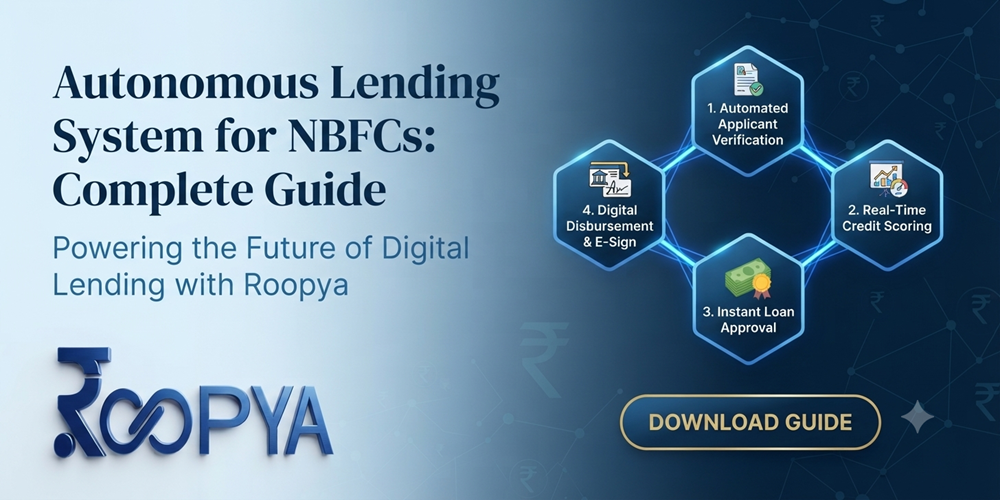
Learn how an autonomous lending system helps NBFCs automate origination, underwriting, collections & compliance. See how Roopya powers it end to end.
Non-Banking Financial Companies (NBFCs) in India are under more pressure than ever to lend faster, price risk more accurately, and stay compliant — all while keeping operating costs low. Borrowers now expect a loan decision in minutes, not days, and competitors backed by modern lending technology are setting that expectation. Manual, spreadsheet-driven, or partially automated loan processes simply cannot keep up. This is where an autonomous lending system comes in: a purpose-built software infrastructure that runs the entire loan lifecycle — from the first application to the final repayment — with intelligence and automation baked into every step.
This guide explains what an autonomous lending system actually is, why NBFCs are adopting it, what its core components look like, how artificial intelligence fits in, and what to evaluate before choosing a platform. Wherever relevant, we reference how Roopya’s unified lending infrastructure approaches each of these problems.
What Is an Autonomous Lending System?
An autonomous lending system is a technology platform that automates the majority of decisions and workflows involved in originating, underwriting, disbursing, servicing, and collecting loans. Instead of loan officers manually reviewing documents, calculating eligibility, and tracking repayments in disconnected tools, an autonomous system encodes an NBFC’s credit policy into configurable rules and models that execute consistently, at scale, and largely without human intervention for standard cases.
The word “autonomous” doesn’t mean lending decisions happen with zero human oversight. It means the system is capable of carrying a loan application through the full journey — data collection, verification, credit scoring, approval or rejection, disbursal, EMI tracking, and collections — on its own, while still allowing credit and risk teams to set policy, review exceptions, and intervene wherever needed. Think of it as the difference between a car with adaptive cruise control and one that still needs a driver’s hand on every gear shift: the destination and rules of the road are set by people, but the moment-to-moment execution is automated.
Why NBFCs Need Automation in Lending
NBFCs occupy a unique position in India’s credit ecosystem. They serve segments — small businesses, gig workers, first-time borrowers, rural customers — that traditional banks often find too costly or too risky to serve through manual underwriting. That business model only works if the cost of originating and servicing each loan stays low, which is very hard to achieve with manual processes. A few pressures make automation less of a nice-to-have and more of a necessity.
1. Rising Borrower Expectations
Digital-first borrowers compare their loan experience with UPI payments and e-commerce checkouts, not with legacy bank branches. A multi-day approval process, repeated document requests, or a confusing application form pushes them straight to a competitor’s app.
2. Thin Margins on Small-Ticket Loans
Many NBFCs now originate small-ticket, short-tenure loans where the absolute revenue per loan is small. Manual processing costs — verification calls, physical document checks, human underwriting time — can quickly erode profitability unless most of that work is automated.
3. Regulatory Scrutiny
The RBI’s digital lending guidelines, data localisation requirements, and fair-practice norms mean NBFCs need auditable, consistent decisioning and clear disclosure to borrowers. Manual processes make it harder to prove that every applicant was assessed against the same policy.
4. Portfolio Risk in a Volatile Economy
Interest rate changes, sectoral stress, and shifting borrower behaviour mean credit risk needs to be monitored continuously, not just at the point of disbursal. That requires systems that can track behavioural signals across the loan’s life, not a one-time underwriting check.
Core Components of an Autonomous Lending System
A complete autonomous lending platform is really a stack of connected modules, each automating a distinct part of the loan lifecycle. Here’s what that stack typically includes.
Loan Origination System (LOS)
The origination layer manages everything from the first customer touchpoint to the credit decision: digital application forms, KYC and document collection, automated credit bureau pulls, income verification, and real-time decisioning against configured credit policy. A strong LOS reduces a loan application that once took days of back-and-forth to a workflow that can be completed in minutes.
Loan Management System (LMS)
Once a loan is disbursed, the LMS takes over: amortization schedules, EMI tracking, payment processing, statement generation, and a customer portal where borrowers can check balances or make payments. This is the system of record for the life of the loan.
Collections Management
Automated reminders, tiered collection workflows, restructuring and payment-plan options, and agent-assignment logic help recover overdue amounts efficiently while keeping the borrower experience reasonable. Well-designed collections automation segments borrowers by risk and delinquency stage instead of treating every overdue account the same way.
Early Warning System (EWS)
Rather than waiting for a loan to become non-performing, an EWS module continuously scores accounts on behavioural and repayment signals to flag early stress — a missed partial payment, a sudden change in usage pattern, or bureau-level deterioration — so risk teams can intervene before the account slips further.
No-Code Business Rule Engine (BRE)
The BRE is where credit policy actually lives: eligibility criteria, pricing rules, approval thresholds, and exception handling. A no-code BRE lets credit and risk teams update policy through a visual interface rather than filing a change request with engineering — which matters enormously when market conditions shift and policy needs to change quickly.
Lending Analytics and Reporting
Portfolio analytics, risk dashboards, regulatory reports, and performance metrics give management real-time visibility into how the book is performing — approval rates, delinquency trends, vintage curves, and product-level profitability — instead of relying on end-of-month spreadsheet reconciliation.
The Role of Artificial Intelligence in Autonomous Lending
Automation and AI are related but not identical. Automation executes predefined rules quickly and consistently; AI adds the ability to learn from data and handle judgment calls that pure rule-based logic struggles with. In a modern autonomous lending system, AI typically shows up in four places.
AI-Powered Document Analysis
Optical character recognition (OCR) combined with natural language processing can extract and verify data from identity documents, bank statements, and income proofs in seconds rather than the hours a manual reviewer would need, while also flagging inconsistencies or signs of tampering that indicate potential fraud.
Intelligent Credit Decisioning
Machine learning models can evaluate far more signals than a traditional bureau score alone — transaction patterns, alternate data, and behavioural indicators — to produce a more nuanced risk assessment. This is particularly valuable for thin-file or new-to-credit borrowers who don’t have an extensive bureau history but do have other signals of creditworthiness.
AI-Enhanced Business Rule Engine
Instead of remaining static until someone manually updates them, AI-enhanced rule engines can analyse historical approval and rejection patterns to suggest policy refinements — for example, identifying that a particular combination of criteria correlates with higher default rates — while keeping a human in the loop to approve any policy change.
Fraud Detection
Pattern-recognition models can cross-reference application data, device fingerprints, and behavioural signals across thousands of applications simultaneously, catching coordinated fraud rings or synthetic identities that would be nearly impossible for a manual reviewer to spot one application at a time.
It’s worth noting that AI in lending works best as a decision-support and automation layer under human-defined policy and oversight — not as an unaccountable black box. NBFCs should expect any AI-driven module to be explainable, auditable, and adjustable, especially given regulatory expectations around fair lending and disclosure.
Key Benefits of Adopting an Autonomous Lending System
- Faster turnaround times: applications that once took days can be assessed and approved in minutes for standard cases.
- Lower cost per loan: automation reduces the manual effort needed for verification, underwriting, and servicing, which matters most for small-ticket lending.
- Consistent credit decisions: every application is evaluated against the same configured policy, reducing variance between underwriters.
- Better risk visibility: real-time dashboards and early warning signals let risk teams act before problems compound.
- Scalability: the same infrastructure can support new loan products or higher application volumes without a proportional increase in headcount.
- Improved compliance posture: automated audit trails and consistent policy application make regulatory reporting and audits more straightforward.
- Faster product launches: pre-configured loan-product templates let an NBFC launch a new product line in days rather than months.
How to Choose the Right Autonomous Lending Platform
Not every “digital lending” vendor offers true end-to-end autonomy. When evaluating platforms, NBFCs should look closely at the following.
Breadth of the Lending Lifecycle Covered
Does the platform only handle origination, or does it also cover servicing, collections, and early warning? Stitching together multiple point solutions from different vendors reintroduces the integration overhead that automation is meant to remove.
No-Code Configurability
Can business and credit teams change loan products, eligibility rules, and workflows themselves, or does every change require a developer? This affects how quickly the NBFC can respond to market conditions or regulatory changes.
Pre-Integrated Ecosystem
Look for platforms with pre-built connections to credit bureaus, KYC and verification providers, payment gateways, and e-signature services. Pre-integrated APIs cut down implementation time significantly compared with building each integration from scratch.
AI Capabilities with Explainability
Ask vendors how their AI models make decisions and whether those decisions can be explained to a regulator, an auditor, or a rejected borrower. Explainability is not optional in lending.
Compliance Readiness
Confirm the platform is built around applicable regulatory guidelines, supports the audit trails regulators expect, and is updated as rules evolve, rather than requiring the NBFC to bolt on compliance separately.
Pricing Model
A pay-as-you-use pricing model, with limited upfront licensing cost, generally suits growing NBFCs better than large capital-expenditure-style software contracts, since it aligns platform cost with actual loan volume.
Time to Go Live
Ask for a realistic go-live timeline based on similar-sized lenders. Plug-and-play platforms with ready loan-product templates can bring an NBFC live in a matter of days, while custom-built systems often take many months.
Implementation: What the Rollout Process Typically Looks Like
- Discovery and product configuration: mapping existing loan products, credit policy, and workflows onto the platform’s configuration layer.
- Integration: connecting credit bureaus, KYC/verification APIs, payment gateways, and any existing core systems (CRM, accounting, core banking).
- Rule engine setup: configuring eligibility criteria, pricing logic, and approval workflows in the no-code BRE.
- User acceptance testing: running sample applications through the full journey to validate decisions, disbursal, and repayment logic before going live.
- Go-live and monitoring: launching to real applicants while closely tracking approval rates, turnaround time, and early portfolio performance.
- Continuous tuning: adjusting rules and models based on real-world performance data as the portfolio matures.
Compliance and Security Considerations for Indian NBFCs
Any autonomous lending platform handling borrower data and credit decisions for an NBFC needs to be evaluated on more than functionality. Key areas to verify with a vendor include alignment with RBI’s digital lending guidelines on disclosures and data usage, data storage and localisation practices, encryption of sensitive borrower data both in transit and at rest, role-based access control and audit logging for every decision the system makes, and a documented grievance-redressal mechanism for borrowers. These aren’t features to check once at onboarding — they should be part of an ongoing compliance conversation with the vendor as regulations evolve.
The Future of Autonomous Lending
A few trends are likely to shape how autonomous lending systems evolve over the next few years. Embedded finance will push lending decisions closer to the point of purchase, with NBFCs partnering with e-commerce, payroll, and other platforms to originate loans inside someone else’s app rather than their own. Alternate data — utility payments, GST filings, e-commerce transaction history — will play a growing role in underwriting thin-file borrowers who lack extensive credit bureau records. Natural-language interfaces will make analytics more accessible, letting a risk manager simply ask a question in plain English instead of building a custom report. And regulatory technology will become more tightly woven into the platform itself, so compliance checks happen continuously rather than as periodic audits.
How Roopya Approaches Autonomous Lending
Roopya provides a no-code, unified lending infrastructure built specifically for NBFCs, banks, and lending service providers, covering the full lifecycle from origination to collections on a single platform. The platform is designed around a few core ideas that map directly onto the components discussed above.
- Fast go-live: plug-and-play infrastructure aimed at getting lenders processing applications quickly rather than after months of custom development.
- Pay-as-you-use pricing: a flexible cost model instead of large upfront licensing fees.
- 300+ pre-integrated APIs: covering credit bureaus, verification services, payment gateways, and other lending infrastructure.
- 20+ pre-configured loan products: ready-made templates spanning personal, business/SME, gold, payday, home, and auto loans.
- AI-powered fraud detection: pre-built fraud-check modules layered across the application journey.
- No-code business rule engine: letting credit and risk teams configure policies, pricing, and approval workflows without engineering support.
- Open API architecture: for integrating with existing CRMs, ERPs, and core systems.
- Full lifecycle coverage: Loan Origination System, Loan Management System, Collections, Early Warning System, and Lending Analytics under one roof.
For NBFCs evaluating whether to build a lending stack in-house, stitch together multiple vendors, or adopt a unified autonomous lending platform, the practical question is usually about time, cost, and control: how quickly can the organisation get to market, how much of that cost is fixed versus variable, and how much day-to-day control does the credit team retain without needing engineering resources for every change.
An autonomous lending system is no longer a futuristic concept for NBFCs — it’s increasingly the baseline expected by borrowers, investors, and regulators alike. The NBFCs that will compete effectively over the next decade are the ones that can originate, underwrite, disburse, and collect loans quickly, consistently, and compliantly, at a cost structure that works for smaller ticket sizes. Choosing the right platform means looking beyond a single feature — like AI-based scoring or a nice application form — and evaluating whether the system covers the full lending lifecycle, can be configured without code, integrates with the tools already in use, and is built with Indian regulatory requirements in mind from day one.
Frequently Asked Questions
What is an autonomous lending system?
An autonomous lending system is a software platform that runs the loan lifecycle — origination, underwriting, disbursal, servicing and collections — with minimal manual intervention. It uses configurable rule engines, credit bureau and alternate-data integrations, and AI-based decisioning to originate, approve, and manage loans automatically within the credit policy an NBFC defines.
How is an autonomous lending system different from a regular loan management system?
A loan management system typically focuses on servicing loans that have already been approved — tracking repayments, schedules and statements. An autonomous lending system covers the full lifecycle, including origination, automated credit decisioning, fraud checks, disbursal, collections and early-warning monitoring, largely without manual case-by-case handling.
Is an autonomous lending platform safe and compliant for NBFCs in India?
Reputable platforms are built to align with RBI’s digital lending guidelines, data localisation norms, and IT Act requirements, and they undergo periodic security and compliance updates. NBFCs should still confirm audit trails, data residency, encryption standards and grievance-redressal mechanisms with any vendor before going live.
Do we need an in-house technology team to run a no-code lending platform?
No-code lending infrastructure is designed so that business and credit teams can configure loan products, rules, and workflows through a visual interface, without writing code. Some technical involvement is still useful for API integrations with existing core systems, but day-to-day policy changes typically don’t require a dedicated engineering team.
How long does it take to go live with an autonomous lending system?
Timelines vary by the complexity of loan products and integrations, but modern plug-and-play platforms can have a lender processing applications within days rather than the months typically needed for custom-built systems, since core modules, APIs and loan-product templates already exist.
Can an autonomous lending system handle multiple loan products at once?
Yes. Platforms built for NBFCs generally ship with configurable templates for personal loans, business/SME loans, gold loans, payday loans and other product types, so an NBFC can launch or adjust several products from the same infrastructure instead of building separate systems for each.
How does AI improve credit decisioning in an autonomous lending system?
AI models can evaluate a wider set of signals than a manual underwriter — bureau data, bank statement patterns, alternate data, and behavioural indicators — to score applications in near real time. This can improve consistency and speed while flagging edge cases for human review rather than replacing oversight entirely.
What does it cost to adopt an autonomous lending platform?
Costs depend on the vendor’s pricing model. Many modern platforms use a pay-as-you-use approach with limited or no upfront licence fees, which lowers the barrier for NBFCs and lending service providers compared with traditional on-premise core lending software.
Can an autonomous lending system integrate with our existing core banking or CRM tools?
Most platforms expose REST APIs and pre-built connectors so they can integrate with core banking systems, CRMs, payment gateways, credit bureaus and verification services, letting an NBFC keep its existing tech stack while adding automated lending capabilities on top.
What is an early warning system in lending, and why does it matter?
An early warning system uses behavioural and repayment data to flag borrowers who show signs of financial stress before they actually default. This lets collections and risk teams intervene proactively — through restructuring, reminders, or outreach — rather than reacting only after an account turns delinquent.