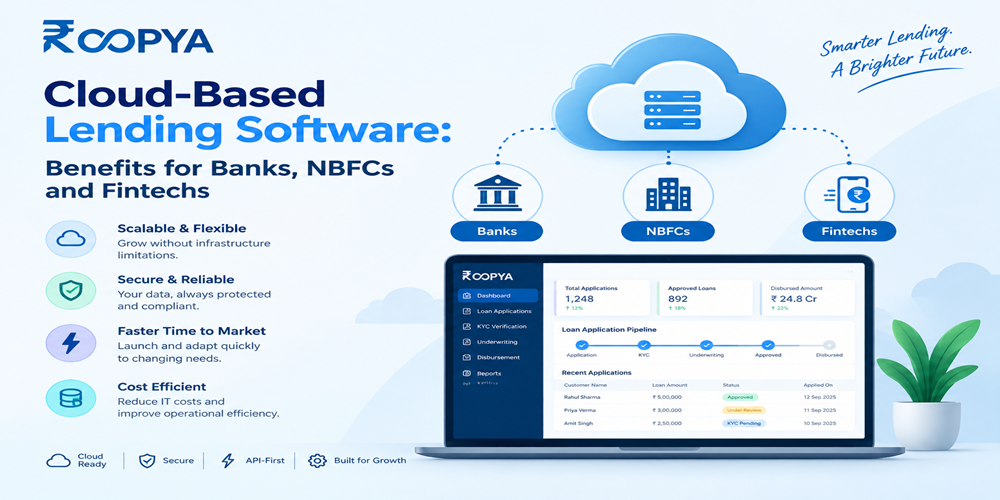
Discover how cloud-based lending software helps banks, NBFCs and fintechs cut costs, scale fast and lend smarter. See how Roopya powers modern lending.
Why Lending Is Moving to the Cloud
Ten years ago, launching a new loan product meant months of server procurement, IT tickets, and painful integrations. Today, a bank, an NBFC, or a fintech startup can go from idea to a live, compliant loan product in days. The single biggest reason for that shift is cloud-based lending software.
Cloud-based lending software is a digital platform, hosted on remote servers rather than on an organisation’s own data centre, that manages some or all of the loan lifecycle: origination, underwriting, disbursement, servicing, collections, and reporting. Instead of buying hardware and licences upfront, lenders access the software over the internet, usually on a subscription or pay-as-you-use basis, and the vendor handles maintenance, security patches, and upgrades.
This is not a minor technical upgrade. It changes the economics of lending itself. Institutions that once needed years and crores of rupees to build in-house loan management systems can now be live in a matter of weeks. Smaller NBFCs and fintechs that could never have justified an on-premise IT team can now compete with much larger banks on speed and customer experience.
In this guide, we break down exactly how cloud-based lending software benefits banks, NBFCs, and fintechs differently, what capabilities separate a good platform from a great one, and what to look for before you choose one for your own lending business.
What Is Cloud-Based Lending Software?
At its core, cloud-based lending software (sometimes called a cloud lending platform, digital lending infrastructure, or SaaS lending stack) typically bundles together several modules that, historically, were built and maintained separately:
- Loan Origination System (LOS): digital application forms, document collection, KYC, credit bureau checks, and automated underwriting
- Loan Management System (LMS): amortisation schedules, repayment tracking, ledgers, and customer servicing
- Business Rule Engine (BRE): configurable credit policies, eligibility rules, and approval workflows
- Collections Management: reminders, workflows, payment plans, and agent allocation for overdue accounts
- Risk & Early Warning Systems: predictive models that flag accounts likely to default before they actually do
- Analytics and Reporting: portfolio dashboards, regulatory reports, and credit risk analytics such as ECL, PD, LGD and EAD calculations
Because these modules live on the cloud, they are accessed through a browser or API, updated centrally by the vendor, and can usually be configured by business teams rather than developers. Platforms built as true “no-code” lending infrastructure, such as Roopya, take this further by allowing credit and operations teams to configure entire loan products, journeys, and rules through a visual interface, without writing code or waiting on an engineering backlog.
The Shift From On-Premise to Cloud Lending
Legacy loan management systems were built to be installed on an institution’s own servers. That model made sense when computing was expensive and the internet was unreliable, but it comes with real costs: large upfront capital expenditure, dedicated IT staff to maintain servers, slow release cycles for new features, and rigid architecture that makes it hard to launch new loan products quickly.
Cloud-based lending software flips this model. Infrastructure is elastic, so computing power scales up automatically during loan application surges, such as festive-season personal loan campaigns or a new product launch, and scales back down when volumes fall. Because the vendor manages the underlying servers, security, and compliance updates, the lender’s team can focus on credit strategy and customer experience rather than infrastructure firefighting.
This shift matters most in India’s lending market, where growth is driven by high-volume, small-ticket loans, and where product velocity, not just balance sheet size, decides who wins market share. NBFCs and fintechs targeting these use cases increasingly rely on cloud infrastructure to launch new personal loan, business loan, gold loan, or payday loan products in days rather than quarters.
Benefits of Cloud-Based Lending Software for Banks
Banks operate at scale, under heavy regulatory scrutiny, and typically carry legacy core banking systems that are difficult to replace overnight. For banks, cloud-based lending software delivers value less by replacing everything and more by modernising the parts of the lending journey that touch the customer and the credit decision.
1. Faster Product Launches Alongside Legacy Core Systems
Cloud lending platforms typically expose REST APIs that sit alongside a bank’s core banking system, rather than replacing it outright. This lets a bank’s digital lending or retail assets team launch a new personal loan or MSME loan journey in weeks, using pre-built origination and underwriting workflows, without a multi-year core banking overhaul.
2. Better Customer Experience Without Rebuilding the Core
Digital application forms, e-KYC, e-signing, and instant eligibility checks can be layered onto existing bank products through a cloud LOS. This closes the experience gap with fintech competitors while keeping the bank’s core ledger and compliance stack intact.
3. Stronger, Centralised Risk Oversight
Cloud lending analytics modules consolidate origination, servicing, and collections data into a single view, which is valuable for banks running multiple lending business lines. Centralised dashboards make it easier to track portfolio quality, monitor early warning signals, and produce the credit risk analytics regulators expect, including probability of default (PD), loss given default (LGD), exposure at default (EAD), and expected credit loss (ECL) calculations.
4. Lower Total Cost for Non-Core Lending Lines
For smaller or newer lending verticals, such as a bank’s co-lending partnerships, supply-chain finance desk, or a digital-only lending arm, running on cloud infrastructure avoids the capital cost of standing up dedicated servers and specialised IT staff for what may still be a relatively small book.
5. Compliance That Keeps Pace With Regulatory Change
Regulatory requirements around digital lending, data localisation, and disclosure norms change frequently. A cloud vendor that continuously updates its platform to reflect the latest regulatory guidance reduces the compliance burden on the bank’s own technology team, since updates are pushed centrally rather than requiring in-house development work.
Benefits of Cloud-Based Lending Software for NBFCs
Non-Banking Financial Companies are often the fastest-growing segment of the lending market, and cloud-based software has become close to a default choice for NBFCs building or scaling a lending book, particularly in small-ticket, secured, and semi-urban lending categories.
1. Speed to Market Is a Direct Competitive Advantage
NBFCs typically compete on how quickly they can approve and disburse a loan, not on the breadth of a product catalogue. Cloud-native loan origination platforms, several of which now advertise go-live timelines measured in a single day, let NBFCs launch pre-configured loan products instead of building origination and underwriting logic from scratch.
2. Pay-as-You-Use Pricing Matches NBFC Growth Cycles
Unlike large upfront software licences, cloud lending platforms are usually priced on subscription or usage-based models. This means an NBFC’s technology cost scales with its loan book, rather than being a fixed cost incurred regardless of volume. For an NBFC in its early growth phase, or one that experiences seasonal spikes in loan applications, this materially improves unit economics.
3. Pre-Built Loan Products and Integrations
Most NBFCs do not need to build integrations with credit bureaus, PAN and Aadhaar verification services, bank statement analysis tools, or payment gateways from scratch. Cloud lending platforms typically ship with a large library of pre-integrated APIs and ready-made loan product templates, ranging from personal and business loans to gold loans and payday advances, cutting integration time from months to days.
4. Configurable Credit Policy Without Engineering Dependence
A no-code business rule engine lets an NBFC’s credit and risk team adjust eligibility criteria, scoring cut-offs, and approval workflows directly, without submitting a change request to a development team. This is particularly valuable for NBFCs that need to tighten or loosen credit policy quickly in response to portfolio performance or macroeconomic conditions.
5. Built-In Collections and Early Warning Capability
Because delinquency management directly affects an NBFC’s profitability, cloud lending platforms that bundle collections workflows and predictive early-warning models help NBFCs intervene before an account slips into default, rather than reacting after the fact.
6. Easier Regulatory Compliance for a Fast-Changing NBFC Rulebook
NBFC-specific regulatory requirements, including digital lending guidelines, Default Loss Guarantee (DLG) norms for co-lending and first-loss arrangements, and KYC and video-KYC mandates, evolve frequently. A cloud platform that is continuously updated to reflect these changes reduces the risk of non-compliance for NBFCs that do not maintain large in-house compliance-engineering teams.
Benefits of Cloud-Based Lending Software for Fintechs
Fintech lenders and loan service providers usually start with limited capital and small teams, and cloud-based lending software is often the only realistic way for them to compete against far larger, better-capitalised incumbents.
1. Near-Zero Infrastructure Investment
A fintech does not need to hire a dedicated infrastructure team or negotiate data-centre contracts before it can start lending. Cloud lending platforms let a fintech begin originating loans with essentially zero upfront infrastructure cost, redirecting scarce early-stage capital toward acquisition and underwriting instead.
2. Embedded Finance and API-First Architecture
Many fintechs do not lend directly to end customers through their own app; instead, they embed lending into another platform’s checkout flow, HR portal, or B2B marketplace. Cloud lending software with an open, API-first architecture allows a fintech to expose loan origination and servicing capability to partner platforms, powering embedded finance use cases such as point-of-sale EMI, buy-now-pay-later, and supply-chain financing.
3. Rapid Experimentation With New Loan Products
Because cloud platforms often ship with dozens of pre-configured loan product templates, fintechs can test a new lending product, such as a salary-advance or micro-business loan, launch it to a small user segment, measure performance, and either scale or shut it down within weeks, rather than months.
4. AI-Powered Underwriting for Thin-File Customers
A large share of fintech lending targets borrowers with limited or no traditional credit history. Cloud lending platforms increasingly embed AI-powered credit scoring that analyses alternative data, such as transaction patterns, utility payments, and digital footprints, alongside bureau data, helping fintechs extend credit responsibly to thin-file and new-to-credit customers.
5. Built-In Fraud Detection at Fintech Scale
Fintechs processing high volumes of small-ticket applications are attractive targets for fraud rings and identity theft. AI-powered document verification and fraud-detection modules, built into the cloud platform rather than developed separately, give fintechs enterprise-grade fraud protection without an in-house fraud-engineering team.
6. Regulatory Credibility With Lending Partners
Fintech loan service providers frequently need to demonstrate to their NBFC or bank lending partners that their technology stack meets regulatory and data-security expectations. Working on an established, compliant cloud lending platform can shorten partner due-diligence and onboarding timelines.
Core Capabilities That Make Cloud Lending Software Valuable
Across banks, NBFCs, and fintechs, a handful of capabilities consistently separate a genuinely useful cloud lending platform from a basic digital form-filling tool.
End-to-End Loan Lifecycle Coverage
The strongest platforms manage the full lending lifecycle, from origination and underwriting through disbursement, servicing, collections, and early warning, on a single data model. This avoids the reconciliation headaches that come from stitching together separate origination and servicing systems from different vendors.
No-Code Configuration
A true no-code lending platform lets business teams, not just developers, design loan journeys, set eligibility rules, and adjust approval workflows through a visual interface. This dramatically shortens the time between a business decision and its implementation.
Pre-Integrated Ecosystem of APIs
Modern lending depends on dozens of third-party services: credit bureaus, identity verification providers, bank-statement analysis tools, e-signature vendors, and payment gateways. Platforms with a large library of pre-integrated APIs remove months of individual integration work.
AI-Powered Decisioning and Document Analysis
Artificial intelligence is increasingly central to cloud lending platforms, powering three areas in particular: automated document analysis that extracts and verifies data from identity documents and bank statements in seconds; intelligent credit decisioning that evaluates alternative data alongside bureau scores; and self-learning business rule engines that suggest policy improvements based on historical approval and rejection patterns.
Security and Regulatory Compliance
Because lending platforms handle sensitive financial and personal data, security cannot be an afterthought. Look for data encryption in transit and at rest, role-based access control, audit trails for every decision and rule change, and a platform that is actively maintained to reflect current regulatory guidelines rather than one that requires a costly custom upgrade every time rules change.
Analytics That Go Beyond Dashboards
Good lending analytics should not stop at descriptive dashboards. Institutions increasingly need credit risk analytics capability, including scorecard development, probability of default modelling, expected credit loss calculation, loan pricing analytics, and stress testing, built into or tightly integrated with the lending platform itself.
Security and Compliance in Cloud Lending: What to Verify
Moving lending operations to the cloud raises legitimate questions about data security and regulatory compliance. These are reasonable concerns, and they deserve a direct answer rather than a marketing one.
- Data residency: confirm where customer data is physically stored and whether it meets applicable data-localisation requirements
- Encryption: data should be encrypted both in transit and at rest, not just at the network perimeter
- Access control: role-based permissions should ensure that only authorised personnel can view sensitive borrower data or approve high-value loans
- Audit trails: every credit decision, rule change, and document access should be logged and traceable for regulatory audits
- Business continuity: ask about the vendor’s uptime guarantees, disaster recovery plan, and data backup frequency
- Regulatory currency: the platform should be updated proactively as digital lending, KYC, and co-lending guidelines evolve, not only after an institution flags a gap
A reputable cloud lending vendor should be able to answer each of these questions clearly and specifically, with documentation, rather than in vague reassurances.
Cost and ROI: What Actually Changes
The financial case for cloud-based lending software rests on a few consistent patterns, regardless of institution size.
Lower Upfront Capital Expenditure
There is no need to buy servers, licences, or data-centre capacity before processing a single loan application. Costs shift from capital expenditure to operating expenditure, which is easier for finance teams to plan around and easier for smaller institutions to absorb.
Reduced IT Overhead
Server maintenance, security patching, and infrastructure scaling become the vendor’s responsibility rather than an internal IT cost centre. This is especially valuable for NBFCs and fintechs that cannot justify a large, dedicated infrastructure team.
Faster Time-to-Revenue
A loan product that goes live in weeks rather than quarters starts generating interest income and fee revenue that much sooner. For growth-stage lenders, this speed advantage often matters more than the direct cost savings.
Operational Efficiency Gains
Automation of manual, rule-driven tasks, such as eligibility checks, EMI calculations, and repayment reminders, reduces the number of staff hours required per loan processed, which becomes a significant saving as loan volumes scale.
How to Choose the Right Cloud Lending Platform
With dozens of vendors in the market, institutions evaluating cloud-based lending software should look past feature checklists and ask a smaller set of sharper questions.
- How long does it realistically take to go live with our first loan product, including integrations and compliance sign-off?
- Can our business and credit teams configure loan products and rules ourselves, or does every change require a developer or vendor ticket?
- Which credit bureaus, KYC providers, and payment gateways come pre-integrated, and which would we need to build ourselves?
- Does the platform cover the full lifecycle, from origination to collections, or will we need to stitch together multiple vendors?
- What AI capability exists today, for document analysis, fraud detection, and credit decisioning, versus what is on a future roadmap?
- How is pricing structured, and does it scale predictably with our loan volume?
- What security certifications and compliance documentation can the vendor provide upfront?
- Can we see the platform’s analytics and reporting layer in a live demo, not just a slide deck?
Institutions that ask these questions early tend to avoid the most common failure mode in lending technology purchases: buying a platform that looks feature-complete on paper but requires months of custom development before it can actually process a single real loan.
How Roopya Supports Banks, NBFCs, and Fintechs
Roopya (roopya.money) is built around this exact set of priorities: a no-code, unified lending infrastructure that covers the full loan lifecycle, from origination through collections, on a single cloud platform.
For institutions evaluating cloud-based lending software, Roopya’s platform is designed to be operational quickly, with same-day go-live for new loan products, over 300 pre-integrated APIs spanning credit bureaus, verification services, and payment gateways, and more than 20 pre-configured loan products covering personal, business, gold, and payday lending, among others.
The platform combines a loan origination system, loan management system, collections engine, and early warning system with lending analytics and credit risk capabilities, including scorecard development, probability of default, exposure at default, loss given default, and expected credit loss calculations, so that risk and finance teams are not left assembling this analysis outside the core platform.
Roopya’s business rule engine is fully self-configurable, letting credit teams adjust policy and workflows without engineering dependency, while AI-powered modules handle document analysis, fraud detection, and credit decisioning in the background. For fintechs and NBFCs building embedded lending journeys, Roopya’s open API architecture and embedded finance capability support integration into third-party platforms and partner ecosystems.
Institutions interested in evaluating the platform directly can request a demo through Roopya’s website.
Cloud-based lending software has moved from a nice-to-have to the default infrastructure choice for lenders of every size. Banks use it to modernise customer-facing lending without disrupting their core systems. NBFCs use it to launch products quickly and manage risk with pay-as-you-use economics. Fintechs use it to compete against far larger institutions with a fraction of the infrastructure investment.
The common thread across all three is the same: cloud lending platforms remove the infrastructure burden from lending, so teams can spend their time on credit strategy, customer experience, and portfolio quality instead. Institutions that choose their platform carefully, verifying security, compliance, integration depth, and true configurability rather than relying on a features checklist, position themselves to grow their loan books faster and more safely than those still running on legacy, on-premise systems.
Frequently Asked Questions (FAQ)
What is cloud-based lending software?
Cloud-based lending software is a digital platform, hosted on remote servers rather than an institution’s own data centre, that manages part or all of the loan lifecycle, including origination, underwriting, disbursement, servicing, collections, and reporting. It is accessed over the internet and typically billed on a subscription or usage basis.
How is cloud-based lending software different from a traditional loan management system?
Traditional, on-premise loan management systems are installed on an institution’s own servers, requiring upfront hardware investment and in-house IT maintenance. Cloud-based lending software is hosted and maintained by the vendor, scales automatically with demand, and is usually configurable by business users rather than developers.
Is cloud-based lending software secure enough for regulated financial institutions?
Reputable cloud lending platforms use encryption in transit and at rest, role-based access control, and detailed audit trails, and are updated continuously to reflect current regulatory guidelines. Institutions should verify a vendor’s specific security certifications and data-residency practices before onboarding.
How long does it take to launch a loan product on a cloud lending platform?
Timelines vary by vendor and product complexity, but modern cloud-native platforms with pre-built loan product templates and pre-integrated APIs can support go-live in as little as a day for standard products, compared with months or years for custom-built, on-premise systems.
Can banks use cloud lending software alongside their existing core banking system?
Yes. Most cloud lending platforms are designed to integrate with a bank’s existing core banking system through APIs, handling the customer-facing origination and servicing layer while the core system continues to manage ledgers and settlement.
Why do NBFCs prefer cloud-based lending platforms over building software in-house?
Building an in-house lending platform requires significant capital, a dedicated engineering team, and ongoing maintenance investment. Cloud platforms let NBFCs access the same capability, often including pre-integrated credit bureau and KYC connections, on a pay-as-you-use basis, which better matches the growth pattern of most NBFC loan books.
What role does AI play in cloud-based lending software?
AI is typically used for automated document analysis and verification, credit decisioning that incorporates alternative data alongside bureau scores, fraud detection across loan applications, and self-learning business rule engines that suggest policy improvements based on historical approval and rejection data.
Is cloud-based lending software suitable for small fintech lenders and loan service providers?
Yes. In fact, small fintechs are often the biggest beneficiaries, since cloud lending software removes the need for upfront infrastructure investment and gives smaller teams access to enterprise-grade underwriting, fraud detection, and compliance capability from day one.
What should an institution check before choosing a cloud lending vendor?
Key checks include the vendor’s data security and compliance documentation, the depth of pre-built integrations with credit bureaus and verification services, how much configuration business teams can do without developer support, pricing structure, and whether the platform covers the full loan lifecycle or only part of it.
Does moving to a cloud lending platform mean losing control over credit policy?
No. Modern cloud lending platforms with a no-code business rule engine typically give credit and risk teams more direct control, not less, since policy and workflow changes can be made by business users through a configuration interface rather than requiring a developer to write and deploy new code.