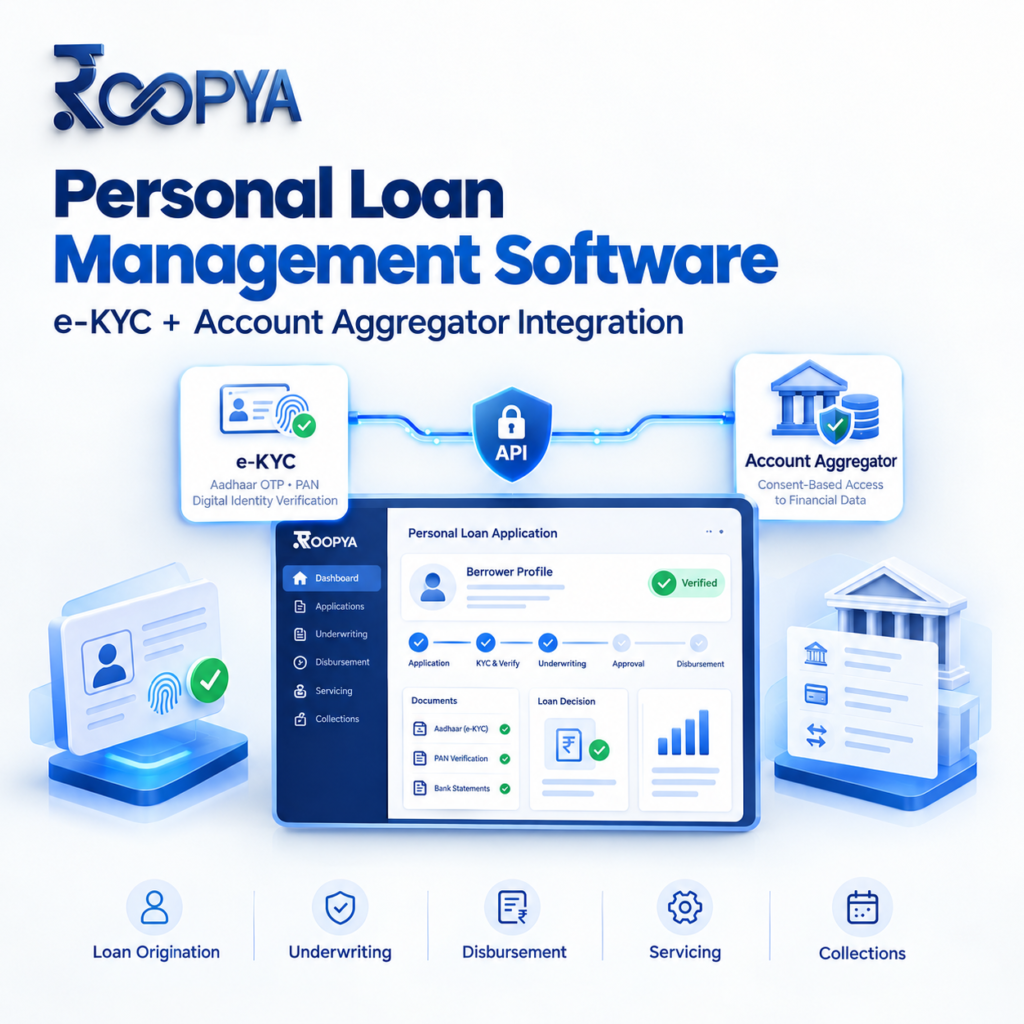
Roopya's personal loan management software combines Aadhaar e-KYC and Account Aggregator data for fast, compliant digital lending. Request a demo.
Personal loans are the most digital product in Indian retail lending, and also the least forgiving. Borrowers expect to apply on a phone, verify their identity without visiting a branch and receive money the same day. Lenders must still confirm who the borrower is, judge repayment capacity from limited history, stay within RBI rules and collect every EMI on time.
Two technologies now sit at the center of that balancing act. Electronic KYC (e-KYC) confirms identity in seconds instead of days. The Account Aggregator (AA) framework lets borrowers share bank data digitally, with explicit consent, so lenders can assess income and cash flow without chasing PDF statements. When both connect directly to a loan management system, the lender gets one continuous flow from application to closure.
This guide explains what personal loan management software should do, how e-KYC and Account Aggregator integrations work, what to check on compliance, and how to evaluate vendors. It also shows how Roopya’s personal loan software approaches the problem.
Key takeaways
- e-KYC answers “who is this borrower?” and Account Aggregator data answers “can this borrower repay?” Both work best on one platform and one application record.
- AA data is only useful once it is converted into underwriting features such as income stability, existing obligations and bounce history.
- The loan management system matters as much as the front end, because servicing and collections decide portfolio quality.
- Consent, audit trails and data protection should be built in, not added later.
What Is Personal Loan Management Software?
Personal loan management software is the system a lender uses to originate, service and collect unsecured personal loans. In practice it combines a loan origination system, which covers application through disbursal, with a loan management system, which covers everything from the first EMI to closure.
Personal loans place specific demands on software: small tickets and high volumes, short tenures, flat or reducing-balance interest, processing fees with GST, prepayment and foreclosure rules, and borrowers who expect instant decisions. Manual steps that are tolerable on a large secured loan become unaffordable on a small personal loan, so automation has to be designed in from the start.
Why e-KYC and Account Aggregator Belong in the Same Journey
Every personal loan decision answers two questions: identity and affordability. When e-KYC and AA are bought as separate integrations, gaps appear. Data captured at KYC never reaches underwriting, and cash-flow data from AA cannot be tied back to a verified identity. A unified platform closes those gaps:
- Verified name, date of birth and address from e-KYC can be matched against account holder details received through AA.
- Cash-flow insights feed the business rule engine on the same application record, so decisions use all available evidence.
- Consent artefacts, KYC evidence and decision logs sit in a single audit trail.
- Borrowers finish in one session, which reduces drop-offs between steps.
How e-KYC Works in a Digital Personal Loan Journey
e-KYC replaces physical document collection with electronic verification against trusted sources. Lenders typically combine several methods, depending on their regulatory permissions and risk policy:
- Aadhaar-based e-KYC. The borrower consents and authenticates, usually with an OTP sent to the Aadhaar-linked mobile number. Whether a lender can use this method depends on its eligibility under the applicable KYC rules.
- Offline Aadhaar and DigiLocker. The borrower shares a digitally signed file or fetches documents from DigiLocker, with consent.
- PAN verification. Confirms that the PAN is valid and that the name matches other sources.
- Fetching an existing record from the Central KYC Records Registry avoids repeat documentation.
- Video-based customer identification (V-CIP). A live video interaction with an official, used where a higher level of assurance is needed.
- Face match and liveness checks. A selfie is compared with the photo on the identity document to reduce impersonation.
Good software orchestrates these steps rather than simply calling APIs. It offers fallbacks when an OTP fails, flags mismatches between the name on the PAN, the e-KYC record and the bank account, and stores the evidence needed for audits. It must also respect RBI’s data rules, which include a prohibition on storing biometric data and a requirement to collect only necessary information.
How Account Aggregator Integration Works
The Account Aggregator framework is an RBI-regulated system for sharing financial data with explicit, revocable consent. Account Aggregators are a category of NBFC licensed by the RBI whose only business is moving data between institutions at the customer’s instruction. They do not lend, advise or store the customer’s financial data.
Three parties are involved. A Financial Information Provider (FIP), such as a bank, holds the data. A Financial Information User (FIU), such as a lender, requests it. The Account Aggregator sits between them as the consent manager. For a personal loan, the lender is the FIU. The flow runs as follows:
- The lender raises a consent request that specifies the data type, purpose and duration.
- The borrower reviews and approves the request in an Account Aggregator app, after linking their accounts.
- The AA passes a digitally signed consent artefact to the FIP and the FIU.
- The FIP sends the encrypted data through the AA, and only the lender can decrypt it.
- The lender’s software parses the data and passes the results to underwriting.
The ecosystem has reached real scale. According to the Department of Financial Services, as of 31 March 2026, 179 institutions were live as FIPs and 989 as FIUs, with more than 2.88 billion financial accounts enabled to share data and 284.6 million accounts linked by users. For lenders, that means a growing share of applicants can share verified bank data within the same session.
Turning Account Aggregator Data into Better Credit Decisions
Raw statements are not decisions. Software has to convert transactions into features that a rule engine or scorecard can use. Typical examples include:
- Income stability. Regularity and amount of salary or business credits over recent months.
- Balance behavior. Average and minimum balances, and how they move around salary dates.
- Existing obligations. EMIs detected from debits, which support a fixed-obligation-to-income (FOIR) calculation.
- Bounces and returns. Failed debits or cheque returns that signal stress.
- Cash-flow volatility. Large swings that suggest irregular income.
- Behavioral red flags. Unusually high cash withdrawals, frequent overdrafts or balance spikes just before applying.
These features support cash-flow-based underwriting, which is especially helpful for new-to-credit and thin-file borrowers where a bureau score alone gives an incomplete picture. Used alongside bureau data, they can sharpen both eligibility and pricing. A no-code business rule engine lets credit teams set thresholds, such as maximum FOIR by income band, without waiting for a code release, and the same features can later feed an application scorecard.
Applied mechanically, data can mislead. Test rules on historical data, monitor approvals and early delinquency by segment, and keep manual review for edge cases.
From Application to Closure: The End-to-End Flow
The table below shows how the pieces fit together in an automated personal loan journey.
| Stage | What happens | What is automated |
| Application | Borrower enters basic details and the loan amount | Digital forms, mobile OTP, duplicate checks |
| Identity | e-KYC, PAN check and face match | API orchestration with fallbacks |
| Financial data | AA consent and bureau pull | Consent capture, parsing, feature generation |
| Decision | Eligibility, limit and pricing | Rule engine and scorecard |
| Agreement | Key Fact Statement, e-sign and repayment mandate | Digitally signed documents, e-mandate setup |
| Disbursal | Funds sent to a verified bank account | Account verification, payout API |
| Servicing | Schedules, EMIs and statements | LMS postings, reminders, customer portal |
| Collections and closure | Delinquency handling, recovery and no-dues certificate | Workflows, early warning, closure letters |
Because every stage shares one data model, a decision can be explained later: which KYC evidence was used, what the borrower consented to, which rule fired and what the repayment history looks like.
What the LMS Must Handle After Disbursal
Many lenders invest heavily in front-end journeys and underinvest in servicing, yet servicing is where costs and complaints build up. A personal loan LMS should support:
- Flexible structures. Reducing-balance, flat-rate and bullet repayments, with configurable fees and GST treatment.
- Repayment collection. e-mandate, NACH, UPI AutoPay and payment-link flows with automatic reconciliation.
- Prepayment and foreclosure. Accurate quotes, charges applied per policy and instant closure.
- Delinquency management. Days-past-due bucketing, penal charges within regulatory norms, reminders and collections workflows.
- Self-service. Statements, repayment schedules, interest certificates and no-dues documents.
- Accounting and reporting. Ledger postings, provisioning inputs, credit bureau reporting and regulatory returns.
An early warning system adds a proactive layer by flagging accounts that show stress before an EMI is missed, so the lender can reach out with a reminder or a restructuring offer.
Who Benefits Most from This Approach
Integrated e-KYC and Account Aggregator workflows suit several lender profiles, though the priorities differ:
- NBFCs and banks. They gain faster turnaround, better underwriting evidence for unsecured lending and a cleaner audit trail across regulated processes.
- Fintech lenders and loan service providers. They need partner-friendly APIs, white-label journeys and consistent data sharing with the regulated lender behind the loan.
- Microfinance institutions moving into individual loans. They can use consented bank data to assess borrowers who lack a long credit history.
- Salary-advance and payday lenders. Very short tenures and small tickets make instant verification and automated collection essential.
Compliance, Consent and Data Protection
Both integrations handle sensitive personal data, so compliance should be designed in. The RBI (Digital Lending) Directions, 2025, in force since 8 May 2025, set the baseline for digital lending by regulated entities and their lending service providers. The points most relevant to this software are:
- Explicit consent and minimal data. Collect only necessary data, with prior consent and an audit trail.
- Borrower control. Borrowers can restrict data sharing, revoke consent and request deletion.
- Key Fact Statement. A digitally signed KFS with loan terms and charges must be provided before the loan is finalised.
- Data localization and biometrics. Borrower data is stored on servers in India, and biometric data is not stored.
- Regulated entities remain responsible for the conduct of their lending service providers.
KYC rules and the Digital Personal Data Protection Act, 2023 also apply. Requirements vary by entity type and change over time, so lenders should confirm their obligations with legal counsel. Software helps by capturing consent artefacts, timestamps and decision logs automatically, and by letting compliance teams update disclosures and workflows when rules change.
Common Mistakes to Avoid
Lenders who adopt e-KYC and Account Aggregator integrations often run into the same avoidable problems:
- Treating consent as a checkbox. Consent requests should state the purpose and duration clearly, and borrowers should be able to understand what they are agreeing to.
- Asking for more data than needed. Collecting extra data raises compliance risk and can lower completion rates without improving the decision.
- Ignoring fallbacks. OTPs fail, accounts do not always link and data sometimes arrives late. Journeys need clear alternatives, such as a manual upload or a video KYC option.
- Skipping data quality checks. Parsed transactions should be validated before they drive a decision, because misclassified credits and debits distort income and obligation estimates.
- Neglecting post-disbursal operations. A fast approval is wasted if mandates fail or collections run on spreadsheets.
How to Evaluate Personal Loan Management Software
Use these questions when comparing vendors:
- e-KYC coverage. Which methods are supported, how are failures handled and how is evidence stored?
- AA readiness. Which Account Aggregators are connected, how are consent requests configured and how well is the data parsed?
- Can business users build rules and scorecards using AA and bureau features without engineering help?
- Servicing depth. Does the LMS handle prepayment, part-payment, restructuring and foreclosure correctly?
- Repayment channels. Are e-mandate, NACH and UPI AutoPay supported with automatic reconciliation?
- Can you reproduce any decision, consent and KYC record on demand?
- Speed and cost. How long does go-live take, and does pricing scale with volume?
- Are portfolio, vintage and roll-rate views available out of the box?
Build, Buy or Combine?
Some lenders build e-KYC and Account Aggregator connections themselves, then discover how much maintenance follows. Each provider has its own API behavior, each regulator update changes a workflow, and each new loan product needs new journeys and rules. The cost is rarely the first integration. It is keeping dozens of them reliable over years.
Buying a platform with these integrations ready shifts that effort to the vendor and lets your team focus on credit policy, distribution and customer experience. Many lenders take a combined route: use the platform for the core lifecycle and add proprietary scoring models or customer interfaces on top through open APIs.
How Roopya Supports Personal Loan Lenders
Roopya provides personal loan software for banks, NBFCs and microfinance institutions on a no-code, unified lending infrastructure that spans origination, loan management, collections, early warning and analytics. The capabilities most relevant to this use case are:
- Pre-integrated API ecosystem. More than 300 pre-integrated APIs, including credit bureaus, verification services and payment gateways, plus an open REST API layer for other systems.
- No-code business rule engine. Credit policy, approval workflows and thresholds that business teams configure themselves.
- Ready journeys. More than 20 pre-configured loan products and customer journeys, including personal loans.
- AI-assisted verification and fraud checks. Document analysis and pre-built fraud modules.
- Lending analytics and credit risk services, including scorecard development.
- Pricing and speed. A one-day setup and pay-as-per-use pricing with zero upfront cost.
Before you commit, ask Roopya for the current list of supported e-KYC and Account Aggregator connectors and walk through your own journey in a demo. For smaller loans, see also the page on small-ticket loan software, and for plan details visit the pricing page.
Metrics to Track After Launch
Measure whether the integrations improve outcomes, not just speed. A short list of indicators is enough to start:
- KYC completion rate. The share of applicants who finish identity verification, split by method.
- AA consent conversion. How many borrowers who are asked to share data complete the consent and linking steps.
- Turnaround time. Time from application to disbursal for auto-approved and manually reviewed cases.
- Auto-decision rate. The share of applications decided without manual intervention.
- Early delinquency. First-EMI defaults and 30-day delinquency by channel, product and score band.
- Repayment mandate success. The share of EMI debits that succeed on the first attempt.
Getting Started
- Define the product. Set the loan amount range, tenure, pricing, fees and target borrower segment.
- Map the journey. Decide which e-KYC methods and which AA data points you will use, and where manual review applies.
- Write the policy as rules. Convert eligibility, FOIR limits and cut-offs into configurable rules.
- Pilot with limits. Launch to a controlled cohort and track approval rate, turnaround time and early delinquency.
- Review and scale. Adjust rules using portfolio data and add channels once the numbers hold.
Start with one product and one borrower segment, prove the economics, then expand. A platform that lets you change rules and journeys quickly makes that iteration cheaper and far less risky.
If you are launching a personal loan product or replacing a fragmented stack, request a demo to see how Roopya can be configured for your journey.
Frequently Asked Questions
What is personal loan management software?
Personal loan management software is a platform that handles the full lifecycle of unsecured personal loans, from application and KYC through underwriting, disbursal, EMI collection, servicing, collections and closure. It usually combines a loan origination system and a loan management system on one data model.
What is e-KYC in digital lending?
e-KYC is electronic identity verification that replaces physical document submission. Lenders use methods such as Aadhaar-based authentication, offline Aadhaar or DigiLocker documents, PAN verification, CKYC records and video-based identification, depending on their regulatory permissions.
What is an Account Aggregator and how does it help lenders?
An Account Aggregator is an RBI-regulated consent manager that moves financial data from institutions such as banks to a lender, only with the customer’s explicit consent. Lenders receive structured, encrypted data that can be used to assess income, obligations and cash flow without manual statement collection.
Is borrower consent required for Account Aggregator data?
Yes. No data moves through the framework without the customer’s explicit consent, which specifies the data type, purpose and duration. Borrowers can revoke consent, and lenders must also follow RBI’s digital lending requirements on consent and data minimization.
Can Account Aggregator data replace credit bureau data?
Usually it complements rather than replaces it. Bureau data shows credit history, while AA data shows current cash flow and obligations. Together they give a fuller view, which is especially useful for new-to-credit and thin-file borrowers.
Which repayment methods should personal loan software support?
Look for e-mandate, NACH and UPI AutoPay, along with payment links and automatic reconciliation. Support for prepayment, part-payment and foreclosure with accurate quotes is equally important.
Is the software compliant with RBI digital lending rules?
A good platform helps with consent capture, digitally signed Key Fact Statements, audit trails and data controls, and is updated as rules change. Regulated entities remain responsible for their own compliance, so they should review configurations with legal and compliance teams.
Do we need a technical team to configure the platform?
Not for routine changes. Roopya’s no-code rule engine and journey configuration let business and credit teams update rules and workflows themselves. Technical support is still useful for custom integrations through open APIs.
How quickly can we go live with Roopya?
Roopya advertises a go-live in as little as one day on its plug-and-play infrastructure. Actual timelines depend on your products, integrations and compliance reviews.