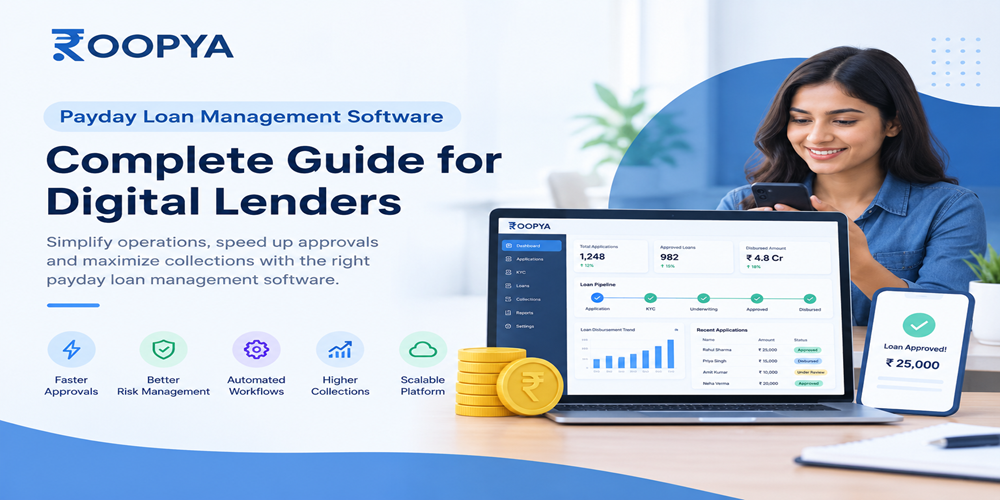
Discover how payday loan management software streamlines underwriting, compliance, and collections for digital lenders. Read Roopya's complete 2026 guide.
Payday lending has always moved fast — borrowers apply, get approved, and receive funds often within hours, not days. That speed is the entire value proposition, but it also means there is almost no room for manual error, delayed compliance checks, or clunky back-office processes. A single missed state-level rate cap, a delayed ACH debit, or a collections call made outside permitted hours can turn into a regulatory complaint or a lawsuit.
This is exactly why payday loan management software has become the operational backbone of modern short-term lending. Rather than stitching together spreadsheets, generic CRMs, and manual underwriting checklists, digital lenders now rely on purpose-built loan management systems (LMS) that automate origination, underwriting, disbursement, repayment, and collections in a single, auditable workflow.
In this guide, we break down what payday loan management software actually does, the features that separate a genuinely capable platform from a basic loan tracker, how compliance fits into the picture, and what digital lenders should evaluate before choosing a vendor.
What Is Payday Loan Management Software?
Payday loan management software is a specialized category of loan management system built to handle the unique mechanics of short-term, high-frequency, small-dollar lending. Unlike mortgage or auto-loan platforms, which are designed around long amortization schedules and infrequent servicing events, payday LMS platforms are built around speed, volume, and short repayment cycles — often two to four weeks.
At its core, the software manages the entire loan lifecycle:
- Digital application intake and borrower verification
- Automated underwriting and risk scoring
- Instant or near-instant approval decisions
- Disbursement via ACH, debit card push, or digital wallet
- Repayment scheduling, including single-payment and installment structures
- Collections workflows for missed or partial payments
- Regulatory reporting and audit trails
Because payday lending is regulated differently in nearly every US state — and under distinct frameworks in markets like the UK, Canada, and parts of Asia — a true payday loan management system also needs built-in configurability for rate caps, rollover restrictions, cooling-off periods, and disclosure requirements, so that a single platform can serve multiple jurisdictions without custom development work for every new market.
Core Features of a Modern Payday LMS
Not all loan management systems are created equal. Many generic lending platforms technically “support” payday loans but lack the depth needed to operate safely and efficiently at scale. Here are the features that matter most.
1. Automated Underwriting and Decisioning
Speed is the product in payday lending, so underwriting has to happen in seconds, not hours. A capable payday LMS integrates with credit bureaus, alternative data providers, bank-statement analysis tools, and fraud-detection engines to generate a risk score and a lending decision almost instantly. Configurable rules engines let risk teams adjust approval thresholds without waiting on engineering resources.
2. Flexible Loan Configuration
Digital lenders rarely offer just one product. A strong system supports multiple loan structures — single-payment payday loans, installment payday loans, and lines of credit — each with configurable terms, fee structures, and repayment schedules, all managed from the same platform.
3. Automated Disbursement and Repayment
Once approved, funds need to move immediately. Integration with ACH networks, real-time payment rails, and card-push disbursement ensures borrowers receive funds quickly. On the repayment side, automated debit scheduling, retry logic for failed payments, and configurable grace periods reduce manual servicing work.
4. Compliance and Regulatory Controls
This is where payday-specific software earns its keep. Built-in rate-cap enforcement by state or region, mandatory cooling-off periods, rollover and renewal limits, and automatic generation of required disclosures (such as Truth in Lending Act documentation in the US) all reduce compliance risk. Robust systems also maintain a complete audit trail of every decision, disclosure, and borrower interaction.
5. Collections and Delinquency Management
When a payment fails, the software should automatically trigger a configurable collections workflow — reminder notifications, retry attempts, soft collections outreach, and, if necessary, handoff to a collections team or third-party agency — all while respecting permissible contact windows and communication rules.
6. Borrower Self-Service Portal
Modern borrowers expect to check balances, make early payments, update payment methods, and communicate with support without picking up the phone. A self-service portal reduces servicing costs while improving the borrower experience.
7. Reporting, Analytics, and Audit Trails
Lenders need real-time visibility into portfolio performance — delinquency rates, approval rates, average loan size, cost per acquisition, and regulatory exposure. Exportable, audit-ready reports also matter enormously during examinations by state regulators or the Consumer Financial Protection Bureau (CFPB) in the US.
8. API-First Architecture and Integrations
A payday LMS rarely operates in isolation. It needs to connect with credit bureaus, payment processors, KYC/AML verification providers, SMS and email communication tools, and accounting systems. An API-first platform makes these integrations faster and more maintainable than a closed, monolithic system.
Key Benefits for Digital Lenders
Faster Time-to-Cash for Borrowers
Automation compresses the application-to-disbursement window from what used to take a full business day down to minutes. For payday lenders, where competitors are often just one tab away, this speed directly affects conversion rates.
Reduced Operational Overhead
Manual underwriting, manual payment scheduling, and manually generated compliance documents all consume staff time. Automating these processes allows a lean operations team to service a much larger loan portfolio without proportional headcount growth.
Lower Default and Delinquency Rates
Better underwriting models, informed by broader data sources and real-time risk scoring, generally produce better credit decisions than manual or rules-only approaches. Automated collections workflows also tend to recover more missed payments than ad hoc manual follow-up.
Stronger Regulatory Standing
Because payday lending attracts intense regulatory scrutiny, having a system that enforces rate caps, disclosure requirements, and permissible collections practices by design — rather than relying on staff memory — significantly reduces compliance risk and the likelihood of costly violations.
Scalability Across Markets
For lenders expanding into new states or countries, a configurable rules engine means new jurisdictions can often be added through configuration changes rather than new development cycles, shortening time-to-market considerably.
Better Borrower Experience and Retention
Self-service tools, transparent repayment schedules, and fast decisions all contribute to borrower satisfaction — which matters for repeat borrowing and referrals in a market where trust is often in short supply.
Compliance and Regulatory Considerations
Payday lending compliance is genuinely complex, and it varies significantly by jurisdiction. In the United States alone, states range from permissive regulatory environments to outright bans on payday lending, with wide variation in permitted APRs, loan amounts, rollover rules, and cooling-off periods in between. At the federal level, lenders also need to account for Truth in Lending Act (TILA) disclosure requirements and oversight from the CFPB.
A well-built payday loan management system should offer:
- State-by-state or region-by-region rule configuration, including rate caps and maximum loan amounts
- Automated TILA-compliant disclosures generated at the point of origination
- Rollover and renewal limit enforcement
- Permissible-contact-window enforcement for collections communications
- Complete, exportable audit logs for regulatory examinations
- Data security aligned with standards such as SOC 2, GLBA, and, where applicable, PCI DSS for payment data
Lenders operating outside the US — including in the UK, where the Financial Conduct Authority enforces strict high-cost short-term credit rules, or in markets like India and Southeast Asia with their own emerging digital lending regulations — should confirm that any LMS vendor can support local compliance frameworks, not just adapt a US-centric product.
How to Choose the Right Payday Loan Management Software
Selecting a platform is a long-term decision, since migrating loan servicing systems mid-portfolio is disruptive and risky. A few questions are worth asking every vendor:
Does it support your specific loan products? Confirm the platform natively handles single-payment payday loans, installment loans, or lines of credit — whichever products you currently offer or plan to launch.
How configurable is the compliance engine? Ask whether rate caps, disclosure templates, and rollover rules can be adjusted by your own compliance team, or whether every change requires a vendor engineering ticket.
What integrations are already built? Check for existing connections to the credit bureaus, bank-data aggregators, payment processors, and KYC providers you already use or plan to use.
Can it scale with loan volume? A system that performs well at a few hundred loans a month may buckle at tens of thousands. Ask about infrastructure, uptime guarantees, and peak-load performance.
What does implementation actually involve? Understand realistic timelines, data migration support, and whether a dedicated implementation team is included.
How transparent is the pricing model? Per-loan fees, flat SaaS pricing, and tiered volume pricing all behave very differently as a portfolio grows — model the total cost at your expected scale, not just your current one.
Implementation Best Practices
Rolling out a new payday loan management system works best as a phased process rather than a single cutover.
- Map your current workflow first. Document every step from application to final repayment or charge-off, including exceptions and manual overrides, before configuring the new system.
- Migrate data in stages. Start with a clean subset — new originations — before migrating historical loan data, to avoid disrupting active servicing.
- Run parallel testing. Operate the old and new systems side by side for a short period to confirm underwriting decisions, disbursement timing, and compliance outputs match expectations.
- Train collections and support staff early. These teams interact with the system daily and will surface usability issues faster than any QA process.
- Set up monitoring and alerting from day one. Delinquency spikes, failed disbursements, and compliance rule mismatches should trigger alerts immediately, not surface in a monthly report.
Build vs. Buy: Should You Build Your Own Payday Loan Software?
Some larger lenders consider building a proprietary loan management system in-house rather than licensing a third-party platform. It’s worth weighing both paths honestly before committing.
The case for building: Full control over the product roadmap, no dependency on a vendor’s release cycle, and the ability to tailor every workflow exactly to your underwriting philosophy. For lenders with very large, stable engineering teams and highly differentiated risk models, this can make sense.
The case for buying: Speed to market is dramatically faster — weeks or months instead of the 12–24 months typical of an in-house build. Compliance logic that has already been tested across multiple jurisdictions reduces regulatory risk during the earliest, most vulnerable stage of a lending program. Ongoing maintenance, security patching, and infrastructure scaling become the vendor’s responsibility rather than an internal cost center that competes with product development for engineering resources.
In practice, most digital lenders — including many banks and NBFCs with sizable technology budgets — choose to license a configurable payday LMS rather than build one, specifically because the regulatory and payments infrastructure required to do it safely is substantial, and getting it wrong carries real financial and reputational cost. Building in-house tends to make the most sense only when a lender’s loan products are so unusual that no existing platform can reasonably support them.
Cost of Payday Loan Management Software
Pricing models vary across vendors, and understanding the structure matters as much as the headline number.
- Per-loan or per-transaction fees scale naturally with volume but can become expensive at high origination counts — useful for lenders still validating product-market fit.
- Flat monthly or annual SaaS licensing offers cost predictability and tends to favor higher-volume lenders, since the per-loan cost falls as volume rises.
- Tiered pricing based on active loan count, portfolio size, or feature set is common among platforms serving both smaller NBFCs and larger banks, allowing lenders to start small and upgrade as they scale.
- Implementation and integration fees, charged separately from ongoing licensing, cover data migration, custom integrations, and onboarding support — these are often negotiable and worth clarifying up front rather than discovering later.
When comparing vendors, it helps to model total cost of ownership at your projected 12- and 24-month loan volumes, not just your current origination rate, since the cheapest option today can become the most expensive one at scale — and vice versa.
Future Trends in Payday Loan Technology
Several shifts are already reshaping how digital lenders build and operate payday lending platforms:
- AI-driven underwriting is moving beyond traditional credit scores toward cash-flow-based and alternative-data models that assess ability to repay more accurately.
- Open banking integrations are making real-time bank-account verification and transaction analysis standard practice rather than a premium feature.
- Embedded lending is placing payday and short-term credit options directly inside payroll apps, gig-economy platforms, and e-commerce checkouts.
- Earned wage access (EWA) products are increasingly offered alongside or instead of traditional payday loans, and many modern LMS platforms now support both under one roof.
- Tighter regulatory technology (RegTech) integration is becoming standard, as regulators themselves move toward more automated, data-driven oversight of short-term lenders.
Lenders choosing a platform today should weigh not just current capabilities but a vendor’s product roadmap against these shifts.
Why Roopya.money
Roopya.money is built specifically for the loan management needs of banks and NBFCs, with the configurability, compliance controls, and automation that short-term and payday-style lending programs require. Rather than retrofitting a generic lending platform, Roopya’s architecture is designed around the realities digital lenders face every day — fast decisioning, jurisdiction-specific rules, and end-to-end servicing from origination through collections — so lending teams can scale their loan book without scaling operational risk alongside it.
Data Security Considerations
Payday lending platforms handle some of the most sensitive data a financial institution can process — Social Security or national ID numbers, bank account and routing details, income verification documents, and full transaction histories. A breach involving this kind of data carries both regulatory and reputational consequences that go well beyond a single lending program.
Before signing with any vendor, lenders should confirm encryption standards for data at rest and in transit, role-based access controls for internal staff, regular third-party penetration testing, and compliance with relevant frameworks such as SOC 2 Type II, the Gramm-Leach-Bliley Act (GLBA) in the US, and PCI DSS wherever card data is processed. Multi-tenant SaaS platforms should also be able to clearly explain how borrower data is logically separated between lender accounts.
Payday loan management software has shifted from a nice-to-have to a genuine operational requirement for digital lenders. The combination of speed, regulatory complexity, and thin per-loan margins means that manual processes simply cannot keep pace with the demands of modern short-term lending. A well-chosen platform reduces compliance risk, lowers operating costs, improves underwriting accuracy, and ultimately allows lending teams to scale sustainably across products and jurisdictions.
For digital lenders evaluating their options, the right system is the one that matches both current loan products and the regulatory environments you operate — or plan to operate — in, with room to grow as volume and geography expand.
Frequently Asked Questions
What is payday loan management software?
Payday loan management software is a loan management system (LMS) purpose-built for short-term, small-dollar lending. It automates origination, underwriting, disbursement, repayment scheduling, collections, and regulatory compliance for payday and short-term loan products.
How is payday loan software different from a general-purpose LMS?
A general-purpose LMS is typically built for long-term, low-frequency loans like mortgages or auto loans. Payday loan software is built around short repayment cycles, high transaction volume, and jurisdiction-specific compliance rules such as rate caps and rollover limits.
Is payday loan management software compliant with state and federal regulations?
A properly built payday LMS includes configurable compliance controls — such as state-by-state rate caps, rollover limits, and Truth in Lending Act disclosures — but lenders should always confirm specific regulatory coverage with the vendor for every jurisdiction in which they operate.
How much does payday loan management software cost?
Pricing varies by vendor and typically follows a per-loan fee, flat monthly SaaS subscription, or tiered pricing based on portfolio size, often with a separate implementation or integration fee. Total cost should be modeled against projected loan volume, not just current volume.
Can payday loan software integrate with credit bureaus and payment processors?
Yes. Modern payday loan management platforms are typically API-first and designed to integrate with credit bureaus, bank-data aggregators, KYC/AML providers, ACH and real-time payment processors, and communication tools such as SMS and email.
How long does it take to implement a payday loan management system?
Implementation timelines vary by vendor and the complexity of data migration, but a phased rollout — workflow mapping, staged data migration, parallel testing, and staff training — commonly takes a few weeks to a few months rather than the 12 to 24 months typical of building a system in-house.
Should a lender build its own payday loan software or buy an existing platform?
Most digital lenders, including many banks and NBFCs, choose to license an existing payday LMS rather than build one in-house, since building safely requires substantial regulatory and payments infrastructure investment. Building in-house tends to make sense only for lenders with highly unusual loan products that no existing platform supports.