Knowing how many people enter a store, facility, airport, campus, or public space provides a useful starting point, but the number alone does not explain what is happening inside. AI people counting can go further by analyzing movement, occupancy, footfall patterns, and changes in visitor volume. With the right analytics, a simple count can become information that helps organizations understand how their spaces are being used and where operational improvements may be needed.
People Counting Gives You the Starting Point
Traditional counting answers a basic question: how many people entered or exited? Modern AI people counting software can provide a broader view by analyzing video feeds and generating structured information from people’s movement.
Organizations can use this information to understand:
- Entry and exit volumes
- Peak and low-traffic periods
- Occupancy levels
- Visitor movement patterns
- Footfall trends across locations
- Changes in customer or visitor activity
This makes people counting more useful than a simple daily visitor total.
What Happens After People Enter
The next question is what happens after people enter a location. Are certain areas receiving more visitors? When does occupancy reach its highest level? Are visitor numbers changing at different times of the day?
AI footfall analytics can help organizations examine these patterns over time. For retailers, this can provide context around customer traffic. For large facilities, it can support operational planning. For public spaces, it can provide visibility into crowd movement and occupancy.
The value comes from connecting the count with the context surrounding it.
From Footfall Numbers to Occupancy Intelligence
Footfall and occupancy are related, but they are not the same measurement. Footfall represents the number of people entering or passing through an area, while occupancy provides an indication of how many people are present at a particular time.
AI occupancy monitoring can help organizations understand changing occupancy levels and identify periods when spaces become highly populated. This can be useful for facilities where capacity, visitor experience, safety, or resource planning depends on knowing how many people are present.
Understanding Peak Hours and Customer Flow
A daily visitor count can hide important variations. Two locations might receive the same number of visitors but experience completely different traffic patterns.
Real-time people counting can provide a more detailed view of when people arrive, when traffic increases, and when activity declines. Over time, these patterns can support decisions around staffing, resource allocation, operating schedules, and space management.
For businesses, business footfall analytics can also help compare visitor activity across different days, time periods, or locations.
Using People Movement to Improve Operations
People counting becomes more valuable when organizations connect the data with operational decisions. Retailers can examine visitor volumes alongside store activity. Facilities can monitor occupancy trends. Large organizations can compare movement across different zones or locations.
An enterprise people counting software platform can centralize this information across multiple sites, making it easier to identify recurring patterns rather than analyzing each location independently.
How AI Turns Counting Into Real-Time Insights
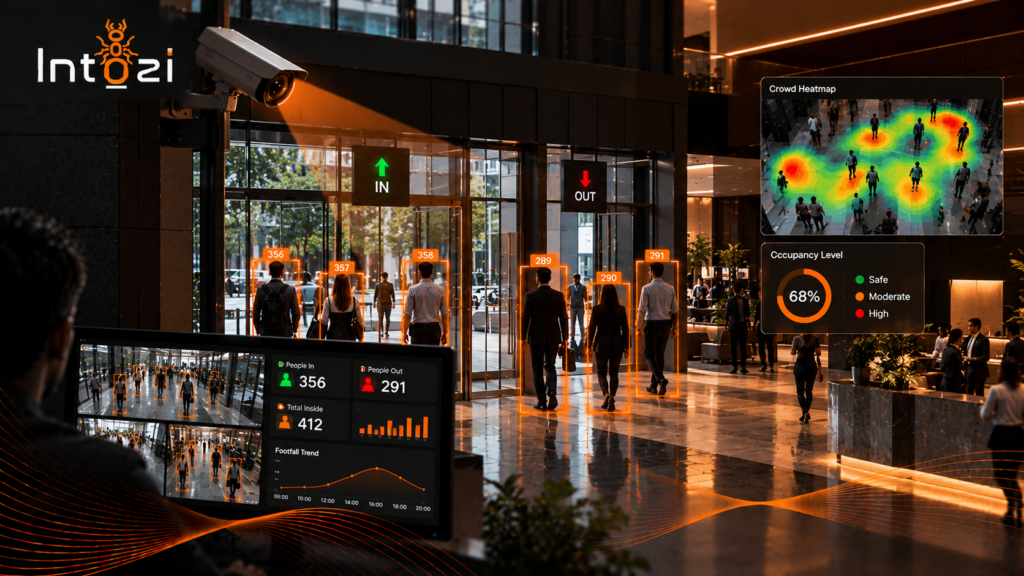
AI-powered systems can analyze video and transform visual information into structured events and metrics. Video-based people counting software uses computer vision to identify people and determine relevant movement patterns without requiring staff to manually count visitors.
A computer vision people counting system can support use cases such as:
- Entry and exit counting
- Occupancy monitoring
- Visitor flow analysis
- Footfall measurement
- Crowd density monitoring
- Multi-location reporting
This allows organizations to move from manually observing video to extracting measurable information from it.
How Ikshana Extends People Counting Beyond Simple Numbers
Intozi’s Ikshana platform applies AI video analytics to help organizations turn video feeds into actionable information. For people-counting use cases, the platform can support AI video analytics for people counting, enabling organizations to analyze visitor volumes, movement, occupancy, and other patterns from relevant video streams.
This approach positions AI people counting as more than a counter. It can become part of a broader analytics layer that helps organizations understand how people interact with their physical spaces.
Frequently Asked Questions
What is the difference between AI people counting and traditional people counting?
Traditional people counting generally focuses on recording the number of people entering, exiting, or passing through a defined area. AI-based systems can go further by analyzing video to identify movement patterns, occupancy, and changes in visitor activity. AI visitor counting software can therefore provide more context around the numbers, helping organizations understand when and where people are moving rather than simply producing a total count.
How can AI people counting help businesses understand footfall?
AI people counting can provide data about visitor volumes across different periods, entrances, zones, or locations. When this information is analyzed over time, businesses can identify peak periods, quieter periods, and changes in visitor behavior. Footfall counting software can therefore support operational planning by giving teams measurable information about how people use a physical location.
Can AI people counting monitor occupancy in real time?
Yes, depending on the camera coverage, configuration, and analytics capabilities of the deployment. AI occupancy monitoring can analyze people entering and leaving defined areas to provide an estimate of the number of people present. This can help organizations monitor changing occupancy levels and identify periods when a particular space becomes highly populated.
What is AI crowd counting software used for?
AI crowd counting software is designed to estimate or count people in areas where multiple individuals may be present. It can support applications involving public spaces, retail environments, transport facilities, campuses, and large venues. Depending on the implementation, it can provide information about crowd size, density, movement, and changes in activity that may be difficult to measure consistently through manual observation.
How does AI people counting software use CCTV video?
AI people counting software can process compatible camera feeds and use computer vision models to identify people and analyze their movement through defined areas. The system can then convert the video into structured metrics such as entry counts, exit counts, occupancy, or footfall. This makes AI people counting solution deployments useful for organizations that already have video infrastructure suitable for analytics.
What can organizations do with people counting data?
People counting data can support decisions related to staffing, space utilization, visitor management, capacity planning, customer flow, and operational scheduling. The usefulness depends on the quality and context of the data. A smart people counting solution can become more valuable when counting information is combined with other video analytics and business data rather than being treated as an isolated number.
Is AI people counting useful beyond retail?
Yes. AI people counting system deployments can be applied across retail, airports, transportation facilities, offices, campuses, manufacturing sites, public spaces, and other environments where understanding people movement is useful. The specific analytics and business value depend on the environment, camera coverage, operational objectives, and how the resulting information is used.
Why is AI people counting more than just counting visitors?
The number of visitors is only one metric. AI people counting can provide a foundation for understanding occupancy, footfall patterns, movement, and changes in activity over time. When organizations analyze these insights together, people counting software can support broader operational intelligence rather than functioning only as a digital counter.