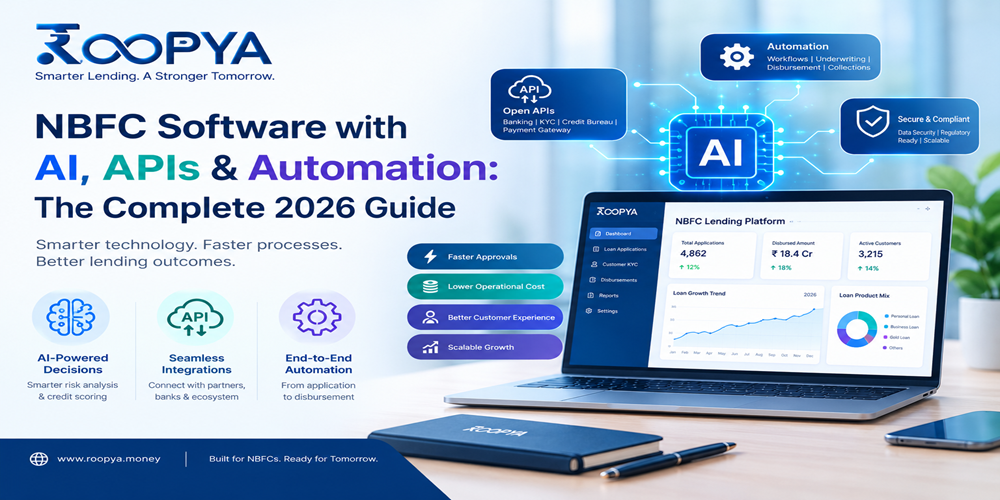
Discover how AI, APIs & automation are transforming NBFC software in 2026. Explore features, benefits, compliance & how to choose the right LMS
Non-Banking Financial Companies (NBFCs) sit at the heart of India’s credit expansion story. From MSME loans and personal loans to gold loans, vehicle finance, and embedded lending at the point of sale, NBFCs now originate a significant share of retail and business credit in the country. But the NBFCs winning market share in 2026 are not the ones with the lowest interest rates alone — they are the ones running on modern, connected, intelligent technology.
NBFC software has evolved dramatically over the last few years. What used to be a basic loan management system (LMS) for tracking disbursals and EMIs has become a full lending technology stack powered by artificial intelligence (AI), open APIs, and end-to-end automation. This guide breaks down what modern NBFC software actually looks like in 2026, why AI and APIs matter, which modules you need, how automation changes unit economics, and how to evaluate a technology partner like Roopya.money.
What Is NBFC Software?
NBFC software refers to the technology platform that powers the entire lending lifecycle for a Non-Banking Financial Company — from customer acquisition and loan origination to underwriting, disbursement, servicing, collections, and regulatory reporting. At a minimum, this includes:
- A Loan Origination System (LOS) to capture applications, run eligibility checks, and manage approvals
- A Loan Management System (LMS) to service active loans, track repayments, and handle restructuring
- A Collections module to manage overdue accounts and recovery workflows
- A Credit Underwriting and Risk Engine to score borrowers and set terms
- Compliance and reporting tools aligned with RBI norms
In 2026, this stack is expected to be API-first, cloud-native, and AI-augmented by default — not as an add-on, but as the operating model.
Why NBFCs Need AI-Powered Software in 2026
The lending landscape has changed on three fronts simultaneously: borrower expectations, regulatory scrutiny, and competitive pressure from fintech-led digital lenders. Legacy, on-premise NBFC software simply cannot keep pace with any of these.
- Borrowers expect instant decisions. A borrower applying for a personal loan or a merchant applying for working capital expects a decision within minutes, not days. AI-driven underwriting models that combine bureau data, bank statement analysis, and alternate data sources make near-real-time decisioning possible.
- Risk needs to be priced dynamically. Static, rule-based credit policies cannot account for the nuance in India’s thin-file and new-to-credit population. Machine learning models continuously learn from repayment behaviour and adjust risk scores, enabling more accurate, more inclusive underwriting.
- Regulatory reporting has become continuous, not periodic. RBI’s Digital Lending Guidelines, data localisation norms, and reporting requirements to credit bureaus (CICs) and regulatory systems demand software that can generate accurate, timely, and auditable reports automatically.
- Operating costs must come down. With interest margins under pressure, NBFCs cannot scale loan books linearly with headcount. Automation absorbs the volume growth that would otherwise require proportionally larger operations, credit, and collections teams.
Core Modules of Modern NBFC Software
A complete, AI-ready NBFC technology stack typically includes the following modules, each of which should be configurable rather than hard-coded, so that policy and workflow changes don’t require new development cycles.
- Loan Origination System (LOS): Digital application forms, document upload, e-KYC, de-duplication checks, eligibility and bureau pulls, approval workflows, and offer generation — ideally completed in a single digital journey with minimal manual intervention.
- Loan Management System (LMS): Repayment schedules, interest accrual, part-payments, foreclosure, restructuring, NPA classification, and ledger management, built to handle multiple product types (term loans, overdrafts, gold loans, BNPL, co-lending) on one platform.
- Credit Underwriting & Scoring Engine: Rule-based policy engines combined with ML scorecards that ingest bureau data, banking data, GST data, and alternate data (utility payments, UPI transaction patterns, device data where permitted) to generate a risk score and recommended terms.
- Collections & Recovery Management: Risk-based bucket segmentation, automated reminders across SMS/WhatsApp/IVR/email, field collection agent apps, promise-to-pay tracking, and settlement workflows — increasingly powered by predictive models that flag early delinquency risk before it happens.
- Co-lending & Partnership Management: As co-lending and Direct Assignment structures grow between NBFCs and banks, software needs built-in capability to split disbursements, track partner exposure, reconcile repayments, and generate partner-wise MIS automatically.
- Compliance & Regulatory Reporting: Automated CIC (credit bureau) reporting, RBI returns, KYC/AML checks, Fair Practices Code adherence, and audit trails that satisfy both internal audit and regulatory inspection requirements.
- Customer Portal & Collections App: Self-service portals and mobile apps where borrowers can view statements, make payments, raise service requests, and download NOCs — reducing inbound call volumes and improving customer experience.
The Role of APIs in NBFC Software
APIs (Application Programming Interfaces) are what transform a standalone LMS into a connected lending ecosystem. Instead of building every capability in-house, modern NBFC software integrates with a network of specialised API providers, dramatically reducing go-to-market time. Key API integrations include:
- KYC & Identity Verification APIs: Aadhaar e-KYC, PAN verification, video KYC, and liveness/face-match APIs to onboard customers digitally and meet RBI’s KYC Master Direction requirements.
- Credit Bureau APIs: Real-time pulls from CIBIL, Experian, Equifax, and CRIF High Mark to fetch credit reports and scores during underwriting.
- Account Aggregator (AA) APIs: Consent-based access to a borrower’s bank account data under the AA framework, enabling richer cash-flow-based underwriting without manual bank statement uploads.
- Bank Statement Analysis APIs: Automated parsing and categorisation of bank statements to assess income stability, existing obligations, and spending behaviour.
- GST & ITR Verification APIs: For MSME and business lending, pulling GST returns and income tax filings directly to validate business revenue.
- e-Sign & e-Stamp APIs: Aadhaar-based e-signature and e-stamping for loan agreements, eliminating physical paperwork and courier delays.
- Payment & Disbursement APIs: UPI, IMPS, and NEFT rails for instant disbursement, plus eNACH/e-mandate APIs for automated EMI collection.
- Fraud & AML Screening APIs: PEP/sanctions list screening, device fingerprinting, and fraud-detection services to flag suspicious applications before disbursal.
The practical benefit of an API-first NBFC software architecture is composability: as new data sources, payment rails, or compliance requirements emerge, the NBFC can plug in a new API rather than rebuild the system.
AI and Machine Learning Use Cases in NBFC Lending
AI is no longer confined to credit scoring. Across the lending lifecycle, AI and machine learning are being applied in several practical ways:
- Alternate credit scoring: For new-to-credit and thin-file borrowers, ML models trained on alternate data — UPI transaction history, utility bill payments, telecom data, and account aggregator cash flows — extend credit assessment beyond traditional bureau scores, widening the addressable market responsibly.
- Document intelligence and OCR: AI-powered Optical Character Recognition (OCR) and document classification automatically extract data from PAN cards, bank statements, salary slips, and GST filings, reducing manual data entry and processing time from hours to minutes.
- Fraud detection: Pattern-recognition models flag anomalies such as synthetic identities, income inflation, or document tampering in real time, reducing first-payment-default (FPD) rates.
- Predictive collections: Instead of treating all overdue accounts the same, ML models rank accounts by probability of self-cure versus likelihood of default, allowing collections teams to prioritise high-risk accounts and personalise communication channels and messaging.
- Conversational AI and chatbots: AI-driven chatbots and voice bots handle routine borrower queries — EMI due dates, statement requests, loan status — in regional languages, reducing call-centre load while improving response times.
- Portfolio risk monitoring: AI dashboards continuously monitor portfolio health across vintages, products, and geographies, surfacing early warning signals (rising delinquency in a specific cohort, for instance) well before they show up in quarterly reviews.
Automation and Workflow Efficiency
Beyond AI models, Robotic Process Automation (RPA) and workflow automation remove manual, repetitive tasks from day-to-day NBFC operations:
- Automated reconciliation of disbursement and repayment entries across bank accounts and the core ledger
- Auto-generation of sanction letters, loan agreements, and repayment schedules from approved terms
- Scheduled, automated NACH/eNACH presentation and retry logic for EMI collection
- Rule-based auto-approval for low-risk, pre-qualified segments, cutting turnaround time (TAT) from days to minutes
- Automated regulatory MIS and bureau reporting on a defined cadence, removing manual spreadsheet work
- Trigger-based borrower communication (payment reminders, welcome messages, NOC issuance) without manual intervention
Together, AI and automation compound: AI improves the quality of decisions, while automation ensures those decisions are executed instantly and consistently, without being bottlenecked by human throughput.
Key Benefits of Adopting AI-Driven NBFC Software
- Faster turnaround time (TAT): Loan decisions that used to take 2–3 days can be compressed to minutes for straightforward cases, improving conversion rates.
- Lower cost of operations: Automation reduces dependency on large back-office teams for data entry, reconciliation, and reporting.
- Better risk-adjusted returns: More accurate, data-rich underwriting reduces both over-rejection of good borrowers and under-pricing of risky ones.
- Improved compliance posture: Automated audit trails and reporting reduce the risk of regulatory penalties and simplify inspections.
- Scalability without linear headcount growth: A well-automated stack lets an NBFC multiply loan book size without a proportional increase in operations staff.
- Stronger customer experience: Digital-first journeys, instant disbursement, and self-service portals meet borrower expectations shaped by UPI and fintech apps.
Compliance and Regulatory Considerations
Any NBFC software deployed in India must be designed around the regulatory framework laid down by the Reserve Bank of India (RBI), including:
- RBI Digital Lending Guidelines: Covering disclosure requirements, direct disbursement to borrower accounts, cooling-off periods, and restrictions on data usage by Lending Service Providers (LSPs).
- Fair Practices Code (FPC): Requiring transparent communication of interest rates, fees, and recovery practices to borrowers.
- KYC Master Direction: Governing identity verification standards, including video KYC and Aadhaar-based e-KYC.
- Data localisation and privacy norms: Ensuring borrower financial data is stored and processed in compliance with RBI and India’s Digital Personal Data Protection (DPDP) Act requirements.
- IT outsourcing guidelines: Where NBFC software or infrastructure is hosted by a third-party vendor, RBI’s outsourcing framework requires defined accountability, audit rights, and business continuity planning.
NBFC software built with compliance as a core design principle — not a bolt-on — reduces regulatory risk significantly and builds long-term trust with both regulators and lending partners (banks, co-lenders, and institutional investors).
How to Choose the Right NBFC Software Provider
When evaluating a technology partner, NBFCs should assess:
- End-to-end coverage: Does the platform cover origination, underwriting, servicing, collections, and compliance, or will you need to stitch together multiple vendors?
- API ecosystem and integration speed: How quickly can the platform integrate with bureaus, AA providers, payment rails, and KYC vendors?
- Configurability: Can credit policies, workflows, and product structures be changed without custom development?
- AI and analytics maturity: Does the vendor offer built-in scoring models, or only raw data with no decisioning intelligence?
- Security and data protection: Is the platform ISO 27001 certified, and does it meet RBI’s data localisation requirements?
- Track record with NBFCs and banks: Does the vendor understand co-lending, partnership lending, and multi-product portfolios specific to the Indian lending market?
- Support and implementation timeline: How long does it take to go live, and what ongoing support is available post-launch?
A Practical Implementation Roadmap
Migrating to a modern, AI-driven NBFC software stack does not need to happen in one disruptive cut-over. A practical, phased roadmap looks like this:
- Phase 1 — Foundation (Weeks 1–4): Map existing loan products, credit policies, and workflows. Identify which APIs (KYC, bureau, AA, payments) are already integrated elsewhere and which need to be added. Define data migration requirements for existing loan books.
- Phase 2 — Core Build (Weeks 4–10): Configure the LOS and LMS for each product type, connect priority APIs (KYC, bureau, disbursement, eNACH), and set up base credit policy rules. Run parallel testing against the legacy system to validate calculations (interest accrual, EMI schedules, penal charges).
- Phase 3 — AI and Automation Layer (Weeks 8–14): Layer in ML-based scoring, document OCR, fraud checks, and automated collections workflows once the core platform is stable. This phase typically overlaps with Phase 2 rather than following it sequentially.
- Phase 4 — Go-Live and Optimisation (Ongoing): Launch with a controlled segment of new originations, monitor TAT, approval rates, and early delinquency closely, then expand to the full book. Continue tuning scorecards and automation rules based on observed performance.
A phased approach limits operational risk while still letting an NBFC capture the benefits of AI and automation within the first few months rather than waiting for a “big bang” launch.
Measuring ROI from NBFC Software Modernisation
NBFCs evaluating a technology upgrade should track a small set of metrics before and after implementation to quantify impact:
- Turnaround Time (TAT): Average time from application to disbursement, segmented by product and risk tier.
- Approval rate and portfolio quality: Whether a higher share of applications can be approved profitably without increasing delinquency.
- Cost-to-income ratio: Operating cost as a share of interest and fee income, which should decline as manual effort is automated away.
- Collections efficiency: Resolution rate on overdue accounts and the cost per rupee recovered, which predictive collections models typically improve.
- STP (Straight-Through-Processing) rate: The percentage of loans that move from application to disbursement with zero manual intervention — a direct measure of how much automation is actually doing.
Tracking these metrics consistently before and after a software transition gives management and the board a clear, data-backed view of return on investment, rather than relying on anecdotal feedback from operations teams.
Why Roopya.money for NBFC Software
Roopya.money is built specifically for the loan management system (LMS) needs of banks and NBFCs, with a focus on combining AI-driven decisioning, open API integrations, and workflow automation in a single, configurable platform. Rather than forcing lenders into a rigid, one-size-fits-all system, Roopya.money is designed to adapt to diverse loan products, credit policies, and partnership structures — including co-lending — while keeping compliance and auditability built into every workflow. For NBFCs evaluating a modernisation of their lending technology stack in 2026, Roopya.money offers a path to faster disbursals, leaner operations, and better risk management without a multi-year implementation cycle.
The Future: NBFC Software Trends Beyond 2026
Looking ahead, a few trends will continue to shape NBFC software:
- Generative AI for credit memos and underwriting narratives, reducing manual write-up time for credit committees
- Deeper Account Aggregator adoption, making cash-flow-based underwriting the norm rather than the exception
- Embedded finance and API-based lending-as-a-service, where NBFC credit lines are offered inside third-party apps and platforms
- Real-time, continuous risk monitoring replacing periodic portfolio reviews
- Greater regulatory emphasis on explainability, requiring AI credit models to be auditable and interpretable, not black boxes
NBFC software in 2026 is no longer just a back-office system of record — it is a competitive differentiator. AI improves the quality and inclusivity of credit decisions, APIs compress integration timelines from months to days, and automation drives down the cost of servicing every loan. NBFCs that invest in a modern, API-first, AI-augmented lending stack are better positioned to grow loan books profitably while staying compliant with an evolving regulatory landscape. Platforms like Roopya.money are built to help banks and NBFCs make that transition without the complexity of managing disparate, disconnected systems.
Frequently Asked Questions (FAQ)
- What is NBFC software used for?
NBFC software manages the complete lending lifecycle for a Non-Banking Financial Company, including loan origination, credit underwriting, disbursement, loan servicing, collections, and regulatory compliance reporting, all on a single platform.
- How does AI improve NBFC lending operations?
AI improves NBFC lending by enabling faster and more accurate credit decisions through alternate data scoring, automating document processing with OCR, detecting fraud in real time, and predicting collection risk so teams can prioritise recovery efforts effectively.
- What APIs are essential for a modern NBFC software platform?
Essential APIs include KYC and e-KYC verification, credit bureau data pulls (CIBIL, Experian, Equifax, CRIF), Account Aggregator (AA) integration, GST/ITR verification, e-sign and e-stamp, and payment rails such as UPI, eNACH, and IMPS/NEFT for disbursement and collection.
- Is cloud-based NBFC software compliant with RBI regulations?
Yes, provided the platform follows RBI’s IT outsourcing guidelines, data localisation norms, and the Digital Lending Guidelines. NBFCs should confirm their technology vendor maintains ISO 27001 certification and stores borrower data within India as required.
- How long does it take to implement NBFC software like a loan management system (LMS)?
Implementation timelines vary by scope, but a configurable, API-first LMS can typically go live in a few weeks to a few months, compared to the 6–12 months often required for custom-built, legacy systems.
- Can NBFC software support co-lending and partnership models with banks?
Yes, modern NBFC software platforms, including Roopya.money, support co-lending by automatically splitting disbursements, tracking partner-wise exposure, reconciling repayments, and generating partner MIS reports.
- What is the difference between a Loan Origination System (LOS) and a Loan Management System (LMS)?
An LOS handles the front-end process of a loan — application, eligibility checks, underwriting, and approval — while an LMS manages the loan after disbursement, including repayment tracking, interest accrual, restructuring, and NPA classification.
- How does automation reduce costs for NBFCs?
Automation reduces costs by eliminating manual data entry, reconciliation, and reporting tasks, enabling NBFCs to scale their loan books without proportionally increasing operations headcount.