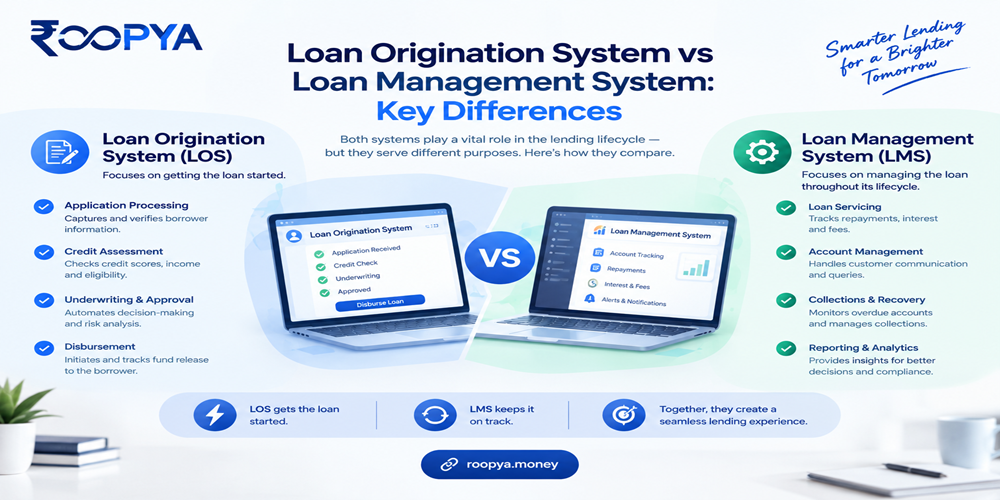
Confused between a Loan Origination System and a Loan Management System? Learn the key differences, features, and how LOS & LMS work together.
Banks, NBFCs, and digital lenders throw around the terms “Loan Origination System” and “Loan Management System” so interchangeably that many lending teams assume they’re two names for the same software. They are not. They solve different problems, serve different stages of the loan lifecycle, and — when confused with each other during a technology purchase — can leave a lender with expensive gaps in automation.
If you’re evaluating lending technology for your bank or NBFC, understanding exactly where a Loan Origination System (LOS) ends and a Loan Management System (LMS) begins isn’t academic. It determines your vendor shortlist, your implementation timeline, your compliance posture, and ultimately how fast you can grow your loan book without growing your operations headcount in proportion.
This guide breaks down what each system actually does, where they overlap, how they work together, and how to decide what your lending business needs — whether that’s one, the other, or both working as a single connected platform.
What Is a Loan Origination System (LOS)?
A Loan Origination System is the software that manages everything that happens before a loan is disbursed. It covers the entire journey from the moment a prospective borrower submits an application to the moment funds hit their account.
Think of an LOS as the front office of lending. It’s where applications are captured, documents are collected, identities are verified, creditworthiness is assessed, and the final lending decision is made.
Core functions of a Loan Origination System
- Application intake and capture — An LOS provides digital forms, mobile apps, or API integrations that let borrowers (or loan officers on their behalf) submit loan applications. This includes capturing personal details, income information, loan amount requested, tenure, and purpose.
- Document collection and verification (KYC) — Modern LOS platforms integrate with KYC utilities, Aadhaar-based e-KYC, PAN verification, bank statement analyzers, and document OCR tools to pull and validate borrower documents automatically, cutting manual data entry and fraud risk.
- Credit bureau integration and scoring — The LOS pulls credit reports from bureaus (CIBIL, Experian, Equifax, CRIF High Mark in India, or Equifax/TransUnion internationally), runs the applicant through credit scoring models, and applies the lender’s risk policies.
- Underwriting and rule-based decisioning — Using configurable credit policies, income-to-obligation ratios, and risk-based pricing rules, the LOS can auto-approve, auto-reject, or route applications for manual underwriter review — dramatically cutting turnaround time (TAT).
- Workflow and approval routing — Applications move through defined workflow stages — sales, credit, risk, compliance — with role-based approvals, maker-checker controls, and audit trails that regulators expect to see.
- Loan offer generation and e-sign — Once approved, the LOS generates sanction letters, loan agreements, and key fact statements, often with e-stamping and Aadhaar-based e-signature for a fully paperless process.
- Disbursement initiation — The final step of origination: triggering disbursement instructions to the core banking system or payment rails, after which the loan “goes live” and ownership shifts to loan servicing.
In short, an LOS exists to answer one question as fast, accurately, and compliantly as possible: should we lend to this person, and on what terms?
What Is a Loan Management System (LMS)?
A Loan Management System takes over the moment a loan is disbursed. It’s the back-office engine that manages the loan for its entire remaining life — sometimes 5, 10, or 20 years — until it’s fully repaid, written off, or settled.
If the LOS is the front door, the LMS is everything that happens inside the house for as long as the loan exists.
Core functions of a Loan Management System
- Loan account servicing — The LMS maintains the system of record for every active loan: principal outstanding, interest accrued, fees, charges, and the complete transaction history.
- EMI and repayment scheduling — It generates amortization schedules, calculates EMIs (reducing balance, flat rate, or custom methods), and manages repayment calendars across different loan products.
- Collections and delinquency management — When a borrower misses a payment, the LMS flags the account, triggers reminder workflows (SMS, email, IVR, app notifications), assigns accounts to collection agents or agencies, and tracks days-past-due (DPD) buckets.
- Interest and penalty computation — Daily interest accrual, penal interest on overdue amounts, late payment fees, bounce charges, and foreclosure interest — all calculated automatically per the loan agreement terms.
- Payment processing and reconciliation — Integration with payment gateways, NACH/ECS mandates, UPI AutoPay, and banking rails to accept repayments and reconcile them against the right loan account, down to the last rupee.
- NPA classification and provisioning — For regulated lenders, the LMS automates asset classification (standard, SMA-0/1/2, substandard, doubtful, loss) per RBI or applicable regulatory norms, and feeds provisioning calculations.
- Restructuring, foreclosure, and settlement — Handling loan restructuring requests, part-prepayments, foreclosure calculations, and one-time settlements (OTS) — all with proper ledger adjustments.
- Regulatory reporting and MIS — Generating reports for regulators, auditors, and management — portfolio quality, NPA trends, collection efficiency, and credit bureau reporting (monthly data submission to CIBIL/CRIF).
- Co-lending and investor reporting — For lenders operating co-lending or securitization structures, the LMS tracks partner shares, waterfall calculations, and investor-ready reporting.
In short, an LMS exists to answer a different question, continuously, for the life of every loan: is this loan being repaid correctly, and what do we need to do if it isn’t?
Loan Origination System vs Loan Management System: Side-by-Side Comparison
| Parameter | Loan Origination System (LOS) | Loan Management System (LMS) |
| Stage of lifecycle | Pre-disbursement | Post-disbursement |
| Primary goal | Decide whether and how much to lend | Manage repayment and loan health over time |
| Core users | Sales teams, credit officers, underwriters | Collections teams, finance, operations, compliance |
| Key processes | Application, KYC, credit scoring, underwriting, sanction | EMI scheduling, collections, interest accrual, NPA management |
| Primary output | A disbursed, sanctioned loan | A serviced, repaid (or recovered) loan |
| Typical duration of use per loan | Days to weeks | Months to decades |
| Integration focus | Credit bureaus, KYC/AML utilities, e-sign, payment initiation | Payment gateways, NACH/UPI AutoPay, collections tools, core banking |
| Compliance focus | Fair lending, KYC/AML, sanction documentation | NPA classification, provisioning, regulatory reporting |
| Failure cost if missing | Slow, inconsistent, or non-compliant lending decisions | Poor collections, rising NPAs, inaccurate financial reporting |
A Step-by-Step Walkthrough: The Loan Origination Journey
To make the distinction concrete, here’s what actually happens inside an LOS during a typical loan application, from the borrower’s first click to disbursement:
- Lead generation and application start — A borrower discovers the lender through a website, app, DSA (direct selling agent), or partner channel, and begins a digital application.
- Data and document capture — The borrower (or an agent on their behalf) enters personal, employment, and income details, and uploads PAN, Aadhaar, bank statements, salary slips, or ITRs.
- De-duplication check — The system checks whether this applicant already exists in the lender’s database to avoid duplicate accounts or masked repeat defaulters.
- KYC and identity verification — Aadhaar e-KYC, PAN validation, and often a liveness/selfie check confirm the applicant is who they claim to be.
- Bureau pull and credit scoring — The LOS fetches a credit report, calculates a bureau score, and runs it against the lender’s minimum eligibility criteria.
- Bank statement and income analysis — Automated tools analyze bank statement PDFs to estimate real income, existing EMI obligations, and cash flow stability.
- Rule-based or AI-assisted underwriting — Based on configured credit policy, the system either auto-approves, auto-rejects, or flags the file for a human underwriter.
- Manual underwriting (if required) — A credit officer reviews flagged applications, can request additional documents, and makes the final call within their delegated authority.
- Offer generation — The system generates a sanction letter and key fact statement (KFS) reflecting the approved amount, tenure, interest rate, and fees.
- E-sign and e-stamp — The borrower accepts the offer digitally, often via Aadhaar-based e-sign, with e-stamping handled electronically.
- Disbursement trigger — Funds are released to the borrower’s bank account, and the loan record is handed off to the Loan Management System for servicing.
Each of these steps, done manually, can take days. Automated well through an LOS, the same journey can often be completed in minutes for low-risk, straightforward applications — which is exactly why digital lenders invest so heavily in origination technology.
A Step-by-Step Walkthrough: The Loan Servicing Journey
Once the loan is live, the Loan Management System takes over a very different, ongoing set of responsibilities:
- Account creation and schedule generation — The LMS creates the loan account and generates the full amortization schedule based on principal, interest rate, tenure, and repayment frequency.
- Mandate setup — NACH, e-mandate, or UPI AutoPay is registered so EMIs can be auto-debited on the due date.
- Daily interest accrual — Interest is calculated and posted to the ledger daily or as per the agreed method, keeping the outstanding balance accurate at all times.
- EMI presentment and collection — On the due date, the system presents the EMI for auto-debit or prompts the borrower for manual payment.
- Payment reconciliation — Incoming payments are matched against the correct loan account, with partial payments, excess payments, and bounced transactions all handled according to policy.
- Delinquency tracking — If a payment is missed, the system updates the days-past-due (DPD) count and triggers the appropriate reminder or escalation workflow.
- Collections workflow — Based on DPD buckets, accounts are routed to tele-calling, field collection agents, or recovery agencies, with every interaction logged.
- Asset classification — The system automatically reclassifies the loan (standard, SMA-0, SMA-1, SMA-2, NPA sub-categories) as per applicable regulatory timelines.
- Restructuring or settlement handling — If a borrower requests restructuring, part-prepayment, foreclosure, or a one-time settlement, the LMS recalculates the schedule and ledger accordingly.
- Regulatory and credit bureau reporting — Monthly data is submitted to credit bureaus, and periodic reports are generated for internal risk teams, auditors, and regulators.
- Loan closure — Once the final payment is received (or a settlement is completed), the system closes the account, generates a no-objection certificate (NOC), and updates the borrower’s credit history accordingly.
This cycle can repeat for years on a single loan, which is why LMS platforms are built for continuous, high-volume, accuracy-critical processing rather than the one-time decisioning that defines an LOS.
Why the Confusion Happens
The confusion between LOS and LMS is understandable for a few reasons:
- Many vendors sell both as a single “Loan Origination and Management System” or end-to-end LOS LMS platform, bundled under one brand name, which blurs the functional distinction even though the underlying modules remain separate.
- The handoff between the two is often invisible to business users. When a loan is disbursed, data needs to flow seamlessly from the LOS into the LMS — account number, sanctioned terms, repayment schedule — and when that integration is done well, staff may not even realize they’re using two different systems.
- Smaller NBFCs and fintech lenders sometimes start with just one. A new-age digital lender might launch with a lightweight LOS and manually track repayments in spreadsheets, or conversely, inherit a legacy core banking LMS and bolt on origination later. Neither approach scales, which is usually what prompts the search for proper lending software in the first place.
How LOS and LMS Work Together in a Lending Business
Even though they’re distinct systems, LOS and LMS are not meant to operate in isolation. A well-architected lending technology stack treats them as two connected stages of one continuous pipeline:
- Lead capture flows into the LOS.
- The LOS runs KYC, credit checks, and underwriting, and generates a sanction.
- Upon disbursement, the LOS hands off the loan record — borrower details, sanctioned amount, interest rate, tenure, repayment schedule — to the LMS via API or batch integration.
- The LMS takes over servicing: generating EMI schedules, collecting repayments, tracking delinquency, and reporting on portfolio health.
- Data from the LMS (repayment behavior, defaults, foreclosures) often flows back into the LOS or a shared data layer to improve future underwriting models — a feedback loop that gets more valuable as a lender’s loan book matures.
This is why many modern lending technology providers — including unified platforms — now offer LOS and LMS as modules of a single system rather than two disconnected products. The benefit is a single borrower record, no data re-entry between systems, real-time visibility across the entire loan lifecycle, and fewer integration points to maintain and secure.
Which One Does Your Lending Business Need?
If you’re a new lender or fintech still building your sales funnel, your most urgent pain point is usually origination: slow manual underwriting, high application drop-off, and inconsistent credit decisions. An LOS should be the priority.
If you already have a healthy loan book but are managing repayments manually or on a legacy core banking module, your bottleneck is likely servicing: missed follow-ups, reconciliation errors, and NPA reporting headaches. An LMS should be the priority.
If you’re scaling past your first few thousand loans, you need both — ideally integrated, so your underwriting decisions and your collections performance inform each other continuously. This is the stage where most banks and NBFCs move to a unified loan lifecycle platform rather than stitching together point solutions.
Key Features to Look for When Choosing Lending Software
Whether you’re evaluating an LOS, an LMS, or a combined platform, a few capabilities separate a system that scales from one that becomes a liability:
- Configurability without code — the ability for your credit and operations teams to change workflows, policies, and product parameters without raising a developer ticket every time.
- API-first architecture — so the system can plug into credit bureaus, KYC providers, payment gateways, co-lending partners, and your core banking stack.
- Regulatory readiness — built-in support for RBI guidelines (for Indian lenders), NPA classification norms, fair lending documentation, and audit trails.
- Scalability — the system should perform the same whether you’re processing 100 loans a month or 100,000.
- Real-time dashboards and MIS — for credit, collections, and leadership to track portfolio health without waiting on manual reports.
- Security and data protection — encryption, role-based access control, and compliance with data protection regulations.
Common Mistakes Lenders Make When Choosing Between LOS and LMS
Even experienced lending teams run into avoidable problems during technology selection. A few patterns show up repeatedly:
- Buying an LOS and assuming it will “also handle collections.” Some origination platforms offer basic repayment tracking, but this is not the same as a full-fledged LMS with delinquency workflows, NPA classification, and regulatory reporting. Lenders who discover this gap after going live often end up bolting on a second system under time pressure.
- Choosing an LMS without checking integration depth with existing origination workflows. If the handoff between systems requires manual data re-entry, you reintroduce the exact inefficiency and error risk the software was meant to remove.
- Underestimating configurability needs. Credit policies, product terms, and collection strategies change often — sometimes seasonally. A system that requires vendor involvement for every policy tweak slows down the business, not just the IT team.
- Ignoring regulatory roadmap requirements. Regulations around NPA classification, data localization, and reporting formats evolve. A platform without a track record of staying current with regulatory changes can become a compliance liability.
- Treating the purchase as a one-time IT project rather than an ongoing partnership. Lending technology needs updates as loan products, scale, and regulations evolve — vendor support quality matters as much as the initial feature list.
Cost Considerations: LOS vs LMS vs Combined Platforms
Pricing models vary across the lending technology market, but a few patterns are common:
- Per-application pricing is typical for LOS platforms, since origination costs scale with application volume, not with how long a loan stays on the books.
- Per-loan or per-active-account pricing is typical for LMS platforms, since servicing cost scales with the size and duration of the live loan book.
- Bundled or platform-level pricing is increasingly common for combined LOS and LMS offerings, often tiered by total disbursement volume or assets under management (AUM), which can simplify budgeting for growing NBFCs.
- Implementation and integration costs — credit bureau connections, KYC utility integrations, payment gateway setup, and core banking integration — are often a separate, one-time cost that lenders should factor in regardless of which system(s) they choose.
Lenders evaluating cost should look beyond the headline licensing fee and account for integration effort, ongoing support, and the cost of maintaining two disconnected vendors versus one unified platform.
Implementation Timeline: What to Expect
A realistic implementation timeline helps set expectations with internal stakeholders and leadership:
- Requirements gathering and configuration (credit policies, product parameters, workflow design): typically 2–6 weeks, depending on product complexity.
- Integrations (credit bureaus, KYC/AML utilities, payment gateways, core banking, co-lending partners): typically 3–8 weeks, run in parallel with configuration where possible.
- User acceptance testing (UAT): 2–4 weeks, covering edge cases like foreclosure, restructuring, and multi-product scenarios.
- Pilot or parallel run: often 2–4 weeks of running the new system alongside existing processes before a full cutover, especially for regulated lenders.
- Go-live and stabilization: an additional 2–4 weeks of close monitoring after full cutover.
Combined LOS and LMS implementations can sometimes be faster overall than implementing two separate systems sequentially, since the data model and integrations are designed to work together from day one rather than being reconciled after the fact.
How Roopya.money Helps
At Roopya.money, we build loan management system and loan origination technology specifically for banks and NBFCs that need both speed in decision-making and discipline in servicing — without stitching together multiple disconnected vendors. Our platform is designed so that origination and servicing share one borrower record, one workflow engine, and one compliance layer, which means your credit team’s decisions and your collections team’s performance data work together instead of living in separate silos.
If you’re evaluating lending technology — whether you need to fix slow loan approvals, reduce NPAs, or finally retire a spreadsheet-based collections process — our team can walk you through how a connected LOS and LMS can shorten your time to disbursement and improve portfolio health in the same system.
Frequently Asked Questions
- What is the main difference between LOS and LMS?
An LOS (Loan Origination System) manages everything before a loan is disbursed — application, KYC, credit checks, underwriting, and sanction. An LMS (Loan Management System) manages everything after disbursement — EMI schedules, repayment collection, delinquency tracking, and NPA reporting.
- Can a lender use an LMS without an LOS?
Yes, but it’s uncommon for lenders doing meaningful loan volume. A lender might disburse loans originated manually or through a partner, then use an LMS purely for servicing. However, without an LOS, underwriting and approval processes typically stay manual, slow, and harder to standardize.
- Is a Loan Origination System only for banks?
No. NBFCs, microfinance institutions, digital lending fintechs, housing finance companies, and even large retailers offering point-of-sale financing use LOS platforms to automate and standardize their credit decisioning.
- Do LOS and LMS need to be from the same vendor?
Not necessarily, but integrating two separate systems from different vendors adds engineering overhead, more points of failure, and potential data-sync delays. Many lenders prefer a unified platform where origination and servicing are modules of the same system, sharing a single borrower and loan record.
- How does an LOS reduce loan approval turnaround time (TAT)?
By automating document collection, KYC verification, credit bureau checks, and rule-based underwriting decisions, an LOS removes manual, sequential steps that typically cause delays — cutting TAT from days to minutes for straightforward applications.
- What role does an LMS play in NPA management?
An LMS continuously tracks days-past-due (DPD) for every loan account, automatically classifies assets according to regulatory norms (standard, SMA, NPA categories), triggers collection workflows at the right stage, and generates the provisioning and reporting data regulators and auditors require.
- Can small NBFCs afford a combined LOS and LMS platform?
Yes. Most modern lending technology, including cloud-based and SaaS platforms, is priced to scale with loan volume rather than requiring large upfront infrastructure investment, making combined platforms accessible to small and mid-sized NBFCs as well as large banks.
- How do LOS and LMS support regulatory compliance?
An LOS enforces KYC/AML checks, maintains audit trails of credit decisions, and ensures sanction documentation meets regulatory disclosure requirements. An LMS maintains accurate loan ledgers, automates NPA classification, and generates the periodic regulatory reports lenders are required to submit, reducing the risk of compliance gaps.
A Loan Origination System and a Loan Management System are not competing products — they are two essential, sequential stages of the same lending lifecycle. The LOS gets the loan approved and disbursed correctly; the LMS keeps it healthy, compliant, and repaid for as long as it’s on your books. Understanding this distinction is the first step to building (or buying) lending technology that actually supports growth rather than slowing it down.
Whether you need a faster origination engine, a more disciplined servicing system, or both working together as one platform, the right starting point is mapping your current pain points against the loan lifecycle stage they actually belong to — and then choosing technology built to handle that stage properly.