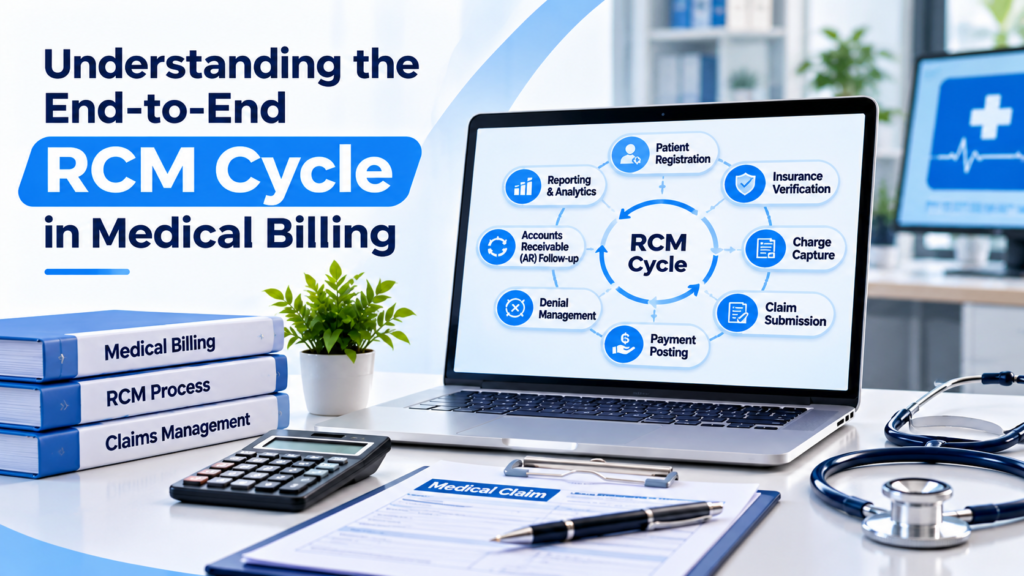
Revenue Cycle Management (RCM) is the complete financial process that healthcare providers follow to manage patient payments, insurance claims, and medical billing. It begins when a patient schedules an appointment and continues until the healthcare provider receives payment and resolves any outstanding balance.
An effective RCM process helps medical practices maintain accurate billing records, manage insurance claims, identify payment issues, and support steady cash flow. Understanding each stage of the revenue cycle is important for healthcare providers, billing teams, and medical practice managers who want to improve their financial operations.
What Is the RCM Cycle in Medical Billing?
The RCM cycle in medical billing is a structured workflow that connects patient care with financial management. It includes patient registration, insurance verification, medical coding, claim submission, payment posting, denial management, and accounts receivable follow-up.
The main purpose of revenue cycle management is to ensure that healthcare services are accurately documented, billed to the correct payer, and reimbursed according to applicable payment terms.
For healthcare providers in the USA, a well-managed RCM process also helps reduce billing errors, maintain organized financial records, and manage patient responsibilities.
13 Key Steps in the End-to-End RCM Cycle
1. Patient Scheduling
The revenue cycle begins when a patient schedules an appointment. The healthcare practice collects basic information, including the patient’s name, contact details, appointment date, and reason for the visit.
Accurate scheduling helps the billing team prepare for the next steps and reduces administrative issues.
2. Patient Registration
During registration, the healthcare provider collects patient demographics, insurance information, and other required details.
Incorrect patient information can lead to claim rejections or delays. Therefore, billing teams should review and update patient records before the appointment.
3. Insurance Eligibility Verification
Insurance verification confirms whether the patient’s insurance coverage is active and what benefits may apply to the scheduled service.
The team checks details such as coverage status, deductibles, copayments, coinsurance, and service limitations. Early verification helps identify potential billing issues before patient care begins.
4. Prior Authorization
Some healthcare services require prior authorization from the insurance payer. The provider’s team must confirm whether authorization is needed and obtain approval when applicable.
Missing or incorrect authorization information can result in claim denials or additional administrative work.
5. Patient Check-In
During check-in, the practice confirms patient identity, insurance details, and appointment information. The team may also collect applicable copayments or other patient payments.
Accurate check-in information supports proper documentation and billing.
6. Charge Capture
Charge capture involves recording the medical services, procedures, and treatments provided to the patient.
Healthcare providers and billing teams must ensure that all billable services are documented correctly. Missing charges can affect reimbursement and create gaps in financial records.
7. Medical Coding
Medical coding converts clinical documentation into standardized codes used for billing and insurance claims.
Depending on the service, coding may involve ICD-10-CM, CPT, and HCPCS codes. Accurate coding is essential because incorrect codes, incomplete documentation, or mismatched services may lead to claim rejections or denials.
8. Claim Preparation and Submission
After coding and charge capture, the billing team prepares the insurance claim. The claim includes patient information, provider details, diagnosis codes, procedure codes, and other required billing data.
Before submission, the team should review the claim for missing information and potential errors. Claims are then submitted electronically or through the payer’s accepted process.
9. Insurance Claim Adjudication
The insurance payer reviews the submitted claim to determine whether the services are covered and how much will be reimbursed.
The payer may approve the claim, partially pay it, deny it, or request additional information. Billing teams should review the payer’s response and take appropriate action.
10. Payment Posting
Payment posting involves recording payments received from insurance companies and patients.
The billing team compares payments with the Explanation of Benefits (EOB) or Electronic Remittance Advice (ERA). Any differences between expected and received payments should be reviewed to identify possible underpayments or billing discrepancies.
11. Denial Management
Denial management focuses on identifying, reviewing, and resolving rejected or denied claims.
The team investigates the reason for each denial, corrects the issue, and submits an appeal or corrected claim when appropriate. Tracking denial patterns can also help practices identify recurring problems and improve their billing workflows.
12. Accounts Receivable (AR) Follow-Up
Accounts receivable follow-up involves monitoring unpaid claims and outstanding balances.
Billing teams contact insurance payers, review claim status, investigate payment delays, and follow up on unresolved balances. Regular AR follow-up helps practices maintain visibility into outstanding revenue.
13. Patient Billing and Collections
After insurance processing, the remaining patient responsibility may include deductibles, copayments, or coinsurance.
The healthcare practice sends patient statements, answers billing questions, and collects outstanding balances according to its policies and applicable regulations. Clear communication helps patients understand their financial responsibilities.
Why Is the End-to-End RCM Process Important?
A complete RCM workflow helps healthcare providers manage financial operations more effectively. Each stage depends on the accuracy of the previous stage.
Key benefits include:
- Fewer billing errors: Accurate patient records and claim reviews help prevent avoidable mistakes.
- Better claim management: Tracking claims from submission through payment helps teams identify delays.
- Improved financial visibility: AR reports and payment records provide insight into outstanding balances.
- More organized operations: A standardized workflow helps billing teams manage responsibilities consistently.
- Better patient communication: Clear billing statements help patients understand their payment obligations.
These benefits depend on consistent processes, trained staff, accurate documentation, and regular monitoring.
How to Improve the RCM Cycle in Medical Billing
Healthcare providers can strengthen their revenue cycle management process by reviewing each stage of the workflow.
Useful practices include verifying insurance before appointments, maintaining accurate patient information, checking claims before submission, reviewing denial reasons, and following up on unpaid claims regularly.
Practices can also monitor key performance indicators (KPIs), such as denial rate, days in accounts receivable, clean claim rate, and net collection rate. These metrics help billing teams identify operational gaps and determine where improvements may be needed.
For healthcare providers searching for a revenue cycle management service USA, it is important to evaluate a company’s healthcare billing experience, service coverage, reporting capabilities, data security practices, and communication process before making a decision.
How Outsourced Accounting Services Support Healthcare Financial Operations
Medical billing and accounting are connected, but they serve different purposes. RCM focuses on managing patient billing and insurance reimbursement, while accounting helps maintain financial records and monitor the overall financial position of a healthcare business.
Outsourced accounting and bookkeeping services can support healthcare organizations with bookkeeping, financial reporting, expense tracking, and month-end financial review. These services can help practice owners maintain organized financial information and understand their business performance.
Healthcare providers should select accounting support based on their reporting needs, software requirements, and internal workflow.
Frequently Asked Questions
What is the first step in the RCM cycle?
Patient scheduling is generally the first step. It begins the process of collecting patient information and preparing for the healthcare visit.
What are the main stages of revenue cycle management?
The main stages include patient registration, insurance verification, charge capture, medical coding, claim submission, payment posting, denial management, AR follow-up, and patient collections.
How does RCM help medical practices?
RCM helps medical practices manage billing workflows, track insurance claims, monitor outstanding payments, and maintain financial records.
What is the difference between medical billing and RCM?
Medical billing primarily focuses on preparing and submitting claims and managing payments. RCM covers the broader financial workflow, from patient scheduling and registration through claim processing and final payment.
Conclusion
Understanding the end-to-end RCM cycle in medical billing helps healthcare providers manage the financial side of patient care more effectively. Every step, from patient scheduling to final payment collection, plays an important role in maintaining accurate billing and organized financial operations.
By improving documentation, verifying insurance information, monitoring claims, and following up on unpaid balances, healthcare practices can build a more consistent revenue cycle workflow. Regular performance reviews and the right operational support can also help practices identify issues and make informed financial decisions.