Short answer: UAE organizations are moving from reactive, perimeter-based security toward continuous, AI-driven, identity-first protection. Faster attacks, a shortage of security staff, sprawling multi-cloud environments, and the arrival of AI systems that create new attack surfaces of their own are all pushing this change. Companies that treat security as part of their AI and cloud programs, rather than an afterthought, are the ones pulling ahead.
Why is UAE security changing so quickly?
Three pressures are converging at once. Businesses are adopting AI, moving workloads to the cloud, and facing regulators who expect continuous evidence of security rather than an annual certificate. Each one makes the old model harder to sustain.
The traditional approach assumed a clear network boundary, a manageable number of servers, and a yearly penetration test. None of those assumptions holds in a environment where employees work from anywhere, applications run across several cloud providers, and AI assistants connect to internal data. Security now has to follow the data and the identities that touch it.
That is why the question for most UAE leadership teams has shifted from “Do we need security?” to “How do we build security into how we adopt AI and cloud?” The answer usually involves a mix of internal capability and external partners, which is where choosing the right provider becomes important.
What are the top cybersecurity trends in the UAE for 2026?
Six trends matter most: AI-native detection and response, multimodal analysis, agentic automation, zero trust, cloud-native application protection, and identity-centric defense. Each targets a specific weakness in traditional security.
AI-native detection and response
AI-native security uses machine learning to detect threats, triage alerts, and connect signals across tools. Its main advantage is scale. Modern environments generate far more alerts than human analysts can review, and AI can separate the likely incidents from routine noise.
The limitation is accuracy. AI-driven tools produce false positives and can miss novel attacks, so they need human oversight, especially when they trigger automatic responses. The best implementations use AI to speed up analysts rather than replace their judgment.
Multimodal AI for security investigations
Security data is not only text. Investigations involve logs, network traffic, emails, screenshots, documents, and sometimes audio from calls. Multimodal AI analyzes these data types together, which makes it easier to reconstruct an incident or spot a phishing campaign that looks ordinary in any single channel.
This is also where a multimodal AI development company in Dubai can contribute. Building systems that combine data types requires careful engineering around data quality, access controls, and how results are explained to analysts.
Agentic and autonomous AI
Agentic AI goes a step further. Instead of only recommending actions, an AI agent can carry out a workflow: isolating a compromised laptop, opening a ticket, or pulling logs for review. Used well, these agents save significant time during incidents.
They also create new risks. An agent with broad permissions can be manipulated through crafted inputs, and its actions can have consequences if it is wrong. Every agent needs narrowly scoped permissions, full logging, and a way for humans to stop or reverse its actions. Organizations looking for a top AI agent development company in Dubai should ask how a vendor handles these controls, not only how quickly the agent works.
Zero trust security
Zero trust starts from a simple principle: no user, device, or network path is trusted by default. Every access request is verified based on identity, device health, and context. In practice, this means replacing broad VPN access with zero trust network access (ZTNA), limiting lateral movement through micro-segmentation, and enforcing least-privilege permissions.
For UAE enterprises, zero trust is less a single product than a way of designing access. Many organizations start with privileged accounts and critical applications, then expand outward. Zero trust Dubai strategies that succeed tend to be incremental and tied to business workflows rather than sweeping overnight changes.
Cloud-native application protection (CNAPP)
CNAPP brings together cloud security posture management (CSPM), cloud workload protection (CWPP), and cloud infrastructure entitlement management (CIEM). Instead of managing misconfigurations, workload threats, and permissions in separate tools, teams get a single view across their cloud estate.
The value depends on integration. A CNAPP that flags a misconfiguration but does not connect to the development pipeline will keep producing the same problem. That is why DevSecOps and shift-left security have become central to cloud security work. Finding a risky configuration in a code review costs far less than finding it in production.
Identity threat detection and machine identity security
Identity is now the main battlefield. Attackers who obtain valid credentials can move through an environment without triggering traditional defenses. Identity threat detection and response (ITDR) focuses on privilege escalation, lateral movement, and unusual use of both human and machine accounts.
Machine identities deserve particular attention. APIs, service accounts, containers, cloud workloads, and AI agents often carry more access than they need, and they rarely receive the same scrutiny as employee accounts. Securing them means inventorying them, rotating their credentials, and removing permissions they no longer use.
Continuous security testing and post-quantum readiness
The annual penetration test is giving way to continuous validation: automated assessments, ongoing vulnerability management, and targeted manual testing when systems change. A yearly snapshot cannot tell an organization whether it is secure today.
Looking further ahead, post-quantum readiness is becoming a planning item. Organizations need to know where cryptography is used, which systems depend on it, and how they would migrate if current algorithms were weakened. Starting that inventory now is far easier than doing it under pressure later.
Which cybersecurity services do UAE businesses need?
Most organizations need a combination of testing, monitoring, cloud security, application security, and compliance support. The right mix depends on what they run, how regulated they are, and how much internal capability they already have.
Vulnerability assessment and penetration testing
VAPT covers web and mobile applications, networks, APIs, cloud configurations, and increasingly AI and LLM systems. Good VAPT produces prioritized findings tied to business risk, along with clear remediation steps that engineers can act on. Reports that list hundreds of unranked issues rarely lead to better security.
Many of the cybersecurity solutions Dubai providers offer now combine automated scanning with manual testing, because automated tools alone miss logic flaws and chained attacks.
Managed SOC services
A security operations center watches for threats around the clock. Building one in-house requires a large team, a constant stream of training, and tooling that must be maintained. For most mid-sized and large UAE businesses, outsourcing this function is more practical.
Managed SOC services typically include 24/7 monitoring, threat detection, incident response, and management of SIEM and SOAR platforms. Organizations evaluating SOC services in Dubai should ask how quickly analysts escalate serious incidents, what the handoff process looks like, and whether the provider uses AI to reduce alert fatigue without hiding important signals.
Cloud security services
Cloud security services cover AWS, Azure, and multi-cloud environments. The core work includes configuration assessment, identity and access review, workload protection, and runtime threat detection. Many serious cloud incidents trace back to misconfiguration or excessive permissions rather than sophisticated exploits, which makes this work one of the highest-return investments.
Organizations searching for cloud security services UAE providers should look for teams that understand both the technical platforms and the regulatory requirements that apply to their sector.
Application and API security
Application security combines static analysis (SAST), dynamic analysis (DAST), software composition analysis (SCA), API security testing, and integration into DevSecOps pipelines. Its goal is to catch vulnerabilities before they reach users, and to know which open-source components carry known risks.
AI security and LLM red teaming
AI security is now a distinct discipline. Red teaming for AI systems tests for prompt injection, training-data poisoning, model manipulation, and insecure integrations, using the OWASP LLM Top 10 as a reference point. Any organization that deploys an AI assistant connected to internal data should treat this as a standard assessment.
Security testing works best when it is built into AI development from the start. Teams working with an AI development company in Dubai should confirm that security reviews are part of the delivery process, not a final checkbox.
Compliance and security audits
UAE organizations face several overlapping requirements. These include the UAE Information Assurance Standards (IAS), the Dubai Electronic Security Center (DESC) Information Security Regulation, the Personal Data Protection Law (PDPL), Central Bank of the UAE (CBUAE) requirements for financial institutions, and NCAP-related readiness. Which ones apply depends on sector, emirate, and the type of data handled.
Compliance work is more manageable when evidence is collected continuously rather than assembled before each audit. Automated evidence collection and continuous control monitoring are becoming standard expectations.
OT and SCADA security
Industrial environments in energy, manufacturing, transportation, utilities, and government infrastructure face a particular challenge. Operational technology (OT) systems were often designed for reliability rather than security, and IT/OT convergence has exposed them to threats that once stayed on isolated networks. OT threat detection and industrial control system protection are specialized disciplines that require teams familiar with both operational systems and cybersecurity.
What are the biggest cybersecurity challenges facing UAE businesses?
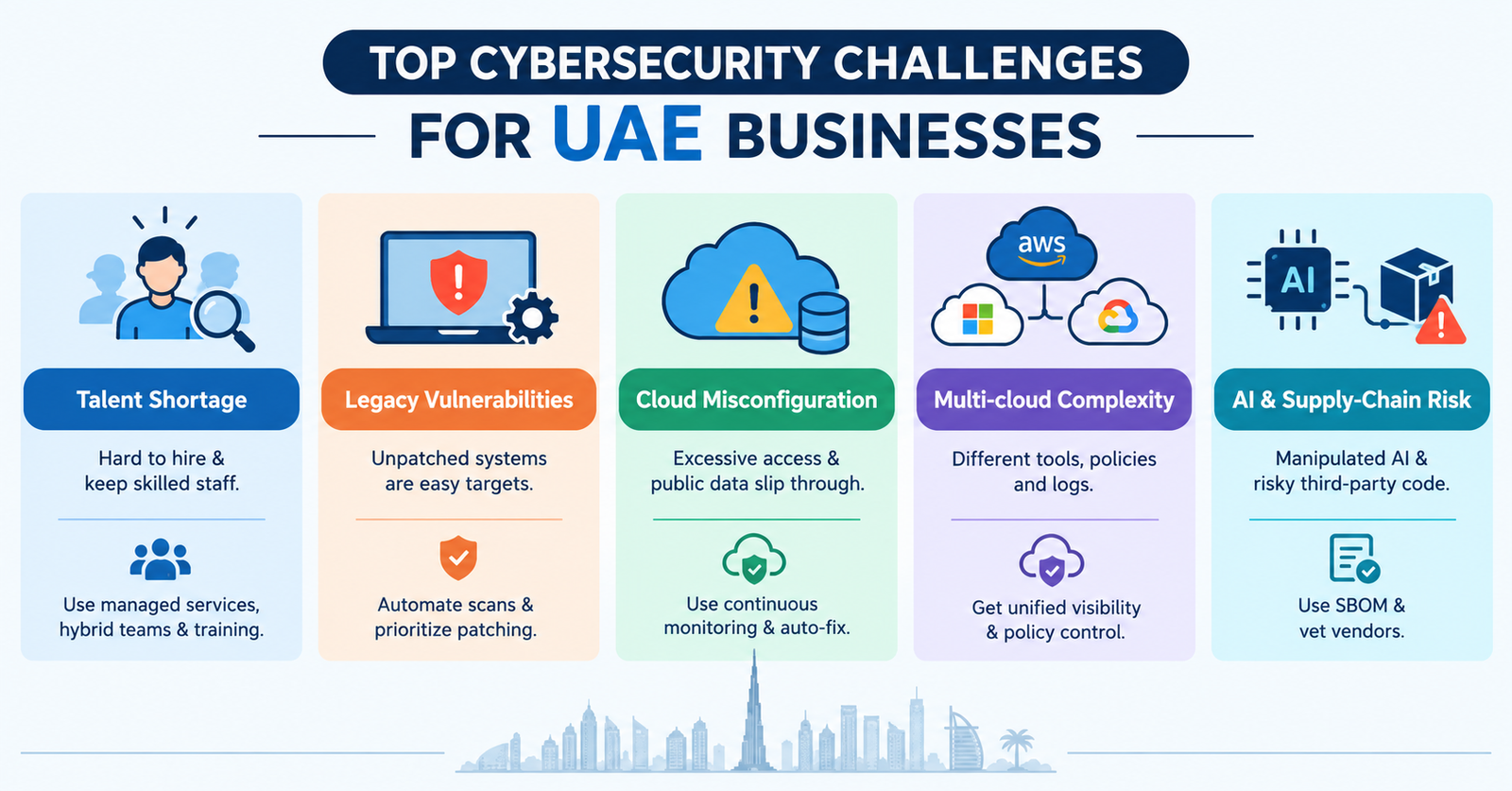
Four challenges come up repeatedly: the talent shortage, legacy vulnerabilities, cloud misconfiguration, and supply-chain risk. Each one shapes how organizations should invest.
The talent gap
Many organizations cannot hire or retain enough skilled security staff. Even when budgets exist, experienced analysts and cloud security engineers are in high demand. The practical responses are managed services, hybrid teams that pair an external provider with internal staff who understand the business, and investment in training for existing employees.
Legacy vulnerabilities and patch debt
Known vulnerabilities remain one of the most exploited weaknesses. Attackers routinely target systems that organizations have not yet patched, often because those systems are difficult to update without disrupting operations. Automated vulnerability management and patch prioritization reduce this exposure, but only if asset inventories are accurate. You cannot patch what you do not know you have.
Cloud misconfiguration
Misconfiguration is common and often invisible. Excessive permissions, publicly exposed storage, weak identity controls, and a lack of continuous monitoring can persist for months without anyone noticing. Continuous posture management and automated remediation for the most frequent issues close much of this gap.
Multi-cloud complexity
Each cloud provider has its own tools, policies, and logs. Without centralized visibility, security gaps appear between platforms, and teams end up managing fragmented controls. Unified cloud security solutions Dubai organizations can rely on usually provide consistent policy enforcement across providers and a single view of risk.
AI and supply-chain risk
AI systems can be manipulated through crafted prompts, poisoned training data, or compromised model components. Software dependencies from npm and PyPI carry their own risks, and third-party vendors can introduce vulnerabilities into otherwise secure environments. A software bill of materials (SBOM) helps organizations know exactly what is running in their systems, which makes it possible to respond quickly when a component is compromised.
How is AI transforming cybersecurity in the UAE?
AI is changing security in five concrete ways: faster detection, automated response, behavioral analytics, better threat intelligence, and more intelligent vulnerability management. Each brings real benefits and real limitations.
Behavioral analytics can flag activity that rule-based systems miss, such as a service account suddenly reading files it has never touched. Threat intelligence synthesis can turn large volumes of external reporting into indicators relevant to a specific organization. AI-driven vulnerability management can rank findings by likely exploitability rather than relying only on severity scores.
The limitations deserve equal attention. AI systems can be wrong, opaque, or overconfident. They depend heavily on the quality of their data, and they introduce new attack surfaces when connected to sensitive systems. The most reliable approach keeps people responsible for significant decisions, logs every automated action, and tests AI systems with the same rigor applied to other critical infrastructure.
Organizations looking for AI automation agency Dubai capabilities should evaluate them on these terms. Useful automation reduces manual work while leaving clear points where humans review and approve. An AI automation agency in Dubai that builds security workflows should be able to explain exactly what its automations can and cannot do.
How are AI and security reshaping key UAE industries?
Security needs differ by sector, and so do the AI use cases that intersect with them. Healthcare, banking, retail, manufacturing, and government each face distinct pressures.
Healthcare
Healthcare organizations combine sensitive patient data with aging infrastructure and tightly connected systems. Multimodal AI supports clinical decision support, medical image and text analysis, and patient data review, but each of these applications expands the set of systems that must be protected.
Healthcare system integrators in Dubai play an important role here. They connect AI tools to electronic records, imaging systems, and scheduling platforms, and each connection is a potential vulnerability if it is not designed securely. Similarly, a healthcare software solution provider in Dubai building AI-enabled applications needs to treat privacy and access control as core design requirements, not features added later.
Banking and financial services
Banks and fintech companies use multimodal AI for fraud detection, document verification, customer intelligence, and security monitoring. These systems analyze transactions, documents, and behavior together, which makes them powerful but also attractive targets. Securing the models, the data pipelines, and the identities that access them is as important as the fraud logic itself.
Retail and e-commerce
Retailers apply AI to visual product search, customer behavior analysis, and personalized experiences. The security concerns here center on customer data, payment environments, and the APIs connecting storefronts, recommendation engines, and third-party services.
Manufacturing and logistics
Predictive maintenance, computer vision, and operational intelligence are improving efficiency in factories and logistics networks. These environments blur the line between IT and OT, so the security approach needs to cover both. A compromised sensor feed or control system can have physical consequences.
Government and smart cities
Video analytics, public safety applications, and citizen services are expanding across the region. These systems handle sensitive data at large scale, and public trust depends on demonstrating that they are secure and governed responsibly.
What does the future of enterprise security look like?
The direction is clear. Security is converging with AI and cloud infrastructure, and the most mature organizations are building systems where protection is continuous rather than periodic. Identity-first and zero trust architectures are becoming the default, and AI-native platforms are taking on more of the routine detection and response work.
Human expertise remains essential. Automation handles volume and speed, while people handle judgment, business context, and accountability. The most effective security teams are hybrid: AI tools operating within clear limits, supported by skilled analysts and a partner who understands the environment.
For UAE enterprises, this means future demand will grow across AI-enabled organizations, not only traditional IT security teams. Providers offering cybersecurity services Dubai businesses rely on will need to show competence in AI, cloud, and identity at the same time.
How do you choose the right cybersecurity partner in the UAE?
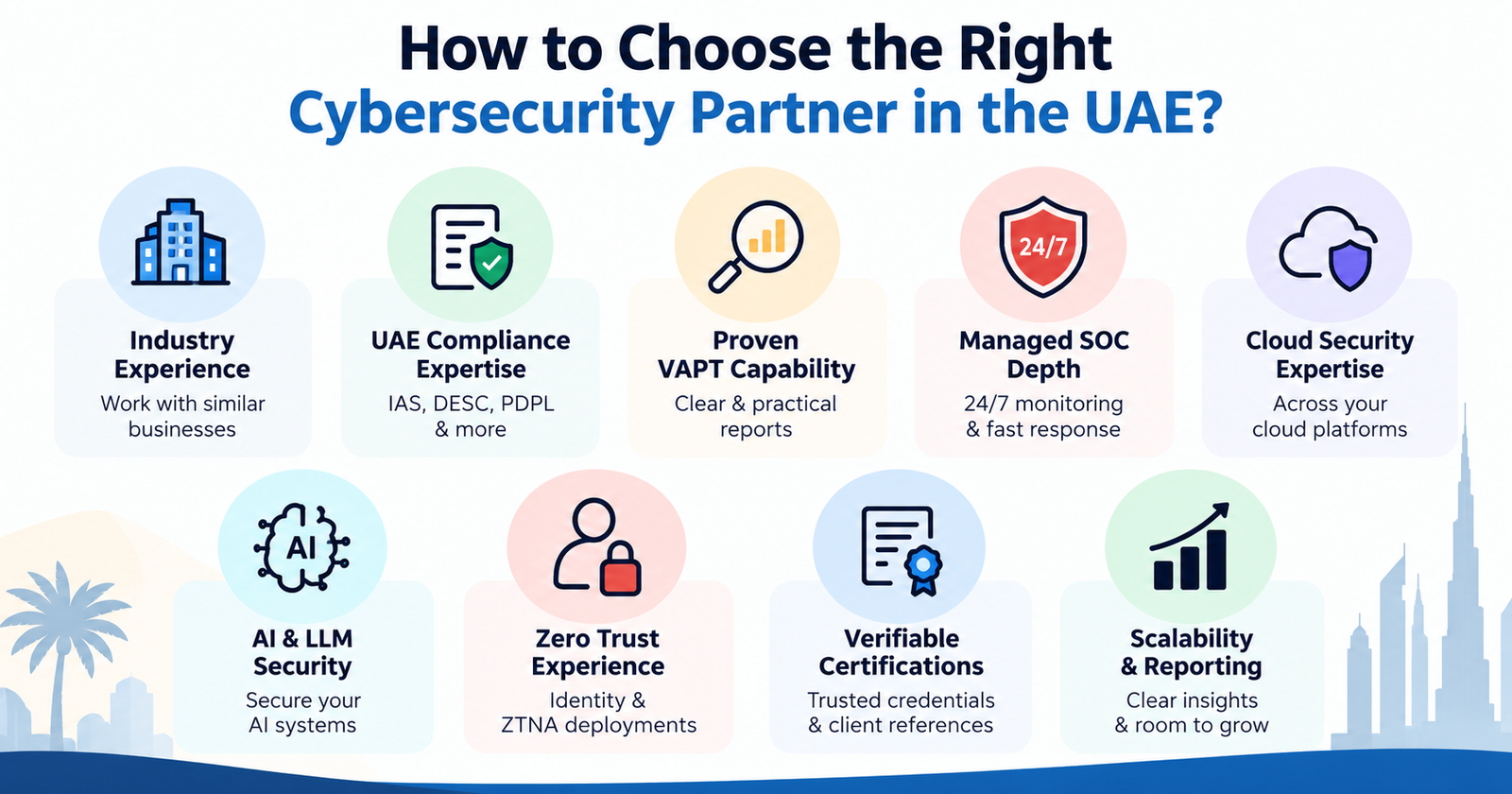
Start with the problem, not the vendor. Define which systems matter most, which regulations apply, and which capabilities you cannot build internally. Then evaluate potential partners against specific criteria.
Look for these qualities:
- Relevant industry experience, especially with organizations similar in size and regulatory exposure.
- UAE compliance expertise, including familiarity with IAS, DESC, PDPL, and sector-specific rules.
- Proven VAPT capability, with sample reports showing how findings are prioritized and explained.
- Managed SOC depth, including 24/7 coverage, incident response procedures, and clear escalation paths.
- Cloud security expertise across the platforms you actually use, not just the ones they promote.
- AI and LLM security capability, if you are building or deploying AI systems.
- Zero trust experience, particularly for identity-centric and ZTNA deployments.
- Verifiable certifications and client references you can contact directly.
- Scalability and reporting, so you can see what is happening and expand coverage as your environment grows.
Ask potential partners how they handle incidents outside working hours, how they manage access to your data, and what happens when their AI tools produce a wrong result. The answers reveal more than any capability list.
What is a practical starting point?
Most organizations do not need to rebuild their security program at once. A sensible sequence begins with visibility: an inventory of cloud accounts, applications, identities, and AI systems. Next comes a risk-based assessment that identifies the most serious exposures, such as excessive cloud permissions or unpatched internet-facing systems. Remediation of those specific risks follows, and then continuous monitoring and periodic testing.
Zero trust, CNAPP, and AI governance can be phased in after that foundation is in place. Attempting everything simultaneously usually produces tool sprawl rather than better security.
Conclusion
AI, cloud, and cybersecurity are now tightly connected, and UAE organizations need security models that are continuous, identity-aware, and grounded in evidence rather than annual checklists. Zero trust, CNAPP, identity threat detection, AI security testing, and automated compliance are where much of the near-term investment will go.
Technology matters, but execution matters more. The organizations that do well will combine sound tools with skilled people, clear governance, and a partner who understands both the threat landscape and the local regulatory environment.
Ready to strengthen your organization’s cybersecurity? Contact us today to build a secure, compliant, and future-ready security strategy.
Frequently asked questions
What are the top cybersecurity trends in the UAE in 2026?
The main trends are AI-native detection and response, multimodal security analysis, agentic automation, zero trust architectures, CNAPP for cloud-native environments, identity threat detection, and continuous security testing. Early preparation for post-quantum cryptography is also gaining attention.
How is AI changing cybersecurity in the UAE?
AI speeds up threat detection, helps analysts triage alerts, supports automated response, and improves threat intelligence. It also creates new risks, including insecure automation and AI-specific attacks, which organizations must manage deliberately.
What is multimodal AI, and how can UAE businesses use it?
Multimodal AI analyzes several data types together, such as text, images, and audio. In security, it helps investigators connect evidence across sources. In banking, healthcare, and logistics, it supports document verification, medical image analysis, and predictive maintenance. A multimodal development services in Dubai provider can help design these systems with security built in.
What cybersecurity services do UAE businesses need?
Most need some combination of VAPT, managed SOC services, cloud security, application security, and compliance support. The right mix depends on their systems, sector, and regulatory obligations.
Why is zero trust important for UAE enterprises?
Hybrid work, cloud adoption, and third-party access have made network perimeters unreliable. Zero trust verifies every access request and limits what an attacker can reach after gaining entry, which is why many organizations now treat zero trust Dubai strategies as a priority.
What is CNAPP, and why does it matter for cloud security?
CNAPP combines posture management, workload protection, and permissions management in one platform. It matters because cloud risks span configuration, identity, and runtime, and separate tools often miss the connections between them.
How can businesses secure AI and LLM applications?
Through threat modeling, LLM-specific penetration testing, input and output controls, least-privilege permissions for AI agents, logging of automated actions, and regular red teaming against the OWASP LLM Top 10.
What are the major UAE cybersecurity compliance requirements?
The UAE IAS, the DESC Information Security Regulation, the PDPL, and CBUAE requirements for financial institutions are among the most common. Sector and emirate can change which apply, so organizations should confirm their scope with qualified advisors.
How can businesses address the cybersecurity talent shortage?
Through managed SOC and MDR services, hybrid models that pair external monitoring with internal oversight, and investment in training for existing staff.
What should businesses look for in a UAE cybersecurity provider?
Relevant experience, UAE compliance knowledge, proven testing and monitoring capabilities, cloud and AI expertise, verifiable certifications, 24/7 incident response, and clear reporting.
Is an AI automation agency useful for security work?
It can be, when its automations are designed with clear limits, human approval points, and full logging. The most useful automation reduces repetitive tasks such as alert enrichment and evidence collection, while leaving consequential decisions to people.