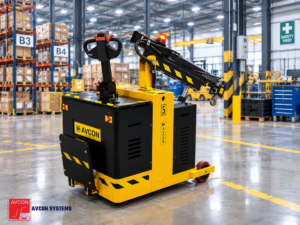
The global autonomous mobile robots market is expanding rapidly as warehouses, factories, and distribution centers turn to automation to manage rising labor costs and surging e-commerce order volumes. Industry estimates value the market at USD 3,530.0 million in 2023, growing to roughly USD 3,997.7 million in 2024, with a projected surge to USD 10,783.9 million by 2031 — a compound annual growth rate of approximately 15.23% across the forecast period.
Self-Navigating Machines Reshaping Logistics
Autonomous mobile robots (AMRs) are self-navigating machines engineered to perform tasks such as material handling, inventory management, and transportation within warehouses, factories, and distribution centers — all while reducing the need for direct human intervention. Unlike fixed automation systems bolted to a single location, AMRs use onboard sensors, mapping software, and increasingly sophisticated AI to navigate dynamic environments, adapting their routes around obstacles and changing floor layouts in real time.
E-Commerce Growth and Automation Pressure
The central driver behind this market’s rapid expansion is the twin pressure of rising automation demand and explosive e-commerce growth. As companies work to boost operational efficiency and reduce human error, integrating AMRs into core workflows has become an increasingly attractive solution across logistics, manufacturing, and healthcare settings. The relentless growth of e-commerce has amplified the need for faster, more efficient order fulfillment, pushing retailers and logistics providers to adopt AMRs for material handling, inventory management, and last-mile delivery support.
Regional data illustrates just how fast this shift is occurring. In India, for example, social commerce has significantly reshaped the retail and e-commerce landscape, with market value projected to grow at a compound annual rate of roughly 31%, reaching approximately USD 37 billion by 2025 — a trend that highlights the accelerating reliance on digital-first retail strategies and directly fuels demand for warehouse and fulfillment automation across emerging markets.
High Upfront Investment Remains a Barrier
Despite compelling long-term efficiency gains, the substantial initial investment required to deploy AMR systems — spanning hardware, software, and integration costs — presents a real challenge, particularly for small and medium-sized businesses. Integrating AMRs into existing infrastructure can also prove complex, often requiring significant upgrades to legacy systems to ensure technology compatibility. To address these barriers, many businesses are turning to cost-effective leasing or financing arrangements that reduce upfront capital burden, while partnering with technology providers offering tailored integration solutions to simplify deployment and ensure compatibility with existing operational systems.
AI Advancement and the Rise of Collaborative Robots
Continuous advancement in artificial intelligence and machine learning is significantly enhancing AMR decision-making, navigation precision, and task optimization capability. AI-driven robots can now process large volumes of data in real time, adapting to dynamic environments, optimizing delivery and picking routes, and improving overall operational efficiency in ways that were not feasible even a few years ago.
Alongside this, the rise of collaborative robots — or “cobots” — represents one of the most significant trends reshaping the industry. Unlike traditional industrial robots that operate independently or within isolated safety zones, cobots are specifically designed to work directly alongside human employees, using advanced sensors and AI-powered algorithms to recognize human presence and adjust speed and movement accordingly. This capability allows cobots to perform intricate tasks requiring genuine human-robot interaction, expanding the range of settings where automation can be safely deployed. One recent product launch introduced a versatile collaborative robot for material handling that integrates advanced AI, mobility, and modular manipulation, with early customers spanning major logistics, healthcare, and pharmaceutical organizations.
Segmentation: Transportation and Goods-to-Person Robots Lead
By application, the market spans sorting, transportation, assembly, inventory management, and other tasks. Transportation generated the largest revenue in 2023, at roughly USD 1,317.9 million, driven by growing need for efficient material handling and logistics automation across industries.
By type, the market divides into goods-to-person (GTP) robots, self-driving forklifts, and delivery robots. GTP robots held the largest share in 2023, at approximately 46.74%, owing to their widespread adoption in warehouses for improving picking accuracy and overall operational efficiency, and are projected to reach USD 5,108.0 million by 2031.
By end use — spanning manufacturing, warehousing and logistics, healthcare, retail, and agriculture — the warehousing and logistics segment is expected to post the fastest growth, at a projected CAGR of roughly 16.27%, while manufacturing is projected to reach approximately USD 4,202.5 million by 2031, fueled by rising demand for automated production lines and cost reduction through robotics.
Regional Landscape
North America led the market in 2023, with approximately 36.25% share and a valuation near USD 1,279.6 million, propelled by early adoption of automation technologies across logistics, manufacturing, and healthcare, along with substantial investment in e-commerce infrastructure. The region’s continued emphasis on operational efficiency, combined with ongoing advancements in AI and robotics, is expected to sustain North America’s leading position through the forecast period.
Asia-Pacific is projected to be the fastest-growing region, with a forecast CAGR of roughly 16.55%, reaching an estimated USD 2,440.8 million by 2031. Countries including China, Japan, and South Korea are investing heavily in robotics and automation across manufacturing, logistics, and agriculture. China’s scale in this space is particularly notable — the country produced approximately 430,000 industrial robots in a single recent year, accounting for more than half of global installations over the preceding three years, and held over 190,000 active robot-related patents by mid-2024, representing roughly two-thirds of the global total.
Regulatory Frameworks
Regulatory oversight varies by region. In the United States, the Occupational Safety and Health Administration sets workplace safety standards covering AMR interactions with human workers, training requirements, and hazard prevention protocols. In Europe, the European Commission shapes policy governing the development and deployment of robotic systems across manufacturing, logistics, and healthcare, aiming to ensure safe, effective, and ethical integration of robots into workplaces and public spaces. China’s Ministry of Industry and Information Technology formulates national policy and standards for industrial automation, while Japan’s Ministry of Economy, Trade, and Industry sets guidelines ensuring AMRs meet safety, performance, and operational standards.
Competitive Landscape
The market is highly competitive, featuring established leaders and emerging players including Swisslog Holding, Locus Robotics, Dematic, GreyOrange, Seegrid, Jungheinrich, Rockwell Automation, Starship Technologies, KUKA, FANUC, Boston Dynamics, Ocado Group, Vecna Robotics, Zebra Technologies, and KNAPP. Recent competitive activity includes a sensor technology firm acquiring an AI-based image processing specialist to strengthen its positioning technology portfolio for AMRs, the launch of a new AMR platform featuring AI-based visual navigation that reduces commissioning time and simplifies fleet programming, and multiple substantial funding rounds — including a USD 100 million Series B raise supporting cobot development and a USD 50 million Series D raise accelerating autonomous lift truck technology.
Labor Market Dynamics and Workforce Transition
Persistent labor shortages across warehousing and logistics have become one of the more understated but powerful forces accelerating AMR adoption. Many distribution and fulfillment operations have struggled for years to fill physically demanding, often high-turnover roles, and AMR deployment offers a way to maintain throughput without depending entirely on a workforce that has become increasingly difficult and expensive to recruit and retain. Rather than purely displacing workers, many deployments are reframing human roles toward robot supervision, exception handling, and higher-value tasks — a transition that companies increasingly emphasize in public communications around new AMR rollouts, partly to manage workforce and public perception concerns alongside the underlying efficiency gains.
This labor-market angle also helps explain why healthcare and retail, sectors not traditionally associated with heavy industrial robotics, are emerging as meaningful growth areas within the broader AMR market. Hospitals face similar staffing pressures around routine material transport and supply delivery, while retailers are exploring AMRs for both backroom inventory management and, in more limited pilot programs, direct customer-facing applications such as automated delivery within large retail environments.
Fleet Management Software as a Differentiator
As AMR deployments scale from single-robot pilots to fleets of dozens or hundreds of coordinated units, the sophistication of fleet management software has become an increasingly important competitive differentiator, arguably rivaling the hardware itself in determining overall system value. Effective fleet orchestration requires dynamically balancing robot allocation across changing task priorities, managing charging cycles without disrupting operations, and coordinating traffic flow to avoid bottlenecks in high-density warehouse environments. Vendors that can demonstrate robust, battle-tested fleet management capability at scale are increasingly winning large enterprise contracts over competitors offering comparable hardware specifications but less mature software orchestration layers.
Investment Implications
For investors evaluating this space, the transportation application segment’s current revenue leadership, combined with warehousing and logistics’ fastest projected growth rate, points toward continued near-term concentration of capital around core fulfillment center automation use cases. At the same time, China’s outsized manufacturing scale and patent activity in robotics suggests that component and subsystem supply chains for AMR hardware are likely to remain heavily concentrated in Asia-Pacific even as end-market deployment continues to grow rapidly across North America and Europe — a dynamic worth watching closely for companies assessing supply chain resilience alongside pure market growth potential.
Outlook
As e-commerce continues its global expansion and labor cost pressures persist across manufacturing and logistics, the autonomous mobile robots market is well positioned for sustained double-digit growth through 2031. The pace of adoption will likely be shaped by how quickly integration costs come down and how effectively next-generation AI capabilities — including collaborative robot technology — can extend automation into settings that have traditionally remained too complex or too human-dependent for robotic deployment.