Introduction
Insurance carriers are under increasing pressure to modernize policy administration while keeping operations flexible, efficient, and customer-focused. Yet selecting a new policy platform can become difficult when evaluations focus primarily on feature checklists and vendor presentations.
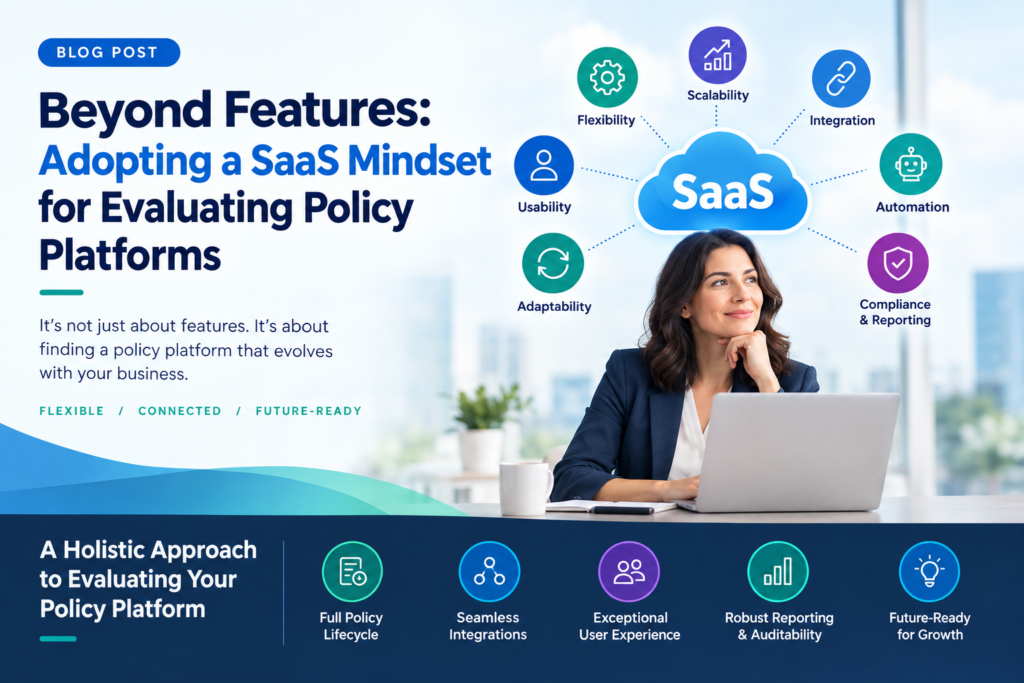
A better approach is to adopt a SaaS mindset for evaluating policy platforms. This means viewing insurance technology as an ongoing business capability rather than a one-time software installation. The focus shifts toward usability, adaptability, scalability, integration, automation, and the platform’s ability to support changing business requirements.
Think Beyond the Initial Implementation
Traditional software evaluations often concentrate on implementation: How long will deployment take? What features are available? What will the initial configuration require?
These questions matter, but they don’t tell the whole story.
A SaaS mindset for evaluating policy platforms asks what happens after implementation. Can the insurer introduce new products efficiently? Can business users adjust workflows? Can the platform support increasing transaction volumes? Can new digital capabilities be connected without creating another layer of complexity?
This longer-term perspective can help insurance organizations evaluate technology according to its ongoing business value.
Evaluate Flexibility as a Core Capability
Insurance products and processes change. Companies may introduce new lines of business, modify underwriting rules, update workflows, expand distribution channels, or respond to changing market requirements.
A policy platform should therefore be evaluated for how easily it can accommodate change.
Configuration capabilities can be particularly important. When business processes and policy products can be configured rather than requiring extensive custom development for every change, insurers may have greater flexibility to respond to new requirements.
The SaaS mindset for evaluating policy platforms treats adaptability as an essential part of the buying decision rather than an optional feature.
Look at the Complete Policy Lifecycle
Policy administration is more than issuing a policy.
A meaningful evaluation should consider the entire lifecycle, including quote intake, policy creation, endorsements, servicing, renewals, cancellations, reinstatements, and related customer interactions.
This also provides an opportunity to examine automation. Routine tasks can potentially be streamlined through configurable workflows, allowing employees to focus on activities that require judgment and personal attention.
SimpleINSPIRE is designed around policy lifecycle management, with capabilities intended to help insurers configure, manage, and digitize policy administration processes.
Integration Should Be Part of the Business Strategy
Modern insurers operate within technology ecosystems rather than isolated applications. Policy administration may need to interact with billing, claims, agency systems, customer portals, payment services, data providers, and other InsurTech capabilities.
When evaluating a platform, insurers should ask how easily it can participate in this ecosystem.
An effective integration strategy can help prevent new technology from becoming another isolated system. It can also create opportunities to introduce additional digital services as business needs evolve.
Measure the User Experience
Software can have extensive functionality and still create frustration if users struggle to navigate it.
A SaaS-oriented evaluation should include the experiences of underwriters, agents, producers, customer service representatives, administrators, and policyholders.
Questions worth asking include:
- How quickly can users complete common tasks?
- Is relevant policy information easy to find?
- Can agents and internal teams work from connected information?
- Can customers access appropriate self-service capabilities?
- Does automation reduce repetitive administrative work?
These questions help connect software capabilities with everyday business operations.
Make Reporting and Auditability Part of the Evaluation
Insurance organizations also need reliable operational and financial information.
During evaluation, buyers should examine reporting capabilities, historical information, transaction visibility, reconciliation, and audit requirements.
SimpleINSPIRE includes reporting capabilities designed around operational visibility and auditable financial information, including the ability to reproduce reports for historical periods.
Rather than treating reporting as a secondary feature, insurers can consider it part of the platform’s overall operational foundation.
Evaluate the Platform for Tomorrow’s Business
The most useful software evaluation does not end when the purchasing decision is made.
Insurers should consider how the platform may support future products, new distribution models, additional integrations, automation initiatives, and changing customer expectations.
That is the real value of a SaaS mindset for evaluating policy platforms: evaluating technology as an evolving business capability instead of a static application.
A thoughtful selection process can compare vendors using real-world scenarios, measurable requirements, integration needs, user experiences, implementation considerations, and future growth plans.
For insurance organizations exploring modernization, this approach creates a more practical way to understand whether a policy platform can support both today’s operations and tomorrow’s opportunities.
Frequently Asked Questions
What does a SaaS mindset for evaluating policy platforms mean?
It means evaluating insurance software as an ongoing technology capability rather than focusing only on the initial implementation. It considers flexibility, scalability, usability, integrations, automation, support, reporting, and long-term business needs.
Why is flexibility important in a policy management platform?
Insurance products, processes, regulations, and customer expectations can change. Flexible platforms can make it easier for insurers to adapt their operations as requirements evolve.
What should insurers examine during a policy platform demonstration?
Insurers should use realistic scenarios involving policy creation, servicing, endorsements, renewals, cancellations, integrations, reporting, automation, and customer or agent interactions.
Why are integrations important when selecting policy software?
Policy administration is typically connected to multiple business systems. Integration capabilities can help create connected workflows and allow insurers to expand their technology ecosystem over time.
Should reporting be included in software evaluation?
Yes. Reporting can support operational management, financial reconciliation, historical analysis, and audit requirements. It should be evaluated alongside core policy administration capabilities.
How can insurers make a vendor evaluation more practical?
Create a consistent set of business scenarios and requirements, then ask each shortlisted vendor to demonstrate how its platform handles those scenarios. This allows stakeholders to assess technology against actual operational needs rather than feature lists alone.
v