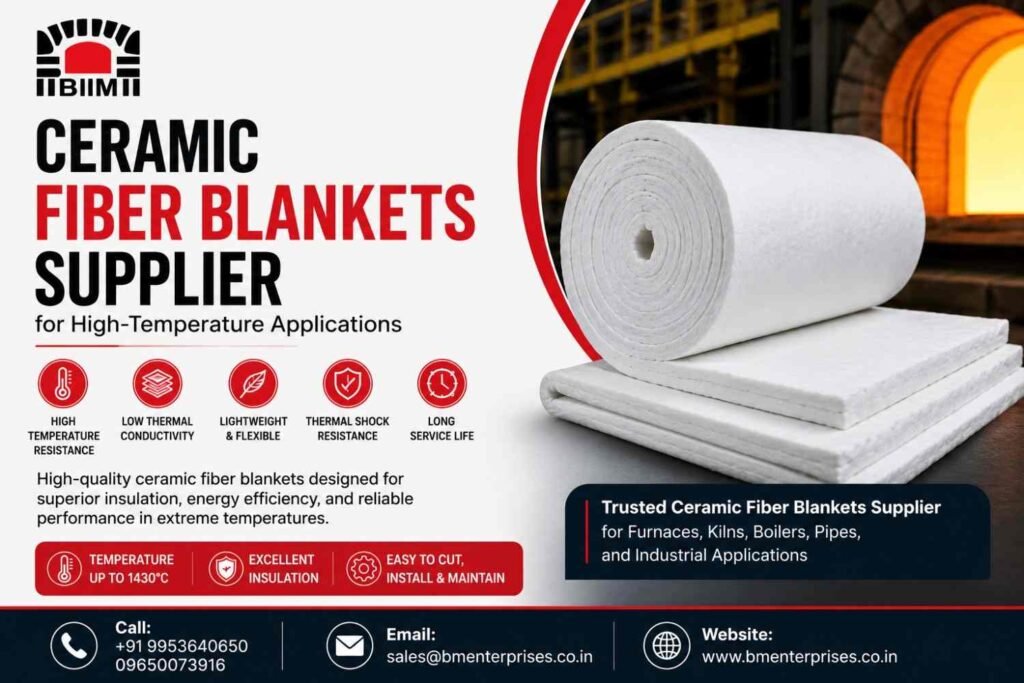
In cases where industrial machinery works under heated conditions, insulation becomes an integral component of the complete thermal system. Ceramic fiber blankets are refractory insulations made to minimize heat loss in addition to giving reliable service. The insulating blankets are used in furnaces, kilns, boilers, heaters, pipes, ducting, and other heated industrial machinery requiring flexibility combined with insulation qualities. According to the type, the blankets available in the market can have classification temperatures ranging between about 1260°C and 1450°C or even more, while densities of the commercially available blankets include 64, 96, 128, and 160 kg/m³.
BM Enterprises offers refractory and insulation materials for industrial use, where the ceramic blankets are chosen when efficient thermal insulation, ease of handling, and temperature resistance are needed. The company strives to offer suitable material according to the needs of the user rather than treating all the insulating requirements in one way. This becomes important since the furnace lining, boiler insulation, pipe wrapping, and maintenance needs require different thicknesses, densities, and temperature grades. Using the correct material, it becomes possible to make an insulation system that controls the heat loss and protects the surrounding machinery.
Why Ceramic Fiber Blankets Are Used for High-Temperature Insulation
The main benefit of using ceramic fiber blankets as the material for the insulating lining is their capability of providing insulation properties without being heavy and rigid as most refractories do. The material comes as a flexible fibrous blanket that can be supplied in rolls that allows it to accommodate itself to any curved surfaces or geometries of equipment. Data from the technical specification provided by producers shows that grades of 128 kg/m³ can possess fairly good properties of thermal conductivity and sufficient mechanical strength to perform a variety of insulation applications. Such flexibility becomes highly appreciated in cases where an insulation system must be mounted on pipes, shells of furnaces, ducts, parts of boilers, equipment with bends and joints. Rather than cutting out rigid shapes from some refractory material, installers can easily cut flexible blankets in the necessary shape and put them in place. This results in a much easier mounting procedure with a minimal number of complicated joints. The lightweight of ceramic blankets, as compared to dense refractory linings, is also worth mentioning in this context.Lightweight Construction and Low Thermal Conductivity
Thermal conductivity is one of the key parameters that should be considered when assessing the insulation. The use of a material having a low value of thermal conductivity could help to prevent the passage of heat energy through the insulation and ensure that there will be a temperature difference between the hot side and the cool surface outside. Thermal conductivity of 128 kg/m³ ceramic fiber blanket grades, according to published technical literature, is influenced by temperature and type of material. According to some Indian technical literature, the thermal conductivity is 0.15 W/mK at a mean temperature of 600°C. Lower losses of heat energy through the walls of equipment could help with improving thermal conditions. For an industrial enterprise where equipment operates continuously for a very long period of time, it could be an important advantage. This is the reason why ceramic insulation blankets are used as thermal insulation materials for high temperatures.BM Enterprises as a Ceramic Fiber Blankets Supplier in India
BM Enterprises provides industrial refractories and insulating products to those clients who want reliable materials suitable for high temperatures. As a ceramic fiber blanket manufacturer in India, BM Enterprises will assist customers in identifying the right blanket, taking into account their temperature, density, thickness, equipment, and installation conditions. Customers need to pay attention not only to the temperature rating of the product, but to its full specification and application conditions. A standard ceramic fiber blanket could have several grades in terms of density and thickness. Product information obtained from Indian manufacturers indicates that 128 kg/m³ blankets could come in several thicknesses such as 12 mm, 20 mm, 25 mm, and 50 mm. Other manufacturers offer their blankets in standard and customized dimensions according to the grade and order condition.Product Quality and Technical Selection
Insulation should first be correctly specified. A blanket with a classification temperature of 1260°C should not just be chosen in every case when there is a need to insulate something at the proximity of this temperature, since the maximum classification temperature and the suggested continuous operating temperature are not always the same. For instance, a published product line offers a classification temperature of 1260°C with an operating temperature of about 1050°C in one grade, while other grades offer higher performance with different operating temperatures. Thus, BM Enterprises can deliver material based on the industrial demand. It will help potential buyers to evaluate technical aspects before buying. The buyer should provide the operating temperature, thickness of insulation, equipment dimensions, and its purpose.Key Features of Ceramic Fiber Blankets
- Resistance to high temperatures: Intended for use in demanding insulation for high temperatures in different temperature grades.
- Low thermal conductivity: Aids in minimizing thermal losses from the system.
- Lightweight construction: Easier to handle, transport, cut, and install than many heavy refractory materials.
- Flexible and soft: Conforms easily to different shaped and irregular surfaces.
- Good thermal insulation: Provides good insulation for keeping process temperature in control.
- Resistance to thermal shock: Applicable in applications that have repeated heating and cooling of material.
- Less heat storage: Lightweight fibrous structure allows quick heating and cooling of equipment.
- Easy installation: Can be cut to desired size and shape and fitted on different equipment.
- Chemical stability: Can be used in most industrial applications if the proper grade is chosen.
- Different density and thickness: Can be selected depending upon temperature, insulation requirement, and application.
Ceramic Fiber Blanket Density and Specifications
- Standard densities: There are four options available based on the type of products: 64, 96, 128, and 160 kg/m³.
- 128 kg/m³ density: One of the most common types that provides a good balance of insulating properties, flexibility, and tensile strength.
- Temperature grades: Various grades are available, usually starting from about 1260°C to 1430°C.
- Thickness grades: Most common thicknesses are: 12 mm, 20 mm, 25 mm, 50 mm, and others based on the need.
- Roll Form: Rolls of flexible material that can be easily cut to fit.
- Sizes: Standard sizes are available, but special sizes can be provided as per the needs.
- Heat conductivity: Provides low heat transfer to ensure good high-temperature insulation.
- Fiber composition: There are two types of fibers based on the need, including alumino-silicate and higher types of fibers.
- Low shrinkage: Special types of products are available that ensure dimensional stability under prolonged use.
- Selection of Specifications: Density, thickness, temperature grade, and operational conditions must be taken into account.
Ceramic Fiber Blanket Density 128 kg/m3 Supplier
128 kg/m³ blanket is the density of a commonly used ceramic fiber blanket in industry. This is evident from the published uses of a ceramic blanket of this density, which include furnace door seal, glass furnace crown insulation, heat processing systems, boiler and incinerator lining, and general insulation applications. When buying from a Ceramic fiber blanket density 128 kg/m3 supplier, it is important that one provides full details of their needs rather than just asking for density. The temperature grade, thickness, width, length, and application are all determining factors. BM Enterprises can help you identify the right specification for your requirements.Common Industrial Applications
- Insulation for furnaces: Ideal for use on walls, roof, doors, backup insulation, and selected repair jobs.
- Insulation for kilns: Ideal for industrial kilns and heat treatment.
- Boiler insulation: Ideal for reducing heat loss in boilers and high-temperature components.
- Pipe insulation: Flexibility of design allows use on pipes and other curved surfaces.
- Insulation for ductwork: Ideal for use on high-temperature ductwork and exhaust systems where appropriate.
- Heat-treatment equipment: Thermal insulation for equipment running at high temperatures.
- Foundry applications: Selected furnace, ladle, and thermal processes insulation.
- Glass industry: Use in suitable high-temperature furnace and process equipment.
- Ceramic industry: Used for Kiln lining, insulation, and maintenance of furnaces.
- Industrial maintenance and repairs: Ideal for replacement or additional insulation in damaged areas.
- Insulation for furnace doors and expansion joints: The flexible nature allows some expansion.
- Back-up insulation: Can be installed behind suitable refractory hot-face materials to improve the overall insulation system.