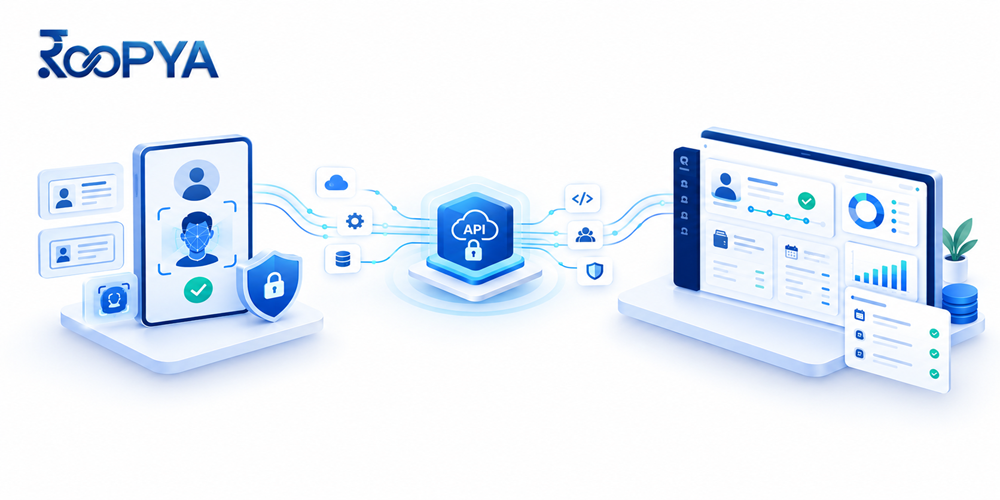
Integrate digital KYC with your loan management system for faster onboarding, lower fraud, and RBI-compliant lending. See how Roopya's LMS streamlines e-KYC, V-CIP, and document verification.
Why KYC Is the Foundation of Modern Lending
Know Your Customer (KYC) verification is the first and most critical checkpoint in any lending relationship. Before a bank or non-banking financial company (NBFC) disburses a single rupee, it must confirm who the borrower is, verify that their identity documents are genuine, and screen them against fraud and regulatory watchlists. For decades, this process was manual: physical copies of Aadhaar, PAN, and address proof were collected, photocopied, stamped, and filed, often taking days to clear before a loan application could even begin underwriting.
That model no longer fits the pace at which digital lending operates. Borrowers today expect loan decisions within minutes, not days, and lenders are under growing pressure from the Reserve Bank of India (RBI) to strengthen fraud controls while simultaneously reducing turnaround time. Digital KYC integration with loan management software resolves this tension. By embedding identity verification directly into the loan origination workflow, lenders can validate a borrower’s identity in near real time, reduce operational cost, and stay compliant with RBI’s KYC Master Directions, all without adding friction to the customer journey.
This guide explains what digital KYC integration actually involves, how it fits inside a loan management system (LMS), what technical and regulatory considerations matter, and how banks and NBFCs can plan an integration that is secure, compliant, and scalable.
What Is Digital KYC Integration in a Loan Management System?
Digital KYC integration refers to connecting a loan management system to one or more electronic identity-verification services through APIs, so that identity checks happen automatically as part of the loan application process rather than as a separate manual step handled by back-office staff.
In a typical integrated flow, when a borrower applies for a loan through a web portal, mobile app, or a loan officer’s dashboard, the LMS triggers KYC verification calls in the background. These calls may include Aadhaar-based e-KYC, PAN validation, bank account verification, document OCR and authenticity checks, facial recognition and liveness detection, and in higher-risk cases, a live Video-based Customer Identification Process (V-CIP) session. The results are captured directly inside the borrower’s loan file, timestamped, and stored as an auditable compliance record — with no manual data entry and no physical paperwork required.
The distinction that matters here is integration versus a standalone tool. Many lenders already use KYC verification tools, but if those tools operate outside the LMS, staff must manually copy results into the loan file, which reintroduces delay and human error. True integration means KYC status, verified data fields, and supporting documents flow automatically into the borrower’s record inside the LMS, and loan underwriting rules can reference that KYC status directly — for example, blocking disbursal until KYC is marked ‘verified’.
Why Digital KYC Integration Matters for Banks and NBFCs
1. Faster Loan Turnaround Time
Manual KYC verification, including physical document collection and back-office checking, commonly takes one to three business days. API-driven digital KYC reduces this to seconds or minutes for standard e-KYC, and to under ten minutes for video-based verification. For NBFCs competing in categories like personal loans, gold loans, and MSME lending, this speed difference directly affects conversion rates, since a meaningful share of applicants abandon a loan application if onboarding takes too long.
2. Stronger Regulatory Compliance
The RBI’s Master Direction on KYC requires regulated entities to verify customer identity using officially valid documents before establishing an account or lending relationship, and it explicitly recognizes Aadhaar-based e-KYC and V-CIP as acceptable digital verification methods. An LMS with integrated digital KYC can enforce these rules systematically — for instance, by preventing loan disbursal until KYC status is confirmed, automatically re-verifying KYC at prescribed periodic review intervals, and generating audit-ready compliance reports for regulatory inspection.
3. Reduced Fraud and Identity Risk
Digital KYC integration allows lenders to cross-verify submitted identity data against government-linked or bank-verified sources in real time, rather than relying on a human reviewer’s visual inspection of a photocopy. Liveness detection and facial matching make it significantly harder for fraudsters to use stolen or synthetic identities, and integration with PAN and credit bureau checks can flag mismatches between a borrower’s declared identity and their financial history before disbursal.
4. Lower Operational Cost
Manual KYC review requires dedicated back-office staff to check documents, re-key data, and follow up on incomplete submissions. Automating this through API integration reduces the manual workload substantially, freeing credit and operations teams to focus on underwriting decisions and collections rather than data entry and document chasing.
5. Better Borrower Experience
A borrower who can complete KYC from their phone in a few minutes, without visiting a branch or emailing scanned documents, is far more likely to complete the application and view the lender favorably. This matters most for digital-first lenders and NBFCs targeting first-time borrowers, gig-economy workers, and MSMEs, where a smooth onboarding experience is often a decisive factor in customer acquisition.
Core Components of a Digital KYC Integration
Aadhaar-Based e-KYC
Aadhaar e-KYC allows a borrower to authenticate their identity using an OTP sent to their Aadhaar-linked mobile number or through biometric authentication. Once authenticated, demographic data such as name, address, date of birth, and photograph are fetched electronically and populated directly into the borrower’s loan application, eliminating manual data entry errors.
PAN Verification
PAN verification confirms that a borrower’s PAN is valid, active, and matches the name provided, and it is also used to check for linkage with Aadhaar as required under current regulations. This step is typically a prerequisite for loan amounts above regulatory reporting thresholds and for credit bureau checks.
Video KYC (V-CIP)
Video-based Customer Identification Process is used where in-person-equivalent verification is required, such as for certain account types or where risk scoring flags an application for enhanced due diligence. A live or AI-assisted video session confirms the borrower’s identity, checks document authenticity, and performs a liveness check, with the recording stored as a compliance artifact.
Document OCR and Authenticity Checks
Optical Character Recognition (OCR) extracts data from uploaded documents such as bank statements, utility bills, and address proofs, while authenticity checks look for signs of tampering, such as font inconsistencies, altered metadata, or mismatched security features on government-issued IDs.
Facial Recognition and Liveness Detection
Facial matching compares a borrower’s live selfie or video frame against the photograph on their identity document, while liveness detection ensures the person is physically present and not using a photograph, video replay, or deepfake to spoof the system.
Watchlist and Sanctions Screening
Many LMS-KYC integrations also include automated screening against politically exposed person (PEP) lists, sanctions lists, and internal fraud databases, flagging high-risk applicants for manual review before underwriting proceeds.
How Digital KYC Fits Into the Loan Origination Workflow
A well-designed integration does not treat KYC as an isolated step but weaves it into the broader loan origination system (LOS) and loan management system pipeline. A typical end-to-end flow looks like this:
- Borrower initiates a loan application through a web, mobile, or agent-assisted channel.
- The LMS captures basic applicant details and triggers a KYC verification request via API.
- The KYC provider returns verification results — identity match, document validity, liveness score, and risk flags — typically within seconds.
- Results are written back into the borrower’s loan file inside the LMS, along with a timestamped audit trail.
- Underwriting rules engine checks KYC status as a gating condition before proceeding to credit assessment.
- If KYC fails or triggers a risk flag, the application is routed to a manual review queue instead of being auto-approved.
- Once KYC and underwriting are both cleared, the loan proceeds to sanction and disbursal, with KYC records retained for periodic re-verification as required by RBI norms.
This workflow ensures that KYC is not a bottleneck that borrowers wait on separately, but a parallel, automated gate that either clears quickly or routes exceptions to human reviewers — keeping both speed and compliance intact.
Technical Considerations for Integration
API-First Architecture
Most modern KYC providers and loan management platforms expose REST APIs with JSON payloads, along with webhooks for asynchronous events such as completed video KYC sessions. When evaluating an LMS or KYC vendor, lenders should confirm support for standard authentication methods (OAuth 2.0 or API keys), clear API documentation, and sandbox environments for testing before production rollout.
Integrating with Legacy Core Lending Systems
Many banks and NBFCs still run core lending or legacy LMS platforms that were not originally designed for API-based integration. In these cases, an API gateway or middleware layer can sit between the legacy core and the KYC provider, translating data formats and managing authentication without requiring a full platform replacement. This approach allows institutions to modernize KYC workflows incrementally rather than undertaking a disruptive core system migration.
Data Security and Encryption
KYC data includes highly sensitive personal identifiers, so integrations must encrypt data in transit (TLS 1.2 or higher) and at rest, apply strict role-based access controls within the LMS, and mask or tokenize sensitive fields such as Aadhaar numbers wherever full values are not operationally required, in line with UIDAI’s data-minimization guidance.
Audit Trails and Data Retention
Every KYC verification event — API call, response, timestamp, and reviewer action — should be logged immutably within the LMS to support regulatory audits. RBI guidelines require KYC records to be retained for a minimum period after account closure, so the LMS must support long-term, tamper-evident record storage.
Handling API Failures and Fallbacks
KYC verification calls can fail due to provider downtime, poor connectivity on the borrower’s side, or data mismatches. Integrations should include retry logic, clear borrower-facing error messages, and a fallback path to manual or assisted KYC so that a temporary API failure never becomes a permanent block on loan processing.
Regulatory Framework Lenders Must Account For
Digital KYC integration in India operates within a defined regulatory framework that any LMS implementation must respect:
- RBI Master Direction on KYC — sets out the requirements for customer identification, including recognition of Aadhaar e-KYC and V-CIP as valid digital verification methods.
- Prevention of Money Laundering Act (PMLA) — requires ongoing customer due diligence, suspicious transaction monitoring, and record retention.
- Aadhaar Act and UIDAI regulations — govern how Aadhaar data can be collected, stored, and used, including consent and data-minimization requirements.
- Digital Personal Data Protection Act (DPDPA) — establishes broader data privacy obligations for handling borrower personal data collected during KYC.
Because these requirements evolve, lenders should treat KYC integration as a compliance-first project: legal and compliance teams should review the chosen KYC provider’s certifications and data-handling practices before integration begins, not after go-live.
Choosing the Right KYC Integration Partner for Your LMS
When evaluating KYC providers to integrate with a loan management system, banks and NBFCs should assess several factors beyond raw feature checklists:
- Regulatory alignment: Does the provider support RBI-recognized methods (Aadhaar e-KYC, V-CIP) and maintain UIDAI authorization where applicable?
- Integration depth: Does the LMS allow KYC status to directly gate underwriting and disbursal workflows, or does it require manual status updates?
- Latency and uptime: What are the provider’s documented response times and service-level guarantees for API calls?
- Scalability: Can the integration handle peak-season application volumes, such as festive-season personal loan demand, without degraded performance?
- Data residency and security certifications: Is data stored within India where required, and does the provider hold relevant security certifications?
- Support for multiple verification methods: Does the system support a risk-based mix of e-KYC, document verification, and video KYC rather than a single rigid method?
Roopya’s Approach to KYC-Integrated Loan Management
Roopya (roopya.money) is built as a loan management system for banks and NBFCs with compliance and speed designed in from the ground up, rather than bolted on afterward. Digital KYC verification is embedded directly into the loan origination workflow, so identity checks, document verification, and risk flags become part of the same system that handles credit assessment, sanction, disbursal, and collections — not a separate tool that operations staff must reconcile manually.
This means underwriting rules can reference live KYC status, audit trails are generated automatically for every verification event, and lenders retain full visibility into where each application stands in the compliance pipeline at any given moment. For banks and NBFCs evaluating how to modernize onboarding without a disruptive core-system replacement, this kind of embedded integration is typically the fastest path to measurable gains in both turnaround time and compliance confidence.
Common Challenges and How to Address Them
Challenge: Inconsistent data across multiple KYC sources
When Aadhaar, PAN, and bank-verification data don’t perfectly match (a common issue with name spelling variations), the LMS should apply configurable fuzzy-matching thresholds rather than rejecting applications outright, routing borderline cases to manual review instead of hard failure.
Challenge: Rural and low-connectivity applicants
Video KYC and OTP-based e-KYC can be difficult for borrowers with poor network connectivity. Offering assisted KYC through agent-led onboarding, alongside fully digital self-service options, helps maintain inclusion without compromising verification standards.
Challenge: Balancing friction and fraud prevention
Adding too many verification steps can cause legitimate borrowers to abandon applications, while too few steps increases fraud exposure. A risk-based approach — where low-risk, low-ticket loans use lightweight e-KYC and higher-risk or higher-value loans trigger additional video KYC or manual review — tends to balance both concerns effectively.
Digital KYC integration is no longer a competitive differentiator for banks and NBFCs; it is fast becoming a baseline requirement for operating a compliant, efficient lending business in India. Lenders that embed KYC verification directly into their loan management system, rather than running it as a disconnected side process, gain faster turnaround times, stronger fraud protection, lower operating costs, and a clearer audit trail for regulators — all while giving borrowers the fast, low-friction onboarding experience they now expect.
Whether you are modernizing a legacy core lending system or building a new digital lending stack from scratch, the KYC layer deserves the same architectural attention as credit underwriting or collections. Platforms like Roopya are built specifically to make that integration straightforward for banks and NBFCs operating under RBI’s regulatory framework.
Frequently Asked Questions
| What is digital KYC integration in a loan management system? |
| Digital KYC integration means connecting a loan management system (LMS) directly to electronic identity-verification services — such as Aadhaar e-KYC, PAN verification, video KYC, and document OCR — so that borrower identity checks happen inside the loan origination workflow instead of through manual, paper-based verification. |
| Is digital KYC mandatory for NBFCs and banks in India? |
| Yes. The Reserve Bank of India’s KYC Master Direction requires regulated entities, including banks and NBFCs, to verify customer identity before establishing an account or loan relationship. Digital KYC methods such as Aadhaar-based e-KYC and Video-based Customer Identification Process (V-CIP) are explicitly recognized as valid means of compliance. |
| How long does digital KYC verification take compared to manual KYC? |
| Manual KYC involving physical document collection and back-office verification often takes one to three business days. API-based digital KYC integrated into an LMS typically completes identity, address, and PAN verification within seconds to a few minutes, and video KYC sessions are usually completed in under ten minutes. |
| Can digital KYC be integrated with an existing legacy LMS? |
| In most cases, yes. Modern KYC and loan management platforms expose REST APIs and webhooks, which allow integration with legacy core lending systems through a middleware or API gateway layer, without requiring a full platform replacement. |
| What documents can be verified through digital KYC? |
| Commonly verified documents include Aadhaar, PAN, passport, voter ID, driving license, bank statements, and utility bills, along with liveness checks and facial matching against the submitted identity document photograph. |
| Does digital KYC reduce loan fraud? |
| Digital KYC reduces several common fraud vectors, including identity impersonation, document forgery, and synthetic identities, by cross-verifying data against government-linked or bank-verified sources and applying liveness and face-match checks that are difficult to fake at scale. |
| What is the difference between e-KYC and Video KYC (V-CIP)? |
| e-KYC typically refers to OTP or biometric-based Aadhaar authentication that instantly confirms identity electronically. Video KYC (V-CIP) is a live, recorded video interaction in which an agent or an AI-assisted system verifies the customer’s identity, document authenticity, and liveness in real time, and is used where in-person-equivalent verification is required. |