Discover how enterprise lending software streamlines loan origination, underwriting, and servicing for banks and NBFCs. Explore features, benefits, and how Roopya.money powers scalable lending operations.
The lending industry has entered a new era. Borrowers now expect loan decisions in minutes, not weeks. Regulators demand tighter compliance and audit trails. Banks and NBFCs (Non-Banking Financial Companies) are under constant pressure to grow their loan books while controlling risk, cutting operational costs, and delivering a seamless digital experience. At the center of this transformation sits one critical piece of infrastructure: enterprise lending software.
Enterprise lending software is no longer a “nice-to-have” back-office tool. It is the operating backbone of a modern lending institution, connecting origination, underwriting, disbursement, servicing, and collections into a single, intelligent system. Financial institutions that still rely on spreadsheets, disconnected point solutions, or legacy core banking modules are finding it increasingly difficult to compete with agile, digitally native lenders.
This guide explores what enterprise lending software is, why it matters, the core modules every platform should have, the benefits it delivers, and how to evaluate the right solution for your institution.
What Is Enterprise Lending Software?
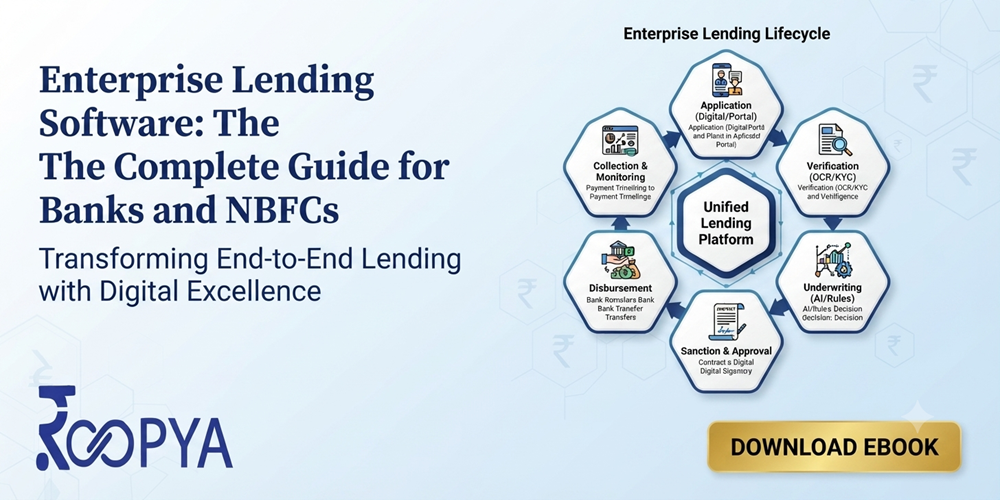
Enterprise lending software is a comprehensive digital platform that manages the entire loan lifecycle — from the moment a borrower applies for credit to the day the loan is fully repaid (or written off). Unlike a simple loan calculator or a basic CRM, an enterprise-grade lending management system (LMS) is built to handle high transaction volumes, multiple loan products, complex regulatory requirements, and integrations with dozens of external systems such as credit bureaus, payment gateways, KYC providers, and accounting software.
At its core, the software typically covers these stages:
- Loan Origination — capturing borrower applications, documents, and initial eligibility checks.
- Credit Underwriting — assessing creditworthiness using credit scores, bureau data, income verification, and custom risk models.
- Approval Workflows — routing applications through configurable approval hierarchies based on loan size, risk category, or product type.
- Disbursement — releasing funds to the borrower’s account, often integrated with core banking or payment rails.
- Loan Servicing — managing repayment schedules, interest accrual, prepayments, restructuring, and statements.
- Collections and Recovery — tracking overdue accounts, automating reminders, and managing recovery workflows.
- Reporting and Compliance — generating regulatory reports, audit trails, and portfolio analytics.
For banks and NBFCs, having all these functions unified in one platform — rather than stitched together from multiple vendors — is what separates enterprise lending software from generic loan origination tools.
Why Banks and NBFCs Need a Dedicated Lending Platform
1. Speed to Market for New Loan Products
Financial institutions frequently need to launch new products — a green energy loan, a supply chain finance product, a co-lending arrangement, or a revised personal loan scheme. Legacy systems often require months of custom development to support a new product. A configurable enterprise lending platform allows product teams to define new loan types, interest structures, and eligibility rules without rewriting code, cutting time-to-market from months to weeks.
2. Regulatory Compliance and Audit Readiness
Lending is one of the most heavily regulated activities in financial services. Institutions must comply with fair lending practices, interest rate disclosure norms, data protection requirements, and reporting obligations to central banks and credit bureaus. A purpose-built lending system embeds compliance checks directly into workflows — automatically calculating APR disclosures, maintaining immutable audit logs, and generating regulatory reports on demand. This reduces the risk of penalties and reputational damage that come from manual, error-prone compliance processes.
3. Risk Management at Scale
As loan books grow, so does exposure to credit risk, operational risk, and fraud. Enterprise lending software incorporates rules engines and scoring models that flag high-risk applications automatically, cross-check applicant data against fraud databases, and apply consistent underwriting logic across every branch and channel. This consistency is difficult to achieve when underwriting decisions rely on individual loan officers using manual checklists.
4. Operational Efficiency
Manual loan processing is expensive. Every hour a loan officer spends chasing documents, re-entering data across systems, or manually calculating amortization schedules is an hour not spent serving customers or growing the portfolio. Automation of document collection, e-KYC, credit checks, and approval routing can cut loan processing time dramatically — often from days to hours — while reducing the headcount required to process the same volume of applications.
5. Superior Borrower Experience
Modern borrowers, whether retail customers or corporate treasurers, expect digital-first experiences: online applications, real-time status tracking, e-signatures, and instant notifications. Enterprise lending software with a strong digital front-end allows institutions to meet these expectations without sacrificing the rigor needed on the back end.
Core Modules of a Modern Enterprise Lending System
Loan Origination System (LOS)
The LOS is the entry point for every loan. It should support multi-channel applications (web, mobile, branch, partner APIs), dynamic application forms based on product type, document upload and verification, and integration with e-KYC and Aadhaar-based verification services where applicable. A strong LOS also supports co-applicant and guarantor workflows, which are common in secured lending.
Credit Underwriting and Decisioning Engine
This module pulls data from credit bureaus, bank statements, GST filings, and internal transaction history to generate a risk score. Enterprise-grade systems allow institutions to configure their own scorecards and decision rules rather than being locked into a vendor’s fixed logic. Some platforms also support machine learning-based risk models that continuously improve as more repayment data becomes available.
Loan Management System (LMS)
Once a loan is disbursed, the LMS takes over — calculating EMIs, tracking principal and interest amortization, handling part-prepayments, foreclosures, and restructuring requests, and generating borrower statements. This module must be flexible enough to support multiple interest calculation methods (reducing balance, flat rate), multiple repayment frequencies, and moratoriums.
Collections and NPA Management
Delinquency management is often the most overlooked but most financially significant module. A good system segments overdue accounts by risk bucket, automates reminder communications (SMS, email, IVR), assigns accounts to collection agents or agencies, and tracks recovery performance. For NBFCs in particular, robust NPA (Non-Performing Asset) tracking and provisioning support is essential for regulatory reporting.
Analytics and Reporting Dashboard
Enterprise lenders need real-time visibility into portfolio health: disbursement trends, delinquency rates, product-wise profitability, branch performance, and regulatory metrics. A centralized dashboard that pulls data from every stage of the loan lifecycle turns raw transaction data into actionable business intelligence.
Integration Layer (APIs)
No lending platform operates in isolation. It must integrate with core banking systems, payment gateways, credit bureaus (like CIBIL, Experian, or Equifax in the Indian context), e-KYC providers, accounting software, and co-lending or securitization partners. A well-documented, API-first architecture is what makes these integrations manageable rather than a perpetual engineering burden.
Key Benefits of Implementing Enterprise Lending Software
Faster loan processing: Automated document verification and underwriting can reduce turnaround time from days to hours, directly improving customer satisfaction and conversion rates.
Lower operational costs: Automation reduces the manual effort required at every stage of the loan lifecycle, allowing institutions to scale their loan book without proportionally scaling headcount.
Improved risk management: Consistent, rules-based underwriting reduces the variability and bias that come with manual decision-making, leading to healthier portfolios.
Better regulatory compliance: Built-in compliance checks and audit trails reduce the risk of regulatory penalties and make audits significantly less time-consuming.
Scalability across products and geographies: A configurable platform allows institutions to launch new loan products or expand into new regions without a complete system overhaul.
Data-driven decision making: Centralized data and real-time dashboards give leadership the visibility needed to make informed decisions about pricing, risk appetite, and growth strategy.
Enhanced customer experience: Self-service portals, real-time application tracking, and faster disbursements build trust and improve borrower retention.
Cloud-Based vs. On-Premise Lending Software
Institutions today generally choose between cloud-based (SaaS) lending platforms and traditional on-premise deployments. Cloud-based platforms offer faster implementation, lower upfront infrastructure costs, automatic updates, and easier scalability — making them attractive for growing NBFCs and fintech-led lenders. On-premise deployments, while requiring more upfront investment, can offer institutions greater control over data residency and customization, which is sometimes a priority for larger banks with strict internal IT policies.
Increasingly, hybrid models are emerging, where core data resides within an institution’s own infrastructure while certain modules — such as analytics or customer-facing portals — run on the cloud. The right choice depends on an institution’s regulatory environment, existing IT infrastructure, and growth plans.
How to Choose the Right Enterprise Lending Software
When evaluating a lending management platform, institutions should consider the following factors:
- Configurability: Can the platform support multiple loan products, interest structures, and workflows without heavy custom coding?
- Compliance readiness: Does the vendor stay current with evolving regulatory requirements relevant to your jurisdiction and lender type (bank, NBFC, microfinance institution)?
- Integration capability: Does the platform offer robust, well-documented APIs to connect with your existing core banking system, credit bureaus, and payment infrastructure?
- Scalability: Can the system handle your projected transaction volume as the loan book grows, without performance degradation?
- Security: Does the platform meet data protection and information security standards appropriate for financial data?
- Vendor support and roadmap: Is the vendor investing in ongoing product development, and do they offer responsive implementation and support services?
- Total cost of ownership: Beyond licensing fees, consider implementation time, training costs, and the cost of future customizations.
How Roopya.money Supports Enterprise Lending Operations
Roopya.money is built specifically for banks and NBFCs that need a reliable, configurable loan management system to run their lending operations end to end. Rather than forcing institutions to adapt their processes to rigid software, Roopya.money is designed around the realities of Indian lending — supporting multiple loan products, flexible interest and repayment structures, integrated KYC and credit bureau checks, and collections workflows suited to varying risk profiles.
For institutions evaluating a shift away from spreadsheets or fragmented legacy systems, Roopya.money offers a path to consolidating origination, underwriting, servicing, and collections into a single, auditable platform — helping lending teams move faster while staying compliant and in control of portfolio risk.
Enterprise lending software has moved from being an operational convenience to a strategic necessity. As competition intensifies and borrower expectations rise, banks and NBFCs that invest in a robust, configurable loan management system position themselves to grow faster, manage risk more effectively, and deliver the digital experience today’s borrowers demand. Choosing the right platform — one that balances configurability, compliance, integration capability, and scalability — is one of the most consequential technology decisions a lending institution will make.
Frequently Asked Questions (FAQ)
Q1. What is enterprise lending software? Enterprise lending software is a comprehensive digital platform that manages the entire loan lifecycle — origination, underwriting, disbursement, servicing, and collections — for banks, NBFCs, and other financial institutions.
Q2. How is enterprise lending software different from a basic loan origination system? A loan origination system typically handles only the application and approval stage. Enterprise lending software covers the full lifecycle, including servicing, collections, compliance reporting, and integrations with core banking and third-party systems.
Q3. Is cloud-based lending software secure enough for banks and NBFCs? Reputable cloud-based lending platforms implement bank-grade security measures, including data encryption, role-based access controls, and compliance with applicable data protection regulations, making them suitable for regulated financial institutions.
Q4. Can enterprise lending software support multiple loan products? Yes. Modern platforms are built to be configurable, allowing institutions to define multiple loan products with different interest structures, eligibility criteria, and repayment schedules without custom development for each product.
Q5. How long does it take to implement enterprise lending software? Implementation timelines vary based on the complexity of integrations and the number of loan products, but cloud-based platforms generally allow institutions to go live faster than traditional on-premise systems, often within a few weeks to a few months.
Q6. Does enterprise lending software help with regulatory compliance? Yes. These platforms typically include built-in compliance checks, audit trails, and automated regulatory reporting features that reduce manual compliance effort and the risk of errors.
Q7. What integrations should enterprise lending software support? At a minimum, it should integrate with credit bureaus, e-KYC providers, payment gateways, core banking systems, and accounting software. API-first platforms make these integrations easier to manage over time.
Q8. Is enterprise lending software suitable for NBFCs, or only large banks? Enterprise lending software is suitable for institutions of all sizes, including NBFCs and microfinance institutions. Many platforms, including Roopya.money, are designed to scale with an institution’s growth rather than requiring a large upfront commitment.