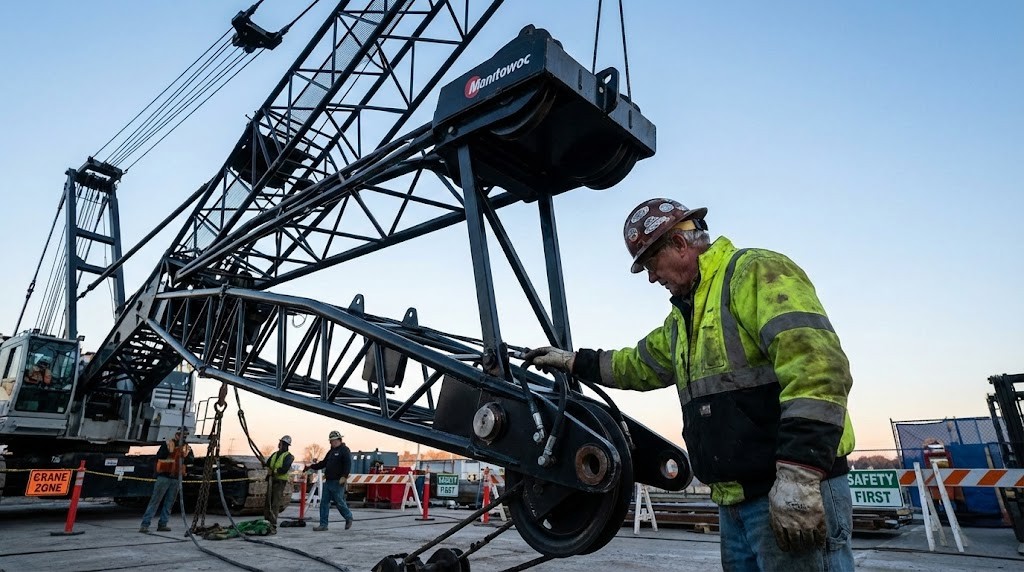
Safety messaging permeates every modern construction environment. Warning signage. Pre-task planning. Behavior-based observation. Near-miss reporting. Yet accident investigation boards consistently reach familiar conclusions. A component succumbed to environmental stress earlier than anticipated. A replacement part lacked corrosion resistance specifications. A system exposed to harsh conditions degraded unpredictably.
This convergence of findings highlights why material specification and component sourcing demand rigorous attention.
Professionals maintaining Manitowoc equipment in demanding environments understand these machines face extraordinary challenges. Marine atmospheres. Chemical exposure. Thermal cycling. Abrasive particulates. But crane safety extends far beyond visible structural elements. It depends on hundreds of individual components maintaining dimensional stability and functional integrity despite aggressive environmental attack.
The chemistry of hidden failure
Serious crane failures rarely announce themselves dramatically. They develop through electrochemical and mechanical processes that progress beneath surface observation.
A slightly dissimilar metal pairing accelerates galvanic corrosion in structural joints. An unauthorized coating system fails to protect substrate steel in salt-air environments. A sensor housing seal degrades under ultraviolet exposure, permitting moisture ingress. These conditions don’t trigger immediate operational cessation. They introduce progressive capability degradation that accumulates invisibly.
Genuine Manitowoc crane parts incorporate specified material grades, protective coatings, and sealing technologies validated for anticipated environmental exposure. This environmental compatibility allows technical staff to establish justified confidence in long-term performance. When components lack appropriate environmental resistance, that confidence proves misplaced. And when confidence fails, safety margins erode without visible warning.
Metallurgical precision under stress
Crane components function within critically defined material properties. Minor metallurgical deviations produce significant performance consequences. High-strength fasteners require controlled hardness to prevent hydrogen embrittlement in corrosive service. Hydraulic cylinder rods depend on chrome plating thickness and adhesion to resist scoring and seal damage. Structural castings must maintain impact resistance across operating temperature ranges. Electronic enclosures need gasket materials that maintain elasticity despite thermal aging and chemical exposure.
Specification-compliant Manitowoc crane parts incorporate these material science requirements. When substitution parts vary metallurgically, even within apparent dimensional tolerances, they modify corrosion resistance, fatigue life, and environmental degradation rates.
These variations frequently escape detection during initial installation and bench testing. They manifest after months of environmental exposure, often during demanding operations when safety reserves face maximum demand.
Degradation predictability in harsh environments
Experienced maintenance personnel develop environmental degradation models through field observation. These models require that material behavior follows established patterns.
With authentic Manitowoc crane parts, environmental degradation follows characterized progressions. Protective coatings fail through recognizable mechanisms. Corrosion initiates at predictable locations. Seal aging produces characteristic symptoms. Condition monitoring reveals meaningful trend data appropriate to exposure severity.
Alternative components frequently exhibit unfamiliar environmental degradation modes. They may corrode rapidly in specific microenvironments, lose protective coatings through adhesion failure, or degrade through unanticipated chemical mechanisms. This unpredictability complicates inspection planning and risk assessment significantly.
Technical decisions in corrosive or contaminated environments depend on accurate degradation rate projection. Predictable material behavior supports sound maintenance planning. Unpredictable behavior corrupts it.
Environmental sealing in safety systems
Modern Manitowoc cranes deploy electronic safety systems requiring environmental protection. Load moment computers, angle sensors, limit switches, and control modules must maintain calibration and response integrity despite moisture, dust, and temperature extremes.
These systems assume that enclosure sealing and connector integrity prevent environmental degradation of sensitive components. A compromised cable gland permits moisture migration along conductor strands. An inferior potting compound develops cracks under thermal cycling. A non-standard gasket material shrinks or swells, breaking environmental seals.
When environmental protection fails, safety systems may provide erroneous data or intermittent response without diagnostic indication. Genuine Manitowoc crane parts incorporate validated environmental protection appropriate to service conditions.
Assembly compatibility in aggressive environments
Thorough installation practices are essential environmental defenses. However, technician capability cannot compensate for material incompatibility.
Proper Manitowoc crane parts incorporate specified surface preparations, thread compounds, and assembly lubricants appropriate to anticipated exposure. Fastener coatings resist galling and seizing. Thread sealants maintain pressure integrity. Assembly lubricants prevent fretting corrosion at interfaces. The installed component maintains functional integrity despite environmental stress.
When assembly requires unspecified compounds or procedures to achieve fit, environmental degradation accelerates at unanticipated locations. Corrosion initiates beneath improper thread sealants. Fretting damages bearing surfaces. Stress corrosion cracking develops at residual stress concentrations.
Environmental reliability and operational continuity
Unplanned maintenance in aggressive environments generates compounded difficulties. Weather windows contract. Access challenges intensify. Contamination risks increase during disassembly.
Components with uncertain environmental resistance contribute directly to this operational pressure. Even routine replacement demands become unpredictable. Schedule reliability suffers. Safety vigilance erodes under operational stress.
Reliable Manitowoc crane parts sustain operational continuity in demanding environments. They enable maintenance planning that accounts for environmental exposure appropriately. This relationship between material specification and safety management deserves enhanced recognition in harsh service applications.
Supply chain verification for environmental service
Components specified for environmental resistance require procurement verification. Documentation matters. A knowledgeable crane parts supplier provides essential risk reduction through material certification, coating specification verification, environmental rating confirmation, and application guidance. These capabilities ensure that components entering service match environmental demands.
When crane parts supplier documentation proves inadequate, consequences manifest in service. Premature coating failure. Unexpected corrosion modes. Seal degradation. Safety margins erode through material incompatibility rather than operational overload.
Environmental experience informs specification
Professionals operating in marine, chemical, or extreme climate environments consistently report similar observations. Equipment failures frequently trace to material specifications inadequate for actual exposure. Components that performed adequately in benign conditions failed rapidly in aggressive service.
Often, these failures originated from substitution parts lacking appropriate environmental ratings. Inadequate corrosion protection. Unsuitable seal materials. Coating systems incompatible with specific contaminants.
Authentic Manitowoc crane parts incorporate environmental specifications validated for demanding applications. They cannot eliminate environmental degradation—material science precludes that. But they ensure degradation progresses predictably, permitting maintenance intervention before safety-critical failure.
Environmental safety through material discipline
Comprehensive job site safety in demanding environments emerges from material specification discipline. Appropriate component selection for exposure conditions. Correct assembly with specified protective compounds. Systematic inspection targeting environmentally induced degradation. Responsive maintenance before functional compromise.
Specifying genuine Manitowoc crane parts reflects environmental awareness and material science respect, not procurement convenience. It ensures that when equipment faces combined mechanical and environmental stress, internal components maintain integrity as designers anticipated.
In aggressive environments where degradation accelerates and inspection access challenges multiply, this predictability proves essential. More critically than in benign conditions, it depends upon components engineered for environmental realities—elements that remain hidden from view yet continuously resist environmental attack throughout every operational cycle.