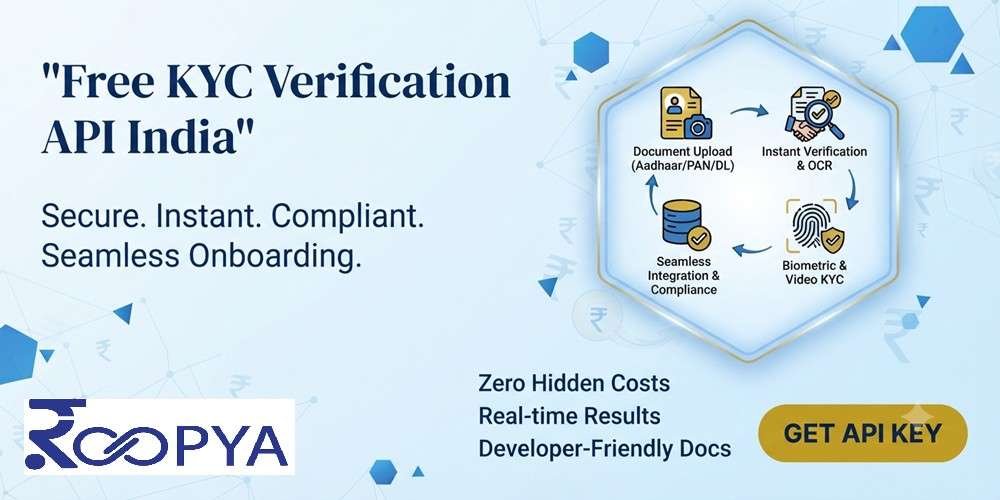
Integrate a free KYC verification API for Aadhaar eKYC, PAN, and bank account checks in India. Fast, RBI-aligned onboarding built into roopya.money's loan management system.
Every rupee that moves through India’s formal credit system now passes through a checkpoint called KYC — Know Your Customer. Whether it is a digital-first NBFC disbursing a personal loan in under ten minutes, a housing finance company onboarding a first-time borrower, or a bank opening a savings account through a mobile app, the same question sits at the front of the process: is this person who they claim to be? A Free KYC Verification API is the piece of infrastructure that answers that question in seconds instead of days, and it has quietly become one of the most important building blocks of digital lending in India.
For lenders evaluating a Loan Management System (LMS), the KYC layer is rarely the flashiest feature on the demo call, but it is usually the one that determines whether an applicant actually reaches disbursement. A clunky, manual, or expensive verification step causes drop-offs at exactly the moment a borrower is most likely to abandon the journey. This guide walks through what a KYC Verification API does, why “free” access matters for growing lenders, how the ecosystem in India is structured, and how a platform like roopya.money brings this capability directly into a lender’s loan origination and management workflow.
What Is a KYC Verification API?
A KYC Verification API is a programmatic interface that lets a business connect its application — a website, mobile app, or loan management system — directly to authoritative identity data sources such as UIDAI (Aadhaar), the Income Tax Department (PAN), the Election Commission (Voter ID), and banking rails (for penny-drop account verification). Instead of a compliance officer manually checking a scanned Aadhaar card or PAN copy against a government database, the API sends a structured request and receives a structured response — typically in under a few seconds — confirming whether the document is genuine, active, and matches the name and other details supplied by the applicant.
In practice, this single integration point replaces what used to be a multi-step, paper-heavy process: collecting physical or scanned documents, manually cross-checking them, storing them securely, and re-verifying if anything looked inconsistent. An API-driven approach compresses that entire chain into milliseconds of machine-to-machine communication, which is precisely why it has become foundational to digital lending, digital banking, and fintech onboarding across India.
Why “Free” Matters for Lenders and Fintechs
Cost structure is one of the biggest hidden levers in a lending business’s unit economics. Every KYC check has a marginal cost, and for a lender processing thousands of applications a month, that cost compounds quickly. A Free KYC Verification API — or a generous free tier that lets teams test, integrate, and run early-stage volumes without upfront spend — removes a major barrier for:
- Early-stage NBFCs and fintech startups that need to validate their lending model before committing to large verification budgets.
- Growth-stage lenders who want to A/B test onboarding flows without every experiment carrying a per-call cost.
- In-house engineering teams building or evaluating a new LMS, who need a sandbox to test Aadhaar, PAN, and bank verification flows before going live.
- Smaller NBFCs and co-operative lenders operating on thin margins, for whom every rupee saved on infrastructure can be redirected toward better pricing or reach.
Free access does not mean lower quality. A well-built free KYC API tier should still return UIDAI-grade Aadhaar data, live NSDL-linked PAN status, and real-time bank account validation — the same data quality a lender would get on a paid enterprise contract, just accessible at a price point that does not punish teams for testing, scaling gradually, or running lean.
The Core Types of KYC Verification Used in India
India’s KYC ecosystem is built around a handful of Officially Valid Documents (OVDs) and verification modes, each suited to a different use case, risk level, and regulatory requirement.
1. Aadhaar eKYC (OTP-based)
The applicant’s 12-digit Aadhaar number is used to trigger a one-time password sent to their Aadhaar-registered mobile number. On successful OTP entry, UIDAI returns demographic details — name, address, date of birth, gender, and photo — digitally signed for authenticity. This is the fastest and most widely used mode for retail lending and account opening, typically completing in under fifteen seconds.
2. Aadhaar Offline XML / Paperless Offline KYC
For situations where OTP delivery is unreliable or the applicant prefers not to share a live Aadhaar number, UIDAI allows a downloadable, digitally signed offline XML or ZIP file that can be verified without pinging UIDAI’s live servers. This is useful for low-frequency or assisted-channel use cases.
3. PAN Verification
The PAN Verification API checks a PAN number against the Income Tax Department’s database, confirming whether it is active, valid, and correctly matched to the applicant’s name. It also typically returns entity type (individual, company, firm, HUF) and, increasingly, Aadhaar-PAN linkage status — a detail that regulated lenders are expected to check under the mandatory linking framework.
4. Bank Account Verification (Penny-Drop / Penny-Less)
Before disbursing a loan, a lender needs certainty that the destination account is genuine and belongs to the applicant. Penny-drop verification deposits a nominal amount (or performs a penny-less name-match check via IFSC and account number) and confirms the account-holder name against the applicant’s KYC name, preventing misdirected disbursements.
5. Voter ID, Driving Licence, Passport, Vehicle RC
These government-issued document lookups serve as secondary identity or address proof, particularly useful in geographies or customer segments where Aadhaar alone is insufficient, or where a lender wants a second independent data point for fraud checks.
6. Video KYC (V-CIP)
For regulated entities, especially banks and larger NBFCs, RBI’s Video-based Customer Identification Process allows a live, recorded video interaction — either agent-assisted or AI-assisted — where the applicant shows their original document and reads a random code, satisfying in-person verification requirements without a physical branch visit.
7. Face Match and Liveness Detection
Increasingly bundled alongside document checks, liveness detection confirms that a real, present person is completing the verification (not a photo or a recording), while face match compares a live selfie against the photo on the Aadhaar or PAN record to prevent identity theft.
The Regulatory Backdrop
KYC in India is not just a UX convenience — it is a legal obligation. The Reserve Bank of India’s Master Direction on KYC governs how regulated entities (banks, NBFCs, payment aggregators, and select fintech intermediaries) must identify and verify customers before onboarding them or letting them transact above certain thresholds. Alongside this, the Prevention of Money Laundering Act (PMLA) requires ongoing customer due diligence, not just a one-time check at onboarding.
A few regulatory details matter specifically for API-based verification:
- Licensing for Aadhaar authentication. Only entities holding AUA (Authentication User Agency) or KUA (KYC User Agency) status — directly or through a licensed sub-agency — are permitted to run live Aadhaar authentication. Any provider claiming “Aadhaar verification” without this licensing is typically doing OCR on an uploaded Aadhaar image, which is a materially weaker check and does not carry the same compliance weight.
- Data minimisation and masking. Regulations require masking of the full Aadhaar number wherever it is displayed or stored, and lenders are expected to retain only what is necessary for the compliance file.
- PAN thresholds. PAN verification becomes mandatory for cash transactions above ₹50,000, all bank account openings, loan disbursements, and investment accounts, among other triggers defined under Income Tax rules.
- Once a customer’s KYC has been performed by one regulated entity, the record can be uploaded to the Central KYC Registry (CKYC), allowing other regulated entities to fetch it instead of re-verifying from scratch, provided consent is obtained.
For a lender building or choosing an LMS, this means the KYC API layer cannot be treated as a black box. It needs to be traceable back to a properly licensed data source, produce an auditable record for each check, and support the retention and masking rules a compliance team will eventually be audited against.
How This Fits Into a Loan Management System
A Loan Management System exists to take a borrower from application to disbursement to repayment with as little friction and risk as possible. KYC sits right at the start of that journey, and how well it is integrated shapes everything downstream:
- Faster funnel, fewer drop-offs. When Aadhaar OTP or PAN verification happens inline, inside the same application flow, applicants complete onboarding in a single sitting instead of abandoning the process to hunt for documents or wait on manual review.
- Cleaner underwriting data. Verified name, address, and date-of-birth fields flow directly into the credit decisioning engine, reducing the mismatches and typos that come from manual data entry.
- Safer disbursements. Bank account verification before payout closes off one of the most common sources of operational loss — money sent to the wrong or a fraudulent account.
- Audit-ready compliance trail. Every check — timestamp, source, response, and consent record — becomes part of the loan file automatically, which matters enormously when RBI or an internal auditor asks for evidence of due diligence.
- Lower cost per approved loan. Automating verification reduces the manpower needed for manual document review, which matters most for lenders operating at thin margins or high volume.
This is the thinking behind building a Free KYC Verification API directly into roopya.money’s loan management platform: lenders using roopya.money should not need to separately shop for, negotiate, and stitch together a third-party KYC vendor before they can even start originating loans. The verification layer is part of the same system that handles application intake, credit decisioning, disbursement, and collections — one workflow, one dashboard, one audit trail.
What to Look for in a KYC Verification API
Not all KYC APIs are built to the same standard, and the difference matters once volumes grow. A few things worth evaluating before committing to any provider, free or paid:
- Live, non-cached data. Responses should reflect the current status in UIDAI, NSDL, or the relevant registry — not a cached snapshot that could return stale or incorrect data.
- Uptime and latency guarantees. A KYC check sitting inside a live application flow cannot afford to be the slowest step; sub-fifteen-second response times are the practical benchmark for OTP-based Aadhaar checks.
- Proper licensing. Confirm the provider operates under valid AUA/KUA authorisation for Aadhaar, rather than running OCR-based document scraping dressed up as verification.
- Coverage breadth. Aadhaar and PAN alone often are not enough — bank verification, voter ID, driving licence, and video KYC support let a lender handle edge cases without adding a second vendor.
- Developer experience. Clear documentation, sandbox access, and predictable response schemas cut integration time from weeks to days.
- Transparent pricing beyond the free tier. A free tier is only useful if the pricing that kicks in afterward is predictable and does not force a lender into a large enterprise contract prematurely.
- Security and data handling. Encryption in transit and at rest, masking of sensitive fields, and clear data retention policies aligned with RBI and MeitY guidance.
Common Use Cases Across the Lending Journey
- Digital loan origination. Instant Aadhaar and PAN checks at the top of the funnel, before a credit bureau pull, to filter out invalid applications early.
- Borrower onboarding for NBFCs and co-operative lenders. A single API call replaces a branch visit or a physical document collection step.
- Employee and agent verification. Loan agents, DSAs (Direct Selling Agents), and field staff can be verified the same way as borrowers, closing off a common source of internal fraud.
- Recurring re-KYC. RBI-mandated periodic re-verification of existing customers can be automated instead of run as a manual campaign.
- Fraud and duplicate-application detection. Cross-referencing Aadhaar, PAN, and bank details across applications helps flag the same individual attempting to apply under slightly different details.
Common Challenges and How to Handle Them
- OTP delivery failures. Mobile numbers not linked to Aadhaar, or network delays, are the most frequent point of friction. Offering an Aadhaar Offline XML fallback keeps the applicant from getting stuck.
- Name-mismatch false negatives. Minor spelling variations between a PAN record and an application form can trigger unnecessary rejections; a good API layer should support fuzzy name matching rather than exact-string comparison.
- Rate limits during peak campaigns. Marketing pushes or festive-season loan campaigns can spike verification volume; check a provider’s throughput limits before running a large acquisition drive.
- Compliance drift. Regulations around Aadhaar-PAN linking, data masking, and CKYC have changed multiple times in recent years; a provider that keeps its API current with these changes saves a lender from having to track every notification manually.
A Free KYC Verification API is no longer a nice-to-have for Indian lenders — it is the entry ticket to running a digital lending operation that is fast enough for borrowers, safe enough for compliance, and cheap enough to scale. Aadhaar eKYC, PAN verification, bank account checks, and video KYC together form the backbone of borrower onboarding, and how well these are woven into a lender’s Loan Management System has a direct effect on approval speed, fraud losses, and audit readiness.
roopya.money brings this verification layer directly into its LMS, so banks, NBFCs, and lending platforms can originate, verify, disburse, and collect from a single system — without stitching together separate vendors for each step of the borrower journey. For a lender evaluating how to modernise onboarding without adding operational complexity, that single-workflow approach is often the difference between a KYC step that helps the business and one that quietly costs it applicants.
Frequently Asked Questions (FAQ)
Q1. What is a Free KYC Verification API and how does it work?
A Free KYC Verification API is a no-cost (or free-tier) programmatic interface that lets a business connect to identity data sources such as UIDAI (Aadhaar) and the Income Tax Department (PAN) directly from its own application. A request is sent with the applicant’s details, and a structured response confirms whether the document is genuine and matches the applicant, usually within seconds.
Q2. Is Aadhaar-based KYC verification legal for private companies in India?
Yes, but only through entities holding valid AUA (Authentication User Agency) or KUA (KYC User Agency) authorisation from UIDAI, either directly or via a licensed sub-agency. Verification offered without this licensing is usually OCR-based document scanning, which is weaker and not equivalent to UIDAI-authenticated eKYC.
Q3. What documents can be verified through a KYC API in India?
The most common documents are Aadhaar (via OTP, biometric, or offline XML), PAN, Voter ID, Driving Licence, Passport, and Vehicle RC. Many APIs also support bank account verification (penny-drop) and video-based KYC (V-CIP) for RBI-regulated entities.
Q4. How fast is Aadhaar OTP-based eKYC verification?
Aadhaar OTP-based eKYC typically completes end-to-end in eight to fifteen seconds, covering OTP delivery, entry, and UIDAI’s digitally signed response with demographic details.
Q5. Is a free KYC API sufficient for RBI-regulated lenders, or is a paid plan required?
A free tier is well suited to testing, low-volume onboarding, and early-stage products, as long as the underlying data source is UIDAI- or NSDL-linked rather than cached or OCR-based. As transaction volumes grow, most lenders move to a paid plan for higher throughput, SLAs, and dedicated support, while keeping the same integration.
Q6. How does roopya.money’s KYC API fit into loan management?
roopya.money integrates KYC verification directly inside its Loan Management System, so Aadhaar, PAN, and bank account checks happen within the same application flow used for loan origination, underwriting, disbursement, and collections, without needing a separate third-party KYC vendor.
Q7. What happens if Aadhaar OTP delivery fails during verification?
If the registered mobile number is unreachable or OTP delivery is delayed, an Aadhaar Offline XML/ZIP fallback can be used instead, since it does not depend on a live OTP round-trip with UIDAI.
Q8. Does KYC verification through an API replace Video KYC (V-CIP)?
Not for every use case. Aadhaar and PAN API checks handle document- and data-level verification, while RBI’s Video-based Customer Identification Process is a separate, regulator-defined requirement for certain account types and risk categories, involving a live recorded video interaction.