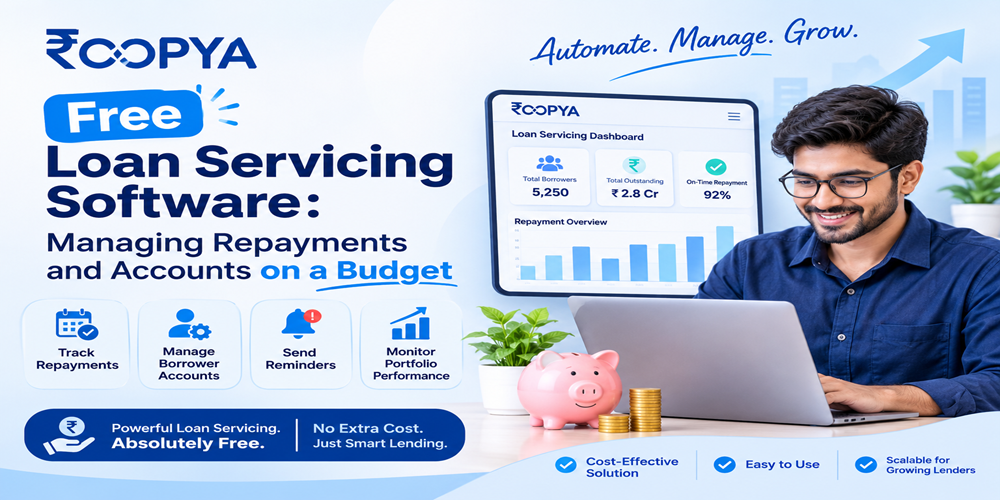
Compare free loan servicing software, its limits and hidden costs, and see how pay-as-you-use platforms manage repayments on a budget.
When you are starting a lending business, every rupee of software spend feels heavy. Free loan servicing software sounds like the obvious answer: record the loans, track the repayments, send the statements, and keep the budget for lending capital. For some very small portfolios, a free tool really is enough. For others, “free” turns into missed payments, reconciliation headaches and an expensive migration a year later.
This guide is written for small NBFCs, microfinance institutions, fintech start-ups, community lenders and loan service providers who want to manage repayments and borrower accounts without a large upfront investment. It explains what loan servicing software does, what “free” usually means, where the real costs hide, which features you should insist on, and when a pay-as-you-use platform becomes the smarter budget choice.
Key takeaways
- Free options exist (spreadsheets, open-source software, freemium tools), but each comes with limits on accuracy, security, support or scale.
- “Free to download” is not the same as “free to run”. Hosting, setup, maintenance and staff time are real costs.
- Even on a tight budget, insist on correct interest calculation, payment allocation, audit trails and borrower statements.
- A usage-based platform with no upfront cost can be a safer budget path than a free tool that you outgrow quickly.
What Is Loan Servicing Software?
Loan servicing covers everything that happens after a loan is approved and disbursed. Loan servicing software records the loan terms, generates the repayment schedule, applies each payment to principal, interest and fees, tracks overdue accounts, produces statements and closes the loan when the final installment is received. Many lenders call this a loan management system (LMS), and the two terms are often used interchangeably.
It is different from a loan origination system, which handles applications, verification and approvals. Origination ends when money is disbursed. Servicing runs for the entire life of the loan, which can be weeks for a small-ticket product or years for a business or home loan. Core servicing tasks include:
- Setting up loan accounts with amount, rate, tenure, fees and repayment frequency.
- Generating amortization schedules for flat or reducing-balance interest.
- Recording and reconciling payments from borrowers.
- Calculating penalties, late fees, prepayment and foreclosure amounts.
- Tracking delinquency and triggering reminders or collection actions.
- Issuing statements, receipts and closure documents.
- Producing reports on portfolio health, collections and outstanding balances.
What Does “Free” Really Mean?
Software marketed as free generally falls into one of five categories. Knowing which one you are looking at tells you what you will eventually pay, in money or in effort.
| Option | Typical cost | Where it works | Main limits |
| Spreadsheets | No licence fee | A handful of loans managed by one person | Manual formulas, no audit trail, error-prone at volume |
| Open-source software | No licence fee, but hosting and developer time | Teams with technical skills and time to customize | You own security, upgrades, compliance changes and support |
| Freemium tools | Free tier, paid upgrades | Early testing with small portfolios | Caps on loans, users or features; limited support |
| Free trials | Free for a limited period | Evaluating a product before buying | Time-limited; data migration after the trial |
| Pay-as-you-use platforms | No upfront cost, charges grow with usage | Lenders who want a full system without a big commitment | Not free, but costs track your volume |
None of these is wrong. The point is to choose consciously, with a clear view of what happens when your portfolio doubles.
Where Spreadsheets Break Down
Spreadsheets are where most small lenders begin, and for good reason: they are familiar, flexible and cost nothing. Problems usually appear gradually, then all at once. Typical failure points include:
- Calculation errors. A single broken formula can misstate interest across dozens of accounts, and nobody notices until a borrower disputes a statement.
- No audit trail. Anyone with access can overwrite a balance. There is no record of who changed what and when, which becomes a serious problem during audits.
- Version confusion. Multiple copies shared by email or chat quickly drift apart.
- Slow reconciliation. Matching bank credits to installments by hand takes longer every month as volumes grow.
- Weak collections. Spreadsheets do not send reminders, flag early delinquency or assign follow-ups to agents.
- Reporting effort. Regulatory and investor reports need to be rebuilt manually each cycle.
If you are using spreadsheets today, a few safeguards help: lock formula cells, keep a read-only master copy, log every manual change, reconcile against bank statements weekly, and back up daily. These reduce risk, but they do not remove it.
Open-Source Loan Servicing: Free to Download, Not Free to Run
Open-source platforms are the most credible free option for a team with engineering capacity. Projects such as Apache Fineract, which underpins several microfinance and core banking tools, show that a community-maintained codebase can handle real lending operations. The licence may cost nothing, but running it responsibly involves several commitments:
- Hosting and infrastructure. You pay for servers, backups, monitoring and disaster recovery.
- Setup and customization. Configuring products, fee structures and workflows to your policies usually needs developer time.
- You are responsible for patching, access control, encryption and data protection.
- New versions can require migration work, and skipping them leaves known vulnerabilities open.
- Compliance changes. When regulations change, your team must interpret them and update the software.
- Community forums help, but nobody is contractually obliged to fix your urgent problem during month-end close.
For a lender with a strong technical team, this can be a sound trade. For a lean team of credit and operations staff, the hidden labor often outweighs the saved licence fee.
Essential Features Even a Budget Setup Needs
Whatever you choose, treat the following as non-negotiable. They protect your borrowers, your books and your regulatory standing.
- Accurate schedule generation. Support for the interest methods you use, such as flat and reducing balance, with configurable tenures and repayment frequencies.
- Payment allocation rules. A clear waterfall that decides how each payment is split across fees, penalties, interest and principal.
- Penalty and fee handling. Automated late fees, prepayment charges and foreclosure quotes that follow your policy.
- Borrower statements and receipts. Clean documents that borrowers can understand and that you can produce on demand.
- Delinquency tracking. Aging buckets and overdue lists so collections can begin early.
- Audit trail and access control. A log of every change and role-based permissions so staff see only what they need.
- Data export and backup. The ability to get your data out in a usable format, so you are never locked in.
- Basic reporting. Outstanding balances, collections efficiency and portfolio quality at a minimum.
If a free tool lacks two or more of these, its savings are probably an illusion.
Managing Repayments Efficiently on a Limited Budget
Repayment management is where servicing software earns its keep. Whether you use a free tool or a paid platform, these practices keep collections predictable:
- Offer automated repayment options. In India, UPI AutoPay and e-mandate based collection reduce missed installments compared with manual transfers. Check whether your software can initiate and reconcile them.
- Reconcile frequently. Match payments to accounts daily or weekly, rather than at month-end, so exceptions are small and easy to trace.
- Send reminders before the due date. A message a few days ahead costs almost nothing and prevents many late payments.
- Handle partial and early payments consistently. Define how the system treats short payments, advance payments and prepayments, and apply the rule every time.
- Escalate by stage. Move from reminders to calls to formal follow-up on a fixed schedule, rather than relying on individual judgment.
Good habits matter as much as good software. A disciplined process on a basic tool often beats a sophisticated tool used inconsistently.
Reports to Review Every Month
Servicing software is only useful if someone reads its output. Even a small lender should review a short set of reports on a fixed monthly schedule, and a weekly check on the first two is better still:
- Collections report. Amounts due, amounts collected and the gap, by product and by due date.
- Delinquency aging. Accounts grouped by days past due, so you can see whether overdue balances are shrinking or building up.
- Outstanding portfolio. Principal and interest outstanding, plus any accrued fees, reconciled to your accounts.
- Exceptions list. Unmatched payments, accounts with negative balances and loans with manual adjustments.
These four views catch most problems early, and they give partners, investors and auditors the confidence that your numbers are under control.
Managing Customer Accounts and Records
Servicing is also about the borrower relationship. Each account should carry a complete, current record: personal and KYC details, the loan agreement, schedule, payment history, communication log and any restructuring or settlement notes. When a borrower calls with a question, your team should be able to answer in one lookup.
Data protection deserves particular care on a budget. Borrower records contain identity documents, bank details and contact information. Restrict access by role, avoid sharing files over personal messaging apps, encrypt stored data where possible and define how long records are retained. A self-service customer portal, where available, reduces inbound calls by letting borrowers view balances, schedules and statements themselves.
Compliance and Security Basics on a Budget
Regulators and lending partners care about how you service loans, not only how you originate them. Whatever tool you use, make sure you can show fair and transparent treatment of borrowers: clear disclosure of charges, accurate statements, consent records for communication and a defined process for handling complaints.
Keep an evidence trail for key events such as disbursal, repayment, penalty application, restructuring and closure. In India, regulated entities should also follow the Reserve Bank of India’s requirements on digital lending, fair practices and data handling, and review them with legal counsel. Software can make compliance easier to demonstrate, but it cannot replace your own policies or your own accountability.
The Hidden Costs of “Free”
Before committing to a free tool, estimate the costs that never appear on an invoice:
- Staff time. Hours spent on manual entry, reconciliation and report building are salary spent on software gaps.
- Errors and disputes. Wrong balances damage borrower trust and can lead to complaints or write-offs.
- Compliance risk. Missing audit trails or consent records can create problems during inspections or partner reviews.
- Migration later. Moving data out of a patchwork of files into a proper system is far more expensive when you have thousands of accounts.
- Downtime and weak support. A failure at month-end affects collections, reporting and borrower confidence.
Putting rough figures against these items often shows that the cheapest tool on paper is not the cheapest in practice.
Thinking About Cost Over Time, Not Just on Day One
A useful way to compare options is to project cost across two or three years instead of the first month. A free tool starts at zero but adds staff time, workarounds and a migration bill as the portfolio grows. A usage-based platform starts with a small charge but stays proportionate to the loans you actually service. A fixed-fee enterprise system has the highest entry cost and may be oversized for a young lender.
Build a simple model with your expected loan count by quarter, the hours your team spends on servicing tasks, and the quoted charges for each option. The answer will vary by business, but the exercise usually makes the true trade-offs visible.
Common Mistakes Small Lenders Make with Servicing Software
- Choosing on price alone. The cheapest option is rarely the one with the lowest cost once labor and errors are counted.
- Skipping the test. Not checking schedules, penalties and payment allocation against sample loans before going live.
- Ignoring exit routes. Storing data in a format that is hard to export if you change tools.
- Over-customizing too early. Building complex workflows before the basic servicing process is stable.
- Leaving access open. Giving every staff member edit rights over balances and borrower records.
- Delaying the upgrade. Waiting until the system fails before planning a migration.
Most of these are avoidable with a short pilot and a clear checklist.
When to Move from a Free Tool to a Paid Platform
There is no single loan count that signals it is time to upgrade, but certain warning signs are reliable:
- Month-end reconciliation takes days instead of hours.
- You are launching a second or third loan product with different rules.
- Collections staff cannot see up-to-date overdue lists.
- Partners, investors or regulators ask for reports you cannot produce quickly.
- You need to connect payment gateways, credit bureaus or KYC services.
- Only one person understands how the system works.
If two or three of these apply, the cost of staying on a free tool is probably already higher than the cost of moving.
A Budget-Friendly Alternative: Pay-As-You-Use Lending Platforms
Between “free but limited” and “enterprise and expensive” sits a third path: platforms priced by usage, with little or no upfront cost. You get a full system from the start and your spend rises only as your loan volume does.
Roopya is one example. To be clear, Roopya is not a free product. It is a no-code lending platform that describes a pay-as-per-use pricing model with zero upfront cost, which can suit lenders who want to avoid a large initial commitment. Its loan management system covers portfolio management, payment processing, amortization schedules and a customer portal, and it sits alongside origination, collections, early warning and analytics on one platform. Other capabilities relevant to budget-conscious lenders include:
- A stated one-day go-live, so you are not paying for months of implementation.
- More than 20 pre-configured loan products and journeys, including support for small-ticket loans and personal loans.
- 300+ pre-integrated APIs for credit bureaus, verification services and payment gateways.
- A no-code interface that lets business users configure products and rules without developers.
Pricing details and any current plans are on the pricing page.
How to Choose: A Practical Checklist
- Total cost of ownership. Add licence, hosting, setup, support, staff time and expected migration cost over two to three years.
- Growth headroom. Will the tool handle ten times your current loan count and more than one product?
- Can you test its schedules and payment allocation against sample loans you have calculated by hand?
- Collections support. Does it flag overdue accounts and support reminders and follow-up workflows?
- Security and audit. Are access controls, logs and backups built in?
- Exit options. Can you export complete data if you leave?
- Vendor stability and support. Who answers when something breaks?
Steps to Get Started
- Clean your data. Standardize borrower details, loan terms and payment histories before moving anything.
- Define your products. Document rates, fees, tenures, grace periods and penalty rules.
- Shortlist two or three options. Include at least one free choice and one usage-based platform for comparison.
- Run a pilot. Load a small set of real loans and compare outputs with your existing records.
- Reconcile, then switch. Run both systems in parallel for a cycle, resolve differences and cut over.
If you are weighing free software against a usage-based platform, talk to the Roopya team for a walkthrough and see which model fits your portfolio.
Frequently Asked Questions
Is there really free loan servicing software?
Yes, in limited forms. Spreadsheets, open-source software and freemium tools can cost nothing to start with. However, open-source systems still need hosting and technical support, and freemium tools usually cap loans, users or features.
Can I manage loans using Excel or Google Sheets?
For a very small number of loans, yes. As volume grows, risks such as formula errors, missing audit trails and slow reconciliation increase. Lock formulas, log changes, reconcile weekly and back up regularly if you stay on spreadsheets.
What are the risks of open-source loan servicing software?
The main risks are the effort and cost of hosting, security, upgrades, customization and compliance updates, which fall on your team. Support is typically community-based rather than guaranteed.
What features should loan servicing software have at a minimum?
At a minimum, look for accurate amortization schedules, payment allocation rules, penalty and fee handling, borrower statements, delinquency tracking, audit trails, role-based access, data export and basic reporting.
Is Roopya free?
No. Roopya is a paid platform, but it describes a pay-as-per-use model with zero upfront cost. See the pricing page or contact the team for current details.
When should a small lender upgrade from free software?
Consider upgrading when reconciliation takes days, you add more loan products, collections staff lack current overdue data, or partners and regulators request reports you cannot produce quickly.
Can loan servicing software handle EMI collection through UPI or e-mandates?
Many platforms can, depending on the payment integrations they offer. Roopya lists pre-integrated payment gateways among its 300+ APIs. Confirm that the specific collection method you need is supported before you commit.
What is the difference between a loan management system and loan servicing software?
The terms are often used interchangeably. Loan servicing refers to post-disbursal activities such as schedules, payments and statements, while a loan management system usually includes servicing along with portfolio management and reporting.
How do I move from spreadsheets to a loan management system?
Clean and standardize your data, define loan products, import opening balances and payment histories for a pilot group, run both systems in parallel for a cycle, reconcile differences and then switch over fully.