Evaluating free NBFC loan management software? Use this checklist covering compliance, security, integrations, and hidden costs before you choose.
For a growing Non-Banking Financial Company (NBFC), the loan management system (LMS) is the engine room of the business. It decides how fast you can onboard a borrower, how accurately you track repayments, how well you stay within RBI guardrails, and how confidently you can scale from a few hundred loans to a few hundred thousand. So when a “free” loan management software shows up promising all of this at zero cost, it’s worth a second look before you commit your loan book to it.
Free and open-source LMS platforms absolutely have a place — especially for early-stage NBFCs, co-lending pilots, or teams validating a new product line before investing in a full-scale platform. But “free” rarely means “complete,” and the gap between a free tool’s marketing page and what it can actually support in production is where most NBFCs get into trouble. This checklist walks through exactly what to examine before you adopt one, so the decision is based on evidence rather than a sales pitch.
What Is NBFC Loan Management Software?
Loan management software (also called an LMS, loan servicing software, or lending platform) is the system that handles a loan’s entire lifecycle after origination: disbursal, EMI scheduling, repayment tracking, interest and penalty computation, restructuring, collections, and closure. For an NBFC, it typically sits alongside — or is bundled with — a loan origination system (LOS) that handles application intake, underwriting, and credit decisioning.
A good NBFC LMS does more than track numbers in a ledger. It needs to understand Indian lending-specific mechanics: reducing-balance and flat-rate interest calculations, NACH/e-mandate based collections, co-lending and BC (business correspondent) arrangements, NPA (non-performing asset) classification per RBI norms, and reporting formats that regulators and auditors expect to see.
Why “Free” Loan Management Software Needs Careful Evaluation
Free tools generally fall into three buckets, and each carries a different kind of risk:
- Open-source projects with no vendor behind them — powerful but you own all maintenance, security patching, and compliance updates yourself.
- Freemium products from a vendor, where the free tier is a funnel into paid add-ons, higher loan-volume limits, or mandatory paid support.
- Bundled “free” modules offered alongside a paid core product (for example, a free LMS tied to a paid payment gateway or paid KYC provider).
None of these are automatically bad choices. The risk is adopting one without checking whether it can actually carry your loan book through a regulatory audit, a sudden volume spike, or a demand for a feature it simply doesn’t have. The checklist below is built around the questions that matter most for an NBFC specifically — not a generic SaaS evaluation template.
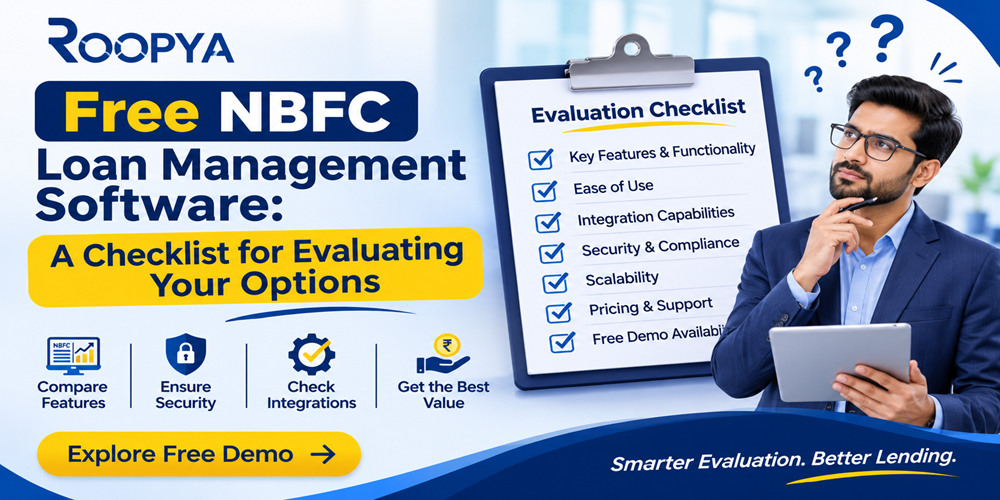
The Complete Evaluation Checklist
1. Core Loan Lifecycle Coverage
Start by confirming the platform supports the full loan lifecycle your NBFC actually runs, not just the parts shown in the demo.
- Multiple loan types (personal, business, gold, vehicle, LAP, microfinance, co-lending) if you offer more than one product.
- Configurable interest methods: flat, reducing balance, daily reducing, and step-up/step-down schedules.
- Disbursement workflows, including partial and staged disbursements.
- EMI scheduling, prepayment, part-payment, foreclosure, and restructuring/rescheduling.
- Penal charges, bounce charges, and late-fee computation aligned with your sanction letter terms.
- Collections workflows: NACH/e-mandate presentation, retry logic, and field-collection assignment.
2. Regulatory & Compliance Readiness
This is the single most important category for an NBFC, and the one free tools most often fall short on.
- Automated NPA classification (30/60/90+ DPD buckets) consistent with current RBI norms for NBFCs.
- Asset classification and provisioning reports (ECL/IRACP as applicable to your NBFC category).
- Fair Practices Code support: sanction letters, key fact statements (KFS), and standardized disclosure formats.
- Audit trails that log every change to a loan record — who changed what, and when — for regulatory and statutory audits.
- Data localization: confirm where the data is actually hosted, since RBI expects financial data on Indian lenders to be stored in India.
- CKYC and credit bureau reporting formats (CIBIL, Experian, CRIF, Equifax) built in or easily exportable.
3. Security & Data Protection
A loan book is one of the most sensitive data assets an NBFC holds. Treat security as a pass/fail gate, not a nice-to-have.
- Encryption at rest and in transit (TLS for all data in motion, AES-256 or equivalent for data at rest).
- Role-based access control so collections staff, underwriters, and finance teams see only what their role requires.
- Data backup frequency and disaster-recovery guarantees — ask for the actual RPO/RTO numbers, not just “we back up regularly.”
- A documented data-retention and deletion policy, and clarity on who owns the data if you migrate away later.
- Independent security certifications (ISO 27001, SOC 2) where the vendor has a commercial arm behind the free tier.
4. Integration Capabilities
An LMS rarely operates alone. Confirm it can talk to the rest of your lending stack without custom development on every connection.
- Payment gateways and NACH/UPI AutoPay rails for collections.
- eKYC and Aadhaar-based verification providers, or at minimum clean document-upload and verification workflows.
- Credit bureau APIs for both pulls (at underwriting) and reporting (post-disbursement).
- Accounting software (Tally, Zoho Books, or your general ledger system) for reconciliation.
- SMS/WhatsApp/email gateways for repayment reminders and statutory communication.
- Open APIs or webhooks, so you are not locked into only the integrations the vendor has pre-built.
5. Scalability & Multi-Product Support
Free tiers are often capped — in loan count, user seats, or transaction volume — and the cap is rarely obvious until you hit it.
- What is the actual ceiling on active loans, users, or monthly disbursements on the free tier?
- What happens operationally when you cross that ceiling — is there a grace period, a hard stop, or forced data lock?
- Can the system handle multiple branches, multiple loan products, and multiple co-lending partners without a re-platform?
- How does performance hold up as loan volume grows — ask for a reference customer at 5–10x your current size.
6. The True Cost of “Free”
“Free” almost always has a boundary. Map it out before you build workflows around the tool.
- Are core compliance reports (NPA, provisioning, bureau reporting) free, or locked behind a paid tier?
- Is customer support free, or billed per ticket/hour once you’re past onboarding?
- Are integrations (payment gateway, eKYC, SMS) free, or do they carry per-transaction fees passed through the LMS vendor?
- Is there a cost to export your own data if you decide to switch providers later?
- What is the realistic cost of migrating off this tool in 18–24 months if it doesn’t scale with you?
7. Vendor Support, SLAs & Product Roadmap
- What support channels exist (email, chat, phone) and what response-time commitment, if any, applies to the free tier?
- How frequently is the product updated, and is there a public changelog or roadmap?
- Is there an active user community or documentation you can self-serve from, given limited vendor support on free plans?
- How financially stable is the vendor — a free tool from a company that shuts down leaves you stranded mid-loan-cycle.
8. Deployment Model: Cloud vs. On-Premise
- Cloud-hosted: faster to deploy, but confirm the hosting region and your exit plan if the vendor’s infrastructure fails.
- Self-hosted/on-premise: more control and easier to meet data-localization requirements, but you own the servers, patching, and uptime.
- Hybrid options, if your NBFC needs some data on-premise and some processes in the cloud.
9. Reporting, Analytics & Dashboards
- Out-of-the-box MIS reports: portfolio-at-risk (PAR), collection efficiency, disbursement trends, branch-wise performance.
- Custom report builder, so finance and compliance teams aren’t dependent on engineering for every new report.
- Export formats (Excel, CSV, PDF) that match what your auditors and board actually expect to receive.
10. Customization & Workflow Configuration
- Can approval workflows, charge structures, and loan templates be configured without code changes?
- Can you add new loan products or fields as your business evolves, without vendor involvement for every change?
- Is multi-language and multi-currency support available, if you operate across states or borrower segments with different needs?
11. Data Migration & Onboarding
- Does the vendor provide tooling or support to migrate your existing loan book, borrower records, and repayment history?
- How is historical data validated after migration — is there a reconciliation step before go-live?
- What is the realistic onboarding timeline, and does it match your business’s go-live deadline?
12. Vendor Track Record & References
- How many NBFCs of a similar size and loan-product mix already use this platform in production?
- Can the vendor provide a reference customer willing to speak about compliance reporting and support experience?
- Are there independent reviews, case studies, or audit reports (not just vendor-supplied testimonials)?
Red Flags to Watch For
- No clear answer on where borrower data is physically hosted.
- Compliance reports described as “coming soon” rather than already available.
- No audit trail or change log on loan records.
- Vendor cannot name a single NBFC reference customer.
- Data export is restricted, delayed, or charged for.
- Free tier terms can change without notice, with no contractual commitment.
How to Run a Structured Evaluation
Rather than relying on a vendor’s feature list, run a short, structured proof of concept before committing:
- Shortlist 2–3 tools using this checklist as your scoring sheet.
- Load a sample of real (anonymized) loan data — not demo data — and run a full month-end cycle: disbursement, EMIs, a few delinquent accounts, and NPA classification.
- Generate the exact compliance reports your auditor asks for and check them line by line.
- Test one real integration end-to-end (for example, a NACH collection or a bureau report upload) rather than just reviewing API documentation.
- Have your compliance and finance teams — not just IT — sign off before go-live.
Free NBFC loan management software can be a genuinely good starting point, particularly for lean teams and early-stage lending books. But the deciding factor should never be the price tag alone — it should be whether the platform can carry your compliance obligations, your data security requirements, and your growth plans without surprises. Use this checklist as a working scorecard against every platform you shortlist, and insist on proof — a working demo with your own data — rather than a features page.
If you’re evaluating loan management systems for your NBFC or lending business, roopya.money is built specifically for this: a loan management system designed around Indian NBFC compliance, collections, and reporting needs. Visit https://roopya.money/ to see how it compares against your checklist.
Frequently Asked Questions (FAQ)
1. What is NBFC loan management software?
NBFC loan management software is a system that manages a loan’s full lifecycle after disbursement — EMI scheduling, interest and penalty calculation, collections, NPA classification, and regulatory reporting — specifically configured for NBFC compliance requirements in India.
2. Is free loan management software really free for NBFCs?
Often only partially. Many free LMS tools cap the number of loans, users, or transactions, or restrict compliance reporting, integrations, and customer support to paid tiers. Always confirm the exact limits and hidden costs before relying on a free plan for production use.
3. What compliance features should NBFC LMS have in India?
At minimum, it should support automated NPA/DPD classification, provisioning reports, Fair Practices Code disclosures (sanction letters and key fact statements), complete audit trails, CKYC support, and credit bureau reporting formats, along with data hosted in line with RBI’s data-localization expectations.
4. Can free LMS scale with a growing loan book?
Some can, but many free tiers have hard ceilings on loan volume, users, or branches. Before adopting one, ask the vendor directly what happens when you exceed the free tier’s limits, and request a reference customer operating at several times your current scale.
5. What integrations are essential for an NBFC’s LMS?
Payment gateways and NACH/UPI AutoPay for collections, eKYC/Aadhaar verification, credit bureau APIs, accounting software for reconciliation, and SMS/WhatsApp/email gateways for repayment communication are the integrations most NBFCs need from day one.
6. How do I evaluate loan management software before switching?
Run a structured proof of concept: load anonymized real loan data, complete a full month-end cycle including NPA classification, generate the actual compliance reports your auditors require, test at least one real integration end-to-end, and get sign-off from your compliance and finance teams before going live.