Table of Contents
- The Legacy Nobody Can Lock Away
- Meet the Student: What You’re Really Signing Up For
- The Reward Map: What the Sponsor Earns
- The Fiqh of Funding: Five Questions Donors Always Ask
- Seasons of Reward: Ramadan, the Last 10 Nights, and Eid
- Choose the Right Vehicle: Trust, Transparency, Al Mustafa Relief Aid
- Final Thoughts
- FAQs
The Legacy Nobody Can Lock Away
Every other legacy on earth can be seized, burned, or forgotten in a bankruptcy hearing. This one can’t be.
What the Prophet ﷺ Left Behind — and Who Carries It Today
The Messenger of Allah (peace be upon him) said he was leaving two things among us: the Book of Allah and his Sunnah. Fourteen centuries later, that handover is still being completed — one generation handing the Qur’an to the next, not in warehouses, but in the chests of huffaz. The Prophet (peace be upon him) even described the Qur’an as a guest: in the house where it is recited, goodness increases. A hafiz is the home that hosts that guest permanently — and a sponsor is the one who pays the bills of the guest house.
The Golden Chain: One Link at a Time
Students of knowledge call it the golden chain — the unbroken line of teachers stretching back to the Prophet ﷺ himself. Every ijazah, every corrected letter, every muraja’ah session is a link being forged right now. The Wikipedia overview of huffaz shows how central memorizers have been to transmitting the Qur’an across centuries. But here’s what the encyclopedias don’t say: every single link has a price tag — fees, food, teachers, time. Chains don’t forge themselves.
Why a Sponsor Is Part of the Chain
Stand in a graduation circle and ask the new hafiz who helped them finish. The teacher’s name gets mentioned. The parents’ prayers get mentioned. And then a stranger gets mentioned — the one who paid the fees and never once showed up to class. In the grammar of reward, that stranger is inside the chain too. You funded a link; the link carries the Book; the Book carries you back.
Learn: Explore Quran education support with Al Mustafa Relief Aid →
Meet the Student: What You’re Really Signing Up For
Sponsorship programs can sound abstract. Let’s make it concrete enough to trip over. Think of it this way: you are not donating to a concept called “Quran education.” You are standing behind a specific child’s specific years — their fees, their meals, their teacher’s patience, their name on a progress sheet that arrives in your inbox like a small monthly miracle.
From Application to Khatam: The Journey in Plain English
It starts with a student — often 7 to 12 years old — passing a simple aptitude check: a good voice, a willing family, a spot in the circle. Then the years begin. New portions memorized daily; old portions revised until they’re harder to forget than a song. Tajweed corrected letter by letter. Around year three to six comes the khatam: the full Book recited from memory in front of teachers and family. Your role runs the whole distance — that’s the deal.
What Your Gift Buys on a Tuesday
Pick an ordinary Tuesday. Your monthly gift helped pay the teacher who corrected five students before Dhuhr. It funded the lunch that kept a ten-year-old’s stomach quiet during revision. It replaced a worn mushaf. It kept the lights on in a room where the Qur’an is being absorbed like sunlight. Nothing about that Tuesday makes the news. Everything about it makes the akhirah.
The Reports, the Names, and the Quiet Prayers
Good programs keep you in the loop — juz progress updates, milestone photos, a khatam invitation you can’t attend but can feel. And behind the paperwork runs something no report can capture: the quiet prayer a student makes for the name on the sponsorship list. You asked for transparency. The angels gave you something better — a witness.
Table 1 — Sponsorship Options: How Your Gift Reaches the Student
| Option | How It Works | Best For |
|---|---|---|
| Monthly sponsorship | Fixed gift covering a student’s standing costs | Long-term reward, budget-friendly |
| One-time annual gift | Underwrites a full academic year at once | Zakat-season and bonus moments |
| Named (memorial) sponsorship | Dedicated to a parent, teacher, or loved one | Sending reward onward |
| Sponsor-a-juz campaign | Fund portions toward a group khatam | Masjid and friend circles |
| Group / business pool | Several donors share one student’s costs | Community teams, small businesses |
The Reward Map: What the Sponsor Earns
Let’s be honest about the best part: this transaction is selfish in the most blessed way possible. You give school fees; you receive a portfolio.
Beneficial Knowledge That Keeps Paying
Allah describes people who “recite the Book of Allah, establish prayer, and spend from what We have provided for them, secretly and publicly” — and then promises them a commerce “that will never perish” (Surah Fatir 35:29–30). Your sponsorship quietly joins that sentence. Beneficial knowledge is one of the three deeds that continue after death (Sahih Muslim) — and you are funding the pipeline it flows through.
Sadaqah Jariyah, Dua, and Barakah in Your Wealth
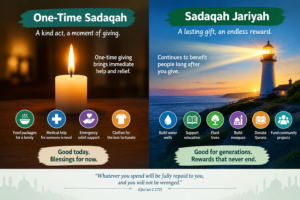
Every lesson taught with your help is a lesson on your record. Every prayer the student makes is a deposit you didn’t schedule. And the wealth itself? The hadith is famously counterintuitive: charity does not decrease wealth. Sponsors keep reporting the same thing across centuries — the accounts expand in ways the spreadsheets can’t explain. The Sadaqah Jariyah appeal exists for exactly this kind of flowing reward.
Sending Reward to Those Who Came Before You
The scholars of Ahle Sunnat agree: reward reaches the deceased. A sponsorship named for your parents means every letter of the Qur’an their student recites is delivered to their scale — a recurring gift to the people who gave you everything and asked for nothing. There is no app for reaching the dead. This is the closest thing.
The Fiqh of Funding: Five Questions Donors Always Ask
Good intentions deserve good answers. Here are the five that come up at every fundraiser.
Can Zakat Sponsor a Hafiz?
Yes — through the recipient, not the subject. Zakat is fard with eight categories named in Surah At-Tawbah 9:60, including the poor and needy. A genuinely poor student or his struggling family qualifies; “hifz classes” as an institution do not. Route your zakat through a 100% Zakat Policy charity in the USA that screens eligibility — and keep institution-building (salaries, buildings, utilities) on the sadaqah and waqf purse. When in doubt, ask which labeled fund your gift enters. One minute of asking beats a year of wondering.
One-Time Gift or Monthly Sponsorship?
Both are loved; they just play different sports. Monthly gifts are the training diet — small, steady, spanning years of study. One-time gifts are the pre-season boosters — Ramadan bonuses, tax refunds, Eid generosity. Serious donors do both: a modest monthly floor with occasional spikes.
What If I Have to Stop? The Flexible Middle Path
Life happens — jobs change, budgets tighten. Reputable programs let you pause, reduce, or hand the sponsorship to another donor without abandoning the student mid-book. Ask about this before you sign up. A program that can’t answer a hard question isn’t ready for your money.
Table 2: Reward & Rules — The Sponsor’s Quick-Reference Card
| Item | The Promise | The Rule |
|---|---|---|
| Learning & teaching Qur’an | Among the best of believers (Bukhari) | Any sincere support counts |
| Helping a hafiz finish | Share in every letter recited | Reward follows the portion you fund |
| Zakat for a poor student | Fully permissible | Recipient must meet 9:60 categories |
| Sponsorship for the deceased | Reward reaches them (Ahle Sunnat ijma) | Name the intention clearly |
| Ongoing benefit (jariyah) | Recorded after the donor’s death | Keep the project self-sustaining |
| Duas of the student | Made for the unseen sponsor | No receipts required |
Seasons of Reward: Ramadan, the Last 10 Nights, and Eid
The legacy is timeless. The calendar still multiplies.
Give Zakat Before Ramadan, Then Open the Sponsorship
Smart donors give zakat before Ramadan — most scholars permit advance payment where genuine need exists, and it beats the pre-iftar price surge — then launch the sponsorship in the first blessed week. Two moves, one phone session: the obligation discharged, the golden chain funded. By next Ramadan, you’ll be renewing a bond instead of scrambling for one.
Last 10 Nights Zakat Donation and Emergency Appeals
A night in the last ten outweighs a thousand months. Automate your last 10 nights zakat donation across the odd nights and let the sponsorship hum underneath it all year. And when the world breaks — a fire, a quake, a war — an emergency zakat donation to live appeals like the Gaza Emergency Appeal keeps your giving honest to the present while the sponsorship invests in the future.
Book Qurbani Online USA Eid ul Adha — and Add a Hafiz
Dhul Hijjah brings the annual search party: “qurbani donation online usa cheap” — efficient, never suspect. To donate qurbani online in the USA through a trusted charity, demand published slaughter standards and transparent pricing — the best qurbani charity USA 2026 lists rotate, the standard doesn’t. A prophetic qurbani donation in the USA honors the Prophet’s second ram for the ummah (peace be upon him); affordable qurbani shares online keep it easy; a qurbani donation website with a 100% policy and secure online udhiya donation in the USA keep it safe to book qurbani online for Eid ul Adha. Then add one hafiz sponsorship to the receipt. Meat feeds a family for days. A hafiz feeds the ummah for generations.
Contact Us: Zakat or sadaqah for your sponsorship? Ask a human, not a chatbot →
Choose the Right Vehicle: Trust, Transparency, Al Mustafa Relief Aid
A golden chain deserves a golden courier.
Where to Give Zakat in the USA — and Where Sponsorships Live
If you’re weighing where to give zakat in the USA or which is the best place to give zakat online, start where the purses are labeled and the promise is public. Al Mustafa Relief Aid is a trusted zakat charity in America — a US-based Muslim charity in Alexandria, Virginia, where you can pay zakat online in the USA through a secure zakat donation website with instant receipts and labeled funds: zakat, sadaqah, project, and sponsorship. Every zakat donation online USA gift and every sponsorship sits behind the same 100% Zakat Policy discipline: your zakat reaches those who need it most, undiluted. For proof-of-work style transparency, see the reporting habit of the Cataract Charity Appeal — same charity, same receipts.
Three Taps to a Sponsored Voice
Open the donation page, select the sponsorship or education fund, confirm. Real phone (+1-703-596-4900), real inbox (info@almustafareliefaid.org), real address (8850 Richmond Hwy, Alexandria, VA).
Book Now: Forge your link in the chain →
Final Thoughts: The Chain Is Waiting for Your Link
Here’s the whole picture in one breath. The Prophet ﷺ left an inheritance that only carriers can unlock. Somewhere tonight, a child with a steel-trap memory and an empty fee envelope is deciding whether the chain continues through him — or breaks at him. A hafiz sponsorship program is how that decision gets made in favour of the Book. You’ve seen the sponsor’s side now: the journey from application to khatam, the reward map that pays in knowledge and dua and barakah, the fiqh that keeps every purse honest, the blessed seasons that multiply it all, and a courier you can actually verify. One link. That’s all the golden chain is asking of you. Forge it — and may Allah make your name the stranger mentioned in a graduation prayer, the donor whispered about in sujood, and the sponsor whose inheritance check never stops arriving.
Learn · Book Now · Contact Us — Give the gift of Qur’an education today.
FAQs
1. How is sponsoring a hafiz different from donating to a school in general?
A general donation funds a system; a hafiz sponsorship funds a person inside that system — with a name, a progress story, and a journey from first letters to khatam. The reward mechanics are similar (both are beneficial knowledge), but the personal link is what keeps donors engaged for the full three to six years of hifz. You’re not lighting a hallway; you’re fueling a specific lamp.
2. What age do sponsored hafiz students usually start, and how long does sponsorship run?
Most hifz circles take students between 7 and 12 years old, and full memorization typically takes three to six years depending on the program and the child’s pace. That’s why monthly sponsorship is the backbone of most programs — the long runway needs steady fuel. Some programs also support older students and converts beginning hifz later in life.
3. I live in the USA — can I sponsor a hafiz remotely?
Yes, and most US donors do exactly that. You choose a trusted zakat charity in America with labeled funds and secure checkout, pay online, and receive milestone updates by email. The student may be in Pakistan, West Africa, or a US-based madrasa — the sponsorship runs through the charity’s reporting either way. Time zones don’t tax reward.
4. What if I can’t continue monthly payments — can I pause or switch to one-time gifts?
Reputable programs plan for this: you can pause, reduce, or transfer your sponsorship to another donor without dropping the student mid-book. Ask about the policy before you enroll — the answer tells you almost everything about how the program treats people. And if monthly never fit your budget, one-time gifts at Ramadan or Eid still fund real portions of real students’ study.
5. What rewards does Islam promise for helping someone memorize the Qur’an?
The foundations are generous and well-attested: the best of believers are those who learn the Qur’an and teach it (Sahih al-Bukhari); beneficial knowledge is among the deeds that continue after death (Sahih Muslim); and Allah describes the charity of those who recite and spend as a commerce that never perishes (Surah Fatir 35:29–30). Add the student’s private duas, the deceased-rental scholars confirm, and the dignity restored to a family — and the reward map reads like a portfolio no market can match.