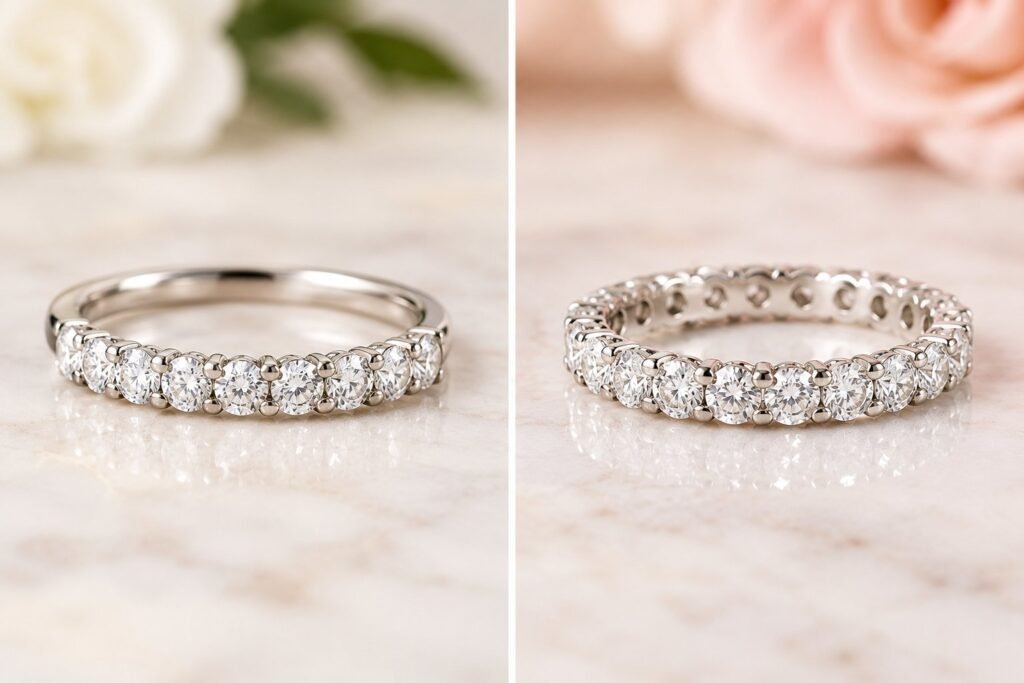
Among diamond wedding rings for women, half eternity and full eternity describe one thing: how far the diamonds travel around the band. A full eternity ring carries stones the entire way around, so the pattern never breaks. A half eternity ring sets them across the top, usually covering a third to two-thirds of the circle, with plain polished metal underneath.
On the finger, the two look remarkably similar. Either works as a women’s wedding band for daily wear. The differences show up in cost, in comfort, and in a few practical points that are easier to weigh before you buy than after.
What You See on the Hand
When a ring sits on the finger, the lower part of the band faces your palm and is hidden by the fingers on either side. A half eternity design places its stones where the eye lands, which is why the two styles photograph so similarly. Set side by side in a case, the distinction is one of construction more than appearance.
The difference shows when the ring turns. A full eternity band presents diamonds wherever it settles. A half eternity band can rotate through the day, and may want an occasional nudge back into place.
How Each One Wears
Comfort against the palm is the next consideration. The underside of a full eternity ring carries stones and the metal holding them, which some people notice when they grip a steering wheel or carry a bag. Others barely register it.
A half eternity band has a smooth stretch of metal at the base, which sits flat against the finger and against a neighboring ring. If you wear your rings all day, this is worth testing in person rather than judging from a photograph.
Points to Weigh
- Diamond count: a full eternity band carries noticeably more stones than a half eternity band of the same width, and that accounts for much of the difference in price.
- Sizing: a band set with diamonds all the way around cannot be resized the way a plain one can, since there is no untouched metal to cut and rejoin. A half eternity band usually can be adjusted.
- Rotation: full eternity looks much the same whichever way it turns, while half eternity may want a small adjustment now and then.
- Pairing: a half eternity band tends to sit flush against an engagement ring, since the plain underside meets the other band without stones in between.
- Stacking: both styles stack, though two half eternity bands take more care so the plain sections line up.
Sizing Deserves the Most Thought
This is the part people tend to revisit years later. Fingers change over time, and a ring bought at one size can fit a decade differently. That does not rule out a full eternity band, and plenty of people wear one happily for a lifetime. It does mean the size wants to be right from the start.
Have your finger measured at a normal temperature rather than after exercise or on a cold morning, and try the width you intend to buy. A wider band tends to fit more snugly than a narrow one at the same stated size. If you fall between sizes, ask which way to round for the width you have chosen.
Setting Style and Width
Setting shapes the look of both options. Shared prongs hold each stone between two prongs, which lets more of the diamond show. Pavé sets many small stones close together, with little metal between them. Channel settings run the stones between two walls of metal for a smooth, low line. Bezel settings circle each stone on its own.
All of these appear in half and full eternity diamond wedding rings for women, in gold and in platinum, so the setting is a separate decision from how far the stones travel.
Width matters as much as setting. A slim band sits as an accent beside an engagement ring, while 3 mm and up holds its own on the finger. Platinum is denser than gold, which some people notice on the hand and others do not.
Choosing Between Them
There is no default answer here. A women’s wedding band is worn more consistently than almost anything else you own, so the question worth asking is a practical one. Which style suits the way you use your hands, how do you want it to sit beside an engagement ring, and how much flexibility do you want to keep for the years