Small details can have a significant influence on the hotel guest experience. Comfortable bedding, clean bathrooms, quality toiletries, fresh towels, and practical room accessories all contribute to how visitors perceive their stay. Hotel slippers are another simple amenity that can add convenience and comfort from the moment a guest settles into the room.
A hotel close toe slipper provides more coverage around the front of the foot than an open-toe design. This makes it a popular choice for hotels, resorts, serviced apartments, spas, wellness centres, and other accommodation businesses looking to provide guests with comfortable indoor footwear.
Close toe slippers are available in different materials, sole types, sizes, thicknesses, and packaging options. Some are designed for short-term disposable use, while others offer greater durability for premium accommodation settings.
Selecting the right slipper involves more than choosing the lowest price. Comfort, fit, hygiene, appearance, floor type, packaging, durability, and the overall positioning of the property should all be considered.
This guide explains the benefits, materials, applications, purchasing factors, and practical considerations involved in choosing hotel close toe slippers.
What Is a Hotel Close Toe Slipper?
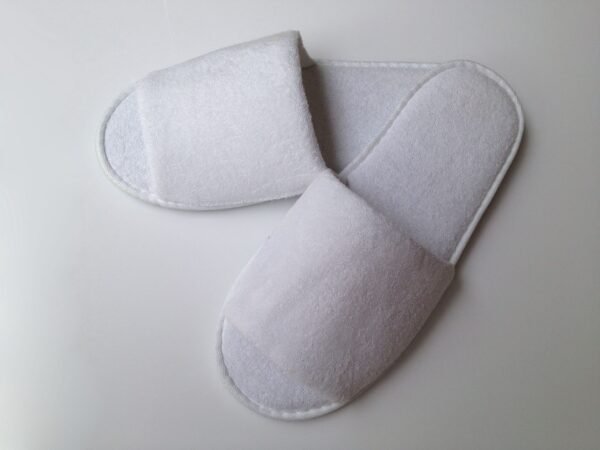
A hotel close toe slipper is a lightweight indoor slipper designed with fabric covering the toes and front section of the foot.
Unlike an open-toe slipper, which leaves the toes exposed, the closed design creates a more enclosed feel.
Hotels commonly place slippers in guest rooms alongside other amenities such as bathrobes, toiletries, towels, and personal care products.
Depending on the design, slippers may be intended for single-guest use or a longer period during a guest’s stay.
A typical hotel close toe slipper consists of:
- A soft upper
- Closed front section
- Inner footbed
- Padded or flat sole
- Outer sole layer
- Optional anti-slip features
- Individual or paired packaging
The exact construction varies according to product quality and intended hotel category.
Why Hotels Provide Close Toe Slippers
Hotel rooms are temporary living spaces for guests. Visitors may not want to walk barefoot across bedroom, bathroom, or corridor surfaces, but they may also prefer not to wear outdoor shoes inside their room.
Slippers provide a convenient alternative.
Guests can use them while relaxing, preparing for bed, moving between the bedroom and bathroom, or visiting appropriate indoor hotel facilities.
Providing slippers can also contribute to the feeling that a room has been thoughtfully prepared.
For premium accommodation, this small amenity may help reinforce the level of service guests expect.
Benefits of Hotel Close Toe Slippers
Close toe slippers offer several advantages that make them suitable for hospitality environments.
Greater Foot Coverage
The most obvious advantage is additional coverage.
Because the front section surrounds the toes, the slipper can provide a warmer and more enclosed feel than an open-toe alternative.
This may be particularly appreciated during cooler weather or in strongly air-conditioned rooms.
Comfortable Indoor Footwear
After travelling, sightseeing, attending meetings, or spending the day in outdoor footwear, guests often want something lighter to wear.
Hotel slippers provide a simple indoor option that allows guests to remove their shoes while still covering their feet.
Premium Presentation
A well-made pair of slippers can contribute to the overall presentation of a guest room.
Slippers placed beside a bathrobe, near the bed, or inside a hotel wardrobe can create a more complete hospitality experience.
Material, stitching, colour, shape, and packaging all influence perceived quality.
Convenient Guest Amenity
Slippers require no complicated setup or instructions.
Guests can simply open the packaging and use them during their stay.
This makes them a relatively straightforward amenity for both guests and housekeeping teams.
Suitable for Different Hospitality Settings
Close toe slippers are not limited to traditional hotels.
They can also be used by:
- Resorts
- Serviced apartments
- Spas
- Wellness centres
- Guest houses
- Premium short-stay accommodation
- Retreats
- Beauty facilities
- Corporate accommodation
The exact slipper specification can be matched to the service level of the business.
Hotel Close Toe Slipper vs Open Toe Slipper
Both designs have advantages.
The right choice depends on guest expectations, climate, property positioning, and budget.
Close Toe Slippers
A hotel close toe slipper covers the toes and provides a more enclosed fit.
It can feel warmer and may create a more traditional indoor-slipper appearance.
Close toe designs are often selected for guest rooms, premium hotels, cooler environments, and properties seeking a comfortable, fully covered style.
Open Toe Slippers
Open toe slippers leave the front of the foot exposed.
They may feel lighter and cooler, particularly in warm environments.
Open designs are also common in spas, resorts, pools, and accommodation properties in warmer climates.
Neither option is universally better. Hotels should consider where and how guests are expected to use the slippers.
Common Materials Used for Hotel Slippers
Material selection influences comfort, appearance, durability, and price.
Non-Woven Fabric
Non-woven material is frequently used for economical disposable hotel slippers.
It is lightweight and can be suitable for properties requiring a simple guest slipper at a competitive price.
These slippers are generally intended for short-term indoor use.
Terry Cloth
Terry cloth provides a soft, towel-like feel.
It is often associated with hotel bathrooms, bathrobes, spas, and wellness environments.
Terry slippers can provide a more comfortable and premium feel than basic non-woven products.
Velour
Velour has a soft surface that can create a refined appearance.
Hotels seeking an upgraded guest amenity may choose velour-style slippers to complement premium towels and bathrobes.
Waffle Fabric
Waffle fabric has a distinctive textured appearance and is commonly associated with spa and hospitality products.
It can coordinate particularly well with waffle bathrobes and other hotel textiles.
Cotton-Based Materials
Cotton and cotton-blend uppers may provide a comfortable feel and attractive presentation.
The exact durability and care requirements depend on whether the slipper is disposable or reusable.
Understanding Hotel Slipper Sole Types
The sole is one of the most important parts of any hotel slipper.
Different materials provide different levels of cushioning, flexibility, and floor contact.
EVA Sole
EVA is commonly used in hotel slipper soles because it is lightweight and can provide cushioning.
Sole thickness varies considerably between products.
A thicker EVA sole may provide greater separation between the foot and floor, although overall performance also depends on construction quality.
Foam Sole
Foam can provide lightweight cushioning for slippers intended for basic room use.
Very thin foam slippers may feel less substantial, while thicker constructions can improve comfort.
Rubber or Textured Sole
Some hotel slippers include rubberised or textured sole surfaces.
These designs may provide additional grip depending on the product and flooring.
Hotels should evaluate slippers on the actual surfaces where guests are likely to wear them.
Are Hotel Slippers Non-Slip?
Hotels should be cautious about assuming that every textured sole is fully non-slip.
Slip performance depends on the sole material, tread design, floor surface, moisture, contaminants, and how the slipper fits the wearer.
If slip resistance is an important requirement, buyers should review the supplier’s product specifications and any relevant testing information.
Testing samples on representative hotel flooring can also help with product selection.
Slippers should never be treated as specialised safety footwear unless they are specifically designed and documented for that purpose.
How to Choose the Right Hotel Close Toe Slipper
Choosing slippers should start with the property’s guest experience and intended application.
Consider Your Hotel Category
A budget hotel may require a simple and economical slipper.
A luxury property may prefer a thicker, softer design with premium materials and custom branding.
The slipper should feel appropriate for the room rate and overall standard of the accommodation.
Evaluate Comfort
Comfort can be influenced by:
- Upper material
- Sole thickness
- Inner padding
- Width
- Toe space
- Stitching
- Overall flexibility
A sample should ideally be tested before a large order is placed.
Check Slipper Dimensions
Many hotel slippers are offered in a standard or one-size design.
However, actual dimensions vary.
Hotels should review the length and width rather than relying only on a generic size description.
Some properties may choose to stock more than one size for improved guest comfort.
Review Sole Thickness
Very thin slippers can be economical but may not provide the experience expected in premium accommodation.
Thicker soles may offer additional cushioning and a more substantial feel.
The ideal thickness depends on the intended use and budget.
Consider Colour
White remains a common hotel slipper colour because it creates a clean and familiar hospitality appearance.
However, other colours can be used to match hotel branding or interior design.
Neutral colours such as grey, beige, cream, and black may also suit certain properties.
Disposable vs Reusable Hotel Slippers
Hotels can choose between products intended for single-guest use and more durable reusable options.
Disposable Hotel Slippers
Disposable slippers are typically assigned to one guest.
They can simplify hygiene management because the same pair is not provided to multiple guests.
They are commonly individually wrapped or packed in pairs.
Reusable Hotel Slippers
Reusable slippers require appropriate cleaning and hygiene procedures between guests if they are intended for repeated use.
They may offer heavier construction and greater durability.
However, hotels need to consider laundering, inspection, replacement, storage, and staff handling.
For many accommodation businesses, disposable or single-guest slippers provide a simpler operational model.
Hotel Slippers for Luxury Accommodation
Luxury hotels need to consider how every amenity supports the overall room experience.
A very lightweight slipper may look out of place beside premium linen, designer toiletries, and high-quality bathrobes.
Luxury properties may prefer:
- Plush uppers
- Terry or velour materials
- Thicker soles
- Extra cushioning
- Neat stitching
- Custom embroidery
- Branded packaging
- Multiple sizes
The objective is not necessarily to choose the most expensive product but to select one consistent with the hotel’s positioning.
Hotel Slippers for Spas and Wellness Facilities
Spas often provide slippers because guests move between treatment rooms, relaxation areas, changing rooms, and other facilities.
Comfort and ease of use are important.
Where floors may become wet, the sole specification deserves particular attention.
A hotel close toe slipper designed primarily for a dry carpeted guest room may not automatically be appropriate for wet spa areas.
Businesses should select products according to the environment in which they will actually be worn.
Custom-Branded Hotel Close Toe Slippers
Customisation can turn a basic amenity into a branded guest touchpoint.
Hotels may add:
- Embroidered logos
- Printed logos
- Brand names
- Custom colours
- Branded wrappers
- Custom boxes
- Printed bands
Branding can be especially useful for luxury hotels, boutique properties, resorts, and hotel groups seeking a consistent visual identity.
Custom orders may require minimum quantities and longer production lead times, so planning is important.
Packaging Options for Hotel Slippers
Packaging affects both presentation and storage.
Common options include:
- Individual plastic wrapping
- Paper bands
- Paper bags
- Fabric bags
- Boxes
- Custom printed packaging
Basic packaging may suit economical properties, while premium hotels may choose more carefully designed presentation.
Hotels considering reduced-plastic strategies can ask suppliers about alternative packaging options.
The packaging should protect clean slippers until guests are ready to use them.
How Many Hotel Slippers Should Be Provided Per Room?
The quantity depends on the room’s expected occupancy and hotel policy.
A double room designed for two adults may commonly be supplied with two pairs.
Suites or family rooms may require additional pairs based on occupancy.
Hotels should also consider whether children’s sizes are needed.
Rather than automatically placing excessive quantities in every room, stock can be matched more closely to expected guest numbers.
How to Calculate Monthly Slipper Requirements
Hotels can estimate consumption using occupancy data.
Suppose a property has 80 rooms and averages 70% occupancy.
That equals approximately 56 occupied rooms each night.
Over 30 days:
56 × 30 = 1,680 occupied room nights.
If two pairs were automatically used for every occupied room night, theoretical consumption could be high. In reality, multi-night guests may not require fresh slippers every day.
Hotels should therefore use actual housekeeping replacement policies and historical consumption data for accurate forecasting.
Buying Hotel Close Toe Slippers in Bulk
Bulk purchasing can reduce unit costs for properties with predictable demand.
Before placing a large order, check:
- Pairs per carton
- Minimum order quantity
- Available sizes
- Material
- Sole thickness
- Packaging
- Delivery costs
- Lead times
- Customisation requirements
- Storage space
Testing a smaller quantity before committing to a large order is particularly important when changing suppliers or specifications.
Cost Per Occupied Room
Hotels should evaluate slippers as part of the total amenity cost per occupied room.
Suppose a pair costs $1.20 and a room normally receives two pairs.
The theoretical slipper cost would be $2.40 per prepared room when both pairs are replaced.
Across thousands of room stays, small differences in unit price can become significant.
However, purchasing a cheaper product that does not meet guest expectations may not represent better value.
Cost should be balanced with the service level the hotel aims to provide.
Storage of Hotel Slippers
Slippers should be kept in a clean, dry storage area until required.
Protect them from:
- Moisture
- Dust
- Excessive heat
- Direct sunlight
- Strong odours
- Chemicals
- Physical damage
Individual packaging should remain intact until the slippers are placed in the guest room.
Organised storage also helps housekeeping teams monitor inventory and access stock efficiently.
Reducing Waste From Hotel Slippers
Single-guest slippers can contribute to hospitality waste.
Hotels can review their processes to reduce unnecessary consumption without reducing guest comfort.
Potential strategies include providing slippers according to actual room occupancy, avoiding automatic replacement during multi-night stays when unused, and monitoring housekeeping usage.
Properties can also explore products made with alternative materials or reduced packaging where appropriate.
Any environmental claims should be evaluated carefully against actual product specifications.
Why Housekeeping Feedback Matters
Housekeeping employees handle hotel slippers more frequently than almost anyone else in the property.
They can identify practical issues such as:
- Packaging that tears easily
- Slippers taking too much storage space
- Inconsistent product quality
- Incorrect quantities
- Guest requests for different sizes
- Frequent unused products
- Difficult room presentation
Their feedback can help purchasing teams choose products that work operationally as well as visually.
Common Mistakes When Buying Hotel Slippers
Selecting slippers only on price is one of the most common mistakes.
Other problems include:
- Ignoring slipper dimensions
- Assuming one size fits every guest
- Choosing soles unsuitable for hotel flooring
- Ordering bulk quantities without testing
- Using low-quality packaging
- Selecting a style inconsistent with the hotel brand
- Ignoring guest feedback
- Over-ordering customised products
- Providing excessive quantities per room
- Failing to monitor monthly consumption
A simple product trial can prevent many of these issues.
What to Look for in a Hotel Slipper Supplier
A reliable supplier should provide clear specifications so hotels can compare products properly.
Useful information includes:
- Slipper length and width
- Upper material
- Sole material
- Sole thickness
- Colour
- Open or closed toe design
- Packaging type
- Carton quantity
- Minimum order quantity
- Branding options
- Delivery times
Hotels purchasing custom hotel close toe slipper products should also confirm artwork requirements, sample approval processes, production times, and minimum quantities.
Frequently Asked Questions About Hotel Close Toe Slipper
What is a hotel close toe slipper?
A hotel close toe slipper is an indoor guest slipper with a front section that covers the toes. It is commonly supplied by hotels, resorts, spas, serviced apartments, and other hospitality businesses.
Are close toe hotel slippers better than open toe slippers?
Neither design is always better. Close toe slippers provide greater coverage and can feel warmer, while open toe slippers may feel cooler and lighter. The best choice depends on the property and intended use.
What materials are hotel slippers made from?
Common materials include non-woven fabric, terry cloth, velour, waffle fabric, cotton blends, foam, EVA, and other synthetic materials.
Are hotel slippers disposable?
Many hotel slippers are designed for single-guest or short-term use. Other heavier products may be reusable if they are specifically designed for this purpose and appropriately cleaned between users.
Can hotel slippers be customised with a logo?
Yes. Depending on the supplier, hotels may be able to add printed or embroidered logos, custom colours, branded wrappers, or personalised packaging.
What size are hotel slippers?
Many hotel slippers use a standard size, but dimensions vary between products. Hotels should check actual length and width before ordering and consider whether additional sizes are necessary.
Are hotel slippers non-slip?
Some slippers have textured or grip-focused soles, but performance varies. Hotels should review product specifications and testing information rather than assuming every textured sole is non-slip.
How many pairs of slippers should a hotel provide?
The quantity normally depends on expected room occupancy and hotel policy. A room for two guests may require two pairs, while other room types may need different quantities.
Should hotels buy slippers in bulk?
Bulk purchasing can be cost-effective for hotels with predictable occupancy. Before ordering, consider carton quantity, storage, product quality, delivery times, and actual monthly consumption.
How should hotel slippers be stored?
Store slippers in a clean, dry location away from moisture, dust, direct sunlight, excessive heat, strong odours, and chemicals. Keep individual packaging intact until the slippers are ready for guest use.
Final Thoughts
A hotel close toe slipper is a simple hospitality amenity that can add comfort and convenience to the guest experience. Its enclosed front provides greater foot coverage than an open-toe design, making it particularly suitable for hotel rooms, suites, serviced apartments, resorts, and selected spa environments.
Choosing the right slipper requires consideration of the entire guest experience. Material, fit, sole thickness, cushioning, packaging, colour, branding, floor conditions, and property category all influence whether a product is suitable.
Hotels should also consider operational factors. Calculating actual consumption, purchasing sensible bulk quantities, monitoring cost per occupied room, and gathering housekeeping feedback can help control expenditure and reduce unnecessary waste.
For premium properties, custom branding and higher-quality materials can help the hotel close toe slipper complement bathrobes, towels, toiletries, and other room amenities. For budget and mid-range accommodation, a well-selected economical design can provide practical comfort without unnecessarily increasing room costs.
By testing products before bulk purchasing and choosing specifications that match the hotel’s service level, accommodation providers can offer slippers that are comfortable, practical, easy for housekeeping teams to manage, and consistent with the overall guest experience.