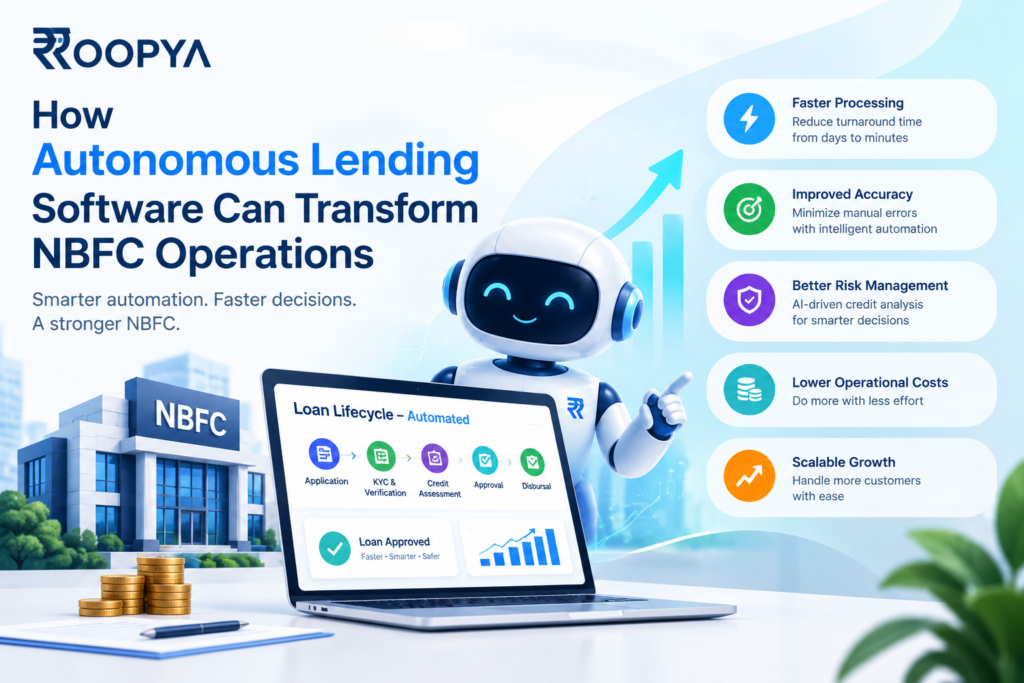
Discover how autonomous lending software helps NBFCs streamline loan origination, underwriting, servicing, collections and compliance while improving customer experience.
Non-Banking Financial Companies (NBFCs) play an important role in extending credit to individuals, self-employed professionals, small businesses and communities that may not always be served adequately by traditional banking channels. As customer expectations shift toward convenient digital services, NBFCs are under pressure to process applications faster, manage risk carefully, control operating costs and provide clear communication throughout the loan journey.
Traditional lending operations often depend on manual data entry, spreadsheets, email approvals and disconnected systems. These processes can create delays, duplicated work, inconsistent decisions and limited visibility into portfolio performance. Autonomous lending software offers a way to coordinate many routine activities through configurable workflows, rules, integrations and, where appropriate, artificial intelligence (AI). It can help teams move from repetitive administration toward exception handling, customer support and informed decision-making.
“Autonomous” does not mean that software should make every lending decision without oversight. In a responsible lending environment, automation should operate within approved policies, explainable rules, access controls and human review processes. The lender remains accountable for its credit decisions, customer treatment, data practices and regulatory obligations. This guide explains how autonomous lending software can support NBFC operations, the features to evaluate, implementation steps and the safeguards that should be part of any deployment.
What Is Autonomous Lending Software?
Autonomous lending software is a technology platform that coordinates lending tasks with limited manual intervention. It may connect a loan origination system (LOS), loan management system (LMS), customer relationship management (CRM), identity and document verification services, credit bureau interfaces, payment systems, collections tools and reporting dashboards.
The platform uses workflow rules to route applications, request missing documents, validate information, calculate eligibility indicators, flag inconsistencies and assign cases to the appropriate team. AI models may assist with document extraction, fraud signals, customer service or risk analysis when their use is appropriate and properly governed. A well-designed platform records what happened, when it happened, which rule was applied and whether a person reviewed or overrode the result.
Capabilities vary significantly between providers. Some platforms automate only selected steps; others connect most stages from lead capture to repayment and closure. NBFCs should therefore assess the actual workflow coverage rather than relying on the word “autonomous” in a product description.
Why NBFC Operations Need Modernisation
Lending teams work with large volumes of documents and sensitive customer information. When data is entered more than once, errors can travel from application processing into underwriting, disbursement, accounting and servicing. Manual hand-offs also make it difficult for managers to see where an application is stuck or why turnaround times are increasing.
Operational modernisation can help address five common challenges. First, inconsistent data collection creates avoidable rework. Second, fragmented systems make it difficult to maintain a complete customer and loan view. Third, manual policy checks may be slow and harder to evidence during audits. Fourth, a growing portfolio can increase collection workloads faster than headcount. Fifth, customers may not know what is required next or how to contact the lender for help.
Automation can reduce these friction points, but technology alone cannot fix unclear credit policies, poor-quality data or weak governance. The strongest programmes combine process redesign, trained staff, reliable integrations and measurable service standards.
1. Faster and More Consistent Loan Origination
Loan origination starts when a prospective borrower expresses interest and continues through application, data capture, verification, assessment, approval and disbursement readiness. Autonomous workflows can guide applicants through forms, check whether required fields are complete, identify missing documents and route cases to the right queue.
For example, a salaried applicant may be asked for a different set of income evidence than a self-employed applicant. A configurable workflow can apply the relevant checklist and alert the applicant or operations team when an item is missing. Data can be captured once and reused by authorised downstream systems, reducing repeated typing. Status notifications can also make it easier for applicants to understand the next step.
Faster processing should not mean weaker checks. A workflow should stop or escalate cases when identity information conflicts, documents appear suspicious, mandatory evidence is absent or a policy threshold requires review. NBFCs should monitor application completion rates, rework, turnaround time and drop-off points to determine whether automation is genuinely improving the process.
2. Smarter Underwriting and Credit Assessment
Underwriting combines information about the applicant, requested loan, repayment capacity, credit history and the lender’s risk appetite. Software can organise data, apply approved policy rules, calculate ratios and produce a structured case summary for an underwriter. It can also highlight missing information or inconsistencies that deserve further examination.
Where lawful and suitable, analytical models may help estimate risk or identify patterns that traditional rules do not capture. These outputs should be validated against relevant populations, monitored for drift and assessed for unintended bias. A model score should not be treated as a complete explanation of a borrower’s circumstances. Decision-makers need clear reasons, appropriate supporting evidence and a way to challenge or review outcomes.
NBFCs should define which decisions may be automated, which require human approval and which must always be escalated. The system should preserve the policy version, input data, decision outcome, reasons and reviewer actions. This creates a more consistent audit trail and helps management investigate unusual outcomes. Credit policy owners—not software vendors alone—must determine acceptable risk and approve changes.
3. Digital KYC, Document Processing and Fraud Controls
Know Your Customer (KYC) and document checks are essential parts of customer onboarding. Integrated systems may support identity verification, document classification, optical character recognition (OCR), field extraction, duplicate detection and checks for mismatched details. These tools can help staff process information more efficiently, particularly when application volumes rise.
Fraud controls can compare permitted data points, detect unusual patterns and flag applications that need additional scrutiny. However, no automated check is perfect. A genuine customer may have a document that is difficult to read, while a fraudulent application may appear consistent. The system should therefore communicate uncertainty, allow legitimate exceptions and provide a secure path for manual review.
Data minimisation is important. Collect only information needed for a defined purpose, obtain consent where required, restrict access by role and retain information according to applicable requirements and approved policies. NBFCs should review the security and reliability of third-party identity, analytics and document-processing providers before connecting them to production systems.
4. Connected Loan Servicing and Lifecycle Management
The lending relationship continues long after disbursement. Loan management software can track schedules, interest calculations, repayments, outstanding balances, account changes, overdue instalments, statements and closure. When origination and servicing systems share reliable data, staff can work from a more consistent view of the loan.
Workflows may trigger reminders before due dates, flag failed payments, create service tickets or route requests for changes to authorised staff. A customer service representative can see relevant account information without asking the borrower to repeat the same details to multiple teams. Automated reconciliation and exception reports can also help operations teams identify transactions that need investigation.
Accuracy is critical in financial calculations and account records. Interest, fees, instalments and outstanding balances must follow the contractual terms and applicable requirements. NBFCs should test calculations thoroughly, retain change logs and ensure that disputed or unusual cases can be reviewed by trained staff. Automation should improve reliability and transparency—not make errors harder to detect.
5. More Structured Collections and Repayment Support
Collections teams must balance timely recovery with respectful customer treatment. Autonomous workflows can segment accounts using approved criteria, schedule reminders, prioritise cases for staff attention and record contact outcomes. They can help teams identify broken promises to pay, repeated payment failures or accounts that may need a more detailed conversation.
Messages should be accurate, appropriate to the customer’s communication preferences and compliant with applicable requirements. The software should not send threats, disclose debt information to unauthorised people or continue inappropriate contact after a valid restriction is recorded. High-risk, disputed or vulnerable-customer situations should be routed to trained personnel rather than handled solely by an automated sequence.
Useful performance measures include contact accuracy, promise-to-pay fulfilment, resolution time, complaint levels and recovery performance by portfolio segment. A low cost per contact is not sufficient if customer complaints rise or the process creates conduct risk. Collections automation works best when it gives staff better context and consistent workflows while preserving fair treatment and escalation routes.
6. Regulatory Compliance, Audit Trails and Governance
Technology can help NBFCs organise evidence and monitor whether defined processes are being followed. Examples include recording approvals, retaining policy versions, maintaining access logs, generating exception reports and tracking completion of required checks. Dashboards may help compliance teams identify overdue actions or recurring process failures.
Automation does not itself guarantee regulatory compliance. Requirements vary by the lender’s activities, product, customer segment and current regulatory directions. NBFCs should map each relevant obligation to a responsible owner, control, evidence source and review frequency. Compliance specialists should validate workflows before release and whenever relevant rules or business processes change.
In India, the Reserve Bank of India has emphasised fair practices, transparency and lender accountability in digital lending arrangements. Outsourcing a technology or sourcing activity does not remove the NBFC’s responsibilities. The lender should perform appropriate due diligence on service providers, monitor their conduct and ensure borrowers receive required disclosures and access to grievance redressal. Always check current RBI directions and obtain qualified compliance advice for the organisation’s specific circumstances.
7. Better Customer Experience and Communication
Borrowers value clarity as much as speed. A well-designed digital journey explains what information is needed, why it is requested, what stage the application has reached and how the customer can get assistance. Automated notifications can confirm receipt of an application, identify missing documents, communicate status changes and remind customers about upcoming payments.
Customer-facing automation should use plain language and avoid implying that a loan is approved before the lender has completed its assessment. It should explain relevant terms clearly and provide a route to a person when a customer is confused, disputes information or needs an accommodation. Digital services should also consider accessibility, mobile usability and customers who have limited connectivity or need assistance using online forms.
NBFCs can measure the experience through application abandonment, repeat contacts, complaint themes, response times and customer feedback. These measures should be reviewed alongside risk and operational metrics so that speed does not come at the expense of informed customer choice.
8. Real-Time Reporting and Operational Visibility
Disconnected spreadsheets can make it difficult to understand the health of a lending operation. A connected platform can bring together application volumes, approval rates, turnaround times, pending documents, disbursements, delinquency trends, collection outcomes and service requests. Managers can filter these metrics by product, branch, channel or portfolio segment where the data and permissions support that analysis.
Operational dashboards help leaders identify bottlenecks, compare performance against service targets and investigate sudden changes. For example, an increase in incomplete applications may indicate confusing forms, a document-upload problem or a change in lead quality. A rise in failed repayments may require investigation of payment integrations, customer communication or portfolio risk.
Dashboards are only as reliable as the underlying data definitions. NBFCs should agree on metric ownership, calculation rules, refresh frequency and reconciliation procedures. Reports used for financial or regulatory purposes need suitable validation and controls; a visually polished dashboard is not a substitute for accurate records.
9. Integration, Security and Resilience
Autonomous lending software is most useful when it can exchange data reliably with existing systems. Integration may involve credit bureaus, identity providers, bank statement analysis, payment gateways, accounting platforms, customer communication services and internal core financial systems. Before implementation, the NBFC should document which system is authoritative for each data item and how failures, duplicate messages and delayed responses will be handled.
Security should be designed into the platform. Important controls may include encryption, multi-factor authentication, role-based access, segregation of duties, secure application programming interfaces (APIs), monitoring, backup and tested recovery plans. Vendors should explain where data is stored, who can access it, how incidents are reported and how information is returned or securely deleted at contract end.
Resilience deserves equal attention. Teams should know what happens if a verification provider is unavailable, a payment file is delayed or a workflow stops midway. A documented manual fallback, incident response plan and tested recovery procedure can prevent a technology outage from becoming a customer-service or financial-control failure.
10. How to Implement Autonomous Lending Software
A phased approach usually reduces disruption and makes benefits easier to measure.
Step 1: Map the current journey. Document each hand-off from lead capture to closure, including exceptions, approval authorities, systems, data sources and pain points.
Step 2: Establish a baseline. Record current turnaround time, manual touchpoints, error rates, application drop-off, cost per processed application, complaints and portfolio indicators. Use these values to define realistic targets.
Step 3: Prioritise use cases. Start with repetitive, rules-based activities that have clear inputs and measurable outcomes—for example, completeness checks, document routing, status updates or exception queues. Avoid automating a poorly understood process simply because it is technically possible.
Step 4: Evaluate vendors and architecture. Check integration options, configurability, audit logs, security controls, service-level commitments, data portability, disaster recovery and support. Ask for demonstrations using realistic cases, including failed checks and exceptions.
Step 5: Pilot with controls. Select a product or limited business unit, involve operations, risk, IT, compliance and customer service, and define human-review thresholds. Test normal cases, edge cases, outages and rollback procedures before expanding.
Step 6: Train and communicate. Staff should understand what the software does, what it does not do, how to resolve exceptions and how to report problems. Customers should receive clear information about digital processes and support channels.
Step 7: Monitor and improve. Compare results with the baseline, investigate unintended effects and update workflows through controlled change management. Keep a record of approvals, tests and releases.
11. How to Measure Return on Investment
The business case should connect software costs with measurable operating outcomes. Potential benefits include less manual data entry, fewer incomplete files, shorter processing times, improved visibility, reduced duplicate work and more consistent servicing. These gains may allow teams to handle growth without increasing every operational task in direct proportion to application volume.
A practical measurement framework can include: average time from complete application to decision; percentage of applications requiring manual rework; cost per completed application; document exception rate; disbursement processing time; first-contact resolution; repayment reconciliation exceptions; complaint rates; and delinquency or recovery measures. Results should be segmented where possible so that improvements in one product do not hide problems in another.
Calculate total cost of ownership, not just licence fees. Include integration, migration, configuration, security reviews, training, support, ongoing model monitoring and vendor management. Benefits should be validated against an agreed baseline and reviewed over a meaningful period. Avoid promising a fixed percentage improvement without evidence from the NBFC’s own pilot and operating conditions.
12. Common Risks and How to Reduce Them
Poor data quality can undermine automated decisions. Clean and reconcile source data, define validation rules and make data ownership explicit. Excessive customisation can create fragile workflows, so prefer maintainable configuration and document necessary exceptions. Weak integration can produce conflicting records; define system-of-record rules and test failure scenarios.
Automation bias is another risk: staff may accept a system recommendation without adequate scrutiny. Train reviewers to question unusual outputs, preserve override mechanisms and monitor patterns in overrides. AI systems can also perform differently across customer groups or as conditions change. Validate them before use and monitor accuracy, drift and fairness indicators over time.
Vendor dependency should be addressed through clear contracts, exit plans, data portability and documented service levels. Cybersecurity and privacy risks require due diligence, access controls, incident reporting and periodic review. Finally, customer harm can occur when messages are inaccurate, decisions are difficult to challenge or support channels are inaccessible. Human escalation, clear disclosures and effective complaint handling should remain part of the operating model.
Autonomous lending software can help NBFCs coordinate the full loan lifecycle—from application capture and verification to underwriting support, servicing, repayment communication, collections and reporting. Its value lies not simply in removing manual tasks, but in creating more consistent workflows, better visibility and a clearer experience for both staff and borrowers.
The most successful transformation is measured, governed and customer-centred. NBFCs should begin with defined operational problems, establish a baseline, select technology that fits their architecture, and introduce automation in stages with human oversight. Security, explainability, fair customer treatment and regulatory compliance must be designed into the process from the start.
For businesses exploring digital lending, the right platform is one that fits their lending model, supports reliable integration and makes processes easier to monitor and improve. Review capabilities carefully, test the complete customer journey and use evidence from a controlled pilot to decide where automation creates lasting value.
Frequently Asked Questions (FAQ)
What is autonomous lending software for NBFCs?
It is software that coordinates lending workflows such as application intake, document checks, underwriting support, servicing, repayment reminders and reporting with limited manual intervention. The exact capabilities vary by provider.
Can autonomous lending software approve loans without human involvement?
Some rules-based decisions may be automated under an NBFC’s approved policy, but not every case should be. Complex, inconsistent, high-risk or disputed cases should be escalated, and the lender remains accountable for its decisions.
How does it help reduce loan processing time?
It can reduce repeated data entry, check application completeness, route files automatically, integrate verification services and notify customers about next steps. Actual improvement depends on process design, data quality and integration reliability.
Does automation guarantee RBI compliance?
No. Software can support controls, evidence and monitoring, but it does not guarantee compliance. NBFCs must assess applicable RBI directions and other legal obligations and maintain appropriate oversight.
Is AI necessary for autonomous lending?
No. Many valuable workflows use clear rules, integrations and conventional automation. AI can be useful for selected tasks, but it requires validation, monitoring, suitable governance and human review where appropriate.
What should an NBFC check before choosing a platform?
Evaluate workflow coverage, audit trails, integration capability, security, privacy, access controls, resilience, reporting, configuration, vendor support, total cost of ownership and data portability.
How should an NBFC begin implementation?
Map the existing process, establish baseline metrics, choose a limited high-value use case, pilot with clear controls, train staff and expand only after reviewing measured results.
Will automation replace lending teams?
Automation is more appropriately used to reduce repetitive administration and help staff focus on exceptions, customer support, risk assessment and oversight. Workforce impact depends on the organisation and how roles are redesigned.