Cleaning is part of production, not an afterthought. In modern plants, food processing equipment must be cleaned consistently between batches to control residues, allergens, microorganisms, and cross-contamination risks. Automated clean-in-place (CIP) systems improve this process by controlling variables such as flow rate, temperature, chemical concentration, and cleaning time. Instead of depending heavily on manual intervention, processors can use programmed cleaning sequences that provide repeatable conditions across tanks, piping, pumps, valves, and other process equipment.
What Does an Automated CIP System Control?
A CIP system circulates cleaning solutions through process equipment without requiring operators to dismantle the equipment.
Automation adds another layer of control. A PLC can manage individual stages of the cleaning cycle, while an HMI gives operators access to operating parameters and system status.
A typical sequence may include:
- Pre-rinse
- Caustic or detergent wash
- Intermediate rinse
- Acid wash when required
- Final rinse
- Drain or recovery
The exact sequence depends on the product soil, equipment configuration, cleaning chemistry, and sanitation requirements.
Why Flow Velocity Matters
Cleaning solution needs sufficient velocity to generate mechanical action against internal surfaces. Simply filling a vessel with detergent and allowing it to sit does not provide the same cleaning effect as controlled circulation.
In sanitary piping, turbulent flow is commonly targeted to improve mechanical cleaning. A flow velocity around 5 ft/sec is often referenced as a practical benchmark, but the appropriate value should be established for the specific piping diameter, circuit, product residue, and equipment.
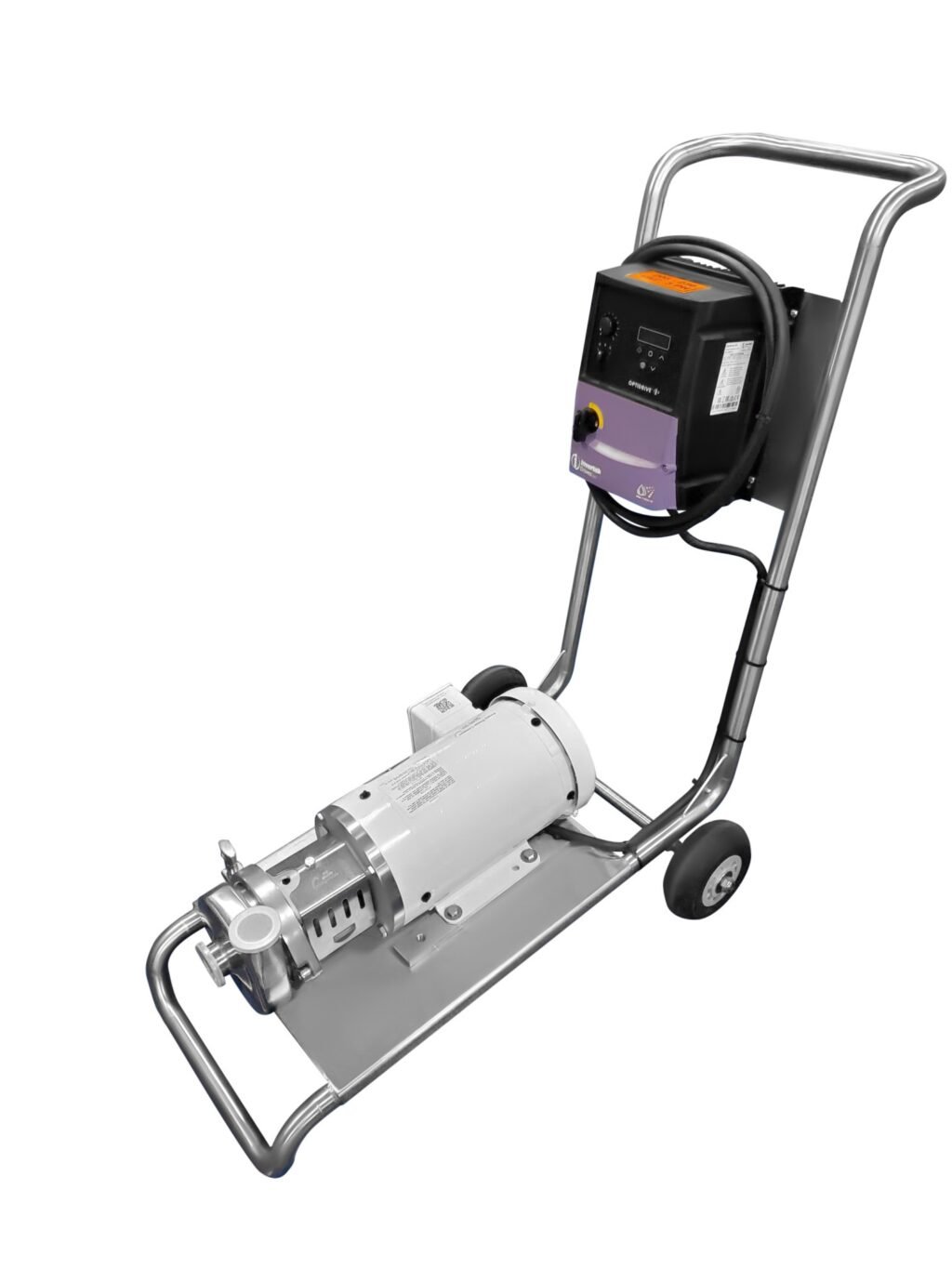
An automated CIP system can monitor and control pump operation so that the cleaning circuit receives the required flow instead of relying on guesswork.
Controlling Temperature More Precisely
Temperature affects both cleaning chemistry and the removal of food residues. However, hotter is not automatically better.
Some soils respond well to elevated temperatures, while excessive heat can cause certain proteins or sugars to become more difficult to remove. Temperature also needs to remain within the limits of the equipment, seals, hoses, and product-contact materials.
Automated systems can use temperature sensors and programmed setpoints to maintain the required cleaning conditions. If the process falls outside the defined range, the control system can trigger an alarm or prevent the sequence from advancing.
That level of control helps reduce inconsistent cleaning cycles.
Managing Chemical Concentration
Cleaning performance depends on using the correct chemical concentration. Too little chemical may leave residues behind, while excessive concentration can increase chemical consumption without delivering a proportional improvement.
Conductivity sensors are commonly used to estimate the concentration of certain cleaning solutions. As the chemical solution circulates, conductivity can help the control system determine whether the solution has reached the required strength.
This makes automated dosing and monitoring possible. Instead of depending solely on manual chemical measurement, operators can establish controlled conditions and repeat them from one cleaning cycle to another.
Time and Return Conditions Matter
A successful CIP cycle requires more than reaching a temperature or chemical concentration. The cleaning solution must remain in contact with the relevant surfaces for an appropriate period.
Automated controls can track the duration of each cleaning stage and prevent the process from moving forward before the required time has elapsed.
Return conditions are also important. The returning cleaning solution provides information about what is happening within the circuit. Temperature, conductivity, flow, and other measurements can help operators determine whether the cleaning cycle is behaving as expected.
In more advanced systems, these values can be recorded for each cycle.
Spray Devices Need Proper Coverage
Tank cleaning presents a different challenge from cleaning closed piping. Spray balls and rotary spray devices need to distribute cleaning solution across the required internal surfaces.
The device must receive adequate flow and pressure to create effective coverage. A poorly sized or poorly positioned spray device can leave shadowed areas where residue remains.
Automation can help by controlling the pump and monitoring the conditions required for the spray device to operate correctly. However, automation cannot fix an unsuitable spray-device design. Mechanical coverage and control strategy have to work together.
Automation Reduces Operator Variation
Manual CIP procedures can vary from one operator or shift to another. Someone may adjust a valve differently, shorten a rinse, or start the next stage before the desired conditions are fully established.
Automation reduces these variations by executing predefined sequences.
For food plants, this consistency can be a major advantage. Once a validated cleaning recipe is established, the same sequence can be repeated with controlled parameters. Operators can still monitor the process and respond to alarms, but fewer decisions have to be made manually during routine cleaning.
Data Logging Improves Process Visibility
Modern CIP systems can record process data such as temperature, conductivity, flow conditions, cycle duration, and alarms.
This information can help identify trends that are difficult to spot during manual cleaning. For example, a gradual reduction in flow could indicate a developing pump issue, restriction, or valve problem.
Historical data can also support troubleshooting and process improvement. If cleaning performance changes, engineers can review previous cycle information rather than relying entirely on operator recollection.
CIP Integration Starts With Equipment Design
An automated CIP system should be designed around the complete process line. Tanks, pumps, valves, heat exchangers, hoses, piping, spray devices, instrumentation, and controls all influence how effectively the system can be cleaned.
This is where experienced food processing equipment suppliers can provide value beyond supplying individual components. A properly integrated system considers how equipment will operate during production and how the same equipment will be cleaned afterward.
For example, pump selection affects flow velocity, valve arrangement affects circuit isolation, and piping geometry affects drainage and cleaning coverage.
Efficiency and Sanitation Work Together
Automated CIP is not simply about reducing labor. Its real value comes from controlling the conditions that determine cleaning performance.
When flow, temperature, chemical concentration, time, and equipment sequencing are properly engineered, processors can achieve more repeatable cleaning while reducing unnecessary water, chemicals, energy, and production downtime.
The goal is a CIP system that cleans effectively without treating every batch as a trial and error exercise. By combining sanitary equipment design with instrumentation, automation, and process-specific cleaning recipes, food processors can make sanitation more predictable while keeping production operations efficient.