How to Pack Kitchen Items Efficiently
Packing the kitchen is often one of the more challenging parts of preparing for a move. Unlike clothing or linens, kitchen items come in many different shapes, sizes, materials, and weights. Fragile glasses need protection, heavy cookware needs sturdy boxes, and appliances may require careful preparation before they can be transported. Learning how to pack kitchen items efficiently can help reduce breakage, save space, and make unpacking much easier.
Whether you are moving across town or preparing for a longer relocation, planning ahead makes a significant difference. Movers in Boston often recommend approaching the kitchen room by room and category by category rather than putting everything into boxes at once. This method works particularly well when coordinating Moving Services Boston, because properly organized and labeled boxes are easier to handle and place in the correct areas at your new home.
Start by Decluttering Your Kitchen
Before buying packing supplies or filling boxes, take time to decide what actually needs to move. Kitchen cabinets and drawers often contain duplicate utensils, unused appliances, expired food, mismatched containers, and items that have not been used for years.
Moving is a practical opportunity to reduce unnecessary belongings. Sort your kitchen items into four basic categories: keep, donate, recycle, and discard. Be realistic about appliances and cookware. If a bread maker, specialty pan, or gadget has been sitting unused for a long time, moving it may add unnecessary weight and take up valuable space.
Check expiration dates on pantry goods and dispose of anything that is expired, leaking, damaged, or unlikely to be used before the move. For unopened and usable food, consider donating suitable items if local organizations accept them.
Decluttering before packing means fewer boxes to prepare, fewer items to unpack, and less time spent organizing your new kitchen.
Gather the Right Packing Materials
Having appropriate supplies makes kitchen packing safer and more efficient. You do not necessarily need specialized materials for every item, but fragile and heavy belongings require suitable protection.
Useful supplies include sturdy small- and medium-sized boxes, packing paper, bubble wrap, cardboard dividers, strong packing tape, markers, resealable bags, and towels or dishcloths. Small boxes are generally useful for heavier kitchen items because they are easier to lift without making the box excessively heavy.
Avoid relying on newspapers alone for valuable or delicate items because ink can transfer onto surfaces. Clean packing paper is a better option for wrapping dishes and glassware.
Before you start, prepare a dedicated workspace where you can wrap items, assemble boxes, and label everything clearly. This helps prevent supplies from becoming scattered throughout the kitchen.
Pack Plates and Dishes Vertically
One of the most important principles when packing plates is to avoid simply stacking them flat in a box. Plates can experience pressure and impact during handling, increasing the possibility of cracks or breakage.
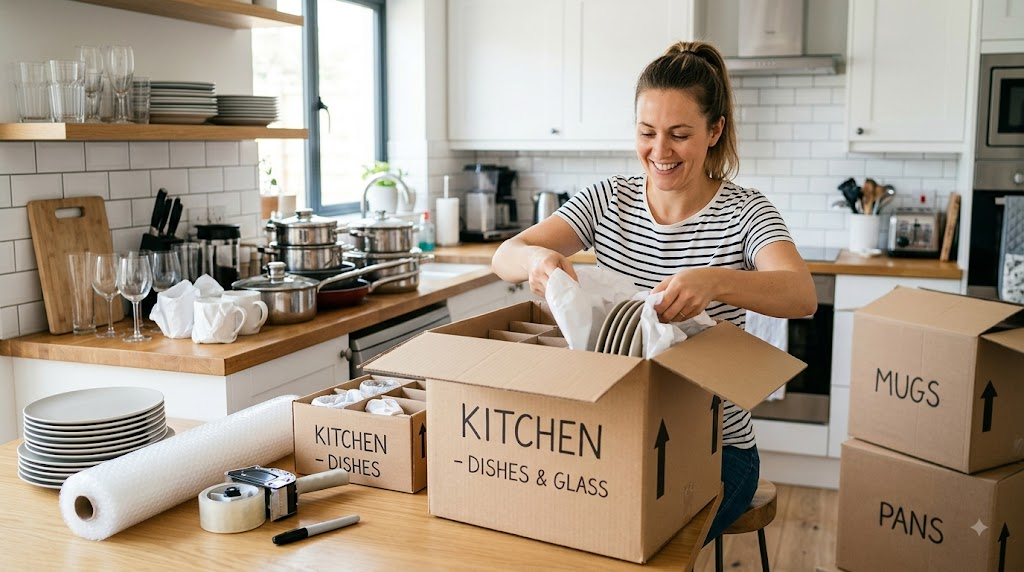
Wrap each plate individually with packing paper. After wrapping, place the plates vertically inside a sturdy box, adding cushioning underneath and around them. You can use additional paper between groups of dishes to prevent movement.
Do not leave large empty spaces inside the box. Fill gaps with crumpled packing paper, clean towels, or other suitable soft materials. The goal is to prevent the dishes from shifting when the box is moved.
Once packed, gently test the box by carefully moving it. If you can hear items knocking against each other, add more cushioning before sealing it.
Protect Glassware and Cups
Glassware requires extra care because it is particularly vulnerable to impact. Wrap each glass individually, paying attention to thin rims and handles. For stemmed glasses, add additional padding around the stem and bowl.
Specialized cell dividers can make packing glasses more organized and provide separation between individual pieces. If you do not have dividers, wrap each item thoroughly and use packing paper to create protective layers between them.
Place heavier glasses toward the bottom only when the box and cushioning are appropriate, while more delicate pieces should receive additional protection. Never overfill a glassware box simply to save space. A box that is too heavy can become difficult to carry and may be more likely to be dropped.
Clearly mark the outside of the box with “Fragile” and “Kitchen” labels. While labels do not replace careful handling, they make the contents easier to identify during loading and unpacking.
Pack Pots, Pans, and Cookware Carefully
Cookware is usually durable, but its weight can make it difficult to pack efficiently. Heavy cast-iron pans, Dutch ovens, and large pots should be placed in smaller, sturdy boxes rather than large boxes that can become excessively heavy.
Use packing paper or towels between nested pots and pans to prevent scratches. If cookware has removable handles, take them off when practical and place the handles in the same box in a protected position.
When nesting cookware, avoid forcing pieces together. A small amount of cushioning between each item can help prevent surface damage and makes separating them easier when you arrive.
Keep exceptionally heavy items distributed across multiple boxes rather than concentrating all the weight in one container.
Prepare Kitchen Appliances Before Packing
Small appliances such as blenders, coffee makers, mixers, air fryers, and toasters should be cleaned and completely dry before packing. Remove crumbs, food residue, and moisture so the appliances are ready to store and use after the move.
If you still have the original packaging for an appliance, it can be useful because the box and internal inserts were designed for that particular product. If the original packaging is unavailable, wrap the appliance with protective material and place it in a sturdy box with cushioning around all sides.
Secure removable parts separately in labeled bags and place them with the corresponding appliance. For example, blender blades, mixer attachments, and coffee-machine accessories should be kept together so they do not become separated during the move.
For larger appliances, consult the manufacturer’s instructions before disconnecting, preparing, or transporting them. Refrigerators and other major appliances may require specific preparation, particularly when they need to be disconnected in advance.
Handle Knives and Sharp Kitchen Tools Safely
Knives require special attention because they can damage boxes or cause injuries if packed improperly. Never place loose knives directly into a box with other kitchen utensils.
Wrap each knife securely in protective material and make sure the sharp edge is covered. You can then group wrapped knives together and place them in a sturdy container. Keep them away from areas where someone may reach into the box without knowing what is inside.
Clearly label boxes containing sharp kitchen tools and avoid placing knives at the top of loosely packed boxes.
Pack Pantry Items Strategically
Food can create unnecessary clutter if it is packed without planning. Start with items you will not need during the final days before moving. Leave everyday essentials accessible until closer to moving day.
Transfer open dry goods into secure containers or tightly sealed packaging when appropriate. Check jars and bottles for leaks and make sure their lids are firmly closed. Wrap items that could leak in plastic bags as an additional precaution.
Glass jars and bottles should be cushioned and packed carefully, while heavy canned goods should go into smaller boxes to keep the overall weight manageable.
Avoid moving perishable food unless you have a safe and practical way to transport it. Use up refrigerated and frozen items before moving whenever possible.
Use Towels and Linens as Extra Protection
You do not have to rely entirely on packing materials purchased specifically for moving. Kitchen towels, dishcloths, oven mitts, and other clean textiles can provide useful cushioning.
For example, you can wrap a ceramic serving bowl in a clean kitchen towel before placing it inside a box. Towels can also fill empty spaces around cookware and help prevent items from shifting.
This approach can reduce wasted space while giving everyday household textiles a practical role during the packing process. However, soft materials should complement proper protective wrapping rather than replace it for particularly fragile or valuable items.
Label Every Kitchen Box Clearly
Efficient packing does not end when the box is sealed. Proper labeling can make the entire moving process easier.
Write the room name and a short description of the contents on the top and at least one side of each box. For example, labels such as “Kitchen – Plates” or “Kitchen – Coffee Maker and Accessories” are more useful than simply writing “Kitchen.”
You can also identify boxes that should be opened first. A box containing everyday plates, cups, coffee supplies, and basic utensils may deserve priority over one containing specialty cookware that you will not need immediately.
If you have a detailed inventory, number your boxes and record their contents separately. This can be particularly useful for larger household moves.
Pack an Essentials Box
Instead of packing every kitchen item away, prepare one clearly marked kitchen essentials box for the first day or two after your move.
Depending on your needs, this box might contain a few plates, cups, basic utensils, a can opener, coffee or tea supplies, paper towels, dish soap, a sponge, and a few simple cooking tools.
The purpose is convenience. You do not want to search through dozens of sealed boxes simply to find a spoon or coffee mug on your first morning in the new home.
Keep this essentials box easily identifiable and, when possible, separate from boxes that contain items you will not need immediately.
Avoid Common Kitchen Packing Mistakes
Several simple mistakes can make kitchen packing harder than necessary. One common problem is putting too many heavy items into one large box. Another is leaving empty spaces around fragile dishes, which allows them to move during transportation.
Packing at the last minute can also lead to poor organization. Giving yourself enough time allows you to declutter, clean items, gather supplies, and pack categories carefully.
Another mistake is failing to label boxes. Even if you remember what you packed, the details can become difficult to recall after moving dozens of boxes.
Finally, avoid assuming that durable materials cannot break. Ceramic, glass, stoneware, and certain cookware can all be damaged when dropped or packed without adequate cushioning.
Frequently Asked Questions
What is the best way to pack kitchen items for moving?
The best approach is to declutter first, group similar items together, use appropriate cushioning, choose sturdy boxes based on weight, and label every box clearly. Fragile dishes and glassware should be individually wrapped and protected from movement.
Should kitchen plates be packed flat or vertically?
Plates are generally better packed vertically with cushioning between them and around the box. This arrangement can help reduce pressure on individual plates compared with creating one tall stack.
How do you pack kitchen appliances?
Clean and dry appliances before packing them. Remove detachable components, protect the appliance with suitable padding, and use the original packaging when available. Keep accessories together in labeled bags.
How can I make kitchen boxes easier to carry?
Use smaller boxes for heavy cookware, canned goods, and appliances. Distribute weight across several boxes rather than creating a single oversized, heavy container.
Conclusion
Packing a kitchen efficiently is mainly about preparation, organization, and appropriate protection. Decluttering before you begin reduces the number of items you need to move, while using the right box sizes and cushioning helps protect dishes, glassware, cookware, appliances, and pantry goods. Labeling each box and preparing an essentials box can also make unpacking significantly more manageable.
With a methodical approach, you can turn one of the more complicated rooms to pack into a structured and manageable part of your relocation. Whether you handle the move yourself or work with East Coast Boston Movers, careful kitchen packing helps protect your belongings and gives you a smoother start in your new home. Take the process one category at a time, pack thoughtfully, and your kitchen will be ready for its next chapter with far less stress.