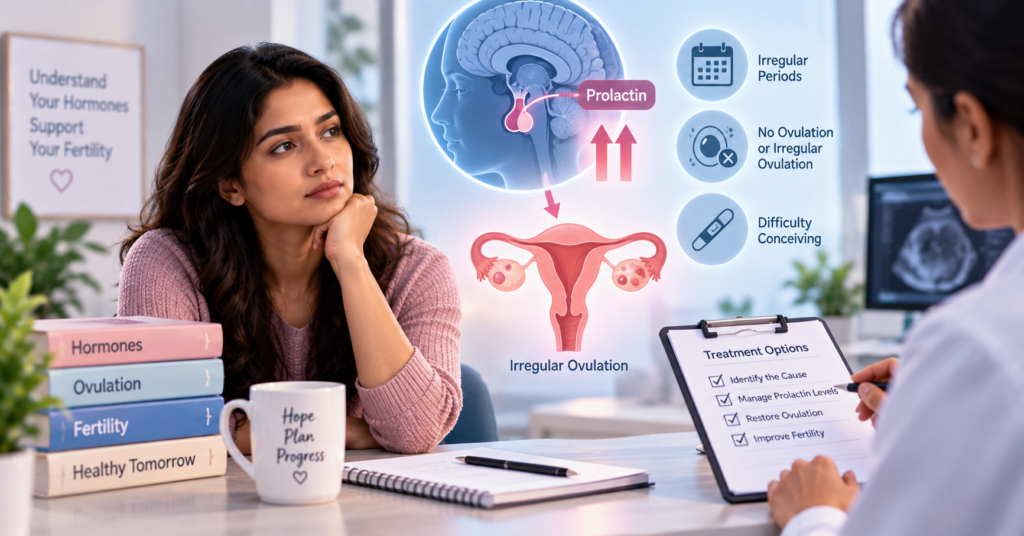
High prolactin can disrupt ovulation and menstrual cycles, but hyperprolactinemia is often treatable and fertility may improve with proper treatment.
When you’re trying to conceive, irregular periods can make it difficult to predict when ovulation is happening. There are many possible reasons for irregular ovulation, and one of them is an elevated level of the hormone prolactin.
This condition is called hyperprolactinemia. High prolactin can interfere with the hormones responsible for normal ovarian function and ovulation, potentially making conception more difficult. The good news is that when elevated prolactin is the underlying cause, identifying and treating the problem can often improve reproductive function.
Here’s what high prolactin means for fertility, what can cause it, which tests doctors may use, and how treatment can help.
What Is Hyperprolactinemia?
Hyperprolactinemia means having a higher-than-normal level of prolactin in the blood.
Prolactin is produced by the pituitary gland, a small gland located at the base of the brain. Its best-known role is supporting breast milk production after childbirth.
Outside pregnancy and breastfeeding, however, persistently elevated prolactin can interfere with reproductive hormone signalling. It can contribute to menstrual irregularities, reduced estrogen levels and infertility.
This is why hyperprolactinemia and fertility are closely connected.
How Does High Prolactin Affect Ovulation?
Normal ovulation depends on coordinated communication between the brain, pituitary gland and ovaries.
When prolactin becomes elevated, it can suppress the reproductive hormone signals involving LH (luteinizing hormone) and FSH (follicle-stimulating hormone). These hormones are important for follicle development and ovulation.
As a result, some women with high prolactin may experience:
- Irregular periods
- Infrequent ovulation
- No periods
- Lower estrogen levels
- Difficulty conceiving
- Vaginal dryness
- Reduced libido
Not everyone with elevated prolactin will experience all of these symptoms.
Can High Prolactin Stop Ovulation?
Yes, sufficiently elevated prolactin can interfere with normal ovulation.
Someone may still have occasional periods while ovulating inconsistently, so having a menstrual cycle does not necessarily confirm that ovulation is occurring regularly.
If periods become irregular while trying to conceive, checking for hormonal causes—including prolactin and thyroid abnormalities—may form part of the fertility evaluation.
What Causes High Prolactin?
There isn’t just one cause of hyperprolactinemia.
Possible causes include:
1. Prolactinoma
A prolactinoma is a usually benign pituitary tumor that produces prolactin.
These tumors can be small or larger. Larger prolactinomas may sometimes cause headaches or vision problems because of their location near structures involved in vision.
2. Certain Medications
Some prescription medicines can increase prolactin levels.
Examples include certain medications used for:
- Mental health conditions
- Depression
- Nausea and vomiting
- High blood pressure
- Pain
Never stop a prescribed medicine on your own because you suspect it is affecting prolactin. A doctor can determine whether a medication could be contributing and whether an alternative is appropriate.
3. Hypothyroidism
An underactive thyroid can sometimes be associated with elevated prolactin.
This is one reason thyroid testing may be included when investigating unexplained high prolactin.
4. Pregnancy and Breastfeeding
Prolactin naturally rises during pregnancy and breastfeeding.
Therefore, a high prolactin result is not automatically a sign of disease. The result needs to be interpreted according to the person’s circumstances.
5. Other Medical Conditions
Certain pituitary disorders and conditions affecting the liver, kidneys or chest wall can also contribute to elevated prolactin. Sometimes, no clear cause is identified.
What Prolactin Level Is Too High?
There isn’t one universal number that can be labelled “too high” for everyone.
Laboratories use different reference ranges, and prolactin levels can also vary depending on factors such as pregnancy, breastfeeding, medications and the clinical situation.
Therefore, it is better not to interpret a prolactin result based on an internet number alone.
If your report shows an elevated value, your doctor may decide whether the test should be repeated and whether additional investigations are needed.
How Is Hyperprolactinemia Diagnosed?
The starting point is generally a blood test measuring serum prolactin.
If prolactin is elevated, doctors may investigate why.
Depending on the situation, evaluation can include:
- Medical and menstrual history
- Medication review
- Pregnancy testing when appropriate
- Thyroid hormone testing
- Assessment for other hormonal abnormalities
- Testing for macroprolactin in selected cases
- Pituitary imaging such as MRI when a pituitary tumor is suspected
The Endocrine Society notes that evaluation should focus on identifying the underlying cause rather than treating the laboratory result in isolation.
What Is Macroprolactin?
Sometimes a laboratory test detects a form of prolactin called macroprolactin.
Macroprolactin generally has much less biological activity than the usual form of prolactin and may not cause the same health effects. Testing for it can therefore be useful in selected people with an unexpectedly elevated prolactin result.
This is another reason why one abnormal laboratory value should not automatically be interpreted as the cause of infertility.
Hyperprolactinemia Treatment
Treatment depends on why the prolactin is elevated.
There is no single treatment that is appropriate for everyone.
Dopamine Agonists
When a prolactinoma is responsible, medications called dopamine agonists are commonly used.
Two medicines doctors may use are:
- Bromocriptine
- Cabergoline
These medicines can reduce prolactin production and, in people with prolactinomas, can also shrink the tumor. The Endocrine Society reports that most prolactinomas respond well to medical treatment.
Treating Hypothyroidism
If hypothyroidism is contributing to the elevated prolactin, treating the thyroid disorder can help bring prolactin levels back toward normal.
Medication-Related Hyperprolactinemia
If a prescribed medication is responsible, the doctor may consider changing the medication or treatment approach when appropriate.
Do not discontinue medication without medical advice.
When a Tumor Requires More Treatment
Most prolactinomas are managed medically.
Surgery may be considered in selected situations, such as when medication is ineffective or causes unacceptable side effects. Radiation is rarely required.
Can Treating High Prolactin Improve Fertility?
In many cases, yes.
When elevated prolactin is interfering with normal reproductive hormone function, lowering prolactin can allow reproductive hormones and ovulation to recover.
The Endocrine Society notes that women with prolactinomas are usually able to become pregnant once prolactin levels normalize.
However, fertility depends on many factors. Correcting prolactin does not guarantee pregnancy if there are other issues involving ovarian reserve, fallopian tubes, sperm quality, age or other reproductive conditions.
Prolactin Levels and Pregnancy
Once pregnancy occurs, prolactin naturally increases as part of the body’s preparation for breastfeeding.
This means prolactin levels during pregnancy should not be interpreted in the same way as prolactin levels during a fertility evaluation.
If you are taking medication for a prolactinoma and become pregnant, contact your endocrinologist or fertility specialist promptly. Medication decisions during pregnancy should be individualized by your treating team.
Can You Get Pregnant With High Prolactin?
It is possible, but significantly elevated prolactin can make conception more difficult by interfering with ovulation.
The important question is why the prolactin is elevated and whether it is affecting reproductive function.
If high prolactin is treated successfully and ovulation returns, the chances of natural conception may improve. Other fertility factors still need to be considered.
When Should You See a Doctor?
Consider discussing a fertility or endocrine evaluation with a healthcare professional if you have:
- Irregular or absent periods
- Difficulty becoming pregnant
- Unexpected breast milk production when not pregnant or breastfeeding
- Reduced libido
- Headaches accompanied by menstrual changes
- Vision changes
- A previously abnormal prolactin test
Headaches or vision changes in someone with significantly elevated prolactin deserve particular attention because larger pituitary tumors can sometimes affect nearby structures.
Hyperprolactinemia vs PCOS
High prolactin and polycystic ovary syndrome (PCOS) can both be associated with irregular periods and ovulation problems, but they are different conditions.
PCOS is a common cause of irregular ovulation, while hyperprolactinemia involves abnormal elevation of prolactin.
Because the symptoms can overlap, testing is important rather than assuming that irregular periods automatically mean PCOS.
Does Everyone With High Prolactin Need Treatment?
Not necessarily.
Treatment depends on the underlying cause, the degree of elevation, symptoms and the person’s overall clinical situation.
Some people with elevated prolactin but few or no symptoms may not require immediate treatment, while others may need medication or additional investigation.
This is why treatment should be based on a medical evaluation rather than a single laboratory result.
Frequently Asked Questions
Can high prolactin cause infertility?
Yes. Elevated prolactin can interfere with reproductive hormone signalling and ovulation, which can make conception more difficult.
Does high prolactin always stop ovulation?
No. The effect varies between individuals. Some may have irregular ovulation, while others may have more significant reproductive hormone disruption.
Can hyperprolactinemia be treated?
Yes. Treatment depends on the cause and may include treating an underlying condition or using medicines such as dopamine agonists for prolactinomas.
Can I get pregnant after treating high prolactin?
Many women with prolactin-related fertility problems can regain reproductive function after appropriate treatment, particularly when a prolactinoma is the cause and prolactin levels normalize.
Does high prolactin affect pregnancy?
Prolactin normally rises during pregnancy, so elevated prolactin before conception and normal pregnancy-related prolactin increases are different situations. Medication management should be discussed with your doctor if you become pregnant.
Final Takeaway
Hyperprolactinemia and fertility are closely connected because excess prolactin can interfere with the hormonal signals required for regular ovulation.
If you have irregular periods, unexplained difficulty conceiving or symptoms associated with high prolactin, a blood test and appropriate medical evaluation can help identify the cause. When hyperprolactinemia is responsible for ovulation problems, treating the underlying cause can often restore reproductive function and improve the possibility of conception.
The key is not simply to lower a number on a laboratory report. The goal is to identify why prolactin is elevated, treat the underlying problem appropriately, and evaluate the rest of the fertility picture when needed.
Medical note: This article is for general educational information and does not replace evaluation by a gynecologist, endocrinologist or fertility specialist. Prolactin results and treatment decisions should always be interpreted in the context of your individual health and laboratory reference range.