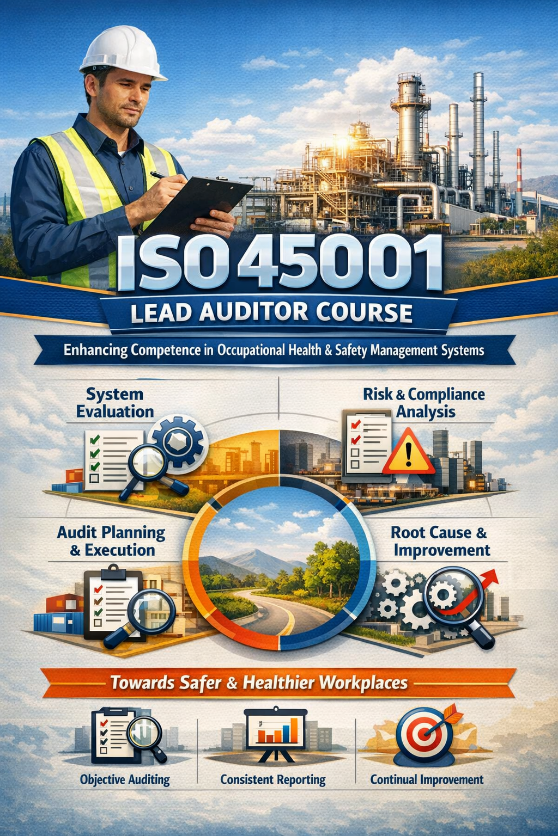
Strengthening Audit Competence in Occupational Health and Safety Management Systems
Internal auditing has become a critical function within occupational health and safety management systems. Today, organizations increasingly rely on internal auditors not only to verify compliance but also to assess how effectively safety processes operate in practice. As a result, this expectation has gradually reshaped the role of internal auditors, requiring a broader skill set and a more analytical approach.
In this context, an ISO 45001 lead auditor course provides a structured framework to support this shift. Specifically, it is designed to enhance the competence of internal auditors by equipping them with the knowledge and skills required to evaluate occupational health and safety systems in a consistent and objective manner. Moreover, the course does not simply build on basic auditing concepts; instead, it expands the auditor’s perspective to include system performance, risk evaluation, and continual improvement.
Therefore, for internal auditors seeking to strengthen their role within the organization, the ISO 45001 lead auditor course represents a significant step toward professional development and operational effectiveness.
Purpose and Scope of the ISO 45001 Lead Auditor Course
The ISO 45001 lead auditor course is structured to develop the ability to plan, conduct, manage, and report audits of occupational health and safety management systems. Importantly, its scope extends beyond introductory auditing practices and focuses on the comprehensive audit lifecycle.
Consequently, internal auditors benefit from this broader scope as it enables them to understand how audit activities connect with organizational objectives. In addition, the course provides clarity on interpreting ISO 45001 requirements while maintaining alignment with established auditing principles. At the same time, it ensures that auditors can evaluate whether management systems are capable of achieving intended safety outcomes.
By combining both theoretical and practical elements, the ISO 45001 lead auditor course prepares internal auditors to approach audits with greater consistency and confidence. Ultimately, this structured approach ensures that audit findings are reliable, relevant, and aligned with organizational needs.
Transition from Compliance-Based Auditing to System Evaluation
In many organizations, internal auditing begins with a focus on compliance verification. Typically, auditors check whether procedures exist and whether documented requirements are met. While this approach is essential, it often limits the ability to identify deeper issues within the system.
To address this, the ISO 45001 lead auditor course introduces a transition from compliance-based auditing to system evaluation. In other words, this involves understanding how processes interact and how risks are managed across different operational areas. Accordingly, internal auditors learn to assess whether safety controls are effective and whether they contribute to the prevention of incidents.
This shift, however, requires a change in perspective. Instead of simply asking whether a requirement is fulfilled, auditors begin to examine whether the system is functioning as intended. As a result, this approach provides a more accurate representation of organizational performance and supports meaningful improvements.
Interpretation of ISO 45001 Requirements in Context
A common challenge for internal auditors is the interpretation of ISO 45001 requirements. Because the standard is designed to be applicable across a wide range of industries, its language is often broad and adaptable. Therefore, without proper guidance, this flexibility can lead to inconsistent or incomplete assessments.
To overcome this issue, the ISO 45001 lead auditor course focuses on the intent behind each requirement. Specifically, participants are trained to translate clauses into practical audit criteria that reflect the organization’s specific context. Furthermore, this includes understanding how policies, objectives, and operational controls contribute to the overall effectiveness of the management system.
Through this approach, internal auditors develop the ability to evaluate compliance with greater accuracy. In addition, they gain confidence in making informed judgments supported by objective evidence rather than assumptions.
Audit Planning as a Foundation for Effective Audits
Audit planning is a fundamental component of the auditing process. Without it, audits may lack direction, leading to incomplete coverage and unreliable findings. For this reason, the ISO 45001 lead auditor course emphasizes structured preparation as a key factor in audit success.
During this phase, internal auditors are trained to define audit objectives, scope, and criteria in a clear and systematic manner. Moreover, this includes identifying areas of higher risk and allocating appropriate time and resources for their evaluation. In addition, planning involves reviewing relevant documentation to gain an initial understanding of the processes being audited.
As a result, a well-prepared audit enables auditors to conduct their activities efficiently and effectively. Not only does it reduce uncertainty during the audit process, but it also ensures that critical areas are not overlooked. Consequently, the quality and credibility of audit outcomes are significantly enhanced.
Conducting Audits with Objectivity and Consistency
The execution phase of an audit requires a structured approach combined with the ability to adapt to real-world conditions. At this stage, internal auditors must gather sufficient evidence while maintaining objectivity throughout the process.
To support this, the ISO 45001 lead auditor course provides guidance on conducting audits through techniques such as interviews, observations, and document reviews. Additionally, it emphasizes verifying information from multiple sources to ensure accuracy and reliability.
Equally important, effective communication plays a critical role. Internal auditors must interact with employees at different levels, ensuring that information is gathered clearly and respectfully. This, in turn, helps build trust and encourages open communication.
Ultimately, consistency in audit execution ensures that findings are comparable across different audits and departments, contributing to a more reliable system-wide assessment.
Evaluation of Audit Findings and Root Cause Analysis
The identification and evaluation of audit findings are central to the auditing process. First and foremost, findings must be based on objective evidence and clearly linked to ISO 45001 requirements.
In this regard, the ISO 45001 lead auditor course provides a structured evaluation approach. Specifically, internal auditors learn to assess the significance of findings within the system context and distinguish between types of nonconformities.
More importantly, the course emphasizes root cause analysis. Rather than focusing only on symptoms, auditors are encouraged to identify underlying causes. As a result, organizations can implement effective corrective actions and prevent recurrence.
Audit Reporting and Communication of Results
Audit reporting is a formal process that communicates results to management. Therefore, clarity and structure are essential.
Accordingly, the ISO 45001 lead auditor course trains auditors to present findings in an informative and actionable manner. In particular, reports should reflect objectives, provide evidence-based conclusions, and highlight key areas requiring attention.
Beyond written reports, auditors must also communicate findings during closing meetings. In doing so, they need confidence, clarity, and the ability to justify conclusions with evidence.
Follow-Up Activities and Continual Improvement
The audit process does not end with reporting. Instead, follow-up activities ensure corrective actions are implemented effectively.
For this reason, the ISO 45001 lead auditor course highlights follow-up as a critical audit stage. Specifically, auditors verify that issues are resolved and improvements are sustained.
Consequently, this approach ensures audits contribute to continual improvement rather than merely identifying deficiencies.
Conclusion
In conclusion, the ISO 45001 lead auditor course plays a vital role in advancing internal auditor competence. Overall, it provides a structured approach to evaluating and improving occupational health and safety management systems.
As expectations continue to evolve, internal auditors must adopt a more analytical and system-focused approach. Therefore, this course equips them with the knowledge, skills, and professional judgment needed to perform audits effectively and contribute to safer working environments.