Introduction
Customers expect products and services to meet consistent standards. For organizations, maintaining that consistency can become difficult as teams grow, processes change, and customer needs evolve. ISO 9001 certification offers a structured way to manage quality, review performance, and improve how work gets done.
ISO 9001 is an internationally recognized quality management system (QMS) standard. It can be applied by organizations of different sizes and across a wide range of industries. Rather than focusing only on final product inspection, it encourages businesses to manage quality throughout their operations—from understanding customer requirements to evaluating results and addressing problems.
What Is ISO 9001 Certification?
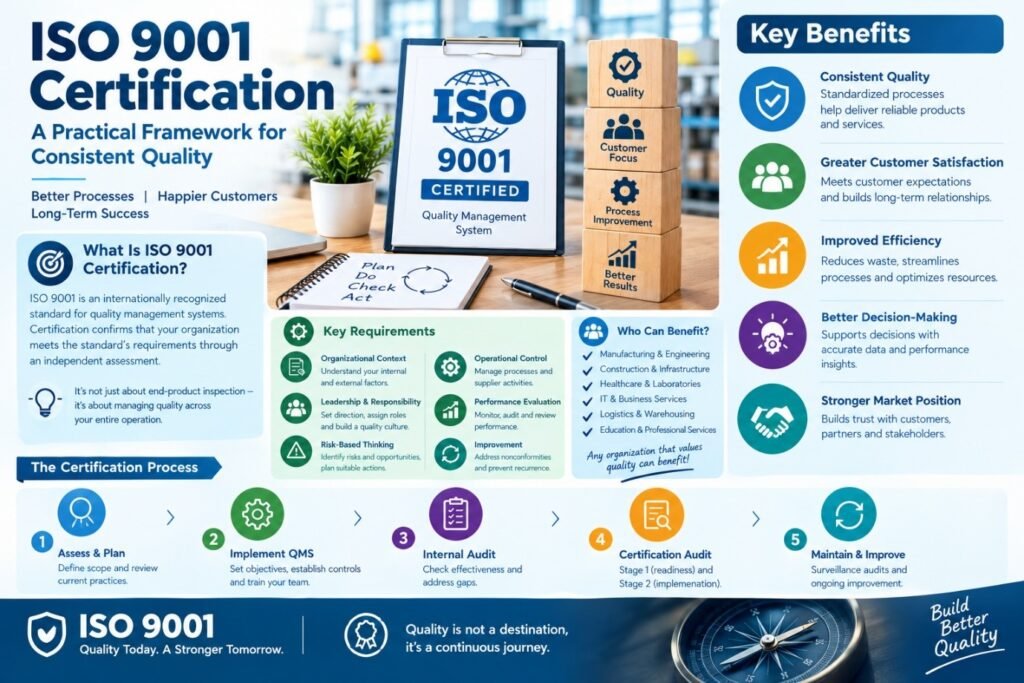
ISO 9001 sets out requirements for establishing, implementing, maintaining, and continually improving a quality management system. Certification is an independent assessment that verifies whether an organization’s QMS meets the standard’s requirements within a defined scope.
The standard is based on principles such as customer focus, leadership, employee involvement, process management, evidence-based decision-making, and continual improvement. It follows the Plan-Do-Check-Act approach, helping organizations plan their processes, put them into practice, review outcomes, and make improvements.
Certification does not automatically guarantee that every product or service will be defect-free. Instead, it demonstrates that the organization has a management system designed to support consistent quality and respond to issues in a systematic way.
Key Requirements Organizations Need to Address
To prepare for certification, an organization needs to understand how its processes affect quality and customer satisfaction. Important areas include:
- Organizational context: Identify relevant internal and external issues, interested parties, and the scope of the QMS.
- Leadership and responsibility: Define quality commitments, assign responsibilities, and ensure that quality objectives support the organization’s direction.
- Risk-based thinking: Identify risks and opportunities that may affect the intended results of the QMS, then plan suitable actions.
- Operational control: Establish and manage processes for delivering products or services, including relevant supplier and outsourced activities.
- Performance evaluation: Monitor suitable measures, review customer feedback, conduct internal audits, and hold management reviews.
- Improvement: Address nonconformities, determine their causes, and take action to reduce the chance of recurrence.
Documentation should support effective process control. Organizations should avoid creating records simply to produce paperwork; documented information needs to be useful, current, and appropriate to the way the business operates.
Who Can Benefit From ISO 9001?
ISO 9001 is not limited to manufacturing companies. Its requirements can be adapted to many types of organizations, including:
- Manufacturing and engineering businesses
- Construction and infrastructure providers
- Healthcare and laboratory support services
- Information technology and business service companies
- Logistics, distribution, and warehousing operations
- Educational institutions and professional service providers
A small company may use the standard to clarify responsibilities and reduce process variation, while a larger organization may use it to coordinate quality practices across departments or locations. The QMS scope should reflect the actual activities and sites included in the certification.
Steps in the ISO 9001 Certification Process
The process generally begins with preparation and continues through an independent audit.
- Define the scope and assess current practices Identify the products, services, locations, and processes that will be covered. Compare existing practices with the standard to find gaps that need attention.
- Develop and implement the QMS Set quality objectives, assign process owners, establish controls, and provide relevant training. Make sure employees understand the procedures and how their work contributes to quality.
- Conduct an internal audit Review whether the QMS is implemented and working as intended. Record findings and address identified nonconformities before the external certification audit.
- Complete the certification audit The certification body typically conducts a Stage 1 audit to review readiness and a Stage 2 audit to evaluate implementation and effectiveness. Any findings must be addressed in line with the certification body’s process.
- Maintain the system After certification, the organization needs to continue monitoring performance, conducting internal audits, reviewing the QMS, and participating in surveillance audits. Certification is maintained through ongoing conformity, not just the initial assessment.
Practical Benefits of a Quality Management System
A well-implemented QMS can help an organization make its processes more consistent and easier to manage. Clear responsibilities and defined procedures can reduce confusion between teams. Monitoring and analysis can help identify recurring issues, while corrective action can support more reliable problem-solving.
The system can also help organizations understand customer expectations and collect feedback in a structured way. Over time, this can contribute to stronger customer relationships and more informed decisions about process changes, training, and resource needs.
Certification may also be relevant when customers or business partners ask suppliers to demonstrate a recognized quality management approach. However, the commercial value depends on the organization’s market, customer requirements, and how effectively it uses the system.
Choosing a Certification Body
Organizations should select a certification body that is competent to assess the relevant industry and QMS scope. Before proceeding, clarify the audit approach, scope, expected timeline, fees, and requirements for handling nonconformities.
Check whether the certification body is accredited for the relevant standard and scope, and confirm the accreditation status directly with the appropriate accreditation organization. A clear understanding of the audit process can help the organization prepare realistically and avoid treating certification as a last-minute paperwork exercise.
Conclusion
ISO 9001 certification can provide organizations with a structured way to manage quality, evaluate performance, and support continual improvement. Its value comes from how well the QMS reflects everyday operations—not simply from receiving a certificate. By defining processes, involving employees, reviewing results, and addressing problems, businesses can build a quality management approach that supports both customer requirements and long-term operational consistency.