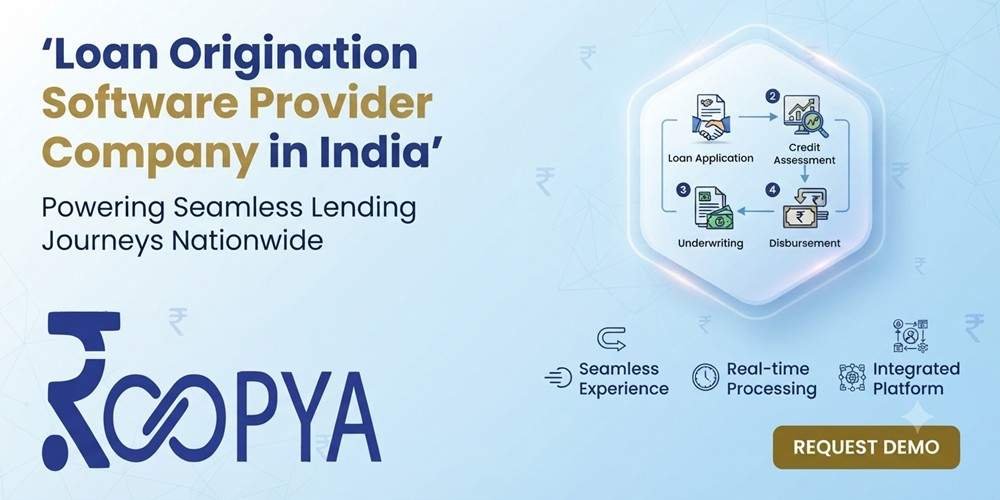
Understand every stage of the loan origination process — from application to disbursement — and see how NBFCs and lenders use automation to cut TAT and boost approvals with Roopya
Every rupee a lender disburses passes through one critical journey first: loan origination. It’s the invisible machinery behind every “approved” SMS a borrower receives — the sequence of checks, verifications, and decisions that determines whether a loan application becomes a live account on a lender’s books.
For banks, NBFCs, and fintech lenders operating in India’s fast-growing credit market, the loan origination process is no longer just a back-office function. It’s a competitive battleground. Borrowers today compare lenders the way they compare food delivery apps — on speed, transparency, and ease. A lender that takes five days to approve a personal loan will lose the customer to one that does it in five minutes.
This guide breaks down the complete loan origination process step by step, explains why each stage exists, where lenders typically lose time and applicants, and how modern loan origination systems (LOS) like Roopya are reshaping the experience for both lenders and borrowers.
What Is Loan Origination?
Loan origination is the entire lifecycle a loan application goes through, starting the moment a borrower expresses interest and ending when funds are disbursed into their account. It covers application intake, identity and income verification, credit assessment, underwriting, approval, documentation, and disbursal.
It is distinct from loan servicing (which begins after disbursement and covers EMI collection, statements, and account management) and from collections (which deals with recovering overdue payments). Origination is the “front door” of lending — and how well that door swings open determines whether a lender wins or loses the borrower’s business.
For regulated lenders in India, origination also carries compliance weight. RBI’s Fair Practices Code, KYC Master Directions, and digital lending guidelines all place direct obligations on how lenders originate loans — from disclosure requirements to data consent to the treatment of loan service providers (LSPs) and co-lending partners.
Why the Loan Origination Process Matters More Than Ever
Three forces have converged to make origination a make-or-break function for lenders:
1. Borrower expectations have shifted. UPI, instant payments, and app-based commerce have reset what “fast” means. A borrower who can transfer money in three seconds will not tolerate a loan application that takes three days to move past document upload.
2. Digital lending volumes are exploding. Small-ticket personal loans, buy-now-pay-later products, merchant loans, and embedded credit at the point of sale mean lenders are processing far higher application volumes than traditional underwriting teams were built for.
3. Regulatory scrutiny has intensified. RBI’s Digital Lending Guidelines (2022) and subsequent circulars have tightened rules around first-loan-default guarantees, data privacy, key fact statements, and the role of digital lending apps — making a compliant, auditable origination process non-negotiable.
Lenders who treat origination as a manual, spreadsheet-and-email process inevitably hit a ceiling: rising cost per loan, inconsistent underwriting decisions, poor audit trails, and a borrower drop-off rate that quietly eats into growth.
The Complete Loan Origination Process: Step by Step
While the exact workflow varies by loan type — personal, business, gold, home, or vehicle loans each have their own nuances — nearly every loan origination process follows the same core stages.
Step 1: Lead Capture and Inquiry
The journey begins when a prospective borrower shows interest — through a website form, a partner LSP or DSA, a co-lending partner, an embedded finance checkout flow, or a call center. At this stage, lenders typically capture basic details: name, contact information, loan amount sought, and purpose.
This is also where channel management matters. A lender sourcing loans through multiple DSAs, aggregators, and digital partners needs a system that can tag, track, and attribute every lead to its source — both for commission payouts and for measuring which channels convert best.
Step 2: Application Submission
The borrower fills out a formal loan application, providing details such as employment status, income, existing obligations, and the specifics of what they’re borrowing for. Well-designed digital application forms are typically:
- Broken into short, logical sections rather than one long form
- Pre-filled where possible using PAN, Aadhaar, or existing customer data
- Mobile-first, since a large share of India’s borrowers apply from smartphones
- Built with conditional logic so a salaried applicant doesn’t see fields meant for a self-employed one
Every additional field in an application form measurably increases drop-off. This is why lean, adaptive application journeys are one of the biggest levers lenders have to improve conversion.
Step 3: KYC and Identity Verification
Before any credit assessment can happen, the lender must establish who the borrower actually is. This typically includes:
- e-KYC via Aadhaar-based OTP or biometric verification
- PAN verification against income tax records
- Video KYC (V-CKYC), now widely accepted by RBI for non-face-to-face onboarding
- Liveliness and facial-match checks to prevent identity fraud
- CKYC registry checks to avoid duplicate KYC across institutions
This step has become significantly faster in India thanks to the India Stack — Aadhaar, DigiLocker, and the CKYC registry allow lenders to verify identity in seconds rather than requiring physical document submission.
Step 4: Credit Bureau and Alternate Data Checks
The lender pulls the applicant’s credit report from one or more bureaus (CIBIL, Experian, Equifax, CRIF High Mark) to assess credit history, existing exposure, repayment behavior, and any defaults.
For thin-file or new-to-credit borrowers — a large segment in India — many lenders supplement bureau data with alternate data sources: bank statement analysis, UPI transaction patterns, GST filings for business loans, utility bill payment history, or telecom data. This alternate-data layer is one of the biggest reasons digital lenders have been able to extend credit to segments traditional banks historically couldn’t underwrite.
Step 5: Document Collection and Verification
Depending on the loan type, borrowers submit supporting documents such as:
- Income proof (salary slips, ITRs, bank statements)
- Address proof
- Business documents (GST returns, financial statements) for SME loans
- Collateral documents (property papers, vehicle RC, gold appraisal) for secured loans
Manual document review is one of the slowest parts of traditional origination. AI-based OCR and document intelligence tools can now extract data from scanned documents, cross-verify it against application data, and flag inconsistencies or tampering — cutting what once took hours down to seconds.
Step 6: Underwriting and Credit Decisioning
This is the analytical core of the origination process. Underwriting combines:
- Credit scoring models (bureau score plus internal application scorecards)
- Business Rule Engines (BRE) that apply the lender’s credit policy — eligibility thresholds, FOIR (fixed obligation to income ratio) limits, blacklist checks, geography restrictions, and product-specific rules
- Risk-based pricing that adjusts interest rate and loan terms based on the borrower’s risk profile
- Fraud detection checks, including device fingerprinting, IP/geolocation anomalies, and duplicate application detection
A well-configured BRE allows a lender to auto-approve, auto-reject, or route to manual review — dramatically reducing the number of applications that need human underwriter time, while keeping full policy consistency across every decision.
Step 7: Loan Decision and Sanction
Once underwriting is complete, the lender issues a decision: approve, reject, or approve with modified terms (a different amount, tenure, or rate than requested). Approved applicants receive a sanction letter outlining the loan amount, interest rate, tenure, processing fee, and other charges.
Under RBI’s digital lending framework, lenders are also required to issue a standardized Key Fact Statement (KFS) — a simplified, borrower-friendly summary of all costs associated with the loan, including the Annual Percentage Rate (APR).
Step 8: Loan Agreement and e-Sign
The borrower reviews and accepts the loan agreement, typically through Aadhaar-based e-signature, which is legally valid under India’s IT Act and eliminates the need for physical paperwork or in-person visits. This stage also covers mandate setup for repayments — typically an e-NACH or e-mandate for auto-debit of EMIs.
Step 9: Disbursement
Once the agreement is signed and mandate registered, funds are disbursed — usually via NEFT, RTGS, IMPS, or direct credit to the borrower’s bank account. For many digital lenders, disbursement now happens within minutes of final sign-off, particularly for small-ticket personal loans.
Step 10: Post-Disbursement Handoff
Origination formally ends here, but a well-built system doesn’t just close the file — it hands the loan cleanly into the loan management system (LMS) for servicing: repayment schedules, statements, and ongoing account management. A broken handoff between origination and servicing systems is a common source of reconciliation errors and customer complaints, which is why lenders increasingly prefer an origination and management stack that’s unified rather than stitched together from separate vendors.
Manual vs. Automated Loan Origination: Where Lenders Lose Time
Lenders running origination through manual processes, spreadsheets, and email-based approvals typically face:
- Long turnaround times (TAT) — days instead of minutes for straightforward applications
- Inconsistent underwriting — different officers applying credit policy differently
- High drop-off rates — borrowers abandoning applications that ask for repeated document uploads or take too long
- Poor audit trails — difficulty proving to regulators or auditors exactly why a loan was approved or rejected
- Limited scalability — origination teams that can’t handle sudden volume spikes without adding headcount
Automated, no-code loan origination platforms address each of these by digitizing the application, running verification and bureau checks via API in real time, applying credit policy through a configurable rule engine, and routing only genuine edge cases to human underwriters. This shifts the underwriting team’s role from repetitive data-checking to actual risk judgment on ambiguous cases — which is where human expertise adds the most value anyway.
The Role of Technology in Modern Loan Origination
A modern loan origination system typically brings together capabilities that used to require multiple disconnected vendors:
- Pre-integrated APIs for credit bureaus, KYC/Aadhaar verification, bank statement analysis, GST verification, and payment gateways — so lenders don’t have to negotiate and integrate each data source separately
- A configurable Business Rule Engine that lets credit and risk teams update policy without waiting on developers
- AI-based document analysis that extracts and validates data from scanned or photographed documents in seconds
- Fraud detection modules that flag suspicious application patterns before they reach underwriting
- Ready-made loan product templates for personal, business, gold, vehicle, and home loans, so new products can launch in days rather than months
- Dashboards and reporting that give risk and business teams real-time visibility into approval rates, TAT, and portfolio quality
This is precisely the gap platforms like Roopya are built to close. Roopya provides NBFCs, banks, and loan service providers with a no-code loan origination and management infrastructure — covering everything from digital application intake and 300+ pre-integrated verification APIs to a self-configurable rule engine and AI-powered document and fraud checks. Lenders can go live with a new loan product in as little as a day, without writing code or managing a patchwork of vendor integrations, and pay based on actual usage rather than large upfront licensing costs.
Compliance Considerations Lenders Can’t Skip
Origination isn’t just an operational process — it’s a regulated one. Lenders operating in India need their origination workflow to account for:
- RBI’s Digital Lending Guidelines, covering disclosure norms, the role of Lending Service Providers, and restrictions on first-loss default guarantee (FLDG) arrangements
- KYC Master Directions, including CKYC registry updates and video-KYC standards
- The Fair Practices Code, requiring clear communication of interest rates, fees, and terms before the borrower commits
- Data protection obligations, especially around consent for pulling credit reports and using alternate data sources
- Key Fact Statement (KFS) disclosure for all digital loans, standardizing how costs are presented to borrowers
Building compliance into the origination workflow itself — rather than treating it as a manual checklist — is far more reliable and auditable, which is why a platform’s ability to stay current with evolving RBI circulars is a genuine differentiator when evaluating loan origination software.
Metrics Every Lender Should Track in Origination
To know whether an origination process is actually working, lenders should monitor:
- Turnaround Time (TAT) — average time from application to disbursement
- Approval rate — percentage of applications approved vs. submitted
- Drop-off rate — where in the funnel borrowers abandon the application
- Cost per loan originated — total origination cost divided by loans disbursed
- First Payment Default (FPD) — an early signal of underwriting quality
- Straight-through processing (STP) rate — percentage of applications that move from submission to decision without manual intervention
Tracking these consistently helps lenders spot friction points — a form field causing drop-offs, a bureau integration adding latency, an underwriting rule rejecting good borrowers — and fix them before they compound.
How to Choose the Right Loan Origination Platform
When evaluating loan origination systems, lenders should weigh:
- Speed to launch — can you go live with a new product in days, not months?
- Breadth of pre-built integrations — bureaus, KYC providers, payment gateways, and fraud checks
- Configurability without code — can risk teams update policy themselves?
- Compliance readiness — is the platform actively updated for RBI’s evolving digital lending rules?
- Scalability — can it handle both a 100-loan pilot and a 100,000-loan-a-month scale-up?
- Total cost of ownership — upfront licensing vs. usage-based pricing
- Integration with servicing and collections — does origination hand off cleanly into an LMS, or does data need to be re-entered?
Lenders that get this evaluation right typically see origination shift from a cost center into a genuine growth lever — faster approvals translate directly into higher conversion and better customer retention.
The Future of Loan Origination
A few trends are shaping where loan origination is headed next:
- AI-driven underwriting that goes beyond bureau scores to evaluate cash-flow patterns, behavioral data, and alternate signals in real time
- Embedded finance, where credit is offered directly within e-commerce checkouts, B2B procurement platforms, and other non-financial apps — pushing origination to be near-instant and nearly invisible to the borrower
- Conversational and self-service journeys, where borrowers can apply for and track loans through chat interfaces rather than traditional forms
- Deeper co-lending and LSP ecosystems, requiring origination platforms to manage multi-party workflows, commission structures, and shared compliance responsibility cleanly
Lenders that build on flexible, API-driven origination infrastructure today will be far better positioned to adopt these shifts without ripping out their core systems tomorrow.
The loan origination process is where lending businesses are won or lost. Every stage — from lead capture to disbursement — either builds borrower trust and speed, or adds friction that pushes customers toward a faster competitor. For NBFCs, banks, and fintech lenders in India, automating this journey isn’t a luxury anymore; it’s the baseline expectation of the market.
Platforms like Roopya exist to make that automation accessible without a multi-year IT project — combining a no-code loan origination system, pre-integrated verification APIs, and a configurable rule engine so lenders can launch compliant, fast, and scalable lending products in days.
Ready to see how a modern loan origination system could change your approval times? Request a demo with Roopya and see the platform in action.
Frequently Asked Questions (FAQ)
1. What is the loan origination process? Loan origination is the complete journey a loan application goes through — from the borrower’s initial inquiry and application, through KYC, credit checks, underwriting, and approval, to final disbursement of funds.
2. How long does loan origination typically take? It varies by loan type and lender. Manual processes can take several days to weeks, while automated, API-driven loan origination systems can approve and disburse small-ticket loans like personal loans within minutes to a few hours.
3. What documents are required during loan origination? Commonly required documents include identity and address proof (PAN, Aadhaar), income proof (salary slips, bank statements, ITRs), and, for secured or business loans, collateral or business documents such as property papers or GST returns.
4. What is the difference between loan origination and loan servicing? Loan origination covers everything up to disbursement — application, verification, underwriting, and approval. Loan servicing begins after disbursement and covers EMI collection, statements, and account management over the life of the loan.
5. What is a Business Rule Engine (BRE) in loan origination? A BRE is a configurable system that applies a lender’s credit policy — eligibility criteria, income thresholds, blacklist checks, and approval logic — automatically to each application, ensuring consistent, policy-compliant decisions at scale.
6. Why do lenders use alternate data in credit decisioning? Alternate data, such as bank transaction patterns, UPI history, or utility payments, helps lenders assess borrowers who have thin or no credit bureau history — a significant segment of first-time borrowers in India.
7. Is a no-code loan origination platform secure and compliant? Reputable no-code loan origination platforms are built to meet RBI’s KYC, digital lending, and data protection requirements, and are updated as regulations evolve — but lenders should always verify a vendor’s compliance posture, security certifications, and audit trail capabilities before onboarding.
8. How does Roopya help lenders with loan origination? Roopya provides a no-code loan origination and management platform with 300+ pre-integrated APIs for KYC, credit bureaus, and payments, a self-configurable business rule engine, AI-powered document and fraud checks, and 20+ ready-to-use loan product templates — allowing lenders to go live in as little as a day.