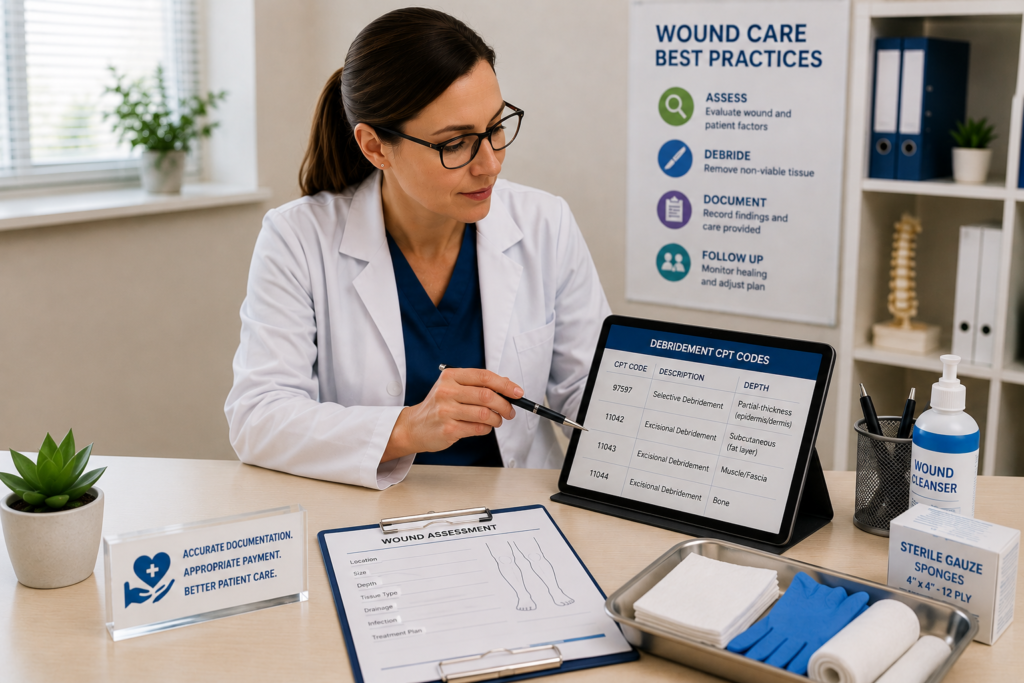
Medicare wound debridement billing can be challenging because the correct code depends on more than the diagnosis or overall depth of a wound. Providers must consider the type of debridement performed, the tissue actually removed, the surface area treated, medical necessity, and the documentation supporting the procedure.
A wound may extend to muscle or bone, but that does not automatically mean the provider can report a deep debridement code. Medicare guidance states that the CPT code should reflect the level of tissue actually debrided, rather than simply the depth or grade of the wound.
For wound care practices, understanding these distinctions is essential for accurate coding, cleaner claims, and fewer avoidable denials.
What Is Wound Debridement?
Wound debridement involves removing devitalized, necrotic, contaminated, or nonviable tissue from a wound to support healing. It may be performed using different techniques depending on the condition of the wound and the tissue requiring removal.
Medicare generally requires the service to be medically reasonable and necessary and supported by the patient’s medical record. The documentation should demonstrate why debridement was needed and what service was actually performed.
Before submitting a claim, providers and billing staff should review:
- The wound diagnosis
- Type of debridement performed
- Tissue removed
- Wound location
- Surface area treated
- Medical necessity
- Provider qualifications
- Supporting documentation
- Applicable Medicare and MAC requirements
Current Medicare policies should always be reviewed because local coverage requirements and billing instructions can differ by jurisdiction.
Key Medicare Wound Debridement CPT Codes
Several CPT codes are commonly associated with wound debridement. Selecting the correct code requires understanding the difference between selective and surgical debridement.
CPT 97597 and 97598: Selective Debridement
CPT 97597 and 97598 are used for selective debridement services. These codes are generally based on the area treated and are intended for medically necessary skilled wound care.
CPT 97597 represents the initial area described by the code, while 97598 is an add-on code for additional qualifying areas.
The medical record should explain:
- The type of tissue removed
- The technique or instrument used
- The wound location
- The area treated
- The condition of the wound
- The reason skilled debridement was necessary
A simple dressing change should not be reported as selective debridement. Medicare specifically states that dressing changes without an active wound procedure should not be billed using these debridement codes.
CPT 11042–11047: Surgical Debridement
The 11042–11047 family is used for surgical debridement and is based on the deepest level of tissue actually removed.
Common codes include:
- 11042: Subcutaneous tissue
- 11043: Muscle and/or fascia
- 11044: Bone
- 11045: Add-on for additional area associated with 11042
- 11046: Add-on for additional area associated with 11043
- 11047: Add-on for additional area associated with 11044
The most important rule is to code the tissue that was actually removed.
For example, if a wound extends to the bone but the provider removes only necrotic subcutaneous tissue, CPT 11042 may be appropriate rather than 11044. Exposed bone by itself does not support reporting a bone debridement code.
Why Tissue Depth Matters
One of the most common mistakes in wound care coding is confusing wound depth with the depth of tissue debrided.
Consider a patient with a chronic ulcer that reaches the bone. If the provider removes only nonviable subcutaneous tissue, the procedure should not automatically be coded as bone debridement.
The documentation should clearly answer:
- What tissue was removed?
- How was it removed?
- What area was treated?
- Was viable tissue involved?
- What was the medical reason for performing the procedure?
This distinction is especially important for CPT 11043 and 11044 because unsupported deep debridement coding may lead to payer scrutiny or denial.
Medicare guidance specifically states that the debridement code should reflect the level of tissue removed rather than the depth, extent, or grade of the wound.
Wound Measurements and Surface Area
Surface area is another important part of Medicare wound debridement billing.
The procedure note should provide clear measurements and identify the area actually treated. When multiple wounds are debrided to the same tissue level, applicable coding rules may allow their surface areas to be combined. Wounds treated at different tissue levels should not simply be added together.
For example, if two wounds are both debrided to subcutaneous tissue, their qualifying areas may be combined when appropriate. If one wound is treated to subcutaneous tissue and another to muscle, the areas should be reported according to their respective levels.
Accurate measurements help the coder select the correct base and add-on codes and provide stronger support during a medical record review.
Documentation Requirements for Wound Debridement
Good documentation is one of the strongest safeguards against wound care billing problems. A note stating only wound debrided does not clearly establish what was performed.
Depending on the service, documentation should include:
- Wound location
- Wound etiology
- Wound measurements
- Tissue characteristics
- Tissue actually removed
- Instrument or technique used
- Depth of tissue removed
- Surface area treated
- Evidence of infection, when relevant
- Patient’s relevant comorbidities
- Medical necessity
- Treatment response
- Ongoing wound care plan
For repeated wound care, Medicare guidance may also expect documentation addressing factors that affect healing, such as diabetes, vascular disease, infection, pressure relief, nutrition, and other relevant conditions.
Photographs may also be useful for prolonged or repetitive debridement services, particularly when the medical record needs additional evidence to demonstrate wound characteristics and treatment results.
ICD-10 Coding and Medical Necessity
CPT codes explain the procedure performed, while ICD-10-CM codes describe the patient’s condition.
The diagnosis should accurately support the reason for the debridement. Depending on the patient’s condition, this may involve codes for pressure ulcers, non-pressure chronic ulcers, diabetic foot ulcers, traumatic wounds, postoperative complications, or other wound-related conditions.
Specificity matters. The diagnosis should include available information such as:
- Anatomical site
- Laterality
- Ulcer stage
- Severity
- Underlying disease
- Associated complications
Medicare states that the diagnosis code reported on the claim must best describe the patient’s condition for which the service was performed.
Selective vs. Surgical Debridement
Providers should not automatically report both selective and surgical debridement codes for the same wound during the same encounter.
CMS guidance indicates that 97597, 97598, and 97602 should not be reported with 11042–11047 for the same wound when the services represent overlapping debridement work. The documented depth and technique should determine the appropriate code family.
For example, removing surface biofilm from a wound may support selective debridement, while removing muscle tissue may support the appropriate surgical debridement code.
Common Medicare Wound Debridement Billing Errors
Several recurring errors can cause claims to be denied or reviewed:
- Selecting a code based only on wound depth
- Reporting bone debridement when bone was only exposed
- Failing to document the tissue removed
- Using nonspecific ICD-10 codes
- Reporting a dressing change as debridement
- Combining wounds incorrectly
- Billing overlapping debridement code families
- Failing to establish medical necessity
- Using a code that does not match the documented procedure
- Ignoring applicable NCCI or MAC requirements
CMS also states that dressings associated with applicable debridement procedures are included and generally should not be separately billed.
How Wound care Billing Services Can Help
For practices handling a high volume of wound patients, consistent billing processes can make coding and claim review more manageable. Wound care billing services may assist with charge review, CPT and ICD-10 coding checks, documentation review, claim submission, denial tracking, and payer follow-up.
The goal should not be to select the highest-paying code. Instead, the billing process should connect four elements accurately:
Documented condition + documented procedure + correct code + Medicare requirements.
A pre-submission review can help identify mismatched diagnoses, unsupported debridement levels, missing wound measurements, and other issues before claims reach the payer.
FAQ
What is the most important rule for Medicare wound debridement coding?
The CPT code should represent the deepest level of tissue actually removed during the procedure, not simply the deepest point of the wound.
Can CPT 11044 be billed when bone is exposed?
Not automatically. CPT 11044 requires documentation supporting actual bone debridement. If bone is exposed but not removed, a bone debridement code is not supported.
Can a dressing change be billed as wound debridement?
No. A dressing change alone does not qualify as an active debridement procedure. Medicare states that simple dressing changes should not be reported using debridement codes.
Can 97597 and 11042 be billed together?
They generally should not be reported together for the same wound when the services represent overlapping debridement work. The medical record should support the appropriate code based on the procedure and tissue removed.
What should a wound debridement note include?
The note should clearly describe the wound, tissue removed, technique used, measurements or treated area, medical necessity, and patient’s response. Additional documentation may be necessary for repeated or complex services.
Conclusion
Medicare wound debridement billing requires careful attention to the actual service performed. The wound’s appearance or maximum depth alone does not determine the CPT code. Providers must document the tissue removed, treatment area, technique, medical necessity, and relevant diagnosis clearly.
Understanding the difference between selective debridement and surgical debridement is particularly important. CPT 97597 and 97598 should not be confused with the 11042–11047 surgical debridement family, and deep codes should never be selected simply because a wound reaches deeper tissue.
Accurate documentation, specific ICD-10-CM coding, appropriate CPT selection, and regular review of current Medicare and MAC requirements can help practices reduce avoidable billing errors and support appropriate reimbursement. Because Medicare policies and local coverage requirements can change, providers should verify current guidance before submitting complex wound care claims.