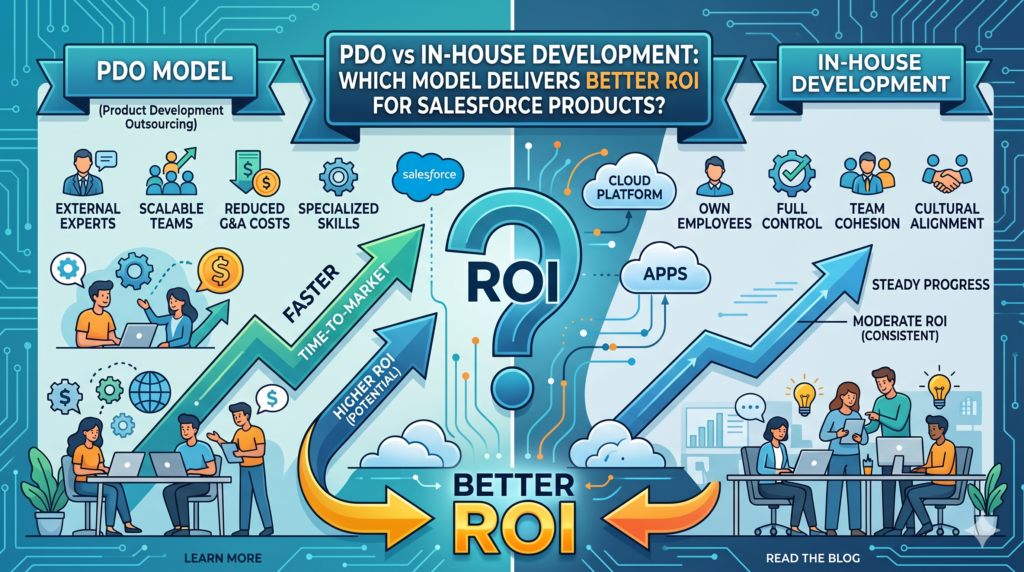
Are you thinking about PDO vs In-House Development, too? Salesforce initiatives often start with clear goals but quickly face delays, rising costs, and limited internal bandwidth. What begins as an in-house effort can slow as teams struggle to keep up with evolving requirements, bringing Product Development Outsourcing (PDO) into focus. Organizations are increasingly adopting Salesforce product development outsourcing to improve speed, reduce costs, and access specialized expertise. But does this shift truly improve outcomes? Let’s explore what drives ROI in Salesforce product development.
Understanding PDO Vs In-House Development in the Salesforce Ecosystem
When it comes to building on Salesforce, businesses typically face a critical decision: develop in-house or partner through Product Development Outsourcing (PDO). While both approaches aim to deliver scalable Salesforce solutions, the way they impact execution, cost, and long-term value can differ significantly.
To better understand the difference, let’s look at how these approaches perform across key development factors.
Product Development Outsourcing (PDO)
Product Development Outsourcers (PDOs) build commercial applications for ISVs and also provide services such as training, support, marketing, and sales. They contribute to product design and can focus on specific parts of an application based on business requirements.
A PDO partner also acts as a specialized Salesforce consultant, offering end-to-end Salesforce development services, including customization, integration, and deployment.
Salesforce PDO takes care of key technical work such as integrations, setup, implementation, and custom features, helping ensure a smooth development process.
In-House Development
In-house development involves building and managing Salesforce solutions internally using your own team, offering full control, customization, and alignment with business goals. While this approach provides closer oversight, it often leads to slower delivery due to hiring and training efforts, along with limitations in expertise and scalability. Over time, maintaining an internal team can also increase overall costs and reduce flexibility.
The Cost Reality: How PDO Vs In-House Models Impact Your ROI
Cost is often the first factor businesses consider, but the real impact on ROI goes beyond initial investment. It includes hiring efforts, resource utilization, time-to-market, and long-term efficiency, all of which differ significantly between PDO and in-house development.
In many cases, rising costs are closely linked to capacity limitations within internal teams. When resources are limited, projects slow down, delays increase, and overall efficiency drops. This is where outsourcing becomes a practical solution, allowing businesses to scale resources quickly, reduce delays, and improve execution, ultimately leading to better ROI.
1. Cost Efficiency:
In-house development requires continuous investment in hiring, training, infrastructure, and team management. PDO reduces these overhead costs by providing ready access to skilled experts and established processes.
2. Time-to-Market:
Delays in development can directly impact revenue. PDO enables faster execution through experienced teams and scalable resources, helping businesses launch earlier and gain a competitive advantage.
3. Access to Expertise and Innovation:
PDO provides access to a global talent pool with specialized skills and exposure to modern technologies, improving product quality and enabling better solutions.
4. Resource Optimization:
Outsourcing allows internal teams to focus on core business activities while external experts handle development, improving productivity and overall efficiency.
5. Risk Reduction and Stability:
Experienced PDO partners help avoid common issues such as integration failures, rework, and inefficiencies, ensuring smoother execution and long-term stability.
Overall, these factors show that PDO not only reduces costs but also improves efficiency, speed, and quality, making it a stronger driver of ROI compared to in-house development.
Partnering with a PDO to Accelerate Time-to-Market in the Era of Agentforce
In today’s competitive Salesforce landscape, time-to-market is no longer just about speed; it’s about how efficiently organizations can move from idea to execution. Partnering with a Product Development Outsourcing (PDO) partner changes this dynamic by combining expertise, scalability, and intelligent automation.
- Eliminating Setup Delays
In-house teams often spend weeks on hiring and onboarding, while PDO teams are deployment-ready from day one, significantly reducing startup time. - Built-in Expertise Instead of Trial-and-Error
PDO partners bring proven experience, enabling faster and more accurate implementation without a learning curve. - Agentforce-Driven Automation
With Agentforce, PDO teams can automate workflows and streamline processes, accelerating development cycles and reducing manual effort. - On-Demand Scalability
PDO allows businesses to scale teams instantly based on project needs, eliminating delays caused by limited internal capacity. - Structured Execution with Lower Risk
Established frameworks and best practices minimize errors, rework, and deployment risks, ensuring a smoother and faster go-live.
By shifting from traditional limitations to a more agile, intelligent approach, PDO enables organizations to accelerate time-to-market and achieve faster business outcomes in the era of Agentforce.
Which Model Ultimately Delivers Better ROI for Salesforce Products?
The answer depends on business goals, project type, and long-term strategybut key differences make the impact on ROI clear:
1. Where PDO Delivers Stronger ROI
- Faster time-to-market enables earlier revenue generation
- Lower upfront costs by eliminating hiring, training, and infrastructure
- Access to specialized expertise for complex and AppExchange-based solutions
- High scalability allows resources to adjust based on project needs
2. Where In-House Delivers Better ROI
- More cost-effective for stable, long-term, and continuous development
- Strong alignment with internal processes and business goals
- Greater control over development, security, and data management
3. Key Differences That Impact ROI
- PDO excels in speed, flexibility, and innovation-driven projects
- In-house works better for consistency, control, and long-term stability
4. The Hybrid Approach (Balancing Both Models)
- Maintain an in-house team for strategy, ownership, and core operations
- Use PDO for specialized development, faster execution, and scaling needs
- Combines control with flexibility to maximize overall efficiency and ROI
Final Insight:
For most modern Salesforce product initiatives especially those requiring speed, expertise, and flexibility, PDO delivers a stronger and faster return on investment.
Strategic Conclusion: PDO vs In-House Development
Choosing the right development approach means aligning execution with business priorities. While in-house development offers control, Product Development Outsourcing (PDO) provides speed, flexibility, and specialized expertise.
For most projects driven by time-to-market and innovation, PDO delivers a stronger path to ROI. A balanced approach combining in-house strategy with PDO execution—often yields the best results, which is why many organizations are adopting Salesforce product development outsourcing.
FAQs:
Q-1. What are the risks of working with a PDO, and how can they be managed?
Ans: Common risks include communication gaps and dependency on external teams. These can be managed through clear requirements, regular updates, and well-defined SLAs.
Q-2. How does data security work when outsourcing Salesforce development?
Ans: Reputable PDO partners follow strict security protocols, compliance standards, and Salesforce best practices to ensure data protection.
Q-3. How long does it typically take to start a project with a PDO?
Ans: Unlike in-house hiring, PDO teams can usually begin within days or weeks, depending on project scope and requirements.
Q-4. How do PDO partners handle changing project requirements?
Ans: PDO teams follow agile methodologies, allowing them to adapt quickly to evolving requirements without significantly impacting timelines.