Cyber threats are rising, and email scams remain the most popular approach for cyber attacks. Spear phishing versus phishing is one topic that many enterprise and individual users don’t quite understand. Both types of attack target the theft of protected information, but they are carried out differently and have somewhat different impacts.
Understanding the distinction between spear phishing and phishing is essential to improving security and reducing the risk of financial loss or data loss.
What Is Phishing?
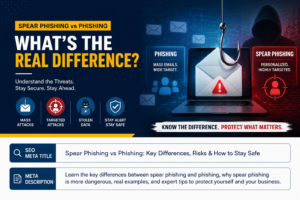
Phishing is a crime in cyberspace that sends emails, SMS, and links to numerous users. The goal is to complete the people who receive it by asking them to provide their personal information (login, password, banking information, or commercial information).
These are new, generic attacks to as many users as possible. A phishing email probably appears to have come from a trustworthy organization, such as a bank, a parcel company, or a software producer. Often, the sender is attempting to make the consumer expect a rush decision.
For example, the attackers could send a fraudulent e-mail saying ‘your account has been frozen, or that you need to update your account details immediately’. Clicking the web link will then take the user to a fake web page that captures their details.
What Is Spear Phishing?
Spear phishing is an advanced form of phishing attack. Traditional mass phishing attacks send messages containing thousands of email addresses obtained from specific sources. Today, spear-phishing attacks target a specific individual, department, or organization; they may send thousands of messages.
Before launching an attack, the cybercriminals collect information about the targeted organization from social media sites, company websites, and directories, and then send them the most plausible emails.
An example might be a scam email sent to a member of staff requesting confidential documents or requesting approval of a payment. Using names, job titles, and business details will make the message seem more plausible to the recipient.
However, this personalization is the biggest factor that makes spear phishing far more dangerous than general phishing.
Spear Phishing vs Phishing: The Main Difference
The primary distinction between these two is whether they are targeted.
Phishing attacks are mass, general attacks against the general email audience. Spear phishing targets specific individuals and is personalized. But they are ‘Volume’ attacks. Thousands of emails sent, hoping at least some will respond.
With a spear phish, if you fail to get it right, then you get no one. Research is required for a spear to be most effective, increasing the attack’s chances of success. Examples include spear-phishing messages that can be very professional and business-like, making them often more difficult to detect. An important point when considering spear phishing vs phishing is that a typical phishing email might call you “customer”, the same email sent to the same individual as a spear could use their name, what they have been doing, or other details about the individual‘s activity in the company.
Spear-phishing attacks are carefully targeted and researched by hackers. The hacker researches the victim and then finds messages that seem genuine and believable. These messages are then targeted at the individual. These messages usually appear to be memos from within the company or directions from a vendor or manager.
A standard phishing email may include a link that prompts you to change your password. The spear-phishing approach would use an email that mentions a genuine project, a work colleague, or an invoice to make the email more convincing. This type of targeted attack is less likely to be ignored or be ignored.
Why Spear Phishing Is More Dangerous
Although both spear phishing and phishing can be extremely damaging, spear phishing is generally more likely to cause the most harm. This is because these types of attack are usually highly targeted and extremely believable, and the individual receiving the email may be led to disclose sensitive data, make a false payment, or allow malware access to the company‘s network.
The majority of BEC scams are spear-phishing campaigns in which hackers impersonate business officials or reliable suppliers. The more of these scams there are, the greater the losses, disruptions, lawsuits, and damage to the corporation’s reputation.
A spear-phishing attack will target senior-level members, such as the finance dept, HR, or senior execs. This attack has a wider scope, as it targets a specific department.
Final Thoughts
Understanding the difference between spear phishing and traditional phishing is necessary to protect yourself and prevent the majority of cyber fraud. Spear phishing preys on human nature and relies on trust, whereas phishing is a mass distribution attack.
The main distinction between the two types of attack is between general appeal (phishing) and direct communication (spear phishing), with the latter lacking personalization. In attacks of this nature, attackers would have done their homework, making the attack more lethal and much harder to identify.
Given the dynamic threat landscape, companies must partner with Threatcop for employee training, cybersecurity awareness, and proactive measures to protect themselves. Recognizing indicators early can prevent you from losing money and data and from affecting your reputation in the long term.