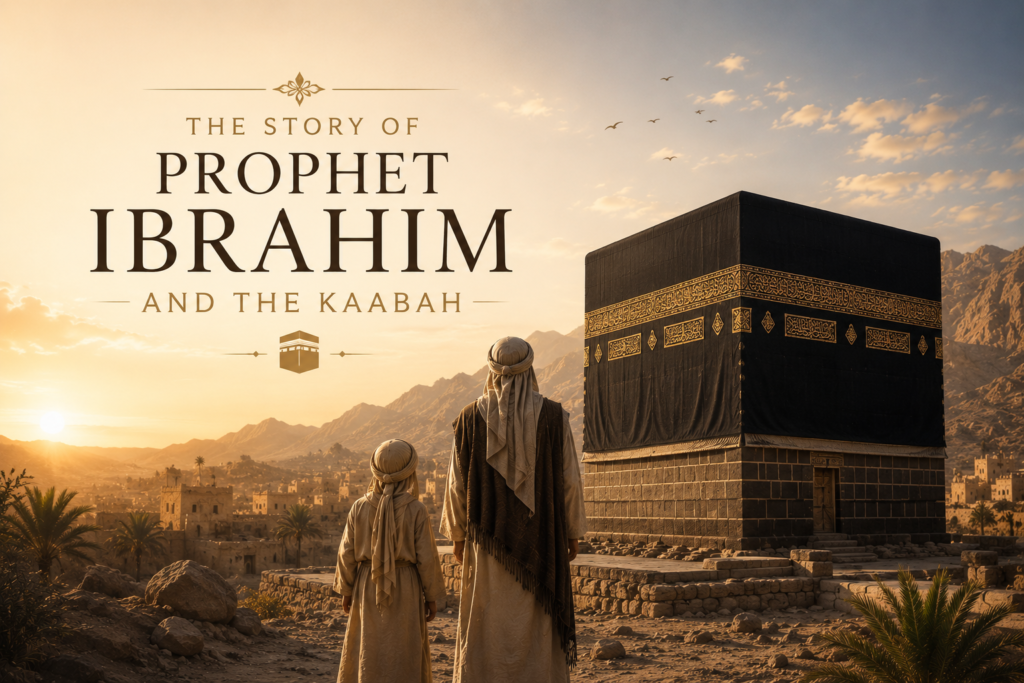
The Story of Prophet Ibrahim and the Kaabah
The Kaabah is the most sacred place in Islam and the direction Muslims around the world face during Salah. Every year, millions of Muslims travel to Makkah to perform Hajj and Umrah, hoping to worship Allah at the House that has been central to Islamic history for thousands of years. For those planning their journey, understanding the story of Prophet Ibrahim and the Kaabah adds a deeper meaning to the pilgrimage.
If you are planning to visit Makkah, learning about the history and purpose of the Kaabah can help you appreciate the rituals you will perform. You can also explore Umrah packages from the UK to begin planning your journey.
Who Was Prophet Ibrahim (Abraham)?
Prophet Ibrahim A.S is one of the most important prophets mentioned in the Quran. He was known for his complete devotion to Allah and his rejection of idol worship.
Allah chose Ibrahim as a close friend, or Khalil. His life was filled with tests that demonstrated his faith, patience and willingness to obey Allah.
One of the greatest parts of his story is connected to Makkah, where Allah commanded him to establish the foundations of His House together with his son Isma’il (Ishmael).
The story of Ibrahim and the Kaabah is therefore not simply about the construction of a building. It is a story about faith, obedience, sacrifice and submission to Allah.
Why Did Prophet Ibrahim Go to Makkah?
At the time of Ibrahim, the valley that became Makkah was a barren and uninhabited place. Allah commanded Ibrahim to leave his wife Hajar (Hagar) and their young son Isma’il there. Ibrahim obeyed Allah’s command even though the valley had no obvious source of food or water.
The Quran records Ibrahim’s prayer:
“Our Lord, I have settled some of my descendants in an uncultivated valley near Your sacred House…” — Quran 14:37
Ibrahim asked Allah to provide for his family and to make people’s hearts inclined towards them. This part of the story is closely connected to the origin of Zamzam and the later development of Makkah as a place of worship.
The Miracle of Zamzam
After Ibrahim left Hajar and Isma’il in the valley, their food and water eventually ran out. Hajar searched for help and water, moving between the hills of Safa and Marwah. She made repeated journeys while looking for someone who could help her and her child.
Allah then provided water through the miraculous spring of Zamzam.
The Prophet Muhammad S.A.W later described the events surrounding Hajar and Isma’il, including how Ibrahim had left them in the valley and how Zamzam appeared. The detailed account is recorded in Sahih al-Bukhari 3364.
This event is remembered by Muslims during Umrah and Hajj through Sa’i, the seven journeys between Safa and Marwah.
Therefore, when pilgrims walk between these two hills today, they are remembering Hajar’s trust in Allah and her determination to care for her child.
Allah Commands Ibrahim and Isma’il to Build the Kaabah
As Isma’il grew older, Ibrahim returned to Makkah. Allah then commanded Ibrahim and Isma’il to establish the House.
The Quran says:
“And when Abraham and Ishmael were raising the foundations of the House…” — Quran 2:127
The verse continues with the beautiful supplication they made:
“Our Lord, accept this from us. Indeed, You are the Hearing, the Knowing.” — Quran 2:127
According to the authentic narration recorded in Sahih al-Bukhari, Ibrahim began building the Kaabah while Isma’il brought stones to him. As the walls became higher, Isma’il brought a stone for Ibrahim to stand on so that he could continue building.
This stone is associated with Maqam Ibrahim, the Station of Ibrahim.
The Quran also mentions that Allah commanded Ibrahim and Isma’il to purify His House for those who perform Tawaf, remain there for worship, and bow and prostrate in prayer. Quran 2:125 connects the House with worship and the Station of Ibrahim.
Ibrahim’s Dua for the Kaabah
While building the Kaabah, Ibrahim and Isma’il did not simply focus on constructing the House. They also prayed to Allah.
Their supplication is recorded in the Quran:
“Our Lord, accept this from us. Indeed, You are the Hearing, the Knowing.” — Quran 2:127
They then asked Allah to make them and their descendants people who submit to Him. This is one of the important lessons from their story. Even while performing a great act of worship, Ibrahim and Isma’il asked Allah to accept their efforts.
Their example teaches Muslims that worship is not only about performing an action. Sincerity and acceptance from Allah are equally important.
What Does the Kaabah Represent?
The Kaabah is not worshipped by Muslims. Muslims worship Allah alone. The Kaabah is the direction of prayer, known as the Qiblah, and it is the centre around which Muslims perform Tawaf during Hajj and Umrah.
Its importance goes back to the worship of Allah and the legacy of Ibrahim. Allah describes the House as a place of security and a place of return for people. He also commands Ibrahim and Isma’il to keep it pure for worshippers.
For Muslims performing Umrah today, standing before the Kaabah can therefore be a powerful reminder of the generations of believers who have worshiped Allah in this sacred place.
The Connection Between Ibrahim and Umrah
Many of the rituals associated with Umrah are connected to the story of Ibrahim and his family.
- Tawaf takes place around the Kaabah, the House that Ibrahim and Isma’il raised.
- Sa’i between Safa and Marwah recalls Hajar’s search for water and her trust in Allah.
- Maqam Ibrahim reminds Muslims of Ibrahim’s role in building the House.
- Zamzam reminds pilgrims of Allah’s provision for Hajar and Isma’il.
This means that Umrah is not simply a journey to visit a famous religious site. Its rituals connect Muslims with the stories of the prophets and their families.
The Kaabah Before and After Prophet Ibrahim
The Quran describes Ibrahim and Isma’il as raising the foundations of the House. Islamic scholars have discussed the history of the Kaabah and its foundations, but Muslims should be careful not to treat every historical story about its earliest construction as equally authentic.
What is firmly established is that Ibrahim and Isma’il raised the foundations of the House and prayed for Allah to accept their work.
Centuries later, the Quraysh rebuilt the Kaabah before the prophethood of Muhammad S.A.W. Aisha R.A narrated that the Quraysh had reduced part of the original foundations associated with Ibrahim when they rebuilt it.
The Prophet S.A.W explained that, had his people not recently left the period of disbelief, he would have rebuilt the Kaabah upon Ibrahim’s foundations. This is recorded in Sahih al-Bukhari 1583.
This narration gives us an important insight into the history of the Kaabah and its connection to Ibrahim.
What Can Muslims Learn From the Story?
The story of Ibrahim and the Kaabah contains lessons that remain relevant to Muslims today.
1. Trust Allah Even When the Future Is Unclear
Ibrahim obeyed Allah even when he could not see how his family would survive in a barren valley.
2. Obedience Requires Sacrifice
Ibrahim and his family repeatedly faced difficult tests, but they continued to obey Allah.
3. Worship Requires Sincerity
While building the Kaabah, Ibrahim and Isma’il asked Allah to accept their work. Their example reminds Muslims that good deeds should be performed sincerely for Allah.
4. Difficulties Can Have a Greater Purpose
The hardships experienced by Hajar eventually became part of the rituals of Hajj and Umrah. Her struggle between Safa and Marwah is remembered by millions of pilgrims every year.
5. The Kaabah Is a Symbol of Tawhid
The central message of Ibrahim’s life was worshipping Allah alone. The Kaabah continues to represent the unity of Muslims in worshipping the One God.
Why Should Pilgrims Learn the Story Before Umrah?
Knowing the history behind the rituals can make an Umrah journey more meaningful. When you perform Tawaf, you are not simply walking around a building. You are worshipping Allah around the House connected with Ibrahim and Isma’il.
When you perform Sa’i, you remember Hajar’s struggle and reliance upon Allah. When you see Maqam Ibrahim, you remember the prophet who helped establish the foundations of the Kaabah.
And when you drink Zamzam, you remember how Allah provided for Hajar and her son Isma’il. For a first-time pilgrim, learning these stories before travelling can transform Umrah from a simple physical journey into a deeper spiritual experience.
Conclusion
The story of Prophet Ibrahim and the Kaabah is one of faith, obedience and complete submission to Allah. Ibrahim and Isma’il raised the foundations of the House and asked Allah to accept their work. Hajar’s struggle for water, the emergence of Zamzam and the establishment of the Kaabah all became connected to the rituals Muslims continue to perform today.
For Muslims travelling from the UK, understanding this history can make the experience of Umrah even more meaningful. The journey to Makkah is not only about reaching a destination; it is an opportunity to reconnect with the legacy of Ibrahim, Isma’il and Hajar and reflect on the same message of worshipping Allah alone.
Frequently Asked Questions
Q : Did Prophet Ibrahim build the Kaabah?
The Quran states that Ibrahim and Isma’il raised the foundations of the House. Quran 2:127 directly mentions them raising the foundations of the Kaabah.
Q : Who helped Prophet Ibrahim build the Kaabah?
His son Isma’il helped him by bringing stones while Ibrahim built the House. This is mentioned in Sahih al-Bukhari 3364.
Q : What is the connection between Hajar and Sa’i?
Sa’i commemorates Hajar’s search for water between Safa and Marwah. Her actions are remembered as part of Hajj and Umrah.
Q : What is Maqam Ibrahim?
Maqam Ibrahim is associated with the stone on which Ibrahim stood while building the Kaabah. The Quran refers to the Station of Ibrahim in connection with prayer.
Q : Why is the Kaabah important to Muslims?
The Kaabah is the Qiblah toward which Muslims face during prayer and the centre of Tawaf during Hajj and Umrah. It is a sacred House dedicated to the worship of Allah.