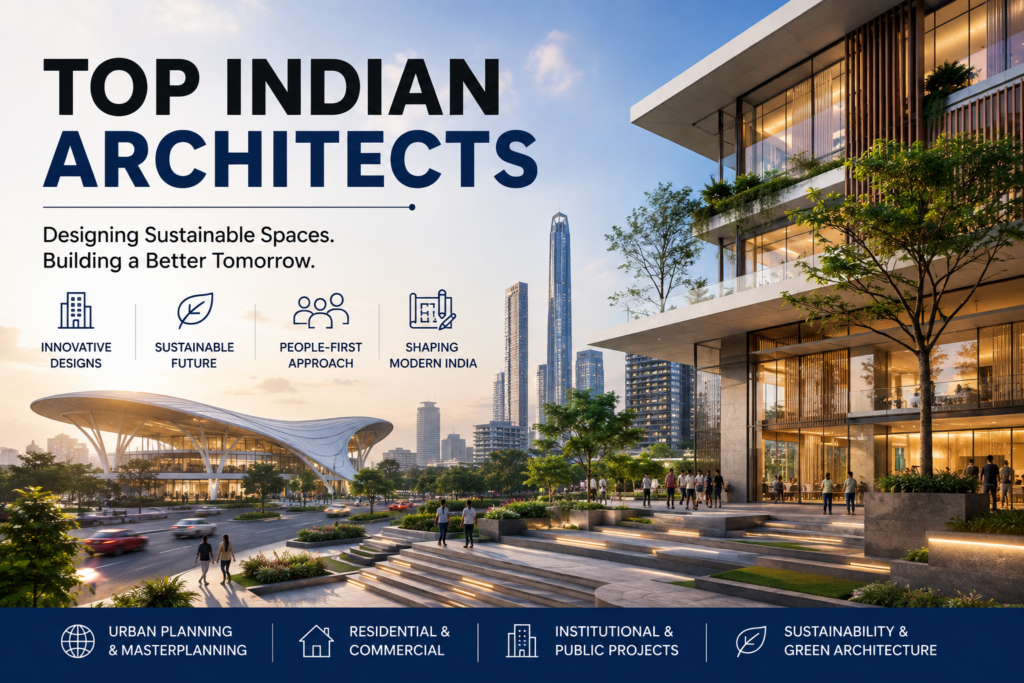
India’s built environment is changing rapidly. From expanding cities and new residential communities to commercial developments, educational campuses, transport infrastructure, and public projects, architecture has become an important part of how the country responds to growth.
The work of top Indian architects goes beyond creating visually attractive buildings. Modern architectural practices are increasingly expected to consider sustainability, functionality, local context, technology, accessibility, and the everyday experience of people who use these spaces.
As India’s cities continue to evolve, Indian architects are playing an increasingly important role in creating buildings and urban environments that can respond to changing social, economic, and environmental needs.
The Changing Role of Indian Architects
Architecture in India has traditionally reflected the country’s diverse cultures, climates, materials, and regional identities. Today, architects are combining these influences with contemporary construction methods and changing expectations around how people live and work.
The role of an architect is therefore much broader than preparing drawings for a building.
Modern architecture practices may be involved in:
- Urban planning
- Masterplanning
- Residential architecture
- Commercial developments
- Educational spaces
- Hospitality projects
- Transport infrastructure
- Public-sector projects
- Affordable housing
- Sustainable design
- Mixed-use developments
This wider approach allows architecture to influence not only individual buildings but also the communities and cities surrounding them.
What Makes Top Indian Architects Stand Out?
There is no single formula for defining the top Indian architects. Different practices may have different strengths, design philosophies, and areas of expertise.
However, several qualities are increasingly important in contemporary architecture.
1. A Strong Understanding of Context
Good architecture responds to its surroundings.
Climate, culture, local materials, urban density, transportation, and community needs can all influence architectural decisions. A building that works well in one location may not necessarily be appropriate for another.
Understanding the context helps architects create spaces that feel connected to their environment instead of appearing disconnected from it.
2. People-Centred Design
Buildings ultimately exist for people.
Whether it is a residential development, office, school, hospital, transport facility, or public space, successful architecture needs to consider how people move through and interact with the environment.
People-first design can include considerations such as natural light, ventilation, accessibility, comfort, safety, circulation, and opportunities for interaction.
This philosophy is increasingly visible in contemporary Indian architecture.
Sustainability Is Becoming a Core Architectural Priority
Sustainability is no longer simply an additional feature of a building. It is increasingly becoming part of the fundamental design process.
Architects are exploring ways to reduce energy consumption, improve thermal comfort, use resources more efficiently, and create healthier environments.
Passive design strategies can be particularly useful in India’s varied climatic conditions.
These strategies may include:
- Building orientation
- Natural ventilation
- Solar shading
- Daylight optimisation
- Efficient building envelopes
- Landscape integration
- Appropriate material selection
- Reduced dependence on mechanical cooling
Design Forum International, for example, highlights passive design through the principles of comfort, savings, and sustainability as part of its architectural approach.
Indian Architects and Nation Building
Architecture has a direct relationship with economic and social development.
Large-scale infrastructure, housing, commercial centres, educational facilities, and public projects all contribute to the growth of cities and communities.
This is why some architecture practices increasingly view their role through the broader concept of nation building.
Design Forum International describes its work as a people-first approach to architecture and urbanism and has been working in the field since 1995. Its portfolio includes nation building, affordable housing, transport infrastructure, educational projects, offices and IT parks, hospitality, masterplanning, and other sectors.
This broad project experience demonstrates how contemporary architecture can extend beyond individual buildings to address larger urban and societal requirements.
The Importance of Residential Architecture
Housing remains one of the most visible areas of architectural development in India.
As lifestyles change, people increasingly expect homes to provide more than basic shelter. Natural light, ventilation, flexible spaces, amenities, security, landscape, and connectivity can all influence residential design.
Architects must balance these expectations with practical considerations such as construction costs, land availability, environmental conditions, and urban density.
Luxury residential architecture adds another layer of complexity because design expectations are often closely connected to material quality, spatial experience, privacy, landscape, and customisation.
Growth of Mixed-Use and Commercial Architecture
Indian cities are becoming more interconnected, and mixed-use developments are playing an important role in this transformation.
A well-planned mixed-use environment can bring residential, retail, office, entertainment, and community functions closer together.
This can potentially reduce unnecessary travel while creating more active urban environments.
Commercial architecture is also changing. Modern offices increasingly focus on collaboration, employee wellbeing, flexibility, technology, and access to natural light.
The result is a shift from purely functional buildings toward environments designed around the people who use them.
Masterplanning Creates a Larger Impact
While individual buildings receive considerable attention, masterplanning can have an even broader influence.
Masterplanning considers how multiple buildings, roads, public spaces, landscapes, services, and movement systems work together.
For growing Indian cities, this integrated approach can be especially valuable.
A successful masterplan needs to consider both current requirements and future development. It should provide enough flexibility to respond to changes in population, technology, transportation, and economic activity.
This is one reason masterplanning and township design remain important areas for leading architecture practices.
Affordable Housing and Inclusive Design
Architecture should not be limited to premium developments.
Affordable housing presents an important opportunity for architects to demonstrate how good design can improve everyday life while remaining practical and accessible.
Thoughtful affordable housing can address:
- Efficient use of land
- Natural ventilation
- Daylight
- Community spaces
- Safety
- Accessibility
- Efficient infrastructure
- Long-term maintenance
- Quality of living
Design Forum International includes affordable housing among its areas of architectural work and describes the objective as creating dignified and accessible homes for thriving communities.
Technology Is Transforming Architectural Design
Technology has changed how architects design, communicate, and manage projects.
Digital modelling, Building Information Modelling, advanced visualisation, computational design, and other technologies can help architects study complex projects before construction begins.
These tools can assist with:
- 3D visualisation
- Building performance analysis
- Coordination between disciplines
- Design iterations
- Construction documentation
- Project communication
However, technology is most effective when it supports rather than replaces architectural thinking.
The fundamental questions remain the same: Who will use the space? What does the site require? How can the building perform better? And how can design improve the experience of its users?
How to Choose an Architecture Firm in India
Someone looking for an architecture firm should look beyond photographs of completed buildings.
A firm’s portfolio can provide valuable information, but potential clients should also consider its experience, design philosophy, project types, technical capabilities, and understanding of the client’s requirements.
Some useful questions include:
- Does the firm have experience with similar projects?
- Does its design philosophy align with the project’s objectives?
- Can the team manage multidisciplinary requirements?
- How does the firm approach sustainability?
- Does it have experience with large-scale developments?
- How does it balance aesthetics and functionality?
- What is its approach to collaboration and project management?
These questions can help clients identify an architectural practice that is appropriate for their specific project rather than simply selecting a firm based on reputation.
Why the Future of Indian Architecture Looks Promising
India’s continued urbanisation, infrastructure development, changing lifestyles, and growing environmental awareness are creating new opportunities for architecture.
The next generation of Indian architects will likely need to think across multiple disciplines. Architecture will increasingly intersect with sustainability, technology, mobility, public health, urban planning, landscape design, and social infrastructure.
The most successful practices will be those capable of balancing innovation with practicality.
Final Thoughts
The work of top Indian architects reflects the changing needs of a rapidly developing country. Modern architecture is increasingly concerned with sustainability, functionality, technology, urban planning, affordability, and the human experience.
From residential communities and commercial developments to educational spaces, transport infrastructure and large-scale masterplans, architects have an opportunity to influence how India’s cities develop.
For those exploring established architectural practices and contemporary design approaches in India, Design Forum International offers an example of a multidisciplinary practice working across diverse sectors with a people-first approach.
Ultimately, the future of Indian architecture will not be defined only by impressive buildings. It will be defined by how effectively those buildings and spaces serve people, communities, and the evolving needs of India.