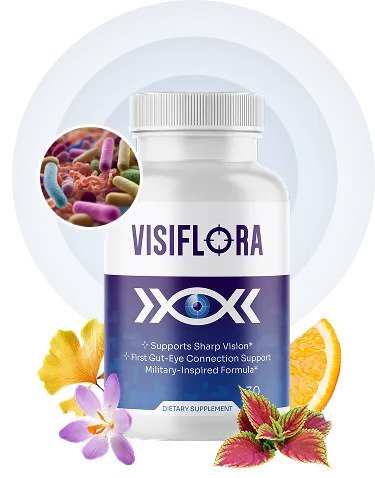
What Is Visiflora?
Visiflora is marketed as a daily dietary supplement designed to support eye health, visual comfort, and long-term vision wellness. The product is promoted as a multi-ingredient formula containing vitamins, minerals, antioxidants, carotenoids, and botanical extracts.
The brand particularly emphasizes the gut-eye connection, suggesting that supporting overall internal health and nutrient absorption may complement nutritional support for the eyes. Its formula is marketed as a 22-in-1 vision-support product.
However, it is important to distinguish between a supplement’s marketing claims and evidence for the finished product. Current available information does not establish that itself has been proven in a high-quality clinical trial to improve vision or treat an eye disease. One recent review also notes that the current labeling makes it difficult to compare the doses of many ingredients with doses used in clinical research.
How Does Visiflora Work?
Visiflora’s formula is intended to provide nutritional support through several areas:
- Antioxidant protection
- Macular and retinal nutrition
- Support for normal visual function
- Low-light vision support
- Nutritional support for eye tissues
- Support for the proposed gut-eye connection
The formula includes nutrients such as lutein, zeaxanthin, vitamin A, vitamin C, vitamin E, and zinc, alongside botanical ingredients including bilberry, ginkgo biloba, saffron, grape seed extract, and eyebright.
These ingredients do not all have the same level of scientific evidence. Some nutrients have substantial research behind their role in eye health, while evidence for other botanicals or combinations is more limited.
Visiflora Ingredients
According to the manufacturer’s current information, it contains a broad combination of 22 named ingredients. They are presented in several functional groups.
1. Lutein and Zeaxanthin
Lutein and zeaxanthin are carotenoids that are naturally concentrated in the macula, the central part of the retina responsible for detailed vision.
They are among the better-known nutrients used in eye-health formulations. They are also components of the AREDS2 nutritional approach for people with certain forms of age-related macular degeneration.
Importantly, having these ingredients in a supplement does not mean the product is equivalent to an AREDS2 formulation. The exact amounts and overall formulation matter.
2. Vitamin A
Vitamin A plays an essential role in normal vision, including the visual processes involved in seeing in low-light conditions.
A supplement can provide useful nutrition when dietary intake is inadequate, but more vitamin A is not automatically better. Excessive intake of some forms of vitamin A can create health risks.
3. Zinc
Zinc is an essential mineral involved in numerous biological processes, including normal retinal function and vitamin A metabolism.
It lists zinc as one of its eye-support ingredients. The product information currently available lists 11 mg of zinc in one version of its formulation.
4. Vitamins C and E
Vitamins C and E have antioxidant functions and are commonly found in nutritional formulas intended to support eye health.
Antioxidants help protect cells from oxidative stress, but this should not be interpreted as proof that taking an antioxidant supplement will prevent or reverse a particular eye condition.
5. Astaxanthin
Astaxanthin is a carotenoid antioxidant included in Visiflora’s formula. The manufacturer positions it as part of its antioxidant-defense approach.
Research into astaxanthin and eye-related outcomes exists, but evidence for individual ingredients should not automatically be treated as evidence that Visiflora as a whole produces the same effects.
6. Bilberry Extract
Bilberry contains anthocyanins and has traditionally been associated with eye health and circulation.
Although bilberry is frequently included in vision supplements, evidence for specific outcomes such as substantially improving night vision is not strong enough to assume that every bilberry-containing supplement will produce such an effect.
7. Saffron Extract
Saffron has attracted scientific interest for potential effects related to retinal and visual function. It is included in Visiflora’s macular and lens protection blend.
More research is needed to determine how different saffron preparations and doses translate into meaningful benefits for people taking commercial supplements.
8. Ginkgo Biloba
Ginkgo biloba is another botanical used in the formula. The manufacturer associates it with circulation and retinal support.
However, ginkgo can interact with certain medicines, so people taking medications should discuss its use with a healthcare professional.
9. Other Ingredients
The product information also lists:
- Grape seed extract
- Rutin
- Quercetin
- Taurine
- Alpha-lipoic acid
- Coleus forskohlii
- Eyebright
- Lycopene
- Selenium
- Copper
- Chromium
These ingredients are presented as part of the product’s antioxidant, circulation, gut-support, and vision-support strategy.
Potential Benefits of Visiflora
Supports Nutritional Eye Health
Visiflora provides several nutrients associated with normal eye function, including vitamin A, zinc, lutein, and zeaxanthin.
For people whose diets do not provide adequate amounts of certain nutrients, supplementation can be useful. However, the benefit depends on individual nutritional status.
Provides Lutein and Zeaxanthin
Lutein and zeaxanthin are particularly relevant to macular health and are among the most established nutrients in modern eye-health supplementation.
Their presence is therefore one of the more notable aspects of the formula.
Provides Antioxidant Nutrients
The formula combines vitamins C and E with carotenoids and several plant compounds that have antioxidant properties.
This provides broad nutritional antioxidant support, although antioxidant activity in a laboratory or biological pathway does not necessarily translate into a measurable improvement in eyesight.
Supports a Broad Eye-Wellness Approach
Rather than focusing on a single ingredient, Visiflora combines multiple vitamins, carotenoids, minerals, and botanical extracts.
This may appeal to adults looking for an all-in-one nutritional supplement instead of purchasing several individual products.
Gut-Eye Connection
The manufacturer places considerable emphasis on the relationship between gut health and eye health. Research does support biological communication between the gut, immune system, and other organs, including the eyes.
However, the specific claim that taking Visiflora will improve vision by reducing gut-derived toxins has not been established by a clinical trial of the finished product.
What Does the Evidence Say?
This is one of the most important points to consider when reviewing Visiflora.
Some of its individual ingredients have scientific research supporting their nutritional role in eye health. Lutein and zeaxanthin, for example, have an established place in research surrounding age-related macular degeneration and the AREDS2 nutritional formulation.
But ingredient evidence is not the same as product evidence.
A study showing that a particular dose of lutein or zeaxanthin may have a particular effect does not prove that Visiflora produces that effect. The dose, formulation, duration, population, and clinical outcome all matter.
Current independent reviews also raise an important labeling issue: some versions of the product disclose amounts for certain vitamins and minerals while placing numerous other ingredients into a combined proprietary blend. That makes it difficult to determine the exact dose of every ingredient and compare it directly with clinical studies.
As of 2026, available product information should therefore be interpreted as evidence of what Visiflora contains and what the manufacturer intends it to support, rather than proof that the finished supplement can improve or restore eyesight.
Get more information – VisiFlora Official Website
Visiflora Review 2026: Pros and Considerations
Potential Advantages
Broad ingredient profile: The formula includes several nutrients commonly associated with eye health.
Lutein and zeaxanthin: These are particularly relevant to macular nutrition.
Convenient format: The product is marketed as a once-daily supplement, making it simpler than taking numerous individual products.
Antioxidant support: Several vitamins, carotenoids, and botanical compounds contribute antioxidant activity.
Gut-eye approach: The product takes a broader nutritional approach rather than focusing exclusively on one eye nutrient.
Important Considerations
Not a treatment for eye disease: It should not be considered a replacement for diagnosis or treatment from an optometrist or ophthalmologist.
Evidence varies by ingredient: Some components have considerably more research behind them than others.
Exact doses matter: A proprietary blend can make it difficult to determine whether individual ingredients are present at clinically studied amounts.
Marketing claims need context: Statements about clearer vision, night vision, eye strain, or long-term protection should not automatically be interpreted as clinically proven outcomes.
Is Visiflora Safe?
The manufacturer’s websites describe Visiflora as a dietary supplement intended for daily use.
Nevertheless, “natural” does not automatically mean risk-free. Botanical ingredients can interact with medicines or cause side effects in some people.
Extra caution is appropriate for anyone who:
- Takes prescription medications
- Has a diagnosed eye condition
- Has a chronic medical condition
- Is pregnant or breastfeeding
- Has known allergies to any listed ingredient
- Is considering combining Visiflora with another multivitamin or eye supplement
People should also avoid taking multiple supplements containing the same vitamins or minerals without checking their total intake.
Does Visiflora Replace an Eye Exam?
No.
A dietary supplement cannot replace a comprehensive eye examination. Blurred vision, sudden changes in eyesight, flashes, a sudden increase in floaters, eye pain, or other significant visual changes should be evaluated by an eye-care professional rather than self-treated with supplements.
Regular eye examinations can help identify conditions such as refractive errors, glaucoma, cataracts, diabetic eye disease, and age-related retinal problems.
Who Might Consider a Vision Supplement?
Adults interested in nutritional support for general eye wellness may consider discussing a vision supplement with a healthcare professional.
However, whether supplementation is appropriate depends on diet, age, existing eye health, medications, and nutritional needs.
Someone who already eats a varied diet and has no nutritional deficiencies may not receive the same benefit as someone whose diet is lacking particular nutrients.
Final Verdict: What Should You Know About Visiflora in 2026?
Visiflora is a multi-ingredient vision-support supplement built around nutrients such as lutein, zeaxanthin, vitamin A, zinc, vitamins C and E, and several botanical extracts. Its main selling point is its broad formula and emphasis on the proposed gut-eye connection.
The most important distinction is between potential nutritional support and proven clinical outcomes. Several ingredients have legitimate scientific interest in eye health, but that does not establish that Visiflora can improve eyesight, reverse vision problems, or prevent eye disease.