Trading
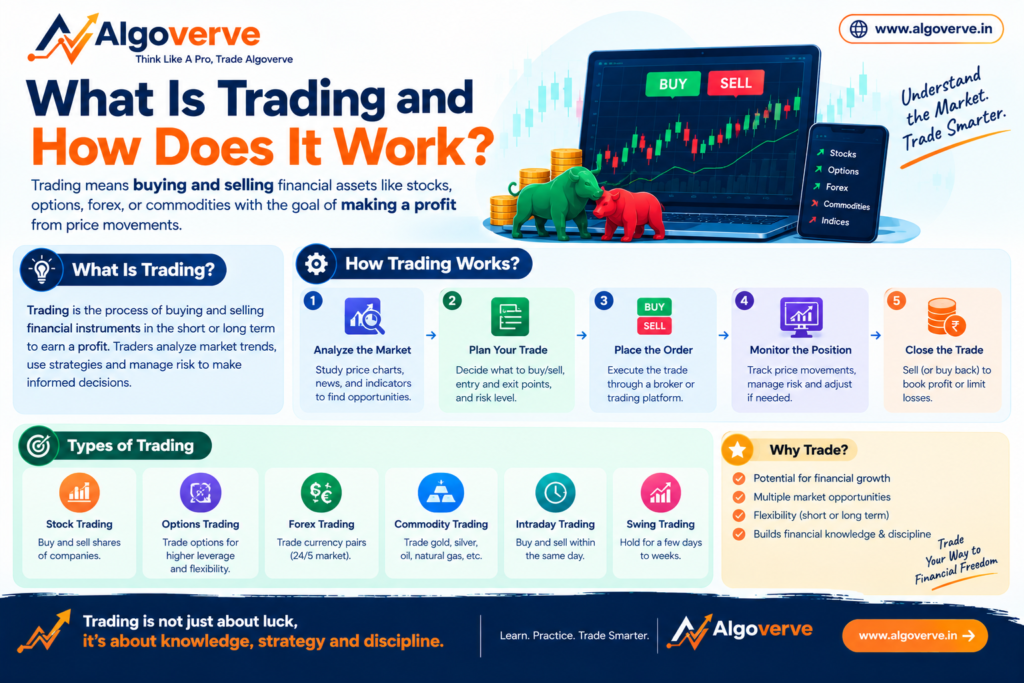
Trading involves exchanging items in financial markets. Unlike long-term investing, which focuses on owning an asset for years to build wealth, trading focuses on short-term price movements. Traders try to buy an asset at a lower price and sell it later at a higher price, or sell at a high price and buy it back lower.
What Is Trading?
Trading is the process of buying and selling financial instruments with the objective of benefiting from changes in their prices.
These financial instruments can include:
- Stocks
- Equity indexes
- Futures
- Options
- Currencies
- Commodities
- Bonds
- Other marketable financial instruments
In simple terms, trading involves taking a position based on an expectation about the market and then closing that position according to a predefined plan or changing market conditions.
For example, suppose a trader buys a stock at ₹500 and later sells it at ₹550. Before transaction costs and taxes, the difference is ₹50 per share.
If the trader instead sells at ₹470, the difference is a loss of ₹30 per share.
This simple example shows the basic idea behind trading:
Buy or sell → Price changes → Position is closed → Profit or loss is realized
However, real-world trading is more complicated. Prices can move quickly, transaction costs can affect results, and there is no guarantee that a particular trade or strategy will be profitable.
How Does Trading Work?
Trading takes place through financial markets where buyers and sellers interact.
A typical trading process looks like this:
Choose a market → Analyze the market → Develop a trading plan → Place an order → Order execution → Manage the position → Exit → Review
Let’s look at each step.
1. Choose a Market
The first step is deciding what you want to trade.
For example, a trader may focus on:
- Indian stocks
- Index futures
- Stock futures
- Options
- Commodities
- Currency markets
Different markets have different characteristics, risks, trading hours, liquidity, and costs.
2. Analyze the Market
Traders generally analyze markets using one or more approaches.
Technical Analysis
Technical analysis studies price and market data to identify patterns and potential trading conditions.
Common tools include:
- Moving averages
- Support and resistance
- Trendlines
- RSI
- MACD
- Volume
- Breakouts
- Candlestick patterns
Fundamental Analysis
Fundamental analysis focuses on factors that may affect an asset’s underlying value.
For stocks, this can include:
- Revenue
- Earnings
- Profitability
- Debt
- Valuation
- Industry conditions
- Economic conditions
Quantitative Analysis
Quantitative approaches use mathematical and statistical methods to analyze market data.
Algorithmic and systematic trading strategies can use quantitative rules to generate signals or manage positions.
3. Create a Trading Strategy
A trading strategy is a defined approach for deciding when and how to trade.
A strategy can specify:
- Entry conditions
- Exit conditions
- Position size
- Stop-loss
- Profit target
- Trading hours
- Maximum number of positions
- Risk limits
For example:
Buy when price breaks above a predefined resistance level and exit if the price falls below a predetermined risk level.
The exact strategy depends on the trader’s objectives, market, timeframe, and risk tolerance.
4. Open a Trading Account
To trade through an online market platform, traders generally need the appropriate accounts and access to a broker or other authorized market intermediary.
In India, investors and traders typically interact with regulated market infrastructure and intermediaries to access securities markets.
The exact account requirements depend on what you want to trade and the services you use.
5. Place an Order
Once a trader identifies an opportunity according to their strategy, they can place an order.
Common order types include:
Market Order
A market order is intended to execute at the available market price.
Limit Order
A limit order specifies the maximum price a buyer is willing to pay or the minimum price a seller is willing to accept.
Stop Order
A stop-based order uses a specified trigger condition and can be used as part of an entry or risk-management process, depending on the order type and market.
The availability and exact behavior of order types can vary by broker and market.
6. Order Execution
After an order is submitted, it goes through the relevant trading and execution infrastructure.
If the order is matched with an appropriate counterparty under the market’s rules, the trade is executed.
Execution price may differ from the price a trader expected, particularly in fast-moving or less-liquid markets.
This difference can contribute to slippage.
7. Manage the Position
After entering a trade, the trader needs to manage the position according to the trading plan.
Management may include:
- Monitoring price
- Adjusting a stop-loss where appropriate
- Taking partial profits
- Closing the position
- Managing exposure
- Following predefined exit rules
Risk management is an important part of this process.
8. Exit the Trade
A trade is completed when the position is closed.
For example:
Buy → Sell = Long position completed
Or:
Sell → Buy = Short position completed
The difference between the entry and exit prices, after applicable costs and adjustments, determines the trading result.
What Is Online Trading?
Online trading refers to buying and selling financial instruments through internet-connected trading platforms.
Instead of communicating orders through traditional offline processes, traders can use:
- Websites
- Desktop trading platforms
- Mobile trading apps
- Broker platforms
- Specialized trading software
An online trading platform can provide features such as:
- Live or delayed market information
- Charts
- Watchlists
- Order placement
- Portfolio information
- Position monitoring
- Trading history
The exact features depend on the platform and market.
What Is Stock Trading?
Stock trading involves buying and selling shares of publicly listed companies.
For example, a trader might purchase shares because their strategy indicates a potential upward price movement.
The trader may later sell the shares based on a target, exit signal, stop-loss, or another condition.
Stock trading can be conducted over different time horizons.
Types of Trading
Trading can be categorized according to the holding period and strategy.
Intraday Trading
Intraday trading involves opening and closing positions during the same trading session.
Traders may use:
- Short-term price movements
- Technical analysis
- Momentum
- Breakouts
- Volume
- Market structure
Intraday trading can involve significant risk because short-term price movements can be unpredictable.
Swing Trading
Swing traders generally hold positions for longer than a typical intraday trade, potentially for several days or weeks.
The goal is often to capture a larger price movement than a typical intraday strategy attempts to capture.
Position Trading
Position trading generally involves holding positions for longer periods.
The strategy may rely more heavily on broader trends and fundamental or technical factors.
Options Trading
Options trading involves contracts whose value is linked to an underlying asset.
Options include:
- Calls
- Puts
Strategies can involve buying, selling, or combining multiple option contracts.
Because options can involve leverage, time decay, volatility, and multiple interacting factors, they require a strong understanding of risk.
Futures Trading
Futures are standardized contracts involving an agreement to transact an underlying asset or financial exposure at specified terms.
Futures trading can provide significant market exposure and may involve leverage, which can increase both potential gains and losses.
What Is a Trading Strategy?
A trading strategy is a structured set of rules used to determine how trades should be considered and managed.
A strategy should ideally answer questions such as:
When should I enter?
When should I exit?
How much should I trade?
Where is the invalidation or risk point?
When should I avoid trading?
What happens if the market moves against the position?
A strategy without clear rules can easily turn into emotional decision-making.
Common Trading Strategies
There is no universal strategy that works in every market condition.
Some commonly discussed approaches include:
Trend Following
Trend-following strategies attempt to participate in established market movements.
They may use moving averages, breakouts, or other trend indicators.
Momentum Trading
Momentum strategies focus on assets showing strong price movement or other predefined momentum characteristics.
Mean Reversion
Mean-reversion strategies attempt to benefit when prices or spreads move back toward a defined reference level.
Breakout Trading
Breakout strategies attempt to enter when price moves beyond a predefined range or level.
Options Strategies
Options traders can create strategies involving calls, puts, spreads, hedges, and other combinations.
The suitability of any strategy depends on the market, assumptions, risk controls, and the trader’s objectives.
What Is Risk Management in Trading?
Risk management is the process of controlling how much capital or exposure is placed at risk.
It can include:
- Position sizing
- Stop-loss rules
- Maximum daily loss limits
- Portfolio exposure limits
- Diversification
- Maximum number of simultaneous positions
- Trading-session restrictions
For example, instead of risking a large portion of capital on a single trade, a trader can define a maximum acceptable risk level.
Risk management does not eliminate losses, but it can help structure how losses are handled.
What Is a Stop-Loss?
A stop-loss is a predefined exit mechanism intended to limit losses when a trade moves against the position.
For example, a trader enters at ₹500 and defines a risk exit around ₹480.
If the relevant stop condition is triggered, the position may be closed according to the applicable order and market mechanics.
Stop-loss orders do not guarantee an exact exit price in every market situation. Fast price movements and liquidity conditions can affect execution.
What Is Backtesting?
Backtesting means evaluating a trading strategy using historical market data.
For example, a trader may ask:
How would this strategy have behaved if its rules had been applied to historical data?
Backtesting can provide information about:
- Historical trades
- Drawdowns
- Trade frequency
- Winning and losing periods
- Strategy sensitivity
- Historical performance
However, backtesting has limitations.
Historical results do not guarantee future results.
A strategy may perform differently when market conditions change. Excessive optimization can also result in overfitting.
What Is Paper Trading?
Paper trading allows traders to simulate trades without using actual trading capital.
It can help traders understand:
- How a strategy generates entries
- How exits behave
- How positions change
- How drawdowns develop
- How execution assumptions affect results
Paper trading is particularly useful for beginners and for traders testing new systematic strategies.
What Is Algorithmic Trading?
Algorithmic trading uses computer-based rules to automate trading decisions or execution.
Instead of manually watching the market and deciding when to trade, a trader can define conditions that a system evaluates.
For example:
If price crosses above a specified level and additional conditions are satisfied, generate an entry signal.
The algorithm can then monitor the market and respond according to its predefined rules.
This approach is also commonly called algo trading or automated trading.
Manual Trading vs Algorithmic Trading
| Feature | Manual Trading | Algorithmic Trading |
|---|---|---|
| Decision-making | Human-driven | Rule-based |
| Execution | Manual or assisted | Automated or semi-automated |
| Emotional influence | Can be significant | Can reduce discretionary decisions |
| Speed | Depends on trader | Generally faster for predefined rules |
| Monitoring | Human attention required | Can be automated |
| Backtesting | More difficult to systematize | Easier to formalize |
| Technical dependency | Lower | Higher |
| Flexibility | High discretionary flexibility | Depends on programmed rules |
Neither approach eliminates market risk.
The main difference is how trading decisions and execution are structured.
How AlgoVerve Fits Into the Trading Process
For traders interested in systematic trading, AlgoVerve provides a no-code environment focused on building, testing, paper trading, monitoring, and reviewing options strategies.
Instead of manually writing an entire trading program, users can configure strategy rules through a structured strategy-building workflow.
Depending on the strategy, users can define elements such as:
- Exchange
- Symbol
- Expiry
- Buy and sell legs
- Entry conditions
- Target
- Stop-loss
- Trailing rules
- Re-entry conditions
- Execution settings
AlgoVerve also provides paper trading using live NSE and BSE market data with virtual capital.
This creates a structured workflow:
Build → Test → Paper Trade → Monitor → Review
For someone learning trading in India, this type of workflow can help turn a trading idea into a clearly defined and testable process.
Advantages of Trading
Trading can offer several potential benefits, depending on the approach.
Flexibility
Traders can choose different markets, instruments, timeframes, and strategies.
Accessibility
Online trading platforms have made market information and order placement more accessible.
Systematic Approaches
Traders can define repeatable rules instead of relying entirely on intuition.
Technology
Modern platforms provide charting, analysis, backtesting, paper trading, and automation tools.
However, accessibility does not mean trading is easy or low-risk.
Risks of Trading
Trading involves financial risk.
Important risks include:
Market Risk
Prices can move against your position.
Leverage Risk
Leveraged products can magnify both gains and losses.
Liquidity Risk
Some instruments may have limited liquidity, making execution more difficult.
Slippage
Actual execution may differ from the expected price.
Emotional Risk
Fear, greed, impatience, and overconfidence can influence decision-making.
Technology Risk
Trading platforms, internet connections, APIs, and other systems can experience technical problems.
Strategy Risk
A strategy may perform differently from expectations or fail under changing market conditions.
How Beginners Can Start Learning Trading
If you are new to trading, focus on understanding the fundamentals before trying complex strategies.
Step 1: Learn Market Basics
Understand stocks, indexes, futures, options, orders, liquidity, volatility, and leverage.
Step 2: Learn Risk Management
Understand position sizing, stop-losses, drawdown, and exposure.
Step 3: Choose One Market
Avoid trying to learn every market simultaneously.
Step 4: Build a Simple Strategy
Define clear entry and exit rules.
Step 5: Backtest Where Appropriate
Study how your rules behaved historically.
Step 6: Use Paper Trading
Practice without immediately risking real capital.
Step 7: Review Your Results
Look beyond profits. Analyze drawdown, consistency, costs, execution, and strategy behavior.
Step 8: Understand Live Trading Risks
Before using real money, understand the risks and operational requirements of your chosen market and platform.
Frequently Asked Questions
What is trading in simple words?
Trading is buying and selling financial instruments based on a planned approach, with the goal of managing exposure to price movements.
How does trading work?
Trading works through markets where buyers and sellers interact. A trader analyzes a market, places an order through an appropriate platform or intermediary, the order may be executed, and the position is eventually closed according to the trading plan or market conditions.
What is online trading?
Online trading is buying and selling financial instruments through internet-based platforms, websites, or mobile applications.
Is trading the same as investing?
No. Trading and investing can differ in time horizon, objectives, strategy, and risk management. Trading often focuses on shorter-term price movements, while investing commonly involves longer-term ownership and objectives.
What is algo trading?
Algo trading is the use of predefined computer-based rules to automate or systematize trading decisions and/or order execution.
Is trading profitable?
Trading does not guarantee profits. Individual results depend on strategy, market conditions, risk management, execution, costs, and other factors.
What is the best trading strategy?
There is no universally applicable trading strategy. Different strategies behave differently across markets and market conditions. Traders should evaluate strategies based on their own objectives, risk constraints, and testing.
Can beginners learn trading?
Yes. Beginners can learn trading by studying market fundamentals, risk management, order types, strategy development, backtesting, and paper trading before considering live trading.
Final Thoughts
Trading is more than simply buying when a price looks attractive and selling when it rises.
A structured trading process involves understanding the market, defining a strategy, managing risk, placing orders, monitoring positions, and reviewing results.
For beginners, the most important concepts to understand are market mechanics, trading strategies, risk management, position sizing, order types, backtesting, and Paper trade.
Technology has also changed how traders can approach markets. Online trading platforms, trading apps, algorithmic trading systems, and no-code platforms can help traders organize and automate parts of the trading process.
For traders exploring algo trading in India, the key is to avoid treating automation as a shortcut to guaranteed results. A computer can follow rules consistently, but those rules still need to be carefully designed, tested, monitored, and reviewed.
With platforms such as AlgoVerve, traders can explore a systematic workflow for building and testing no-code options strategies, Paper trade with live market data, monitoring strategy behavior, and reviewing trading activity.
Learn the market. Define your rules. Test your strategy. Manage your risk. Trade systematically.