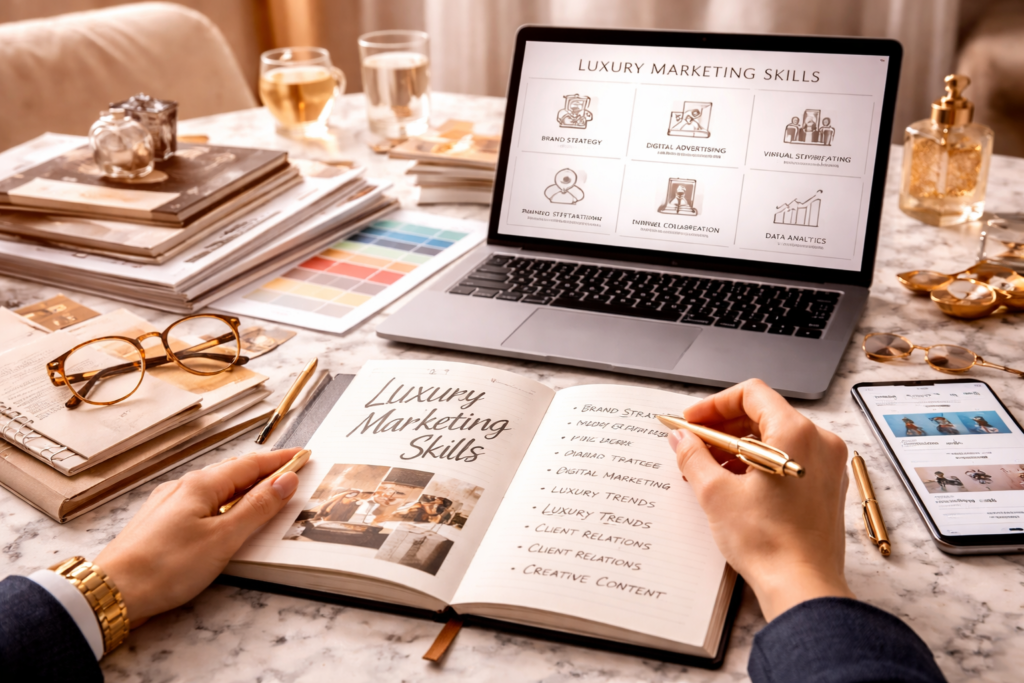
Luxury marketing looks glamorous from the outside, but the real work is much more demanding.
A luxury marketer is not just promoting products. They are shaping perception, protecting brand value, and creating desire without making the brand feel pushy or ordinary. That is a very different assignment from mainstream marketing. Current luxury coverage from Shopify and McKinsey shows that modern luxury brands are expected to balance exclusivity, storytelling, premium experience, personalization, and digital innovation all at once.
That means luxury marketing professionals need a broader skill set than many people assume. They need taste, yes. But they also need commercial judgment, channel fluency, customer empathy, and the discipline to make a brand feel elevated across every touchpoint. The best professionals in this space are part brand builder, part strategist, part storyteller, and part operator.
1) Brand positioning is one of the most important skills
Luxury marketing professionals need to understand how a brand should sit in the customer’s mind.
That sounds simple, but it is one of the hardest parts of the job. In luxury, weak positioning creates generic messaging. And generic messaging kills desirability. Strong luxury brands are clear about what they stand for, who they are for, what emotional territory they own, and why they deserve premium pricing. Shopify’s luxury-marketing guidance highlights brand story and exclusivity as foundational strategy elements, which makes positioning a core professional skill rather than an optional branding exercise.
A good luxury marketer should be able to answer questions like:
- What makes this brand distinctive?
- What kind of customer identity does it speak to?
- What should the brand never sound like?
- What should the customer feel after interacting with it?
If they cannot answer those, they will struggle to create coherent campaigns, content, or creative direction.
2) Storytelling is not optional in luxury
Storytelling is one of the clearest differentiators in luxury. Shopify explicitly identifies brand story as a core part of luxury marketing, and recent commentary across luxury and brand strategy has reinforced that emotional narrative is becoming even more central to effective marketing leadership.
Luxury marketers need to know how to tell a story that does three things at once:
- builds emotion
- communicates standards
- protects exclusivity
That means understanding founder narratives, craftsmanship stories, customer transformation stories, and campaign narratives that feel refined rather than overly sales-driven. This is why many brands lean on a luxury brand storytelling agency when they need stronger messaging systems. The real challenge is not just writing pretty copy. It is building a narrative world that stays consistent across websites, social content, campaigns, and customer experience.
3) Customer experience thinking is a core luxury skill
Luxury is not only about what the customer buys. It is about how the brand makes them feel during the process.
McKinsey’s work on luxury retail and hospitality repeatedly points to emotion, personalization, and culture of excellence as major drivers of premium experiences. Shopify’s luxury retail coverage similarly describes luxury as highly personalized and relationship-led.
That means luxury marketing professionals need customer-experience intelligence. They should understand:
- what premium customers expect
- where friction damages trust
- how tone and timing affect perception
- how online and offline moments connect
This is a huge difference between luxury marketing and ordinary campaign work. A great luxury marketer does not think only about impressions and clicks. They think about the entire experience, from first discovery to post-purchase follow-up.
4) Taste and creative judgment matter more than people admit
Luxury marketing requires judgment.
You can teach tools. You can teach dashboards. But it is much harder to teach someone what feels elegant versus loud, refined versus generic, premium versus try-hard. Creative judgment is one of the most valuable skills in the field because luxury branding depends heavily on restraint, coherence, and detail. Shopify’s luxury and fashion content repeatedly emphasizes exclusivity, visual polish, and the importance of making the brand world feel intentional across digital channels.
This does not mean luxury marketers have to be designers. It means they need the ability to recognize:
- when a visual feels off-brand
- when copy feels too promotional
- when a campaign angle sounds mass-market
- when a creator partnership weakens perception instead of strengthening it
That level of judgment is what separates someone who can “do marketing” from someone who can market luxury well.
5) Digital fluency is now essential
Luxury used to be associated with traditional media, flagship stores, and selective distribution. That is no longer enough. McKinsey and Shopify both point to the growing importance of digital transformation, unified commerce, personalization, and omnichannel customer journeys in the luxury sector.
So modern luxury marketers need real digital fluency. They should understand:
- ecommerce fundamentals
- social discovery
- content distribution
- email and CRM flows
- paid acquisition basics
- analytics and conversion pathways
This is especially true because customers now expect luxury brands to meet them across channels without losing the sense of exclusivity. Shopify’s luxury-trends coverage notes that luxury customers increasingly expect a connected experience across digital and physical touchpoints.
6) Performance marketing knowledge matters, even in luxury
A common mistake is assuming that luxury marketers only need “brand” skills.
In reality, they need enough performance literacy to understand how demand is built and measured. That does not mean they should treat luxury like a discount ecommerce store. It means they should understand paid social, search intent, retargeting, creative testing, landing-page logic, and how customer acquisition affects long-term brand health.
A strong luxury marketer should be able to work well with a paid media agency and ask smart questions:
- Are we acquiring the right kind of customer?
- Does this creative protect premium perception?
- Are we optimizing only for clicks, or for brand-fit conversions?
- Is our retargeting elegant or annoying?
The best professionals know that performance and luxury can work together, but only with discipline.
7) Analytics and commercial awareness are critical
Luxury marketing is creative, but it is not vague.
Professionals in this space need to understand the numbers behind the brand. That includes basics like:
- customer lifetime value
- average order value
- repeat purchase rate
- conversion quality
- acquisition cost
- channel performance
- branded search growth
The luxury sector’s current slowdown and changing client preferences make this even more important. McKinsey’s 2025 luxury outlook argues that brands need sharper strategic responses as the old momentum of the market weakens. That means marketers who can connect brand work to commercial outcomes will be much more valuable.
In practice, the skill is not just “being good at analytics.” It is knowing how to interpret data without losing brand judgment.
8) Emotional intelligence is a major advantage
Luxury is built on nuance.
That is why emotional intelligence is such an underrated skill for luxury marketers. They need to understand aspiration, trust, status signals, discretion, and how different customers interpret tone. McKinsey’s work on personalization and customer experience reinforces that brands perform better when they understand customers more deeply and deliver experiences that feel tailored rather than generic.
A marketer with strong emotional intelligence is usually better at:
- writing with the right tone
- managing premium communities
- collaborating with founders and creative teams
- handling high-value customer feedback
- building campaigns that feel human instead of mechanical
That matters even more in luxury, where the emotional layer often drives the commercial result.
9) Collaboration is a real luxury-marketing skill
Luxury campaigns rarely succeed because of one person.
They require coordination between brand, creative, ecommerce, performance, partnerships, retail, and customer experience. Modern luxury is also more omnichannel than before, which makes cross-functional collaboration even more important. Shopify’s digital playbook and luxury-trends content highlight the need for integrated experiences across online and offline touchpoints.
That means strong luxury marketers need to communicate clearly with:
- designers
- content creators
- media buyers
- ecommerce managers
- retail teams
- founders and executives
The ability to align all of those groups around one brand standard is a genuine professional advantage.
10) Canadian market awareness is useful, too
If you are working with brands targeting Canada, local market awareness matters. Recent Canada Post ecommerce guidance highlights how social discovery, trust signals, and emerging shopping channels influence purchase behavior in Canada.
So luxury marketing professionals working in Canada should understand:
- how discovery and trust interact in Canadian ecommerce
- which channels influence action
- how local expectations differ by region or audience
- how to adapt messaging without diluting the brand
This does not mean creating a totally different brand for Canada. It means being smart enough to localize without losing the luxury codes.
A strong luxury marketing agency often stands out because it can combine this local market sensitivity with a globally consistent premium brand standard.
11) The best luxury marketers combine art and discipline
If there is one pattern that defines the strongest people in this field, it is this: they are both creative and controlled.
They know how to tell a story, but they also know how to measure what is working. They understand aesthetics, but they also understand channel performance. They can build desire, but they do not sacrifice clarity. That mix matters because luxury today is no longer protected from digital complexity. Brands need marketers who can preserve elegance while working in a fast, measurable, multi-channel environment.
How to build these skills if you want to work in luxury marketing
Start by developing your eye and your judgment. Study how premium brands speak, how they pace their campaigns, how they use language, and how they present products without sounding ordinary. Then build the practical layer: learn ecommerce, content strategy, analytics, customer journeys, and paid media basics. The strongest career path is rarely purely creative or purely technical. It is a combination.
And if you already work in marketing, one of the fastest ways to improve is to practice one question repeatedly:
Does this make the brand feel more desirable, or less?
That question sharpens almost every luxury-marketing decision.
Conclusion
Luxury marketing professionals need more than conventional marketing skills.
They need positioning skill, storytelling ability, customer-experience thinking, digital fluency, performance awareness, analytics, emotional intelligence, and creative judgment. Most importantly, they need to understand that in luxury, every message shapes perception. And perception is not separate from performance. It is part of performance.
The people who succeed in this field are the ones who can protect the brand’s standards while still helping it grow. That is the real skill set luxury demands.
FAQs
1) What makes luxury marketing different from regular marketing?
Luxury marketing is different because it is not only trying to create demand. It is also trying to protect desirability, exclusivity, and long-term brand value. Mainstream marketing can often lean on urgency, discounts, and broad accessibility. Luxury marketing usually cannot do that without weakening the brand. Current Shopify luxury guidance emphasizes brand story, exclusivity, and elevated customer experience as core strategy elements, while McKinsey highlights the importance of emotion and premium experience in luxury retail.
2) Do luxury marketers need analytics skills, or is it mostly creative work?
They absolutely need analytics skills. Luxury marketing is creative, but it still has to justify budgets, understand customer behavior, and support profitable growth. Marketers need to understand metrics like customer lifetime value, acquisition cost, repeat purchase rate, and channel performance. McKinsey’s recent luxury outlook makes it clear that the sector is facing slower growth and changing customer expectations, which means sharper commercial decision-making matters more than before.
3) Is storytelling really that important in luxury marketing?
Yes. Storytelling is one of the most important skills in luxury marketing because luxury products are rarely sold on utility alone. They are sold through meaning, identity, emotion, craftsmanship, and aspiration. Shopify explicitly lists brand story as a core part of luxury marketing strategy, and broader commentary on modern marketing leadership continues to elevate storytelling as a high-value strategic skill.
4) What digital skills should luxury marketing professionals learn first?
The best starting points are ecommerce fundamentals, content strategy, email and CRM, social media distribution, paid-media basics, and analytics. Today’s luxury customers move across digital and physical channels, so marketers need to understand how those touchpoints connect. Shopify’s luxury-trends and digital-playbook coverage stresses unified commerce, personalization, and cross-channel experiences as central to modern luxury growth.
5) Can someone move into luxury marketing from general marketing?
Yes, but they usually need to strengthen their brand judgment and category sensitivity. General marketing experience can provide strong foundations in channels, performance, and communication. What often needs development is the luxury layer: restraint, premium storytelling, customer-experience nuance, and understanding how exclusivity works in practice. Studying current luxury brands, premium retail experiences, and luxury ecommerce execution can help close that gap.
6) What soft skills matter most in luxury marketing careers?
Emotional intelligence, communication, collaboration, and judgment are some of the most important soft skills. Luxury work often involves founders, creatives, premium customers, retail teams, and high brand expectations, so marketers need to navigate nuance well. McKinsey’s work on personalization and customer experience supports the broader point that understanding people deeply is a meaningful competitive advantage.