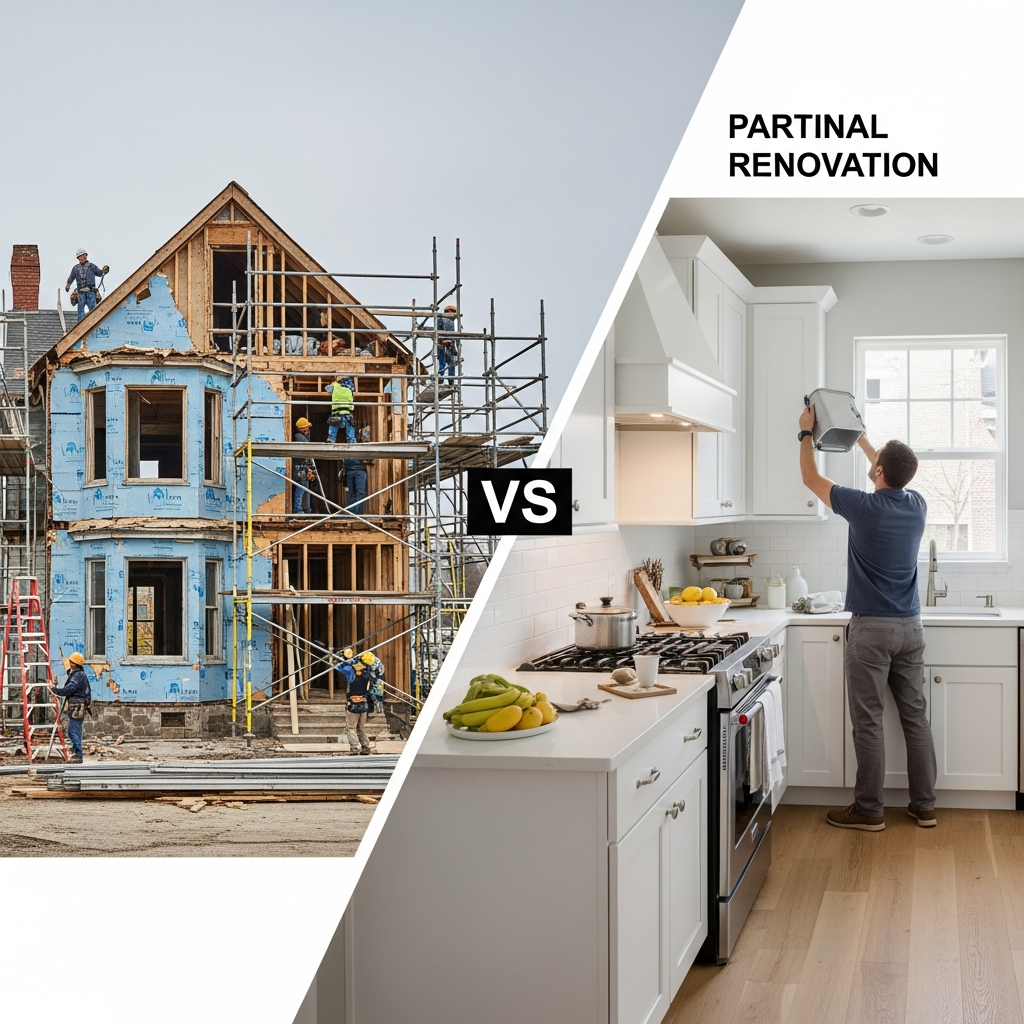
When homeowners decide it’s time for an upgrade, one major question arises: should you invest in a whole house renovation vs partial renovation? Both approaches have advantages, but the right choice depends on your goals, budget, timeline, and long-term plans.
Understanding the difference between a partial home renovation and a complete remodel can help you make a financially smart and strategically sound decision—especially in competitive housing markets across Canada.
What Is a Whole House Renovation?
A whole-house renovation involves updating most or all areas of your home. This can include structural changes, system upgrades, layout modifications, and complete interior redesign.
Common Features:
- Electrical and plumbing upgrades
- Structural modifications
- Kitchen and bathroom remodels
- Flooring replacement throughout
- HVAC system updates
Homeowners planning major projects often consult experienced home renovation contractors in Toronto to coordinate multi-trade execution efficiently.
What Is a Partial Home Renovation?
A partial renovation focuses on specific areas—such as a kitchen, bathroom, basement, or main floor—without altering the entire home.
Common Examples:
- Kitchen remodel only
- Bathroom upgrades
- Basement finishing
- Single-room redesign
For instance, a kitchen renovation Brampton may dramatically improve daily functionality without requiring a full-home investment.
Cost Comparison: Whole House Renovation Cost vs Partial Renovation
Whole House Renovation Cost
In Canada, a full renovation typically ranges between:
- $75–$200 per square foot
- $100,000–$300,000+ depending on scope
Costs increase when structural changes, new additions, or full system replacements are involved.
Partial Renovation Cost
A partial renovation varies widely:
- Kitchen remodel: $25,000–$60,000
- Bathroom remodel: $10,000–$30,000
- Basement finishing: $20,000–$50,000
A targeted renovation is usually more budget-friendly upfront but may require future updates in other areas.
Timeline Comparison
Whole House Renovation Timeline
A full-home remodel typically takes:
- 4–8 months (or longer for large homes)
This includes planning, permits, demolition, rough-ins, and finishing.
Partial Renovation Timeline
Partial projects often take:
- 4–12 weeks depending on scope
A focused approach minimizes disruption and allows homeowners to remain in the home during construction.
Disruption Level
Whole-home renovations often require temporary relocation due to:
- Major demolition
- System shutdowns
- Structural work
Partial renovations are less disruptive, especially when confined to one section of the home.
Homeowners sometimes work with a Home construction company in Brampton to determine whether staged renovations can reduce household disruption.
Design Flexibility
Whole-house renovations provide complete design freedom. You can:
- Reconfigure floor plans
- Create open-concept layouts
- Upgrade systems throughout
- Achieve consistent design themes
Partial renovations, while limited in scope, allow for focused customization in high-priority areas.
Return on Investment (ROI)
Both renovation types can increase property value—but in different ways.
Whole House Renovation:
- Appeals to buyers seeking turnkey homes
- Increases long-term resale potential
- Improves energy efficiency throughout
Partial Renovation:
- Boosts value in key areas (kitchen & bathrooms)
- Offers faster ROI
- Requires lower upfront investment
In markets like Ontario, updated kitchens and bathrooms often deliver the strongest return.
Pros and Cons
Whole House Renovation
Pros:
✔ Complete transformation
✔ Modernized systems
✔ Design consistency
✔ Higher resale potential
Cons:
✖ Higher upfront cost
✖ Longer timeline
✖ Greater disruption
Partial Renovation
Pros:
✔ Lower cost
✔ Shorter timeline
✔ Less disruption
✔ Flexible phased approach
Cons:
✖ Inconsistent design between rooms
✖ May require future renovations
✖ Limited structural improvements
When Should You Choose a Whole House Renovation?
A full renovation makes sense if:
- Your home has outdated systems
- Multiple areas require upgrades
- You plan to live in the home long-term
- Layout reconfiguration is necessary
When Is a Partial Renovation the Better Choice?
A partial renovation may be ideal if:
- Your budget is limited
- Only certain rooms need updating
- You’re preparing the home for resale
- You prefer phased improvements
Long-Term Value Considerations
While a whole renovation requires significant investment, it can eliminate the need for additional upgrades for many years. Partial renovations are practical for immediate improvements but may require additional phases later.
Balancing cost, timeline, and long-term plans ensures your renovation aligns with your lifestyle and financial goals.
In-Depth FAQs – Whole House vs Partial Renovation
1. Is a whole house renovation worth the investment?
A whole-house renovation can be worth it if your home requires structural updates, system upgrades, and layout improvements. It often delivers stronger long-term resale value and improves energy efficiency. However, it requires careful budgeting and a longer timeline commitment.
2. How do I know if I should renovate the entire house or just one room?
Evaluate the condition of your home. If multiple rooms feel outdated or systems need upgrading, a full renovation may be more cost-effective than piecemeal updates. If only one area lacks functionality, a partial renovation may be sufficient.
3. Can I live in my home during a whole-house renovation?
In many cases, temporary relocation is recommended due to dust, noise, and system interruptions. Partial renovations, however, often allow homeowners to remain in the house.
4. Which option offers better ROI?
Kitchen and bathroom renovations often provide the highest short-term ROI. Whole-home renovations may deliver greater long-term value if completed strategically.
5. Are permits required for both types of renovations?
Yes, if structural, electrical, or plumbing changes are involved. Permit requirements depend on project scope and local regulations.
6. Can I renovate in phases instead of doing a full remodel?
Yes. Many homeowners choose phased renovations to spread costs over time while gradually improving their property.
Final Thoughts
Choosing between a whole house renovation vs partial renovation depends on your goals, financial flexibility, and long-term plans. A full renovation delivers dramatic transformation and long-term value, while partial upgrades provide targeted improvements with lower immediate investment.
Careful planning, professional guidance, and realistic budgeting will ensure your renovation decision aligns with both lifestyle and financial objectives.